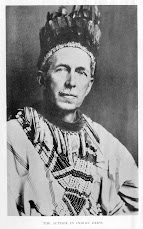
The Progressive Phase of G.H.Teed
by
Christopher Lowder
from
The Collector’s Digest Annual 1972
(G H Teed was a Canadian and a prolific and popular author. Biographical information on the author can be found in this book which has yet to be delivered.)
With very little juggling, we can divide up the
career of George Heber Teed (the ‘Hamilton’ was a personal fancy, added, it is
thought, because the name Heber had unfortunate associations for him) as a
Sexton Blake writer into five phases — Early, Progressive, Mature, Violent,
Late.
The Early phase is self-explanatory. Although
there is a certain amount of mystery attached to his first couple of years in
the game, and although he did seem to leap into a prominence that very few
other writers, in any other field of writing were far from assured.
One could tell that here was an extremely
promising writer, certainly; but that promise was yet to be fulfilled. Teed was
still learning his craft.
By 1915, however, a gradual change can be seen
in his work, culminating in that extraordinary Summer Double Number of the
Union Jack, “Bribery and Corruption” (see Note 1), in which, throughout the
whole of its 80,000-word length, no-one is murdered.
To those who may not have read this particular
tale, the idea of a detective story without a body may seem astonishing, not to
say laughable. In fact, “Bribery and Corruption” is a tour de force in every
way, and can be read on many levels.
It can be read simply as a good story, well
told. It can be read as a fine political novel, in which one is given an
extraordinary insight into the machinations and motivations of an ambitious
rogue who seeks political control over a whole town.
It can be read as an intellectual exercise where
one follows the analytical and deductive processes of a detective, and as a
clever example of how to write a novel-length story around that detective
without resorting to violence, murder or sudden death. And it can be read for
its stunningly visual descriptions of a part of the world - New Brunswick,
Canada - the author knew as a child, and which obviously affected him deeply.
Following on from this, it can also be read, I
think, as a vivid slice of autobiography. There are minor characters in the story
who, I am certain, were lifted straight out of Teed’s youthful experiences and
not given even the thinnest of fictional veneers. There are situations and
incidents aside from the tale’s main plotline that I suspect Teed himself had
taken a part in at some time in his early career, or at least knew of at first
or second hand.
This is partly what I mean by the term ‘Progressive.’
There is a maturity - almost a self-awaredness - about “Bribery and Corruption”
that is largely absent in his previous stories. Clearly Teed enjoyed writing
this tale, and clearly he was coming to terms with himself as a writer of what
were then considered to be solely ‘juvenile’ stories.
There is another factor worthy of note
concerning this phase - and one which is possibly the most important of all. He
was beginning to regard the villains he was writing about as not wholly
two-dimensional, cardboard characters.
It is made quite plain that Hammerton Palmer,
the crooked financier who is the villain of the piece in “Bribery and Corruption,”
is a sympathetic character, for all his political wheeling and dealing and
general roguery. He saves a young boy’s life through an heroic and unselfish
action on his own part, and at the end of the story gets away scot free thanks
to the intervention of Sexton Blake.
That this process of ‘cleaning up’ Palmer was a
deliberate one on Teed’s part is given added weight if one reads “The Prize
Ship,” a two-part, 40,000-word story by Teed, that was published in Pluck a
month or so before “Bribery and Corruption” appeared in the Union Jack.
Here, again, Palmer is the hero/villain of the
piece, and here, again, he gets away thanks to Blake - and with a sizeable
slice of the loot (£8,000) gained by his financial trickery.
Compare this with Palmer’s first appearance
almost exactly a year before in the Summer Double Number for 1914, “The Death
Club.” In this story, he is nothing more than a cold-blooded murderer, and
escapes the law, and the gallows, by the skin of his teeth, and with no help at
all from Blake. (See Note 2.)
We see a gradual change in other Teed characters
too in this period. Huxton Rymer is a good example of a ruthless killer who
becomes far more appealing, and, indeed, ‘real,’ as time goes on. The Rymer of “The
Diamond Dragon,” “The Great Mining Swindle” or “The Case of the Radium Patient”
is a far less sympathetic character than the Rymer of “The Two Mysteries” or “The
Blue God.”
Of course, giving fictional crooks a
three-dimensional aspect, making them to a certain extent into sympathetic and
appealing characters, was nothing new, and I’m not suggesting that Teed
revolutionized detective fiction as a whole when he used this method. What he
did do, however, was to give his particular characters much more depth than his
fellow-writers in the same field gave theirs.
There is no redeeming feature in Andrew Murray’s
Professor Kew, for instance; Lewis Jackson’s Kestrel remained an out-and-out
murderous crook from “The Case of the Cataleptic” (1916) right through until “The
Case of the Biscay Pirate” (1944) - and who could ever feel any sort of
sympathy for Robert Murray’s malignant Mr. Reece? E. S. Brooks made Waldo into
a friendly enough type, true, but unfortunately Waldo remained, like Norman
Conquest, stubbornly two-dimensional until the end of his days.
Only Zenith, Anthony Skeene’s brilliant albino,
aspired to any sort of depth character on the same level as Teed’s best
creations. But Zenith, alas, was a paradox, and very quirky.
This Progressive phase of Teed’s lasted from
1915 until 1917, when it was cut short - one might almost say in its prime -
with an abruptness that only those who were alive at the time would appreciate.
Quite simply, Rymer, Yvonne, Wu Ling and the
rest became War casualties, and when they returned, after the War, when Teed
came back to writing in 1921, they had all undergone a subtle change in their
characters that made them not quite what they once were.
Mostly, this change was for the better. The
period from 1921 until the late ‘20’s is considered by most people, and with
justice, to be Teed’s best, happily coinciding with the true Golden Age of the
Sexton Blake saga - which is why I term this period, from Teed’s point of view,
the Mature phase.
But one of his creations at least altered course
so radically that he might just as well have been an entirely different, even
new, character.
I refer, of course, to Prince Menes, ‘the Man
from Everywhere,’ a character of great originality and easily the most skilful
creation of Teed’s Progressive phase.
Incidentally, it is interesting to note that
Prince Menes was created at a time (1917) when Teed was certainly refreshed as
a writer of Sexton Blake stories, and I think this is why the character was
such an original one.
The year 1916 saw Teed much more concerned with
another market - the Nelson Lee Library. He had started writing for this market
the previous year, but in 1916 he wrote nearly half the total output -
seventeen stories, as opposed to the six (including one Library) he wrote about
Sexton Blake. In 1917, the reverse was the case, as E. S. Brooks began to
corner the market, so to say - six Nelson Lee stories, and sixteen Blakes
(again, including one Library).
One of the main factors that caused Teed to
concentrate on the Nelson Lee Library was probably simple economics. It’s far
easier in the long run to knock out seventeen novelettes than seventeen longer
stories, and if the reward, in terms of hard cash, is proportionately easier to
come by, then Teed (who, concerning his own money-making activities was fairly
hard-headed - even if he did tend to lose it at a rather faster rate than it
actually came in) probably didn’t hesitate too much in his choice of markets.
Whatever the reason, he undoubtedly came back to
the Blake fold full of new ideas and new courses for his characters to take.
It is a pity that the only real sign of this
renewal of vitality shows itself in one single new series. True, 1917 was the
year when the Black Rat made his first appearance, and also Marie Galante - but
the former was a typical Teed character, and the latter, since she was featured
in only one story, never had time to develop.
Prince Menes, on the other hand, had plenty of
time to develop, and he made the most of it.
There are four stories which concern us here - “A
Case of Reincarnation,” “The Secret Hand,” “The Case of the Crimson Terror,”
and “The Invisible Ray” - and a brief synopsis of the background of the series
might well be in order.
Ten thousand years ago, Egypt was a flourishing
and mighty nation that ruled the known world. However, the country itself was
ruled by the Order of Ra, the Sun God (remember, this is Teed’s version of
history) whose Supreme Master was Prince Menes, twin brother to the actual
Pharaoh. In time, the Pharaoh grew jealous of Menes’ power, and eventually the
Order was betrayed by ten priests and priestesses, Menes was exiled, and the
fortunes of Egypt sank, over the succeeding ten thousand years, because of this
betrayal and banishment.
Before the original Menes died, however, he
swore that in ten thousand years he would be reincarnated, and that his
appearance on earth would coincide with the reappearance of those same ten
priests and priestesses of Ra, who had betrayed their Order. Also, that during
those ten thousand years, the spirit of Ancient Egypt would pass from one
civilization to another, from one nation to another, and these civilizations
and nations would rise up and fall again, just as Egypt had done, until this
spirit would eventually pass to a nation that would rebuild the shattered
Egypt, to make her great once more.
Then, in the latter half of the 19th Century, a
son was born to a Russian Grand Duke and a Chinese princess. At the age of ten,
he was placed in charge of a priest of the Greek Orthodox Church who later ‘renounced
his former faith and embraced the ancient beliefs of Egypt - the worship of Ra
and Amen-Ra - the reverence of Isis and Osiris’ (“A Case of Reincarnation”).
This was Akbad the patriarch, who taught his
young charge that he was the reincarnated Prince Menes, who had been born again
to find the spirit of Ancient Egypt, and weld the modern Egypt into one mighty
nation. But first he had to seek out those ten priests and priestesses of the
Order of Ra, who were all now reincarnated and alive somewhere in the world,
and exact a terrible vengeance on them for their original betrayal of the
Order, ten thousand years before.
This, in essence, was the premise for Teed’s new
series, and the jumping-off point for the weirdest, most original set of
stories Teed ever envisaged. The pity of it was that it was never finished.
However, in the course of the four stories that
were written, Teed came up with some strange, not to say astonishing, angles,
which, apart from anything else, give us a good idea of the state of his
personal philosophy at the time.
It is dangerous to connect a man’s fiction with
the man himself, but sometimes, as in this case I think, it is largely
justified by the intensity of the writing, and the esoteric knowledge that Teed
obviously had at his finger-tips.
It is a well-known fact that Teed was what might
be described as a hack - I use the word in its best sense; Charles Hamilton was
a hack, so was Dr. Johnson. Basically, he wrote for money - and he wrote, in
his time, a lot of words for a lot of money. He also spent a lot of money, owed
a lot of money, drank more than was good for him, womanised more than somewhat,
and generally racketed around the environs of Fleet Street behaving like just
about every other writer who was (and, indeed, still is) engaged in the
business of making a living by writing stuff that will never come up for
nomination in the literary section of the Nobel Prize awards.
That he was a better writer, per se, than the
majority of his colleagues has nothing to do with the fact that his market was
the lowest in Grub Street.
Strange, then, that this same hack should show
such a wide-ranging knowledge of such rather esoteric subjects as: Freudian
psychology, mysticism, metaphysics and physiological structurization - not to
mention high finance and modern business techniques.
These last two, of course, are themes that Teed
often used in his stories - “The Crimson Pearl,” “Scoundrels All,” “The Green
Portfolio,” “The Crook of Marsden Manor,” to name but a few - and he showed a
truly remarkable grasp of involved financial chicanery for a man who had lived
most of his early life managing- plantations of one sort or another.
That Teed knew something of ancient religions
and beliefs, too, is fairly common knowledge and, indeed, obvious to anyone who
has ever read any of his early Wu Ling tales. There is a graphic and totally
authentic account of a pagan sacrificial ceremony in “The Yellow Tiger,” and “The
Black Abbot of Cheng-Tu” is packed with esoteric Buddhist lore and information.
But one has only to start into the first four
Prince Menes stories to realize that Teed not only knew a bit about mysticism -
the sort of ‘bit’ one can read up in any good encyclopaedia - but was a
positive authority on it.
That his obvious enthusiasm for mysticism and
the occult was mis-placed is an unfortunate fact, but it still does not detract
from the immense amount of study he had plainly put into the matter.
I say ‘mis-placed’ since most of the premises
Teed used as jumping-off points for his stories in the ‘Man from Everywhere’
series are false ones.
At some time or other, he had obviously come
into contact with that extraordinary farrago of falsification and sheer
downright nonsense The Secret Doctrine by Mme. Helena P. Blavatsky, the founder
of Theosophy.
Mme. Blavatsky, who, during the course of her
life, had been a circus bareback rider, a professional pianist, and a
sweat-shop worker, amongst other things, largely created a pre-historic
macrocosm and a gaudy panoply of gods and goddesses to people it.
The Secret Doctrine is supposedly based on an
Atlantean treatise “The Book of Dzyan,” which she said had been showed to her
by the ‘world-ruling’ Mahatmas of Tibet. Mme. Blavatsky was a firm believer in
Atlantis, Lemuria and other lost continents, some of which she even invented
herself.
Unfortunately for her, an elderly Californian
scholar, William Emmette Coleman, decided to dig rather deeper into The Secret
Doctrine than Mme. Blavatsky cared for or, indeed, her misguided followers
bothered to. He discovered that her sources (all unacknowledged) were the
Indian Vishnu Purana, Alexander Winchell’s World Life, Ignatius Donnelly’s
infamous Atlantis: the Antediluvian World (which, in turn, is a medley of
inventions, misstatements of fact, errors of interpretation and downright
lies), and other pseudo-scientific works. The crowning cheat of all was that
most of the “Book of Dzyan” was cribbed wholesale from the “Hymn of Creation”
in the ancient Sanskrit “Rig-Veda” (see Note 3).
Thus, it can be readily seen that anyone who
relies on The Secret Doctrine - and, indeed, the hundreds of Theosophical,
mystical and occult tomes that have sprung, directly or indirectly, from it -
as a cornerstone of his spiritual convictions is sadly deluding himself, and
the only practical use to be made of it is either as kindling, or, as the
fantasy writer Edgar Rice Burroughs did, a basis for a series of science
fiction stories (i.e. his ‘Martian’ novels).
It
is doubtful whether Burroughs, who was something of a super-materialist, ever
put any real faith in the occult, and especially The Secret Doctrine. Teed, on
the other hand, for all his hard-headedness and general practicality, was
obviously rather taken with the whole concept of lost continents, occult lore,
and the ‘wisdom of the ancients’ at this stage in his development.
The ‘Man from Everywhere’ series is full of the
sort of esoteric mystical lore that was packed into the books and pamphlets of
Donnelly, Mme. Blavatsky, and others of their ilk.
“The Case of the Crimson Terror,” for instance
(the third in the series), contains an interesting synopsis of all that had
gone before in the previous stories, and also a facinating account of world
history that owed a huge debt to the theories of the occultists.
Before the known civilizations there existed the
continent of Atlantis, and also the ‘Pacific continent’ (see Note 4), which
were the cradles of all learning and knowledge. When Atlantis supposedly
disappeared beneath the waves, the survivors spread out through the world and
colonized places as far apart as Egypt, India, South America, and so on. These
colonists brought with them their crafts, advanced knowledge, and religious
philosophies - the latter chiefly centring around the sun and the moon.
The colonists who reached Egypt found a wide and
beautiful valley where the Sahara now lies, and there built a vast temple to
Ra, the Sun God, in the massive pyramid of Zagwa, which was later covered over
by the drifting sands of the desert when Egypt fell after the betrayal of the
Order of Ra.
Though Egypt itself tumbled to the position of a
vassal to nations, then as a slave, then as a barren desert, the Order of Ra
survived and prospered, hidden in the secret underground temple, and through
the ages gathered in the knowledge and scientific discoveries of other civilizations,
so that at the time of the ‘Prince Menes’ series, the
Order of Ra had at its disposal a vast fund of scientific knowledge and arcane
lore (a mixture of the profane and the sacred), all of which was inculcated
into the man who was said to be the reincarnation of the first Prince Menes,
who had lived ten thousand years before.
The debts that Teed owed to the occultists are
many and varied. In the ‘Prince Menes’ series, he has various characters
arguing, favourably, such myths and theories as reincarnation, lost continents,
ancient wisdom of the most sophisticated nature (he even mentions, at one
point, ‘men from the stars’ as the bringers of advanced knowledge), hypnotism
as a means of seeing back into the past, ESP, rejuvenation, and a host of other
ideas, some of which, like ESP, have been found to have a factual and
scientific basis.
It would take more than my alloted space to
fully go into the occult sources (and, too, the fictional sources - see Note 5)
that Teed plundered to construct this fascinating series. Indeed, a complete
exegesis would probably fill a medium sized novel.
The most curious part of all is that Teed
undoubtedly more than half-believed what he was writing about, when he was
setting down all the background data and mystical information for the series.
It wasn’t simply a case of mugging it up in the local reference library, for
again and again he warns the reader not to scoff at the weird happenings or
startling psychic occurrences he is describing. And there is a basic integrity,
an intensity, as I have said before, about the tone of his writing that, it
seems to me, has nothing whatsoever to do with the fiction writer’s normal ‘warning
to the curious’ that is written purely as a realistic effect.
The
stories themselves - apart from all the mystical angles which must have puzzled
his younger readers, as well as excited their imaginations - were extremely
adult in other ways, too.
Although “A Case of Reincarnation” contains some
fairly heavy occult philosophy (far more sophisticated stuff than one gets in
the lost-race type of novel that Rider Haggard, for instance, was busily
churning out around this time, and which would have found favour with the same
type of readership), there are some extremely abstruse stock market and financial
convolutions in the story that even I had to read twice. In the end, Menes
ruins the ‘villain,’ Lord Roncote, because Roncote it appears is the
reincarnation of one of those priests who betrayed the Order of Ra so many
thousands of years before.
“The Secret Hand” contains perhaps the strongest
meat of all. Here Blake acts as King-maker in a political drama that exceeds
even “Bribery and Corruption” in its scope and sophistication. We learn that
Blake is a supporter of the government in power (see Note 6), and that out of ‘sheer
party loyalty’ he takes the case offered to him, by an M. P. of the Opposition
party, to stave off a political crisis that might force a general election, the
outcome of which would run against his own political views.
During the course of the story, it comes out
that the wife of the M. P. is a murderess, and also the reincarnation of one of
the traitorous priestesses of Ra.
In the end, Menes exacts a terrible vengeance by
deliberately driving her insane.
As an incidental point to this story, it is
interesting to note that Teed was by no means totally wrapped up in matters
occult. Blake makes use of a sophisticated type of lie-detector at one point,
and Menes goes one better by employing what can only be described as a pocket
tape-recorder.
In “The Case of the Crimson Terror,” Teed sets
out his Atlantis theories, and we learn that Blake has written a monograph on
the Rosetta Stone and made ‘some little study of Egyptology.’ Menes employs his
vast scientific know-how to good effect by sending his intended victim
half-crazy by using his knowledge of oxydization.
If “The Secret Hand” is the most dramatic of the
quartet, the fourth story, “The Invisible Ray,” is certainly not far behind it
in that respect, and has, to a certain extent, an even more adult
subject-matter - modern psychology. At one point in the story, we are given a
description of Blake’s knowledge of the subject that is extremely advanced . . .
including, as it does, a theory of Blake’s that criminals cannot simply be
cured by terms of imprisonment, but by a training of the subconscious mind.
Teed also tells us that Blake’s monograph on the
“Psychological Relation of the Human Physique to the Mentality” is acknowledged
by a distinguished authority on the subject as being ‘a very able treatise.’
This might come as something of a shock to those who only know of Blake’s
various papers on tobacco ash, firearms, and the rest of the rather mundane
subjects that other writers foisted on to him.
Taken as a whole, there is no doubt that the “Man
from Everywhere’ series is the culmination of Teed’s Progressive phase, and one
of the very best sets of stories he ever embarked upon. The fact that it was
cut short when it hadn’t even reached the half-way mark is a tragedy of the
first water. In any case, if Teed was using themes like this, what on earth
would the next series have been like? To what new heights would he have raised
the Sexton Blake mythos?
The mind, as they say, boggles, and any
speculation we might make on the subject would be mere wishful thinking. Teed
didn’t go on with the series, and, in fact, he didn’t return to the Blake fold
for nearly five years.
A lot can happen in that time, and, quite
obviously, a lot did. In 1923, Teed was writing ‘Blake was no believer in the
occult’ (“The Hyena of Paris”), and when Menes returned in 1924, in “The Mummy’s
Twin,” he was no longer the embodiment of mystical power but, as S. Gordon Swan
so rightly put it once, just ‘a sinister Easterner working against the West, a
Wu Ling of Egypt, but a rather inferior Wu Ling’ (see Note 7).
As I have said, I consider the phase from 1921
to the latter part of the same decade to be Teed’s very best - his ‘Mature’
phase. And, indeed, “The Mummy’s Twin” is a terrific yarn on all counts, and a
marvellous example of this ‘very best.’
But it is not Prince Menes - or, at least, the
Prince Menes that Teed originally envisaged. (See Note 8.)
What actually changed his mind about mysticism
and the occult is by no means clear. It is certain, however, that his attitude
towards figures such as Menes and Wu Ling and even Marie Galante had hardened
over the intervening period when he had not been writing. Where before they had
been romantic figures - characters that had more kinship with 19th Century
fantasy heroes; brooding figures of myth and legend - now they presented a
definite threat to Western civilization. Each character now headed a coloured
organization that had as its basic aim world domination.
And although this basic aim was the jumping-off
point for some marvellous stories, something within G. H. Teed had been lost in
the change-over process from Progressive to Mature. A spark of youthful
idealism, perhaps, that, though based on a mis-placed enthusiasm for an
assortment of ill-considered and largely illogical occult theories, is still to
be regretted - as the quenching of any youthful flame is to be regretted.
NOTES:
1.
Stories
mentioned in the text are as follows: “Bribery and Corruption” (UJ No. 616 -
Summer Double, 1915); “The Prize Ship” (Pluck, Nos. 555/556 - 1915); “The Death
Club” (UJ No. 558 - Summer Double, 1914); “The Diamond Dragon” (UJ No. 493 -
Easter Double, 1913); “The Great Mining Swindle” (Boys’ Friend 3d. Library, No.
228 - May, 1913); “The Case of the Radium Patient” (UJ No. 548 - Spring Double,
1914); “The Two Mysteries” (SBL 1st 11 - June, 1916); “The Blue God” (UJ No.
685 - Christmas Double, 1916); “The Case of the Cataleptic” (UJ No. 620 -
1915); “The Case of the Biscay Pirate” (SBL 3rd 65 - February,
1944); “The Crimson Pearl” (UJ No. 564 - Holiday Double, 1914); “Scoundrels All”
(UJ No. 613 - 1915); “The Green Portfolio” (UJ No. 1066 - 1924); “The Crook of
Marsden Manor” (SBL 2nd 224 - January, 1930); “The Yellow Tiger” (SBL 1st 1 -
September, 1915); “The Black Abbot of Cheng-Tu” (UJ Nos. 1236-1254 - 1927); and
“The Hyena of Paris” (UJ No. 1033 - 1923).
2. There seems no evidence at all for the theory
mooted by E. S. Turner, in the chapter devoted to Sexton Blake in his classic “Boys
Will Be Boys” (Michael Joseph: 1948, 1957), that Hammerton Palmer was modelled
on Sir John Hammerton, a senior executive and Editor of the Amalgamated Press
around that time. Apart from anything else, Palmer wasn’t ‘quietly dropped’ as
Turner says. He was a leading character in “The Blue God” (see Note 1) and “The
Great Ivory Swindle” (SBL 1st 325 - 1924). He was also mentioned on numerous
occasions, in such novels as “The Case of the Courtlandt Jewels” (SBL 1st 253 -
1922), etc.
3. L. Sprague de Camp & Catherine C. de Camp:
Ancient Ruins and Archaeology (Doubleday, 1964). Chapter XI, “Nan Matol and the
Sacred Turtle.”
4. There may indeed have been such a place as ‘Atlantis,’
though the very fact that its location has been shunted about the globe by such
a variety of enthusiasts, eccentrics, and downright madmen tends to make one
very sceptical. Best location seems to be either somewhere in the
Mediterranean, or around the tip of southwestern Spain. Flying machines made
out of unknown metals and cities built out of solid gold can be crossed off the
list of the sort of activities the ‘Atlantean’ went in for, however. The myth
of the ‘Pacific continent’ can be exploded far more easily. Due to the
geological structure of the earth’s crust in that area, there never has been,
nor is, nor ever will be a large land-mass in the Pacific.
5. Teed’s third wife, Mrs. Inez Teed, said that her
husband used to enjoy the novels of Sax Rohmer. This figures. I would guess
that he had delved fairly deeply into Guy Boothby’s stories, too, especially
the ‘Dr. Nikola’ series. I would also suspect that he read quite early on in
his life two fantasy novels that were extraordinarily popular at the turn of
the century - Phra the Phoenician by Edwin Lester Arnold (Chatto & Windus,
1891), and George Griffith’s Valdar the Oft-Born (C. Arthur Pearson, 1895), the
latter a rather tedious plagiarism of Arnold’s book.
6. This would be Lloyd George’s wartime government.
In the story, it is implied that Blake (and, presumably, Teed as well) is an
opponent of Asquith, whom Lloyd George toppled from power in the December of
1916.
7. S. Gordon Swan: “Character Changes” - Collectors’
Digest No. 208; April, 1964.
8. For readers who are interested in following the ‘Prince
Menes’ series through to the bitter end, the entire sequence (1917 and
post-War, in chronological order) is as follows: “A Case of Reincarnation” (UJ
No. 722 - 1917); “The
Secret Hand” (UJ No. 723 - 1917); “The Case of
the Crimson Terror” (UJ No. 728 - 1917); “The Invisible Ray” (UJ No. 731 -
1917); “The Mummy’s Twin” (UJ No. 1067 - 1924); “The Adventure of the Blue Bowl”
(UJ No. 1112 - 1924); “The House on the Cliff” (UJ No. 1113 - 1924); “The Great
Canal Plot” (SBL 2nd 19 - 1925); and “The Case of the Mummified Hand” (SBL 2nd
35 - 1926).
I use the term ‘bitter end’ advisedly - in “The
Case of the Mummified Hand,” Menes takes poison. About the only instance I can
recall of a major Teed villain ending it all by his own hand. Teed villains
were usually a pretty hardy lot.


 The greatest problem
that confronts the pilot is a strong side wind, for this produces “crabbing.”
That is to say, the plane is being continually forced sideways at the same time
as it is moving forward.
The greatest problem
that confronts the pilot is a strong side wind, for this produces “crabbing.”
That is to say, the plane is being continually forced sideways at the same time
as it is moving forward.