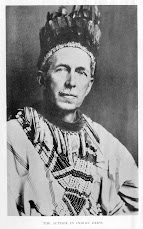
From Travel magazine, August 1925. Digitized by Doug Frizzle March 2010.
A Whaler on theChileanCoast—Chile's Strange Idea of a Pullman—The Spotless Town of South America— Mountains and Deserts of Southern Chile—Beating the Tax Collector
The following article is one of a series written for Travel on the more unusual phases of life on the west coast of South America, which mill be included in Mr. Verrill's book, "Down the West Coast of South America" to be published in the fall. The last article, Those Who Worshipped the Sun, appeared in the July issue, while the next will appear in September.—Editor
“THERE are no Pullman cars on the train," the suave occupant of the ticket booth in theSantiago railway station informed me. "But," he added, "The Señor may engage an apartment. It will be most comfortable and private for the Señora."
This sounded promising. If my wife was to take that long fourteen hour train journey to Concepcion in comfort, then a private compartment would be necessary. And as the ticket seller dilated in voluble Chilean Spanish on the manifold advantages of his suggestion, we pictured a luxuriously fitted little parlor with every luxury and convenience.
"But if the Señor desires it, then must he engage it at once," resumed the attendant, "There are but the two on the train, and I must notify the station master that the compartment is reserved for the Norte Americano caballero and his Señora. It's cost?"— he spread his palms deprecatingly—"Ah, Señor! It is but a trifle for such convenience and comfort— merely twice the ordinary fares, Señor."
And so, as Chilean railway fares are very cheap and the alleged palatial accommodations meant an additional cost of but fifteen dollars, I engaged the compartment at once, relieved at the opportunity to do so at small cost. Had we been ambassadors or potentates we could not have been received with greater formality and deference when we reached the station the following morning. An official, whose uniform might have been that of a general, bowed low, and ordering two uniformed guards to shoulder our baggage, led the way to the waiting train, conducted us to the one first-class coach, and with a grandiose sweep of his hand indicated a curtained-off section at one end of the car on which was pinned a huge placard marked "RESERVADO."
"Behold!" he exclaimed, sweeping aside the curtains. We were too amazed at the revelation to speak, but the joke most assuredly was on us. Enclosed by the flimsy green curtain were two ordinary, leather upholstered seats in no way differing in the least from every other seat in the coach. There was nothing more, not even a footstool. We had paid fifteen dollars for hanging a curtain on its brass rod!
Before we had traveled a dozen miles, moreover, we discovered that the only advantage of the curtain was that it prevented the clouds of dust that seeped through our "compartment" windows from reaching the other occupants of the coach, and confined it to our "private" section. So, as we had no desire to monopolize the dust of central Chile, we promptly ordered the costly strip of cloth removed. But I must admit that even if our visions of a luxurious compartment had vanished we had all the service and attention that normally belongs with an entire Pullman section. Obsequious attendants hovered about, brushing the dust from seats and garments, opening and closing the windows as required, offering suggestions as to edibles and drinkables, and deserting us only at the frequent stations. Each time the train stopped they would rush off, and working like stevedores, shoulder the heavy bags, baskets, bundles and innumerable other forms of impedimenta belonging to disembarking passengers, and, panting and sweating, would lug them across the station platform to a safe resting place. Never have I seen such obliging and willing-workers on a railway train, and seldom did they receive a tip for their trouble. And never have I traveled on a train wherein passengers were so freely, permitted to pile innumerable and bulky pieces of baggage on seats, in aisles and overhead. But evidently the Chilean State Railways are operated for the benefit and convenience of the traveling public rather than for the profits or the convenience of officials, and equally as evidently, Chilean railway rules are made to be disobeyed. Although the cars were plastered with signs prohibiting smoking, everyone, including the train crew, smoked incessantly and, as is always the case in Chile, the fact that the lavatories were plainly marked "Caballeros" and Señoras" respectively, neither sex paid the least heed to the signs. However, everyone seemed to be quite happy and content, each newcomer piled his or her baggage wherever there was available space left, and all chattered and laughed and munched their sandwiches and fruit, and drank their wine, and rushed madly out and as madly back again at each station, and embraced and back-patted and kissed friends and acquaintances as if it were all a gay holiday excursion or a picnic.
I had heard such glowing praises bestowed upon the scenic beauties of central and southern Chile that I was a bit disappointed at the landscape as the train left Santiago and its suburbs behind. To one who had never seen any land but the desert districts of northern Chile with the grim, dull-gray mountains where the only greenery is in the plazas and little "quintas," the Mapucho valley and the country about would appear most beautiful. But to one accustomed to the tropics, or to the pastoral sections of England or theUnited States, the valley held few attractions. In many ways it impressed me much as some parts of northern France, a resemblance made more striking by the long lines of attenuated poplars and the far-reaching vineyards. But beyond the well-tilled and cultivated fields, the fruit orchards, the waving seas of ripening grain, and the pastures with the grazing flocks, the hills were typically Chilean—the same ochre, moth-eaten hills that had greeted us at Valparaiso. To be sure, it was an unusually dry season; the wide river beds were mere gulleys of cobbles with scarcely a trickle of water, and the countryside was not at its best. But I could not imagine those hopeless hillsides bearing a mantle of green, even with abundant rains.
Everywhere the dominant features of the landscape were the poplars and weeping willows. But, however picturesque and decorative poplars may be in reasonable numbers, yet they are monotonous when they border every field, line every irrigation ditch, and stretch in endless avenues for mile after mile beside the roads. Weeping willows, too, become tiresome and rather depressing, a bit reminiscent of old-fashioned cemeteries, and we longed for the sight of a sturdy oak, a stately elm, a clump of white birches or a beech copse. Something else seemed to be lacking and, presently it dawned upon me that it was wild flowers. It was the Chilean spring, the season of seasons when one might reasonably expect a wealth of wild blossoms, and yet no sign of these harbingers of spring gladdened the eye. In the States, in England, in any temperate land, the spring landscape is gay with a mosaic of color. Buttercups and daisies or bluebells and primroses carpet the fields. Bits of woodland wonderful with rosy azaleas, dogwood or hawthorn; meadows golden with cowslips, blue with sweet flag or starred with violets; roads and lanes bordered by modest anemones, gaudy wild lilies or nodding columbine; fences and walls blanketed with clematis and honey-suckle, sweet-briar and bitter-sweet, and, even along the dusty, grimy railway tracks tansy and mallow pinks, dandelions and butter-and-eggs doing their humble best to brighten and beautify the otherwise ugly spot; all these are ours. But not even a mullein stalk, a dandelion or an iron-weed broke the greens, browns and dull yellows of this landscape. Here and there a rather dejected looking poppy grew, like a pariah, on the outskirts of a field of grain; blue chickory appeared at rare intervals, and clumps of lonely, inconspicuous white flowered weeds strove to maintain a precarious existence beside the roads. But even these were seemingly on the point of suffocation from the all pervading dust that covered every leaf, rose in dense clouds behind every plodding ox cart, and sifted like smoke through the car windows.
It seemed almost as if every weed, every non-utilitarian bit of vegetation had been uprooted, utterly exterminated, to make room for crops. But to offset the lack of wild flowers, there were the roses—hedges of crimson, pink, white, salmon; masses of blossoms rioting over adobe walls and low-roofed houses, as if man, having eliminated every lovely but valueless wild plant, had suddenly awakened to the need of color and beauty and had striven to replace the native flowers with those of his own planting. And nowhere, I feel certain, are there more beautiful or larger roses than those of Chile. Indeed, the profusion, size and color of Chile's cultivated flowers are on a par with her fruits, and, oftener than not, they have outgrown all bounds and are, practically, wild.
Another disappointing feature of the landscape was the absence of picturesque villages and people. There is nothing beautiful in a low, mud-walled hut with filthy dooryard wherein pigs, poultry and other livestock wallow and browse, and it must be confessed that the average home of the Chilean farmer and laborer is of this sort. The larger haciendas which we saw at intervals were palatial, beautifully kept and most attractive homes, surrounded by delightful gardens of flowers, palms and ornamental shrubs. But we missed the well-to-do, thrifty-looking farm houses of England and the States, the neat hay ricks, the well-filled corn cribs, the piled cordwood, the neat, trim cottages, and the great prosperous-looking barns. The farm hands, too, did not appear as well off or as contended as their fellows of other lands, though perhaps that was partly due to their costumes or lack of costume.
A plowboy in blue jeans, cowhide boots and coarse straw hat, or his British prototype in smock and gaiters, may be a far more elegantly or attractively garbed individual, but he at least fits his environment and is most unmistakably a rustic. But the Chilean peasant, as far as appearances go, might be either a farmer, a tramp, a dock hand or a brigand.
It is regrettable that the Chilean peasant has no national nor distinctive costume such as one sees in France, Spain, Holland or Scandinavia. The poncho is the only typical garment, and this useful bit of apparel is common to many Latin American countries. However, what the peasantry lacked in the way of picturesqueness was fully offset by the gayly bedecked and caparisoned rancheros,—the gentlemen farmers and cattlemen with their broad-brimmed, low-crowned Spanish hats, short jackets adorned with braid and buttons, flaming sashes, gaudy ponchos, ridiculously immense silver spurs and ornate horse trappings, and who looked as if they might have stepped bodily from the pages of an Ibañez novel.
Although I was rather disappointed at the scenery at first, I found that it rapidly improved. Beyond San Fernando, the cultivated land was far more extensive; vineyards and orchards were more numerous and larger, the houses appeared better and neater, with picturesque tiled roofs, and the vegetation was more varied. Even the hills and mountains were less bare and hopeless, while the fields showed patches of vivid yellow mustard, mauve-flowered vetch and scarlet poppies. Even the familiar stalks of mullein appeared at times, and along the ditches were cat-tails and pink mallows. The bird life, too, was interesting, for everywhere were the Chilean prototypes of New England songsters, and they seemed like old friends.
There were the familiar meadow larks uttering their plaintive, long-drawn notes; the blackbirds querulously piping from the reeds; the soft gray mourning doves; the swift-winged sparrow hawks; the harriers coursing low above the fields; the perky song sparrows; the impudent flycatchers, and scores of others. What did it matter if the larks' breasts were scarlet instead of yellow, if the blackbirds wore dull yellow instead of crimson and gold epaulets, if the sparrows and all the others were clad in slightly different hues and patterns? But, also, there were many birds totally distinct from any we have in the north. The great, handsome, black and white, spur-winged plovers that rose in flocks at the train's approach, and wheeling and whistling, circled about to alight upon newly ploughed ground. The tiny dwarf teal that paddled about, with equally tiny grebes, in every pool. The curious, dull-colored burrowing parrots, climbing, like four-footed creatures, over the cut banks, and popping in and out of their holes like marmots, and the tail-less, dust-colored, bustard-like "perdiz" that would half flutter, half run a few yards, and squatting down, would be instantly transformed into lumps of the bare earth.
The section south of San Fernando would have been a credit to any land. Greatly was I impressed by the wonderfully healthy and thriving appearance of the vegetation. There seemed to be an entire absence of disease or insect ravages. In the States, even at the best of times, one constantly sees the effects of insect pests and plant diseases. Constant vigilance and unending labor is essential if the farmer is to raise a crop, and insecticides are universally used. But throughout my trip through Chile's farm belt, I saw no evidences of insecticides on the plants, no one spraying the vegetables or fruit trees or picking bugs and caterpillars from vines and plants. Also, I was greatly surprised at the vast amount of waste or untilled land. Possibly much of this area is poor soil or unfit for farming, but as far as superficial observation went I could see no difference, either in soil or other character, between the cultivated and uncultivated areas. Indeed, areas of tilled land were often in the midst of wide stretches of waste land, and vice-versa. Another matter that seemed strange to me was the apparent ease of farming. In England or the States the farmer toils from dawn until dark with work never done; but in Chile, with the exception of a few men and boys leisurely plowing or harrowing with slow plodding oxen, or half-heartedly directing the irrigating waters in the way they should go, I saw few men at work in the fields. Groups stood idly at the wayside stations or about the little farm houses and chatted beside the roads; but all appeared to be taking life very easily and the farms seemed to be pretty much taking care of themselves. Possibly the Chilean farmer has solved the problem of raising lucrative crops without hard work, and if so, who would not go back to the soil, get close to nature and be a farmer in Chile?
By the time we reached Parral we had been transported as if by magic to New England. There was nothing in the landscape to remind us that we were still in Chile. Buttercups and daisies, pale blue forget-me-nots, pink clover and purple lupins carpeted the fields. The good old mullein was again in its element. Oaks, walnuts, chestnuts, locusts and elms were everywhere, and maples shaded the station platforms. On every side were brushy sheep pastures, blackberry thickets and typically New England brooks bordered by alders, while the occasional swamps were dense with a growth of ferns, brakes and brambles.
At Chillanthe character of the country had completely altered once more. The land stretched away in rolling prairies to the distant hills, and was almost bare of cultivation. Instead, there were green pastures separated by rows of hardwood trees and shrubs, so that the country appeared like a vast crazy quilt of various shades of green. Sleek cattle and splendid horses grazed in great herds watched over by the Chilean cowboys, and, taken all in all, it was just such a scene as one might view from the windows of one of our own transcontinental trains.
At Yumbel we had entered yet another land. Richly green hills appeared beyond the fields; the broad vividly blue river meandered through lush meadows; truck farms, vineyards and wheat fields again covered the land, and as the train swung along the banks of the ever winding Bio-bio river, we felt as if we had been whisked to the borders of theHudson or theConnecticut. But the really beautiful scenery of valleys, hills and stream was sadly marred by the clouds of choking dust that filled eyes, nostrils and mouth. I had been told that I would find southern Chile wet and rainy. Instead, I found it as dry as tinder and with a cloudless sky. No rain had fallen for nearly two months, and all averred that it was an abnormal and unprecedented condition of affairs. But wherever I went in Chilethe weather, according to the natives, was abnormal. In rainless Antofagasta I experienced almost tropical downpours, and about rainy Concepcion I found weather conditions such as one might expect in a desert. All of which goes to show that Chilean weather is as uncertain as in any other country, and which may explain why travelers invariably disagree in their impressions of a strange land. But no two could fail to agree as to the beauty and attractiveness of the district about Concepcion. It is a delightfully varied land, a land of green meadows through which flow babbling brooks shaded by drooping willows and lined by tamarisks; a land of pastures wherein graze herds of blooded cattle and superb horses; a land of well-tilled farms and seas of grain; a land of rolling hills gleaming as if plated with gold where acres of yellow-flowered giant lupins grow in rank profusion; a land of charming lakes, of pine-clad mountains and of broad serene rivers. And scarcely less delightful than the country round about is the charming little town with its hospitable people.
With its wide cobbled streets, its low massive buildings and its sleepy air, Concepcion is typically Spanish American, and yet it is wholly un-Latin in its cleanliness. It is literally a spotless town, and, despite the scarcity of water at the time of my visit, the streets were meticulously flushed and washed each morning. And, as the street cleaners made their rounds and literally scrubbed the cobbles with their stiff, long-handled brooms, the cocheros took advantage of the opportunity, and dipping water from the flooded gutters, carefully washed not only their antique, weather-beaten vehicles but their horses as well. To be sure, there are no very ancient, very beautiful or very unusual buildings in Concepcion, for the original town of the name, which was established by old Pedro de Valdivia, was located where the little fishing village of Penco now stands. But between attacks by hostile Indians, earthquakes and tidal waves, life in the place became even too strenuous for the adventurous Dons, and the present site was selected and the original city abandoned to the elements. Today, only a few crumbling ruins mark the old city. But, even if Concepcion cannot boast of age-old churches and palaces, it can rightfully boast of a fine university, of excellent shops and stores, of up-to-date business blocks and of a delightful, neatly kept little plaza with a magnificent fountain in the center and a double row of wide-spreading linden trees bordering the promenades. All about, too, are monuments, statues and parks, while theAlameda, —if only properly paved or surfaced,—would be as fine a drive as any South American city could show. But probably the most attractive spot about the city is the Caracoles hill that rises to a height of about five hundred feet at the edge of the Alameda, Up this hill, which has been transformed into a public park, one may travel by auto over the winding road, and from the summit gaze across a wonderful panorama of countryside, river and distant sea, with the little city at one's feet. The only trouble is that the roads, like all roads in southern Chile, are abominable, and it is torture rather than pleasure to traverse either them or the city streets in the bouncing, jouncing motor cars of ancient vintage, or the still more pre-historic, bone-breaking, horse-drawn vehicles.
How some of the public conveyances one finds in these smaller Chilean towns manage to remain intact is little short of miraculous. They appear to be on the point of dropping to pieces, and as one jolts and bumps along over the horrible pavements one feels certain that a trail of the component parts of the vehicle must be left behind. But nowhere in all Chile did I see such battered junk piles as passed for motor cars in Concepcion. The jitney to which the red- capped porter—even in far-off southern Chilethe "red cap" is as inevitable as in the Grand Central— led us, and onto which he began piling our luggage, looked as if it had been tumbled down a mountain side, submerged in the sea and had survived a few earthquakes. Indeed, judged by appearances, it might have served old Valdivia as a conveyance in his march from Santiago.
"Do you call that a car?" I exclaimed. "Why, that's a wreck!"
The chauffeur, an immensely fat, triple-chinned Chilean who could have made a fortune in slap-stick comedy films, stopped panting and puffing over stowing the luggage, turned, and grinned good-naturedly. "Si, Señor," he agreed. "But it is the best wreck in Concepcion."
To our amazement, too, the "best wreck in Concepcion," as well as ourselves, managed to survive the trip from railway station to the plaza where, to our amazement, we discovered what was apparently a really excellent hotel. As a matter of fact, the hotel was excellent, as far as site, appearances and equipment went. There were private baths with the rooms, electric lights, and the meals were beyond criticism. But the proprietor, a Slav and an ex-traveling salesman, had his own most unique and remarkable ideas as to decorative effects and furnishings. There was not a dresser, a chiffonier or even a bureau in any room. There was not a curtain or shade on any window. But beside one bed in each room was a gaudily decorated cuspidor; each bath was supplied with a thermometer, though minus soap or bath towels; every lock was upside down, and the fastenings to the bathroom doors were invariably on the outside and not on the inside! However, the hotel was completed instead of being left in a half-finished state, as were many of the buildings, and especially the churches of the town.
Wondering why building work had come to such an abrupt halt, I made enquiries and discovered that there was method in this seeming madness, for under the law taxes can only be levied on completed structures, and no matter how long a building may remain with a section of roof or wall or other portion uncompleted it is free from taxation.
Frequent trains and trolley cars connect Concepcion with its port of Talcahuano which is a busy and far from unimportant port, where the Chilean government maintains a naval station and dry dock. Here there are musty shops and ship chandelries, and a superabundance of noisome drinking places wherein one might expect plots to be hatched and dark deeds committed. To a Yankee, the town is of no little interest, for in former times it was a famous whaling port and in its harbor countless bluff-bowed, weather-beaten, oil-soaked whale ships from New Bedford, Nantucket, Salem and New London, cast anchor. Ashore, the boisterous hard-bitten, patched and toil-stained whalemen, after long months or years at sea, made merry and drank and sang and fought. And here, after they had accumulated tidy sums through oil or bone, and had broiled under equatorial suns and had frozen in Arctic or Antarctic seas, many Yankee whalemen settled down and made their homes. Later, many an old Yankee whaleship was sold to Chilean owners to be used in the local whaling industry, and many an old Yankee veteran of whaling days of New England stood as skipper upon their decks. Indeed, it was largely owing to the whaling ships, and the industry and commerce that followed ever in their wakes, that Talcahuano became of importance. A few of the newer ships—mere youngsters of fifty or sixty years ago, still cruise about the south Pacific and under the Chilean flag capture the humpbacks. But even they have deserted Talcahuano, and the last of the Yankee whaleships in Talcahuano's harbor is a stripped, pathetic hulk whose ornate figurehead is scarred and broken, whose stout wooden davits are sagging and awry, and whose painted ports are faded and weathered. Even her name is obliterated, but still plain upon her broad, square counter one may read the letters of her home port—"New Bedford," as though neither time, neglect, man's vandalism nor the elements could obliterate the memory of that famous old Yankee whaling port.
From Travel magazine, Volume XLV May, 1925 Number 1. Digitized by Doug Frizzle, February 2010.
Antofagasta, Chile's NitratePort—The Driest of Dry Towns—Chile's Fourth of July—Curiosities of the Fire and Police Departments.
(This is the fourth of Mr. Verrill's series of articles dealing with the West Coast of South America. Others will follow in subsequent issues of TRAVEL—The Editor.)
IT is a popular belief that it never rains in northern Chile, but two days after my arrival in Antofagasta it poured for six hours, and, a few days later, another drenching downpour proved conclusively that weather is as fickle in nitrate land as elsewhere. Nevertheless, real dyed-in-the-wool rains are rare in this desert region, and to the inhabitants, such a deluge as welcomed me is a real event in their lives,—almost a fiesta in fact. To them a real drenching rain is a thing to be remembered for years, to be regarded as a phenomenon, to be recalled for generations. It is like the great "blizzard of '88'' to New Yorkers, the "night of the big wind" to the Irish, the eruption of Morne Pelee to the West Indians, and we can easily imagine a gray-headed, tottering old Antofagastan, a half century or more hence, spinning wonderful yarns of the days when rain fell in torrents in this rainless land, and dating all important events of his life from "the day of the rain," But a few years ago it would have been even more remarkable than at present. There is no doubt that the climate has changed, as within the past three or four years several rains have fallen where, for longer than the oldest inhabitant could remember, no rain had fallen before. Still, rainy days in Antofagasta are far too few and far between to be reckoned with, and no provisions have been made to guard against them.
Few roofs are watertight; there are no gutters or drains to carry the water from streets and sidewalks, and when it rains, pots and pans are quickly requisitioned to catch the dripping water both indoors and out.
On the Pampas a rainfall is a dire calamity and causes tremendous monetary losses to the nitrate officinas, but in the city the worst results are sodden walls and carpets, damp beds and linen and flooded streets; —small matters, more than offset, at least in the minds of the common people, by the benefits derived from obtaining several days' supply of water free of cost. Water, in fact, is a most important and far from cheap item in the lives of theAntofagasta people. Until a few years ago, all water was supplied by peddlers who, with barrels mounted on carts, made their rounds and sold distilled sea water by tin or bottle. Today, Antofagasta has an excellent supply of the purest water piped for nearly 200 miles from its source in a glacial lake in the distant Andes. But the supply is controlled by the railway company and is sold to the public at prices which to us would seem exorbitant. The better class of houses and buildings are piped and are provided with meters, but the great majority of the natives purchase their water from tank carts which peddle it from door to door as of old.
One can scarcely blame the working classes for going unwashed and in filthy rags where water costs five cents a gallon, and neither can we wonder that when a rain does descend upon the dry and dusty town the people hail it with delight as a blessing.
But for over three hundred and sixty days of the year Antofagasta is as dry as the proverbial bone. There is not even the misty drizzle that veils Peru's capital during the winter months and there is seldom a day on which the sun does not shine, at least for an hour or two. For this reason Antofagasta, though much farther south than Lima, is not so unbearably unpleasant during the cold weather, and though there are absolutely no provisions made for heating buildings or homes, one does not feel as though in a tomb or within a short distance of an iceberg.
Nevertheless, the traveler who visits Chile between April and November will be convinced that the country was most appropriately named.* After sundown the heaviest wraps, overcoats and furs are essential if one is to experience even a modicum of comfort. As far as the town itself is concerned, it has certain attractions and many improvements and admirable features. Roughly, it may be described as a cross between a western mining town, a rural village and a second-rate English seaport. It fronts on an open roadstead, where frequently the heavy seas make embarking and disembarking hazardous or impossible; and is built on a narrow strip of beach that slopes sharply up from the water's edge to the gloomy, dun-brown, wrinkled mountains, standing out in silhouette against the sky.
* Oddly enough, the word CHIRE in the Quichua tongue or CHILE in Mapuche, literally means "a cold place."
On the night of Chile's greatest fiesta, the anniversary of the republic's independence, theDies y ocho, or 18th of September, great beacon fires of salitre are kindled on the mountain slopes back of the town. Like titanic red fire the nitrate burns with a dazzling, blinding color, like the incandescent molten metal in a great blast furnace, and throws off dense masses of smoke. Illuminated by the glare of the flames, each ridge and peak and rugged buttress of the mountains glows dully red, throwing the gulleys and canyons into dense black shadows; up from the burning piles great columns of orange-tinted smoke roll and twist and writhe; the sky is painted crimson to the zenith, and every street and roof and building stands sharply forth outlined in vivid red. Even the waters of the bay beyond are ruddy in the glare, and the anchored ships seem inky silhouettes with every mast and rope and spar as clearly cut as though drawn upon the scene with an artist's pen. It is an awe-inspiring, wonderful sight, and gazing at it, one feels that thus must these raw and frowning mountains have appeared when molten lava flowed down their sides and volcanic vents spouted flame, and smoke, and the new-born rocks were still red hot and the very heavens blazed with the fury of the inferno hurling up the towering peaks from the bowels of the earth.
Aside from this curious custom of building bonfires with the only highly combustible material at hand, the Antofagastans show little originality in their merrymaking on Independence Day. In a general way it is strikingly like our "safe and sane Fourth," or rather, I might say, like a series of them, for two or three days are given over to the fiesta. Here and there a few firecrackers pop half-heartedly, a few sticks of red fire are lit at night, and flags fly everywhere. It is certainly safe enough, in so far as peril from fireworks and toy pistols is concerned, but as much cannot be said for the sanity of the celebration, for to theRoto or laboring class, the fiesta means merely unstinted drinking and unlimited Pisco or native rum. As a result, a large percentage of theRoto merrymakers get gloriously drunk, and while they are mostly merely hilarious or sodden, a number always become possessed of homicidal mania, and stabbing affrays, shootings and deaths are of far too frequent occurrence. There are, however, a large number of decent, sober and peace-loving Rotos who, with their friends and families, pile themselves and their belongings into carts and singing and laughing, betake themselves to the beach on the outskirts of the city and there have a glorious time picknicking.
This form of celebration is not confined to the common people by any means. People of all classes flock to the seaside, much as do our own holiday crowds, while others prefer the horse races, excursions to the Pampas, or other equally harmless and healthful forms of diversion. Formerly, theDies y ocho was not regarded as complete unless every house and building that required it had been newly painted for the great day. When this custom was in vogue, the stranger, arriving in Chile shortly before the 18th of September, might well have thought that every inhabitant was a painter by profession. Everywhere ladders were leaning against walls, and everywhere men were painting away as though their lives depended upon it. Houses, gleaming in fresh and vivid coats of paint, were on all sides; others were partly done and reminded one of ragamuffins whose shoulders had been hidden under bits of gay finery leaving their soiled and bedraggled nether garments exposed; while still others were dingy and dull, appearing almost immodest in their nakedness. It was, in fact, a veritable painting spree, and gave one the impression that the depressing brown of the encircling mountains had driven the people mad and that they were insanely striving to make up for nature's lack of decorative effects. Like all Spanish Americans, the Chileans are a bit addicted to themañana habit, and hence they put off the annual painting until the last minute, with the result that all painted at once, for it was obligatory by law to have one's house or place of business painted by the day of fiesta. It was, in short, by far the most sensible and commendable method of celebrating the national holiday and one well worthy of imitation by other nations. But each year the number of newly painted buildings grew less, the law became more and more lax, and today, one scarcely sees a painter at work in anticipation of Dies y ocho.
And, speaking of Chilean customs and of Antofagastan ways that might well be copied to our own advantage I might call attention to the fact that this little nitrate town has forestalled any future possibility of traffic congestion by making all thoroughfares one-way streets. And the authorities see to it that the vehicles obey the rules. At every important corner a traffic policeman stands on duty. While a traffic cop in long blue coat, spiked white helmet and with sword instead of club, may seem incongruous to us, yet such a figure is mightily efficient in Antofagasta. With the immensely wide streets and the small number of motor vehicles this wholesale one-way traffic system may appear ridiculously unnecessary. But it is far better than the congestion of Lima's streets and the hopeless confusion arising from allowing vehicles to travel in any and all directions in the narrow, crooked thoroughfares of most Latin-American towns. Possibly the rule was made partly in order that the visitor driving about town might be impressed with the excellence of Antofagasta's streets, or again, it may be a device to disseminate traffic over the city and thus prevent any one locality from becoming a business district and leaving other sections deserted.
It has been said by one well-known writer that, "there was not a town between Lima and Valparaiso that possessed a shade tree or a paved street," and that, "with few exceptions, the buildings were mud shacks thatched with grass." Very evidently that writer had never visited the west coast, and certainly he had never seen Antofagasta. I doubt if anywhere between Lima and Valparaiso he could find a mud shack thatched with grass, for while mud houses are plentiful grass is not, and in most of the towns roofs of any sort are more of a name than a reality. And in practically every town one finds plazas with flowers, shrubs and shade trees. Antofagasta, although at the edge of a desert is no exception, rather it excels all others in the extent of its plazas and the abundance of its trees and greenery. To be sure, the streets are barren of shade trees, there are no long avenues of palms or eucalyptus, no front yards filled with flowers and shrubbery, no walls draped with blooming vines, as in Lima. But wherever there is a plaza there is a riot of vegetation and large trees, while in the center of the Avenida Brazil, a splendid highway leading to the race track, is a park of trees, flowers and shrubbery, half a mile or more in length, beautifully laid out, and containing a children's playground with swings, slides and similar devices for juvenile entertainment. And though they may not be visible from the street, many of the back yards of the houses are filled with flowers and with growing vegetables, for the soil of the desert is rich, and only water is needed to make anything grow.
And one would look in vain for the "mud shack thatched with grass." The majority of the residences of Antofagasta are of wood; the more pretentious homes and the stores and office buildings are of solid masonry or concrete, and many of the buildings are three or four stories in height. Many of those now in use, and still more in course of construction, would be a credit to any city. The Intendencia, the Catholic church, the Spanish Bank, and others are imposing, beautiful and artistic structures. But one searches in vain for anything that savors of Spanish or Latin-American type. As a whole, the city is far more like an English than a South American town. Prat Street, the principal business street, might well be a street in an English provincial town were it not for the signs in Spanish. And the majority of foreigners are British, for the greater number of large industries as well as the railway are English. And quite British also is the juxtaposition of well-to-do homes and miserable hovels and tumble-down huts. None but a British corporation would expect its English employees to occupy residences surrounded by squalid native shacks and facing filthy corrals. And none but a British corporation would think it fitting to have its properties unpainted, badly kept and out of repair, a condition which would lead one to think the company was on the verge of bankruptcy.
It must not be supposed that British interests in nitrate land are paramount, from a financial standpoint. On the contrary, the Americans have more capital invested than the British, for the Chuquicamata copper mines, the DuPont explosive works, the Grace Company's holdings and several of the largest nitrate industries are American. Also there are many Germans, while the Jugo-Slavs have a firm footing and control many important lines of business. But there are two types of inhabitants which are conspicuously lacking in this nitrate town. The Indian and the Cholo, who are striking features of the Peruvian towns and form the bulk of the working class, are practically unknown in Antofagasta. To be sure, now and then a few Indians or even a Cholo or two may be seen on Antofagasta's streets, but they are strangers, natives of the far interior towns or of Bolivia, and are merely transients. Undoubtedly the absence of the native Indian and the Cholo, a term applied more or less indiscriminately to those of mixed Spanish and Indian blood as well as the city dwelling Indians, is due to the fact that this arid, barren northern coast of Chile was practically uninhabited by the aborigines at the time of the Spanish conquest. But in place of the Cholo and the Indian, Antofagasta, like other Chilean cities, has a working class quite as distinctive as the Cholos of Peru. These are theRotos, people of practically pure Spanish blood, ragged, dirty, but highly picturesque rascals, upon whose labor the country depends, just as Peru depends upon the Cholos and Bolivia upon the Indians.
Very wide and comprehensive indeed is the term Roto (literally "ragged"). In their ranks are thefleteros or boatmen, the stevedores, the draymen, the coach drivers, the common laborers, the peddlers, the mechanics, the street sweepers, in fact every class of workman, laborer and humble artisan; a veritable army, a class by themselves and a mighty power to be reckoned with in politics and industry. And in theRoto class are as many social grades as among the well-to-do or the military classes. Everywhere they are in evidence, energetic, loud-voiced, a bit swaggering, often wild looking, and, as a whole, quick tempered, hard drinking, temperamental and wholly irresponsible.
The Rotos of the street—the peddlers, truckmen and laborers, are perhaps the most picturesque features of Antofagasta and the only unusual or striking sights of the town. In their loose blouses, usually made from flour sacks, their queer head coverings, also of flour sacks, and their ragged, filthy nether garments, they may be seen working, swearing, shouting about the docks and warehouses and looking far more like a horde of brigands or pirates than a gang of laborers. Bearing poles, with both ends draped with fish, across their shoulders, they hurry through the streets crying their wares and seeming to care not a jot whether or not they dispose of their loads. But theRoto is at his best when he is driving one of the heavy two-wheeled drays drawn by three mules hitched abreast.
The Roto scorns to occupy a seat on the vehicle and from that point of vantage drive his team like an ordinary truckman. Instead, he mounts the left-hand animal and, seated on a high, uncomfortable looking saddle, and armed with a long-lashed whip whose wooden handle ends in a leather-guarded hilt like a sword, he handles his team by means of quaint Spanish oaths, hoarse war whoops and pistol-like cracks of his wicked whip.
That he is brutally cruel and absolutely lacking in any sense of humanity goes without saying. He is as ready to fight as to work and on the least provocation he will whip out a knife and leap to the attack. I was told by a reliable Englishman who had resided for many years in Antofagasta, that less than two years ago knife fights were of nightly occurrence even on the main streets, and that five or six years back it was a common sight to see several dead Rotos sprawled on the pavement almost any morning. Fortunately the efforts of the authorities and the police have resulted in confining these stabbing affrays to theRoto sections of the town, and at the present time the rougher, wilder lot of Rotos are seldom seen in the better sections of Antofagasta after nightfall. Of course men of this type are ripe for trouble, mob violence and revolution at any time, the more especially as they are absolutely lacking in education and intelligence and are easily swayed and excited. Let a man publicly denounce the government and the existing order of things and declare for Bolshevism, and in a moment the crowd of listening Rotos will wave the red flag and clamor for bloodshed and revolution. And let some one wave the Chilean flag or let the band strike up the national anthem, and instantly theRotos are screaming themselves hoarse with "Viva Chile" and are in a patriotic fervor ready to shed the last drop of their blood for their country.
In the past the streets and plazas of the town have seen many bloody sights, hundreds of Rotos shot down, many hundreds wounded, shops looted and citizens murdered. And so it came as almost a miracle that during my visit to Antofagasta, which, as I have said, was coincident with a change of government, the practical exile of President Alessandri and military control, there was no excitement, no mob violence, nothing whatever that savored of a revolution or of Roto lawlessness. All of which, according to those who should know, went to show that the change of government met with the full approval and desires of the common people.
In most countries the laboring class is always aiming at something better, striving to imitate if not equal those higher in the social scale, usually a bit ashamed of being what they are. But not so theRotos. They are proud of the fact that they are Rotos, they are almost a race by themselves, and they have their own amusements, their own life, and, to a certain extent, their own language or jargon which is quite unintelligible to a person knowing only ordinary Spanish.
Their favorite pastime, aside from drinking and fighting, is theCueca, a dance peculiar to the country and which consists mainly of slow steps, body writhings and the use of a handkerchief, which is waved, dropped, and flirted in apparently aimless fashion. As a matter of fact every movement of the handkerchief, every motion of the body, every step, even the words of the song and the music which accompanies the dancers, have their meanings, usually very suggestive and quite unfit for description.
Nevertheless, theCueca is, when well danced, an attractive and picturesque performance and one of the few truly Chilean customs that have been retained in the nitrate town. Of course theRotos, like everyone else in Antofagasta, are racing fans. The Sunday horse races are the event of the week, the more especially as bull fights are unpopular and things of the past, while the state lottery is prohibited. As a sporting proposition the Antofagasta races are hopeless, for they are flagrantly, obviously and unblushingly crooked; but this merely adds zest to the betting and places the outcome entirely in the realm of chance, as no one, not within the inner circle of owners and jockeys, can possibly foretell the winner or even a place horse, no matter what the animal's previous records or feats may have been. As the betting is all of the pari-mutuel class, and as tickets sell for five and ten pesos (about fifty cents and one dollar) a person can have a great deal of fun and no little excitement without losing a fortune. And as the chances of big winnings are good, horses at times paying as much as seven hundred pesos on an investment of ten pesos, it is little wonder that theRotos as well as their betters look upon the races as royal sport.
The use of the much depreciated peso as the unit of value has resulted in many necessities and luxuries being very cheap in Antofagasta, To be sure, imported goods are high, but even these are far less costly than in Peru, while Chilean-made goods are, as a whole, extremely moderate in price. It is rather staggering to the stranger to look into a shop window and see a pair of shoes marked $56.00 or a shirt labeled $20.00. But when one learns that the dollar mark stands for pesos, and that the exchange rate is nine or ten pesos to the dollar, it is a different matter. Moreover, Chilean-made goods are as a whole excellent in quality and workmanship. The shoes, shirts, cloth, furniture and countless other articles are fully as serviceable as those imported and sell for a fraction of the price, while foodstuffs of every variety are made, grown or prepared in the republic. There are splendid wines, liquors, cigars, cigarettes, smoking tobaccos, macaroni, cheese, butter, biscuit, candies, chocolates, canned goods, and in fact everything edible, and about the only things in this line that the Chileans have not succeeded in preparing properly are pickles. They may make fifty-seven varieties, but it is safe to say that not one of the lot is fit for human consumption.
But the stranger in Antofagasta, who is forced to reside in a hotel, will not find living cheap. To secure good accommodations in the best of the hostelries one must pay New York prices. A suite of two rooms with bath will cost at least six dollars (60 pesos) a day without meals, or ten dollars (one hundred pesos) with meals, for two persons. And even at such prices the accommodations are far from being the best one might expect. But the hotels, or at least the best, are clean, and I found one Antofagasta hotel that in one respect excelled all others I had known in Spanish America. It was the one place in which I could secure a properly cooked soft-boiled egg. To the Spanish American a boiled egg means one of two things. It is either pasado por agua (passed through water) and is literally "passed through" hot water and is served raw and lukewarm or else it is boiled to the consistency of hard rubber. But to my indescribable surprise and intense delight I discovered that when I ordered a medium boiled egg at my hotel I received an egg that was neither raw nor hard. Only once did my mozo fail me. One-morning he brought my eggs as thoroughly boiled as though they were intended for a salad.
"But Señor" he expostulated when I berated him, "they were cooked but three little minutes. I timed them with my own watch."
As he spoke he proudly exhibited his timepiece.
"Nevertheless they were hard, hard as rocks," I declared.
He looked puzzled. Then an expression of vast relief swept over his face and he grinned.
"Caramba, I understand!" he exclaimed. "It must be that my watch is a little slow!"
Eggs by the way are about the safest things one can order in the town. The meat, sold, cooked and eaten within a few hours after the animals are slaughtered, is tough, tasteless and far too fresh, although the fish, if one is sure they are freshly caught and have not been killed by dynamite, are excellent. During the season, too, the big sea crayfish or spiny lobsters are splendid and the giant scallops or Ostiones are most delicious. During the Chilean winter months the variety of green vegetables is somewhat limited, but during the summer—from October until April, excellent native fruits and a great variety of vegetables are obtainable. Most of these are brought from the south, for very little is raised in the desert nitrate region, and as the bulk of these imported products are sold in shops or are peddled about the streets, theAntofagasta market is rather disappointing. Perhaps I should be a bit more specific and say the contents are disappointing, for the market itself is a most imposing and beautiful structure, by far the finest building in the town, and much more suitable for a government building than a market. But within, it is woefully bare with none of the crowd of barterers, the colorful display of fruits and vegetables, the noise of chatter, cackling fowls and hum of business that is so characteristic of most Latin-American markets, and, judging from the market alone, the stranger might reasonably assume that the Antofagastans were on a hunger strike or that they never ate.
Another peculiarity of the town is the great number of pawn shops. They appear to be everywhere and all seem to do a rushing business. At first one is puzzled by this, but the secret of their existence, and the extent of their patronage, lies in a peculiar custom of the natives of pawning their good clothes every Monday and redeeming them every Saturday.
The Chilean working man or woman reasons that as he or she cannot wear good garments during working hours, and as their best clothes are only donned for the week-end holidays—or for occasional fiestas—there is no reason for keeping them in his or her possession during the week. Moreover, they argue, if by delivering their apparel to "Uncle" for five days they can secure some most useful and much-needed pesos, why should they not take advantage of it? They never appear to realize that each time they visit the pawn shop to repay the loan and secure their garments they pay a usurious rate of interest or that by the end of the year they have paid the pawnbroker many times the value of the clothes. It is a custom firmly fixed and nothing can change it. It is to be regretted that other native customs have not survived as strongly, that the people have done away with the picturesque habits of their ancestors and have thus lost practically all attractions and interest for strangers. Even the mardi-gras or carnival, which is so dear to most Latins and is the great fiesta of the year in Panama, is ignored in northern Chile, and the nearest approach to it is the students' fiesta or Fiesta de primavera which corresponds to our May Day.
This takes place on the first Saturday in October and continues over Sunday. It is a holiday confined to the children, mainly the pupils of the schools and colleges, who don fancy dress and masks, parade the streets, both afoot and in decorated floats, hold battles of confetti and in general carry out the carnival spirit. In a way it is a far more attractive and admirable revel than the mardi-gras, for the youngsters seem far more fitted for the parts they play than grown-ups, and some of the costumes are really wonderfully beautiful. Especially is this true of the little tots, children of three to eight years, who, garbed as Spanish ladies with shawls, mantillas, high combs and fans, or as Dutch girls or Cholas, ballet dancers or Dresden dolls, are really fascinating.
It is only during this fiesta that one realizes how many children there are in Antofagasta or how numerous must be the schools to educate them. Aside from the schools of lower grades, which correspond to our own public schools, there are kindergartens, parochial schools, a high school and the San Luis College as well as commercial schools for boys and one for girls and a manual training school for girls, while in Antofagasta as well as in Iquique are schools of mines and nitrates in which the latest methods of the mining and nitrate industries are taught. This is a most wise course, for the very life and existence of both towns depends upon these twin industries, and of the two, perhaps the nitrate industry is the more important.
It would seem that I arrived in Antofagasta at a most propitious time. Not only was I welcomed by a bloodless revolution and the heaviest rain ever known, but in addition I reached the nitrate town just in time to witness theDies y ocho, the spring and the Columbus Day celebrations. Everything that the little town could exhibit seemed to be taking place as if especially for me. But there was yet more to come, for my advent was coincident with the fire season.
It seems that in Antofagasta conflagrations have their closed and open season like fish or game or other sports, the open season for fires being from August to December. Just why this is so is something of a mystery, although the solution may lie in the fact that this period is coincident with the time when insurance policies must be renewed or lapse. At any rate, there is no denying that Antofagasta's fires, and there have been many and disastrous ones, have all occurred at this season. And the city kept up its reputation during my stay. To be sure there were no tremendous fires, fires that consumed a square block or more, as has happened almost yearly, but one conflagration that I witnessed destroyed eight or nine houses and only lack of a stiff wind and the prompt action of the firemen prevented others from causing untold damage. Evidently, too, the municipal authorities feel that it is no concern of theirs if the citizens' homes or places of business go up in smoke, or perhaps they feel that lack of a city fire department tends toward increasing the business of the insurance companies. Whatever the reason, the city itself does not possess a single piece of fire-fighting apparatus nor is there a single fireman on the city's payrolls. But the Antofagastans do not lack either firemen or apparatus. Each of the foreign colonies—Slav, German, Spanish, Italian, has its own fire brigade of volunteers and its own hose wagons and motor trucks while, to show that they are not to be outdone by outsiders, the Chileans have their volunteers and apparatus. And they do excellent work considering that the men are untrained and must dash madly from home or business at the sound of the clanging fire gongs. To be sure, they are a bit slow, very cautiously climbing up the ladders to a second-story window and descending with great care and deliberation, and they quite sensibly feel that they are not called upon to risk life and limb for the sake of saving inanimate property. But they are just as anxious to wreck furniture and batter down doors and windows as their compeers in our own cities, and no metropolitan fire fighter could excel them in unnecessary destructiveness. And as the water used in extinguishing the flames is sea water, the contents of an Antofagasta house or building are not even fit for a fire sale after a wetting down by the local bomberos.
The apparatus used by these volunteers is a strange admixture of the modern and the antique and, when the fire gongs clang, one may see motor fire trucks of the latest design tearing through the streets, while close in their wakes are ancient, two-wheeled hose wagons drawn by panting, shouting bomberos hauling on a long rope exactly as our greatgrandfathers hauled similar antiquated apparatus to fires a century or so ago. And often the bomberos' rush to a fire becomes a sort of hare and hounds or hunt the thimble game. There is no electric fire alarm system, no definite number of strokes of a bell from a signal box. The nearest approach to it is a prearranged system of bell strokes to indicate various parts of the city. Heading in the general direction thus indicated, the firemen follow the crowd, unless the smoke or flames are clearly visible. As a rule this is the case, for when a fire breaks out one cannot rush to a near-by corner and send in an alarm. Instead, one must either scurry to the nearest fire company house or must find a corner store that possesses a telephone. And as time is of no more account, in the minds of the telephone operators in Chile than in our own country, one's home or shop may be totally consumed before one obtains a connection with the fire fighters' headquarters. Very often, too, the fire is discovered by the men kept constantly on watch in the fire company's towers, and as there is no sure and quick way of notifying the absent owner of a building that his property is on fire, it is a common occurrence for an Antofagasta citizen to return home from a dinner, a dance or some other entertainment only to discover that his residence is a pile of smouldering, sodden ashes which, to make the loss even more complete, has been thoroughly gone over by looters who look upon every fire as a treasure trove wherein findings are keepings. Even the police, who, by the way are very efficient, are totally unable to prevent this looting of burned or partly burned buildings, for the thieves, pretending to be friends of the owners of the building, or tenants thereof, boldly carry off furniture or anything else, even loading their booty into carts for transportation. Moreover, the honest people render the thieves' acts more easy through their custom of hurriedly removing all their possessions from their houses near a fire, a habit acquired through long and painful experience and most sensible withal. But very often, in their anxiety to salve their goods and chattels from fire and water, which may and usually do spread, they place temptation in the way of the ever-present looters who, while the owners' backs are turned, brazenly make off with the household furnishings piled helter skelter on the sidewalk.
And speaking of thieves and police let me call attention to the unique and remarkable vehicles which the guardians of Antofagastan law and order employ for transporting lawbreakers to and from the courts and jails. Unlike our own commodious and even luxurious motor vehicles, the Chilean police wagons resemble dog kennels on wheels. They are tiny, boxlike affairs, minus windows or ventilation, too low to permit a full-grown man to sit, much less stand upright within, and are painted a vivid scarlet. And to complete the effect, and perhaps as a warning to other prospective evil doers, each bears upon its roof a carved wooden image of his Satanic Majesty, a very realistic and horrible little devil, tail, cloven hoof, trident and all complete, surrounded by painted wooden flames and bearing upon his mouth a most fiendish grin, as though fairly revelling in the thought that the occupants of the red vehicle are in his clutches.
I have now published over 35 books. They are by authors from the past, the books were rare so I have made them available in paperback or as ebooks. They are available at Lulu.Com, more particularly they are listed here. Doug's Bookstore
Printing from this blog appears to be challenging.
I recommend that you click and drag (select) all the text that you want. 'Ctrl' + 'C' to copy. Then open an empty WORD document on your computer and 'Ctrl' + 'V' to paste. You should then print with page previews... This suggestion may save a few trees - blog articles tend to run on and not be space efficient.
and the Outboard Boys Series. The Boys, Terry, Martin and Warren, were created by Roger Garis and appeared in the four-book series published in 1933 and 1934. The Boys used their powerful outboard motors to solve mysteries and have adventures, etc.
 Rubbing Elbows with