Showing posts with label Panama. Show all posts

Saturday, 12 April 2014

The Lost Mine -Part 2 from 1952

Now with perhaps 400 of Verrill's stories included in this blog, we are beginning to exhaust the 'easy' finds. This story as is mentioned below, has twice appeared in The Wide World magazine which was published in the UK and USA. The illustrations are different in the two versions and the end point of 'part 1' is different in each edition. Link to Part 1 just below./drf
The Lost Mine -Part 2
By A. Hyatt Verrill
from The Wide World magazine, July 1952, Vol.109. Digitized by Doug Frizzle, April 2014.
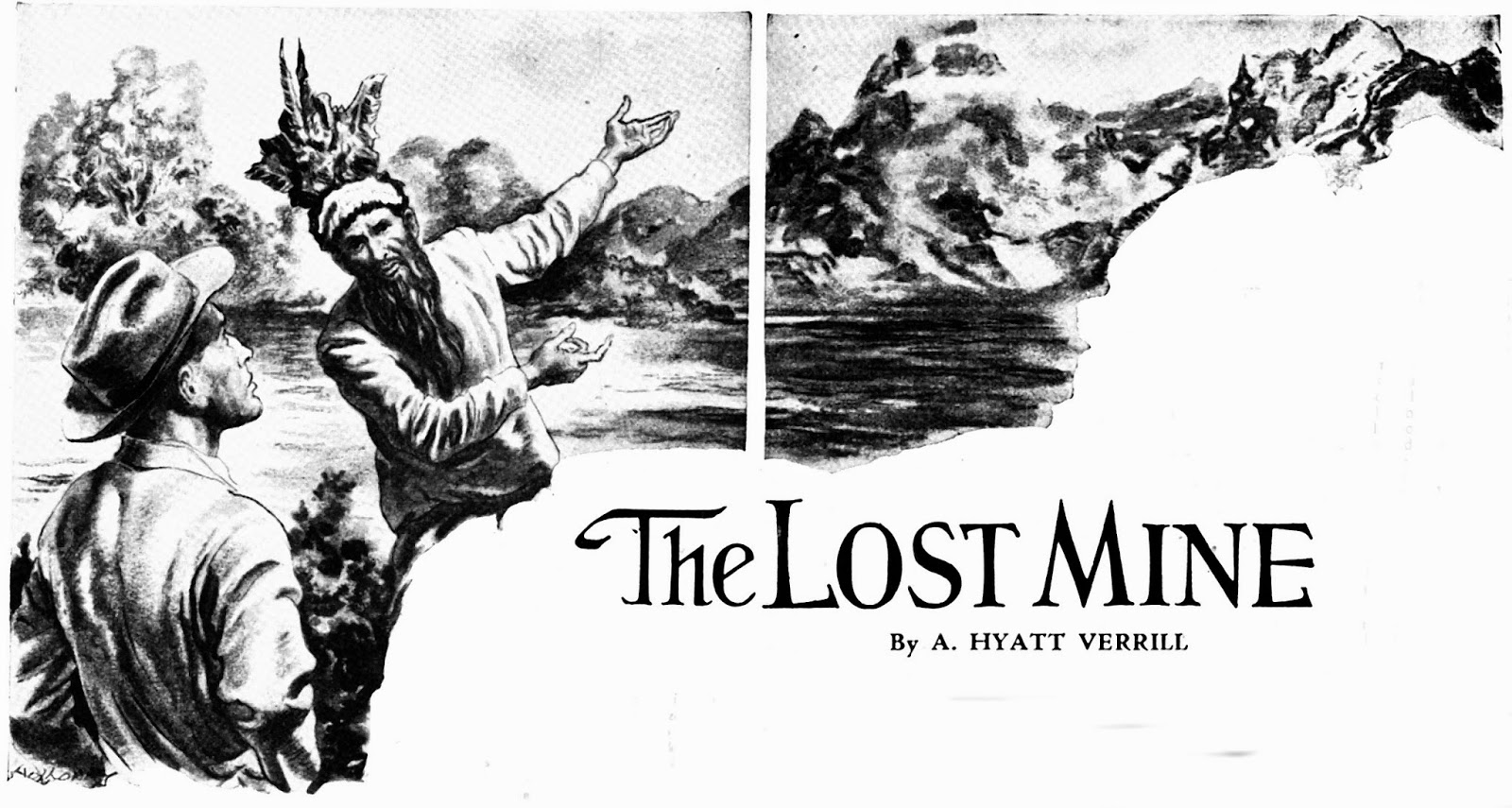
 
Somewhere in the little-known interior of Panama, lost to the sight of civilized men for centuries, lies Tisingal, reputed to be one of the richest gold-mines ever worked by the Spaniards when they ruled the New World. Many expeditions have set out to seek the vanished bonanza, but all have ended in failure and disaster. When the Author went into the jungle to study the wild Indians everybody assumed he was in search of Tisingal, and before long he found himself involved in some very strange experiences. We originally published this story in 1929. The first instalment described the start of Mr. Verrill’s upriver journey and his meeting with various people who told him of the existence of a mysterious native “king,” whom, with the aid of an Indian guide called Chico, he determined to seek.

II (Conclusion)
THE following morning we left the General’s home in a torrential shower, and, until he was hidden from sight by a bend in the stream, could see the old Spaniard standing motionless in the drenching rain wistfully watching us. I had been the first white man to visit him for ten years or more; our short stay had evidently been an epoch in his solitary, hermit-like existence.
At the end of a week it seemed to me we must have traversed the entire length of Central America, but Chico, Indian-like, would not commit himself. It was always “Un poco mas lejo” (“A little farther”) to all questions as to the distance to the Comisario’s home. And then, quite suddenly and without a word of warning from our guide, we were there!
No one but an Indian would have dreamed any human beings were within a hundred miles. No boat was drawn up on the bank, no opening showed in the fringe of dense jungle, no tell-tale smoke rose above the trees, and no sounds of voices issued from the forest. A scarcely-distinguishable trail led from the verge of the stone-strewn playa into the bush, and with Chico in the lead we trudged along it.
Half a mile inland we came upon a small clearing, and were vociferously welcomed by yelping curs which rushed towards us from three thatched huts. As we reached the largest of these the Comisario himself appeared. A dignified-looking, keen-faced Indian, he was—much to my surprise and momentary disappointment—clad in a white home-spun cotton coat and trousers.
His appearance, in fact, was far more that of a well-to-do native planter than a wild Indian, but I soon found that his more or less conventional costume was a mere veneer; he and his family were at heart as primitive and unspoiled by civilization as I could wish. All of them, men and women alike, wore clothing, but the garments of the women were a blaze of gay colours. Their necklaces and other ornaments were of teeth, bones and shells; and there was not a single “civilized” article or utensil in the houses.
Finely-woven hammocks swung between the palm-wood timbers; baskets, calabashes, and peculiar pottery vessels were scattered about; beautifully-finished bows and long arrows rested on the rafters overhead; and two young Indians were occupied in painting each other’s faces. Upon a fire of glowing coals a great earthern olla was boiling, sending forth appetizing odours, and one of the women was busily crushing cacao beans on a wooden slab by rolling a heavy oval stone backwards and forwards.
No one exhibited the least surprise at our arrival, and Chico informed me that the sphinx-faced Comisario had been aware of our approach for the past four days. How he had received the news our guide did not reveal, but I have no doubt that couriers telling of my plans had been sent overland from the Indian hut where we first stopped. Toluka, as the old fellow was called, seemed quite friendly, but did not appear at all enthusiastic over my proposed visit to his king.
Under the influence of presents to himself and family, however, he presently unbent, and not only gave his official permission for Chico to guide us to the king’s palace, but even volunteered to send one of his own youths with us, so that we should be under Government protection, so to speak. And once Toluka had discovered the contents of my trade-box, his bartering instincts were aroused and he brought forth innumerable articles of great ethnological interest.
During the remainder of the day we rested, and I made good use of my time by acquiring a lengthy list of Shayshan words, with the result that I became convinced these Indians were actually of Mayan ancestry, or at least of a race which had come under Mayan influence in the past.
We made an early start accompanied by a bright-eyed youth, who gabbled incessantly with Chico and performed most amazing acrobatic stunts in balancing himself on the gunwale of his cranky cayuca as he poled the craft along. He was a cheerful, willing fellow, a great help in portaging, and seemed to take everything as a huge joke. And we certainly needed someone of an optimistic disposition!
All that had gone before was as nothing compared with the following three days. It was all up-grade, and the river, although very low, tore along its rocky bed like a mill-race. Often the united strength of the whole party was required to drag our canoe against the current, and I tried to picture what the passage would be like in the rainy season, with the stream in full flood. Then it would fill the bed from bank to bank, a distance of nearly half a mile; and the water-worn bluffs and rounded boulders on either side showed that the torrent must rise fully fifteen feet above its present level.
Here and there great trees were stranded high and dry upon the playa, and at one place we passed an uprooted tree over sixty feet in length and five feet through at the base, which had been carried down by the raging waters and left firmly wedged between two enormous boulders ten feet above my head. Bad as the going was now, I thanked my lucky stars that I had not attempted to reach the Shayshans’ territory during the rainy season.
If current tradition and history were true, and Tisingal actually lay somewhere in this wild, untamed land, then super-human indeed must have been the labours of the old Dons. It seemed utterly impossible that human beings could have transported supplies and equipment, machinery and tools—even a bell and cannon—over this route to the lost mine, or that they could have built a road through such an impenetrable wilderness.
But they worked with slave labour, loss of life meant little or nothing to them, and suffering and hardship were forgotten in their lust for gold. As we toiled onward I wondered how many exhausted and tortured men had died along the route, and how many millions in precious metal had been carried down this selfsame river to enrich the coffers of the King of Spain or to fall into the hands of the dare-devil buccaneers who lay in wait for the gold-laden galleons.

A NIGHTMARE JOURNEY
Meanwhile the country grew steadily wilder and rougher. The river-bed became a canyon, and huge masses of grey, pink, and green porphyry took the place of boulders. On every side rose lofty mountains, covered with dense forests. Often we worked for hours, lifting and carrying our canoes over impassable cataracts or through foaming rapids.
To traverse the dry river-bed was like scaling the walls of some ruined castle. Scrambling and climbing, with bruised and barked shins and hands, we surmounted the barriers of glass-smooth rocks, leaped—with fear gripping our hearts—across the yawning chasms between them,         or crawled, crept, and wormed our way through cavern-like interstices. To portage our stores necessitated Herculean efforts.
No living man could force his way for a hundred yards with a load on his back or shoulders; every bundle and package had to be carried piecemeal from one rock-barrier to the next. Finally it became obvious that our craft could go no farther. The river-bed in front was barred by a great dyke of jagged, razor-pointed, black lava. Through a narrow break in this the water poured in a roaring, plunging torrent, and on both sides the mountains rose in sheer thousand-foot precipices to the low-hung clouds.
Apparently all our labours had been for nothing. We had come to the end of our tether. Further progress was impossible!
But Chico and his fellow-tribesmen merely grinned, as, calmly and deliberately, they hauled their canoes out of the water, began packing the contents of the boats into portable packages, and gave obvious evidence of intending to continue onward. Evidently they knew of some way out of the impasse, and, encouraged by their attitude, Cordova and Pepe likewise fell to work. But Chico promptly interfered. Only the lighter and most essential articles could be taken, he declared; the rest must be left in the canoes. In reply to my questions he pointed toward the frowning, multi-coloured wall of stone that rose on our right.
“Road too narrow,” he announced. And then, as though stating a most ordinary and familiar fact, he added: “Not any farther. The king’s house here.”
Was it possible? Had we actually reached our goal?
I was not to be kept long in doubt. Shouldering their loads, the two Indians picked their way across the stony river-bed toward the precipitous cliff. At the very base of the overhanging wall a narrow, scarcely-visible trail had been cleared, cut, and cleaned from among the debris fallen from above. It wound about enormous masses of rock, passed through a tunnel-like aperture under piled-up fragments of precipice, zigzagged this way and that, and finally came to an end. Pointing dramatically ahead, Chico exclaimed : “Look, sir! The house of the king!”
Before us the bare, rocky playa came to an end. The river flowed in a broad, swift expanse stretching from bank to bank, burbling musically over miniature rapids. Above our heads rose the cloud-hung precipice. On the farther shore the land sloped gently upward to a high hill crowned with jungle, and then, rising tier after tier, to the distant mountains.
Up from the pebbly beach stretched a broad sweep of smooth greensward dotted with clumps of lime, palm, and orange trees, and upon the summit of the grassy hill stood a large hut, its thatched roof of palm-leaves gleaming like gold in the afternoon sunshine.
This, Chico explained, was the “palace” of the Shayshan king, and, gazing at it, all the hardships we had suffered were forgotten, for we had accomplished the seemingly impossible and arrived safely at the home of the mysterious cacique of the Shayshans.
Our arrival had obviously been expected, for a group of Indians had gathered at the water’s edge below the palace, and already a long, narrow canoe was being poled toward us, its bronze-skinned occupant balancing himself upon the after-end, and handling his frail craft with incredible dexterity.
He was a stocky, sturdy youth and, as I learned later, no less a personage than the Crown Prince. Truly we were being received with high honours! He was thoroughly democratic, however, and having greeted me in his own tongue—not a word of which was intelligible to me—he commenced chatting volubly with my two Indian boys.
We were to cross the stream in his canoe, it appeared, though it seemed impossible that our party and our dunnage could be ferried across the swirling river in such a tricky craft. But it would not do to show my doubts in the presence of royalty, and so, as it was a case of trusting to the canoe or swimming, I followed my men and belongings into the dug-out.
I hardly dared to breathe, for the water was within two inches of the gunwales, and a dozen times I felt certain the canoe was on the point of capsizing. But the Indians, and especially the Prince, were as unconcerned as though on dry land. Standing erect, he poled his craft against the swift current and performed feats of balancing that would have shamed an expert performer on the slack wire. And, almost before I realized it, the canoe grated on the opposite bank and we stepped safely ashore just below the home of the Shayshan king.
Like all Shayshan “houses,” the palace was open on three sides, built upon posts several feet above the earth, and floored with strips of black palm-wood. Its steeply-pitched roof was of thatched palm-leaves, with low eaves.
A hearth of baked clay held an ever-smouldering fire, and the furnishings consisted of several carved wooden stools, a number of bark-cloth mats, several large earthenware pots, baskets of various sizes, a platform-like affair of split palm-strips on which stood calabashes and baskets of provisions, and three or four hammocks. Squatted near the hearth were several women and girls, while baby princes and princesses, completely naked, played and rolled about like brown kittens.

THE SHAYSHAN KING
The king himself reclined in a hammock. He displayed no signs of either curiosity or surprise at my appearance, but, through the medium of Chico as interpreter, received me most hospitably. He had carved wooden stools placed for myself and my men, and put the palace and all it contained at my disposal with almost Castilian politeness. Then the welcoming calabash of thick, unsweetened chocolate was passed round, and, having solemnly drunk this with due ceremony, I explained the reason for my visit.
Almost instantly I discovered that King Polu understood Spanish perfectly, and after this our conversation proceeded in that language. I soon found that the King of the Shayshans was a most remarkable man for a Central American Indian. Unlike his fellows, he was as stoical and reserved as any Sioux or Apache, and he possessed all the eloquence, the love of the dramatic, and the power of simple, poetical expression of a North American Indian.
When I asked him how long his family had ruled the Shayshans he rose and led me to the open side of his house facing the river. Stretching out his arm, the king pointed to the towering mountainside high above the rushing stream.
“Once,” he said, raising his hand towards the water-worn crags hundreds of feet in air, “the river flowed on top of the mountain. But even then my fathers were kings of the Shayshans.”
Despite all that had been told me, he proved to be a most amiable and friendly fellow. He assured me that to find all the members of his tribe would be a long, weary, and probably hopeless task, for they were scattered throughout the mountains, miles apart. But, to save me trouble and help me, he would send a messenger to the outlying tribesmen with orders for all of them to gather at his house, bringing in such of their possessions as they were willing to trade.
My theory that the Shayshans were of Maya stock and perhaps the oldest of existing Central American tribes was rapidly confirmed. Not only was the language distinctly Mayan, but the feather head-dresses were precisely like those depicted on Mayan sculptures and figuring in the engravings and paintings made in the days of the Spanish Conquest, and unlike those of any other known tribe.
Even more remarkable was the fact that the Shayshans’ bows were designed to be bent round side outwards, thus differing from the bows of other races. Apart from their bows, the Shayshans used blow-guns, ten or twelve feet in length, and here again the tribe differed from all their neighbours, for instead-of darts the Shayshans used spherical clay pellets, which, at a distance of thirty or forty yards, were as effective as a small-calibre rifle for bringing down large birds.
Except for maize and a few plantain, banana, and cacao trees, these Indians raised nothing in the way of foodstuffs. An almond-like nut, the boiled fruit and young flower-buds of the palm, and a wild tuber resembling a potato were their mainstays. Corn was eaten whole, and the cacao beans, instead of being fermented and made into chocolate, were roasted and ground to a powder, from which a beverage resembling thick black coffee was made. The Indians drank this in inordinate quantities, taking it, boiling hot almost incessantly from morning to night.
The Shayshans appeared so shy, so friendly, and so docile that I could not imagine them in the role of hostile savages. When I mentioned this matter, Polu and the others declared that the tribe had always been peaceful, and that while they distrusted and disliked the Spaniards, by whom their ancestors had been enslaved, they had merely sought protection from these traditional enemies by moving farther and farther into the wilderness.
By this time I had come to the conclusion that Polu was a wily fellow, and that his sphinx-like face concealed a great deal more guile than one might suppose. When I asked about the other tribes who were reputed to inhabit the even more inaccessible mountains, Polu seemed reluctant to answer, professing the greatest dread of them, although claiming to be at peace with all his neighbours.
Learning that I proposed visiting the Doraks, as the Shayshans called them, the king and his friends showed the greatest concern. They declared it would mean my certain death, explaining that though a Shayshan might enter and pass through the Dorak country, provided he did not linger, no white man would be permitted to set foot beyond the recognized boundary of Shayshan territory.
When pressed for reasons for this attitude, the king and his retinue evaded the question. I felt certain they were trying to keep something from me, and as I puzzled over this I remembered Señor Toro’s words, the tales of the old General and others, and the universal belief that the Shayshans held the secret of the lost Tisingal mine. I also recalled Polu’s evident anxiety that I should not attempt to visit his subjects, and his suggestion that I should remain with him while a courier summoned the tribe.

I AM PUZZLED
Was there, after all, some truth in the rumours? Could it be that the wily chieftain was trying to prevent any possibility of my stumbling upon the jealously-guarded secret of the lost mine? Was I “getting warm,” as they say in the game of “Hunt the Thimble”? It was a fascinating conjecture, and it seemed by no means impossible nor even improbable, I reflected, that the fabulously-rich Tisingal might be located not very far from King Polu’s palace.
But I was not there to investigate mines, old or new, and I had no intention of searching for Tisingal, especially if to do so might result in arousing the resentment or even the suspicions of the Indians, and thereby thwart my purpose in visiting them. Nevertheless, the romantic aspect of the matter appealed to me; my exploring instinct was aroused and—well, I doubt if there is anyone who would not be somewhat thrilled at the thought of being almost within stone’s throw of a long-lost and incredibly rich mine which countless men have sought in vain and whose history is one of tragedy, mystery, and romance.
The most adroit and roundabout questioning, however, failed to elicit any definite information from Polu and his fellows, even though I felt sure I had convinced them that I was not searching for gold. It might be, they agreed, that the Doraks knew of the old mine.
They themselves had heard from their fathers, who had heard it from their fathers, that long ago the Spaniards had a mine somewhere in the mountains, where they forced the Shayshans to labour as slaves. But, they added, they themselves knew nothing. They had no knowledge of gold. It was valueless to them, and if they knew where the mine was they would gladly tell me, for was I not their friend? Had I not given them presents, lived with them like a brother, and dwelt in the king’s house?
Eventually, deciding my imagination had over-ridden my common sense, and that, in all probability, the Shayshans knew nothing definite about Tisingal, I busied myself with my scientific work and forgot the lost mine.
Then, as so often happens, Fate intervened and opened the sealed lips of the Shayshan King. His daughter, a chubby brown princess of eight, was seized with a most agonizing but far from dangerous fit of colic, the result of eating too many oily proa-palm nuts. Her shrieks and screams in the middle of the night aroused everyone, and the Indians, firmly believing some evil spirit had taken possession of her, added their wails, lamentations, and incantations to the uproar.
At first Polu and his copper-coloured queen would have none of the white man’s medicine. But when the most powerful of Shayshan potions, the beating of drums, the application of “magic” wood and fungus, and even the slaughter of a cock failed to exorcise the “devil,” the Shayshans, as a last resort, turned to me.
The little princess’s trouble quickly responded to proper treatment, her screams of agony changed to sobs, the sobs to whimpers, and soon she was sleeping quietly and soundly on her mat of pounded bark beside the queen. I very much doubt, however, if Polu slept again that night. When I tumbled into my hammock he was sitting motionless, staring into the black, starlit night, and when I awoke at dawn he was in precisely the same position, immobile as a bronze statue, his mind evidently concentrated on some deep and important matter.
Not until the inevitable chocolate was passed to him did he come back to earth. Then, having swallowed the steaming mess, he rose, took down a long and powerful black-palm bow and sheaf of wicked-looking six-foot arrows and very carefully examined each one in turn. Evidently, I thought, the king was preparing to go out on a hunt. Then, to my unbounded surprise, he requested me to accompany him.
For a time he walked on in silence. Not until we had passed beyond sight and hearing of the house and were well within the jungle did he speak. Then, halting, he turned, beckoned me to his side, and grinned. His Spanish was somewhat crude and limited, and my recently acquired knowledge of Shayshan was even more exiguous. But we had always got along famously, and there was no possibility of misunderstanding him.
Rubbing his stomach, he twisted his face into an agonized expression. “Child sick; very sick,” he said. Then he closed his eyes and sighed contentedly. “I am grateful; you were good to my daughter,” he added. “I am glad the child is well again,” I replied, using his own dialect.
Polu narrowed his eyes; the half-quizzical expression I had often noted—an expression suggestive of crafty shrewdness came over his face. For fully a minute he studied me. Then he turned abruptly and pointed towards the sombre green mountains, their sides still streaked with shreds of the night mist, their shadows purple and mysterious.
“Come!” he ejaculated, suddenly, “Tisingal!”
I could scarcely believe my ears, hardly convince myself I heard aright. I was absolutely dumbfounded. Polu did know the secret of the lost mine! He was about to reveal it to me, was taking me to it as proof of his gratitude for curing the little princess!
For seemingly endless hours we climbed the mountain through a misty, penetrating drizzle. Mile after mile I followed Polu into the shadows of the vast, impenetrable forest, until I lost all sense of direction. I was drenched to the skin and heartily sick of the whole business when the king suddenly halted and beckoned me to him. Carefully parting the drooping ferns and interlaced creepers, he pointed to a pile of rotting, moss-grown masonry rent by the snakelike, twisted roots of great trees, and almost hidden in the accumulation of decaying vegetation.
Here, buried in this untrodden jungle, was the age-old work of civilized man, and unquestionably, as proved by the mortar, of Europeans. Polu walked a few paces farther, and, stepping aside, showed me a stretch of roughly-paved roadway, beside which were the almost vanished hard-wood logs of what once, centuries before, might have formed a stockade or a massive gate. Was it possible that I was actually gazing at the remains of the approaches to Tisingal?

THE GUNS OF TISINGAL!
Then, while my mind was still a chaos of sensations, Polu, with furtive glances about him, as though desecrating a tomb, bent low, and pressing through a thicket, halted among the trees. Before him lay two large cylindrical objects half buried in the earth. At first glance I took them for moss-covered logs, and then, with fast-beating pulse, I realized my mistake. There was no doubt about it—they were cannon! Cannon of bronze; ancient guns of small bore, ornately ringed, bell-mouthed, and thick with the verdigris of countless years of drenching tropical rains and ever-dripping moisture.
Carefully scraping away the growth of moss and tiny ferns, I could distinguish raised figures and letters upon the metal. Corrosion had almost obliterated them, but here and there a letter was decipherable, and on one the date—“1515”—was quite plain.
I had thought that ancient mines, real or imaginary, held only a passing interest for me, and yet, as I knelt there beside those centuries-old guns, in the heart of that unknown forest, I felt a wave of exultation such as I have seldom known.
Beyond the shadow of a doubt I was looking upon objects that many a man would have given half his life and thousands of dollars to behold—the ancient Spanish cannon that once guarded the way to the richest mine in the New World: the long-lost, long-sought, almost fabulous Tisingal! And, strangest of all, that which no other civilized man had been permitted to see had been revealed to me through a child’s attack of colic!
Unquestionably, I was the first European to view those relics of the past and live to tell of it during all the centuries that had passed since Tisingal had been lost to the world. Somewhere nearby, hidden in the rank growth, was wealth beyond one’s wildest dreams, but if I had dared to enter that ominous jungle alone a Silent arrow might have sped from some lurking, watching savage, and my bones might have been added to those of other seekers for the elusive Tisingal.
As I stood there in that shadowy forest and looked upon those ancient bronze weapons, the whole tragic story of the mine came vividly to my mind. I could revisualize the Dons—mail-clad, ruthless, cruel, caring nothing for life or bloodshed where gold was to be won—murdering the simple Indians who resisted the invaders, enslaving those who were peaceful.
I could imagine them hewing their way through the jungles as they penetrated farther and farther into the mountains. I could see them in their cumbersome craft conquering the rapids, falling by the wayside, suffering martyrdom in their lust for gold, until at last they reached the Shayshan country and, by inhuman tortures, wrung the secret of Tisingal from some captive Indian.
And, having come that way myself, I could appreciate the Herculean labours of the Spaniards and their slaves as they transported their goods and equipment up the river, made roads through the jungle, built forts and bridges, and erected their dwellings, their barracks, and even their church, deep within these forests. And I could picture the savage exultation of the long-oppressed and enslaved Indians when, at last, they squared accounts and, massacring the Spaniards to the last man, destroyed every vestige of the Dons’ work.
No wonder, I thought, that the Doraks maintained an endless vigil and prevented all intruders from rediscovering Tisingal! Gold and the white man’s greed for wealth have always been the curse of the Indians, and I was thankful that the secret was so well and so effectively guarded. My only regret was that I had no camera. I had not brought it with me when I left Polu’s home, for I thought I was merely accompanying the king on a hunting-trip.
And now Polu was becoming nervous. He was impatiently urging me to go, meanwhile peering furtively about him, searching the surrounding jungle as if in fear of stealthy, hostile savages. Perhaps it was pure imagination, or perhaps the king’s fears were contagious. At any rate, I felt that we were being watched, that unseen eyes were upon us, and that I stood very close indeed to death. So, with a last glance at the mute guardians of the old mine, I turned, and, in Polu’s footsteps, threaded my way along the indistinguishable trail that led back to the domains of my silent companion.
At last we emerged from the jungle with the king’s house in view, and instantly I halted in amazement. Gathered in a little knot before the thatched hut were half-a-dozen wild-looking naked Indians!
Who were they? Had the hostile Doraks swept down on the Shayshans to demand satisfaction for the king’s action in betraying the secret of Tisingal to a white stranger? Before I could ask a question, or utter a word, however, they caught sight of us, and, in the twinkling of an eye, had vanished!
Oddly enough, Polu did not seem at all surprised or disturbed. He could not or would not understand my queries, and merely grinned amiably as we hurried across the few rods of open grassland to his palace.
Then I understood. Seated in the house were the Shayshans the king’s courier had summoned. They were wild-faced, shockheaded, shy-looking tribesmen, but each and all were garbed in ragged shirts and much-patched trousers. At sight of the white man they had hurriedly transformed themselves from untamed savages to semi-civilized Indians—at least outwardly!

Not until much later did I learn the real facts, however. When I was leaving for the long and laborious trip downstream Polu, with a twinkle in his keen eyes, revealed the great secret. The Shayshans and the Doraks were one and the same people! A Jekyll and Hyde tribe—peaceful, quiet, friendly, and with an external veneer of civilization, or wild, savage, and hostile, as the conditions called for—the Shayshans were the sole guardians of the long-lost mine!

Sunday, 6 April 2014

Through Panama by Motor Car

CHAPTER X
THROUGH THE INTERIOR BY MOTOR CAR
From Panama of Today by A. Hyatt Verrill.
1928. Digitized by Doug Frizzle, April 2014.

By motor into Coclé. Villages and towns. The German colony. Roads and bridges. Hills and llanos. The cattle country. Progressive towns. Schools. The volcano. Natá the oldest city in America. The old church. A fortress and church combined. A marvelous contrast. The city of salt. Onward into Veraguas. Side trips. Silicified forests. Bird life. The capital of Veraguas.

Having visited the ruins of that once "Goode and Staytlye City,'' and having seen all there is to be seen around and about Panama, the visitor will do well to take a trip into the interior.
A few years ago this was a difficult thing to do and even a short journey into the country was filled with discomforts and hardships. But today, one may travel for over two hundred miles into the interior by motor car over roads that, with a few exceptions, are by no means bad, and many miles of which would be a credit to our own country.
But the visitor planning this trip should be provided with camping outfit, food and all other necessities and luxuries, if the journey is to be taken in comfort. There are, it is true, little fondas or so-called hotels in every town of any size in the interior. But these are, with few exceptions, impossible for those travelers who are not inured to roughing it. They are dirty, often vermin infested, lacking in nearly every necessity and convenience, and the sleeping accommodations consist of hard native cots. As a rule, too, anywhere from two to ten persons are crowded into one room and there is no privacy. The meals are of the coarsest native food, badly cooked and worse served, and the charges, considering the accommodations, are ridiculous. It is a far better plan to camp out and cook one's own meals. But in selecting a camp site be sure and do not make the mistake that so many Americans make, of camping on low ground near a stream, on lands where there are cattle or in the jungle. If you do you will be eaten alive by mosquitos, devoured by ticks or made miserable by other insect pests. And be sure not to drink river water unless thoroughly boiled. At nearly every village and town there are driven wells from which pure water may be obtained, and the larger towns are provided with a water supply which is safe, although in the height of the dry season it cannot be relied upon. The best places to camp are the sides of the road, and if near a village so much the better, for some fruits, vegetables and other food may usually be purchased, and eggs, pigeons, chickens and turkeys are always obtainable. If fond of hunting by all means carry a shot gun, for quail and wild pigeon are abundant and will greatly help out the menu. But fight shy of the native beef and pork. Cattle are seldom killed in the interior until they are far too old for breeding purposes, or for shipment to Panama City, and the beasts are slaughtered and the meat sold and eaten the same day.
If the trip is taken during the height of the dry season,—from December until April, practically no shelter will be required. There will be no danger of rain; but as a strong wind blows constantly a protection from this and the accompanying dust is necessary. And be sure to provide blankets and mosquito nets. The nights are cold in the interior and while, during the dry season, mosquitos are not numerous, it is well to provide against any chance of contracting malaria by being bitten by the pests. In the tropics an ounce of prevention is worth many pounds of cure. For this reason no traveler should venture into the interior of Panama without a supply of quinine and other simple medicines and a first aid kit. As there are gasoline filling stations where fuel and oil may be had, at every town, the traveler need not worry on that score. Leaving Panama or Ancon, the route is to Pedro Miguel where a ferry carries the automobiles and passengers across the Canal. Then, over a road that is a disgrace to our government, the way leads through Empire and Camp Gaillard, where the Porto Rican Regiment is stationed, and hence over a roughly-cobbled road through charming hilly country to Panamanian territory. The first portion of the new Panama highroad is far from perfect and, in many places is so narrow, so tortuous and has such sharp, blind curves that it is positively dangerous. The first good sized settlement is Chorrera, an old Spanish town sprawling over the rolling country with its glaring red earth. But it is of little interest, as is Capira, the next village of any size. From here on, the road is wider, straighter and, in some places, is fairly good. Here the highway climbs a number of small mountains or high hills, covered with jungle and affording wonderful vistas of the Pacific and the islands in the offing. Here, too, one passes a little village of the typical wattled, mud-walled, thatch-roofed native huts, but which appear quite different from the others we have seen. They are neat and tidy; about them are flower gardens, and, most incongruously, the windows are furnished with muslin curtains and flower boxes. And the inhabitants seem just as incongruous. They are white skinned, blue eyed and tow headed, for they are Germans, brought out by the Panama government with the mistaken idea that they could make the wilderness blossom like the proverbial rose, and would,—by some miraculous means,—induce progress and prosperity in the district. Unfortunately, the poor colonists, who were entirely ignorant of the tropics and tropical agriculture, have proved a dismal failure. The few crops they have raised, in a spot wholly un-suited to gardening, have been either destroyed by the natives or have proved unsalable, while such products as were harvested and were salable could not be sold except at a loss owing to the high cost of transportation.
As a result, the Germans became poverty stricken and were actually suffering from want until their plight was brought to the attention of charitable persons on the Zone and in Panama City. Thus partially provided for, and by earning a few dollars serving coffee and light refreshments to passing travelers, the colonists who have remained have managed to eke out an existence; but by far the greater number have migrated to more promising fields and are working as laborers. Had the Panama government selected peasants from southern Europe instead of Germans, they might have succeeded, though it is hard to see how any one could succeed as an agriculturist in the district and under present economic conditions.
Beyond here the road swings westward towards the coast to Chame, and hence to Bejuco, both small but rather neat little settlements where orange trees laden with fruit are on every side, and where the traveler may fill his car with the sweetest of juicy oranges at a cost of a few cents.
Beyond Chame a branch road runs to San Carlos while the main thoroughfare continues on to Antón. This district is the beginning of the plains or llanos that sweep inland to the distant mountains. Here, too, the road is excellent, and bridge after bridge is crossed. The land, however, though well watered by the numerous streams, is sterile and thin and is incapable of supporting anything more than a sparse growth of wiry grass and thorny shrubs. It is almost wholly volcanic ash and tufa, and often, near the road, one sees areas of the glaring white ash cut by the rains into weird formations like innumerable spires.
Antón, the largest shipping town in the district, is a fairly good sized village but with few attractions, and from here the smooth surfaced road runs across the almost level llanos to Penonomé. Penonomé the capital of Coclé province, is the most up-to-date, most progressive and the cleanest and best kept town in the interior of the republic.
It was the first to have a municipal water supply and the first to have an electric light system. Its schools are so numerous that they seem out of all proportion to the size of the town, and everyone appears well-to-do, contented and happy. In fact the better class of inhabitants are apparently of a far superior race to those of other interior villages, and their pride in their town is most admirable.
The streets are smoothly paved and well kept, every house is repainted each year, there are numerous well stocked stores, two or three gasolene filling stations and a good market. But the most attractive feature of Penonomé, the ancient church on the plaza, has been completely ruined by rebuilding and modernizing. Penonomé is the outlet for a large area of country, and quantities of rubber, coffee and other mountain products are brought into the settlement by the Indians who dwell about La Pintada and in the mountainous country of the interior of the province. But the Coclé tribe is thoroughly civilized and the Indians have even forgotten their own tongue. However, they still keep up some of their ancient tribal customs, and they weave excellent hammocks, baskets and bags which may be purchased at very reasonable prices in the Penonomé shops.
Immediately after leaving Penonomé a rugged isolated mountain is seen, rising abruptly from the plain to the north, or right hand side, of the road. This is the Guacamayo volcano which is still slightly active. On its southern side, plainly visible as we pass within a few miles of the volcano, is the great red broken down crater. Here are immense deposits of sulphur with hot springs and a few fumeroles. From the summit of Guacamayo a magnificent panorama of country and sea is spread at one's feet; but the climb to the summit is a terrific undertaking and is not to be recommended.
From Penonomé the road continues on across flat llanos and over numerous big iron bridges, and passes through the little villages of Coclé, Rio Grande and Rio Caño to Natá. This town is mainly of interest as being the oldest occupied town on the American continent, having been founded by the Spaniards in 1520. The church, however, is the only remaining building of the original town, the present houses being mainly miserable native shacks, while the town itself is filthy, badly kept and wholly unattractive. Here, as in so many instances, the priests, with more zeal than common sense, have attempted to rejuvenate the splendid old church. But here, fortunately, they only got as far as one tower and left the rest of the building in its original condition. Built of brick and rubble, the old church covers an immense area and was originally surrounded by a stout loop-holed wall which also enclosed the fort. Much of the wall has been destroyed and the fort has vanished, but the church itself is in a fair state of preservation. It contains some priceless Old Masters and some remarkable silver but, like everything else in the place, it seems run down at the heels and woefully in need of cleaning and care.
Near Natá a road branches off to the north across the llanos. This road, which is passable for automobiles during the dry season, leads to within a short distance of the Limon waterfall, one of Panama's greatest natural wonders. Here the Rio Caño, flowing across a high plateau, plunges over the verge of a precipice, and, in a series of gigantic cataracts, falls for over one thousand feet to the level of the plains. During the dry season the volume of water is not great, but during the rainy season and the first part of the dry season, the falls are visible for twenty miles and their roar is audible for nearly five miles.
Beyond Natá the plains are more fertile and in places are covered with large trees while here and there are fields of sugar cane. Here, too, one first sees the giant nests of termites, hard conical or culumnar objects dotting the plains, and looking from a distance like the kahki-colored tents of an encampment.
Soon the sugar cane patches grow more numerous, we pass the centrál of Don Rudolpho Chiari, president of Panama, and presently reach Agua Dulce.
This town, which is an important port, is the center of the salt industry. Indeed, its entire existence depends upon the salt which is crystallized in immense "pans" on the low mud flats about the town and is shipped far and wide. The visitor is often at a loss to understand how a town several miles inland can be a port, but like many other Latin American cities, the town was built at a distance from the sea to decrease the danger of piratical raids in the old days, while the port itself, or the "playa" as it is called, is at the water side. The town and port of Agua Dulce are connected by a splendid road, but as the port consists merely of a dock and a shed there is nothing of interest to be seen. Agua Dulce is by no means comparable to Penonomé or even to Antón, for cleanliness, neatness or attractions.
It is dirty and badly kept, it has few good buildings, the church has been thoroughly modernized, and the inhabitants have a greater admixture of negro blood than in the other towns. There are, however, a number of fairly good shops and several garages and filling stations in the town. Also, from Agua Dulce several side trips may be taken to Pocrí, Chitré, etc.
But the main road runs on to Santiago, the ancient picturesque capital of Veraguas province.1 Beyond Agua Dulce the same flat llanos extend, almost deserted except for herds of rather scrawny, undersized cattle and an occasional native hut. Altogether it is such a scene as one might expect in South Africa. There are the same conical ants' nests, often ten to fifteen feet high, the kopjes, the distant hazy mountains, the thorny mimosa scrub, and one half expects to see a Kaffir kraal or a herd of ostriches or giraffes. But the nearest approach to giraffes are the woefully thin cattle and horses, while there is nothing more resembling an ostrich than the repulsive vultures and carrion hawks.
Now and then another car is met, usually a delapidated Ford; at times a bus or "chiva" tears by, bound for Panama and intermediate stops, and often we pass the big, lumbering, native bull carts creaking ponderously as they are drawn at a snail's pace by two or four great, long-horned bulls lashed by the horns to the cart's pole on which perches the swarthy, brigandish-looking driver.

1 The name Veraguas is of Indian origin and not Spanish as is generally thought. The ending "agua" is merely a coincidence and has nothing to do with the Spanish word "agua" meaning water. The same ending is found in many other Indian words and names such as Managua, Nicaragua, Comagua, etc.
Bird life, too, is abundant. Little flocks of ground doves flutter from the roadway. Graceful quaker-gray swallow-tailed flycatchers dart back and forth as they capture tiny insects. Bold-eyed hawks look disdainfully down from the telegraph poles, and sweet-voiced meadow larks sing from fence posts and shrubbery.
At Estrella, a tiny village about ten miles from Agua Dulce, the road forks, the right hand branch proceeding to San Francisco. But it is almost impassable, even for a Ford, and the main highway stretches straight ahead.
Scenically, however, the old road through the hills is more attractive, and the visitor who is fond of nature and horseback riding, might do worse than take this trip. It leads past the Santa Rosa sugar estate and hence through rugged and picturesque country among the foothills of the cordilleras,—crossing tumbling rivers where one must swim one's horse; meandering through dense thorny jungles; following the verges of deep ravines; passing through narrow defiles with scarcely space for a horse to pass. Here and there are bare areas of brilliant red, purple, yellow and green earth dotted with lumps and boulders of agate, while often one rides for long distances through areas covered with silicified trees. Some of these stumps are standing as if freshly cut; others lie about in short smooth-ended sections as if sawed for cordwood, and still more are scattered about like newly broken sticks and branches. Indeed, one cannot believe that they are flinty hard agate until closely examined and tested.

On the main road also, there are spots where these fossil trees may be seen, but these and the agates are far less numerous than farther back near the mountains. Beyond Estrella the first village worthy of the name is Davisa, about halfway between Agua Dulce and Santiago. Beyond here the plains grow more restricted, there are more hills, and presently one is constantly ascending and descending sharp grades. Then at last the road comes forth from the broken country and ahead sweep broad plains stretching to the far off mountains, and with the little town nestling, white and red, upon the level land.

Wednesday, 26 March 2014

Mystery of the White Indians


The Mystery of the White Indians
A Second Article, Giving the Scientific Explanations That Have Been Suggested to Account for This Tribe of Blond Savages in Eastern Panama [First Article]
By Richard O. Marsh
From The World's Work, April 1925, Vol. XLIX, No. 6. Digitized March 2014 by Doug Frizzle

Golden Yellow Hair and Hazel Eyes
“A canoe came toward us, and in the bow stood a naked savage with a white body, whose yellow hair, falling to his shoulders, was held in order by a gold chaplet two inches wide encircling his head at the brow. He was of medium height, but magnificently developed about the chest and arms; and he stood as erect as a king. Behind him were a girl of ten and a boy of four, and in the stern his wife wielded a steering paddle. Not one of the four gave a start when they came suddenly upon us, and the man and woman did not vary a heart-beat in the rhythm of their strokes as they plied the canoe to pass directly by us. The man eyed us with a truly regal pride and disdain, and passed us by without troubling to turn his head to see whether or not we intended to follow. His whole manner said more plainly than words: ‘I am king here; what are you doing in my domain?’ ”
In his first article, which was published in the World’s Work last month, Mr. Marsh told of the discovery of this tribe of White Indians. His present article provides a more complete account of their physical and mental peculiarities and their significance to the science of human origins.
 
WHEN I brought my three specimen White Indians to the United States, they interested many scientists in the government service at Washington and leading scientists elsewhere, because they led to offer a hope of solving several kinds of knotty problems.
First is the fascinating mystery of the ancient civilizations of the Western Hemisphere that disappeared under the impact with Europeans following the discovery of America by Columbus. Cortez found Mexico flourishing under Montezuma, with a highly organized political life, well-developed arts in precious stones and metals and in architecture, a literature of historical records as advanced as that of the ancient Babylonians and Assyrians, and an astronomical science comparable with that of the ancient Egyptians. Pizarro found the Incas of Peru enjoying an equally high civilization, with the additional blessing of a science of medicine as highly developed as any in Europe and in many respects superior for the Incas had originated the use of quinine, a drug of more general value than any in the Caucasian pharmacopoeia.
Within a century after Columbus’s arrival, these great civilizations had crumbled into dust. The Spaniards destroyed the political unity of these countries, killed or dispersed the men of art and learning, and enslaved the peoples in a servitude that made education impossible. The palaces and monuments fell into decay, and in modern times it is doubtful if a score of men exist who could, if they would, decipher the hieroglyphics left by the Mayas of Central America, for example, which by their variety and quantity undoubtedly hold the key to much lost history and science.
The White Indians may include some of these surviving repositories of the wisdom of the ancients, for the traditions of most of the brown Indian tribes on both continents contain the story of a miraculous white prophet who visited their ancestors, bringing with him knowledge of the arts and sciences, and who gave their people stable and wise government and all they know about nature’s laws. Cortez found White Indians in Mexico City, worshipped as superior beings. The Incas were doubtless partly of white blood. The Mayas may have been—it seems likely from the evidence. Could my White Indians belong to one of these favored tribes?
 
NOT OF MONGOLIAN ORIGIN
THE first step toward finding out was, naturally, to study the language. Dr. John P. Harrington, ethnologist of the Smithsonian Institution, and Dr. Paul Vogenitz, translator and language expert of the Post Office Department, undertook this task. The San Blas Indian interpreter, whom I brought also, was the first medium of communication. In a few weeks, the scientists had learned the language themselves. It early appeared that the language was phenomenal, because it was utterly unlike any other Indian tongue in the Western Hemisphere. All other Indians, whatever their dialect, use an agglutinative speech that suggests their Mongolian origin. But the San Blas language—the White Indians and the San Blas use the same—is not Mongolian in structure. On the contrary, it is pure Aryan, and most closely resembles Sanskrit in its syntax.
Now Sanskrit, of course, is the mother of the Aryan tongues, including not only the Greek and Latin and their modern descendent languages such as French and Italian, but also the speech of the prehistoric tribes of northern Europe, from which the Germanic and Scandinavian languages derive. The English language, with its Saxon base and its Norman and Romance superstructure, is, therefore, doubly descended from the Sanskrit. The White Indian tongue is thus more nearly related to the speech of Topeka, Kansas, than it is to the speech of aboriginal Indians who have lived for thousands of years as their neighbors in the Panamanian jungle.

MELODIOUS, NOT GUTTURAL
THE White Indians call their language Tule. It is described by Dr. Harrington as one of the most melodious and smooth sounding tongues in the world. This quality arises chiefly from the fact that no two consonants ever come together in Tule: the words are made up of an alternating flow of consonant and vowel, so that no harsh or guttural or staccato effects mar its melodious beauty. Besides the five vowel sounds and the two semi-vowels W and Y, the language contains only eleven consonant sounds, K, T, Ch, Sh, Ts, S, L, M, N, R, and P, making an alphabet of only eighteen characters in all.
Practically all other Indian languages are guttural, or “agglutinative,” and are consequently harsh by comparison. The Polynesian languages have “choky” or throaty sounds, that make them difficult for a Caucasian to speak. But Tule offers no such difficulties. It is, indeed, probably the easiest of all languages for a Caucasian to learn. The only “tricky” thing about it is this: every sound has two forms, one short and one long. In this way, the number of sounds available for the construction of words is doubled. This device, which is similar to one employed in Finnish, likewise provides the language with sufficient flexibility to furnish the necessary number of roots and affixes to give a rich vocabulary.
The other Indian tongues, of the agglutinative type, build complex words by putting together separate roots and word-elements. The Tule tongue proceeds quite differently: it follows the habit of other analytical languages and invents a distinct new word to express each new idea or to describe each new object.
Perhaps the most curious fact about Tule is that the men and women do not pronounce the language alike. The boys are taught a masculine pronunciation of each word, whereas the girls learn what the scientists have termed a “feminine lisp” for the same word. Thus, where Olo and Chepu, the boys under examination, use the sound Ch, Margarita, the girl, uses Ts. She uses the S sound where they use the masculine Sh, and Y and L where they use K and R. They describe the chieftain as “sakla,” while Margarita calls the word “sayla.” The boys say “chapu” when they mean “white." but Margarita says “tseppi.”
But an even more astonishing development awaited the scientists as they got deeper into the language. At least 2 dozen words turned up in the White Indian vocabulary that are identical in pronunciation and meaning with words that were used by the Norsemen at the time of the Battle of Hastings. Eleventh-century Norwegian in Central America prior to Columbus! The following is a list of these and other surprising words in the San Blas language:


MEANING                 TULE                                            NORSE
IN ENGLISH             WORD                                          WORD

Work                           Arbaedi        Norwegian               Arbeide
Both                            Bogwá          "                                Baade
Yes                              Eye               Anglo-Saxon            Yea
                                    (Ayah)
Music                          Kala              Norwegian               Kole-Kalla
Foot                             Naga             Russian                     Noga
To Throw                    Mette            "                                Metats
Colored                       Parbatti         Indo-Germanic         Parbh
Sack                            Sagi              Norwegian               Saek
Tree                             Sappi            "                                Sappe
To Say                         Soge             German- Icelandic   Sagen (Saga)
Crab                            Suga             Norwegian               Suge
Boat (Hull)                  Ulu               Anglo-Saxon            Hulu

How did the Norse get into the San Blas vocabulary? These words “belong” in these Indians’ language—they are not borrowed nor out of place. They are not modern additions caused by contact with white men, for these Indians, alone all the American tribes, have been able until now to resist the invasions of outsiders and have fiercely maintained the integrity of their race and institutions. Two or three working hypotheses have been advanced to explain the phenomenon.
First of all, it may be that the White Indians are descendants of Norsemen. It is fairly certain that Norse navigators crossed the Atlantic from Iceland to Greenland, and some scientists estimate that they led a migration of as many as one hundred thousand Scandinavians, who settled on the mainland of America, perhaps as much as a thousand years before Columbus. It may ultimately be established that some of these Norse settlers migrated westward along the northern coast of America and became the ancestors of the Blond Eskimos discovered a few ago by Vilhjálmur Stefansson. Others may have followed the Atlantic coastline southward, founding the Mayan civilization of Yucatan (from which that of Mexico was probably derived) and, continuing across the Isthmus of Panama, gone on down the Andes and founded the Incan civilization of Peru.
Remnants of the stragglers from such a migration may be represented by the White Indians, who have lived for centuries in the mountains adjoining the Atlantic shore of the Isthmus, where they would naturally be if they had dropped out of the southward march. The affinity of their language, in syntax and vocabulary, with the Norse language, is one support to this theory. Another support is their assertion (yet to be verified by further explorations that are now in contemplation) that the untouched wilderness of inner Darien contains the ruins of extensive stone cities built by their ancestors and containing hieroglyphic records of their history. If this assertion be true (and personally l have no doubt of it), it may be that among the inhabitants of that region are White Indians who have preserved the knowledge necessary to read these inscriptions. The importance of such a discovery could hardly be overestimated, as it would rival in potential scientific value the rich Mayan remains, which still await anything like complete translation, though enough has been deciphered to assure the experts in that field that these inscriptions contain priceless records of the history and arts of early America.
There is another theory of the origin of the White Indians that holds no less fascinating possibilities before the student of mankind. This theory is that the White Indians are biological “mutations” from the original brown type with which the human race began. To make clear just what this means and how important it may be to science, it is necessary to make a very brief excursion into biology.
Scientists are now pretty well agreed that Darwin’s theory of “the survival of the fittest” describes, not nature’s means for evolving new and higher forms of life, but nature’s sieve, so to speak, to strain out, from new and higher forms, those that can stand the competitive struggle of life. Since Darwin’s day, science has discovered what is probably nature’s method of creating new forms. This method is called “mutation,” and the word describes a phenomenon, frequently observed amongst plants and occasionally in the animal kingdom, whereby an individual of a fixed species suddenly throws off descendants that are strikingly different from the parent and which thereafter “breed true” to their own new characteristics, instead of following the characteristics of their ancestors. Numerous such mutations among garden plants have been observed in the last fifty years, and their authenticity is beyond question. Once these “mutants” appear, the law of survival operates upon them, and only those new forms survive that are adapted to withstand the hardships of the life into which they have been so suddenly and unexpectedly projected.

EMERGENCE OF THE WHITE MAN
MANY scientists believe that the white race is such a mutation from the aboriginal brown species of homo sapiens. Here is where the second theory about the White Indians enters the field of scientific interest. Have we at last an opportunity to see, repeated before our own eyes, the emergence of white men as biological “sports” from a fundamental brown race, the San Blas Indians? Heretofore it has been assumed that the original mutation of this sort transpired in prehistoric times and might never be repeated. But of course what happened once could happen again—as, indeed, in botany it has been known to happen independently in quite remotely separated parts of the world, and more than twice at that. If the San Blas Indians are a segment of the brown race nearing the end of a “life cycle of a species,” it is scientifically quite tenable to believe that they may be throwing off mutated forms, and that the White Indians are the mutants.
Color is lent to this theory by the identity of language and institutions of the two tribes, and their similarity in high intellectual powers by comparison all of their neighbors. If this theory should prove to be correct, it would be of epochal importance to science, for it would demonstrate, in the instance most convincing to the human mind, the truth of evolution as a principle of universal application and of current, continuing force. Scientists, of course, have no doubt upon this point now; but the lay mind has an instinctive aversion to accepting it as applied to the human race. But if cases of its truth in this highest field can be demonstrated before our own eyes, it should convince even the Doubting Thomases.

A WHOLE RACE OF ALBINOES?
THE third theory concerning origin of the White Indians is startling, but it is by no means without great scientific value and interest. This theory holds that they are albinoes. The most striking support of this theory lies in a very curious trait that is manifested by albinoes of other races and is common to them all. This trait is a habit of rolling the eyes and is probably associated with nervous impulses set up in the body of the albino by reasons of the irritation caused to the eyes by the actinic rays which, in normally pigmented eyes, are toned down or strained out before they touch the optic nerves. The White Indians have this trait of rolling the eyes.
On the other hand, they have pigment in the retina and cornea, as most albinoes have not. Instead of the characteristic pink eyes of the usual albino, they have hazel eyes, that is to say, blue pigmentation overlaid with patches of brown. Nevertheless, Dr. James B. Davenport, who is one of the great biologists of our time, believes that the White Indians are albinoes. He finds them unique, however, in their numbers. Nowhere else, he says, has so high a percentage of a population been albino—in this case so numerous as to amount to a quasi-race. And if, as he believes, they are an albino side-line of the San Blas Indians, they indicate an extraordinarily interesting field of scientific study of that tribe itself, offering the most favorable opportunity to learn more about a phenomenon of biology that is extremely helpful to that science. Controlled study of albinism in rats and mice and rabbits has been one of the most useful instruments that science has had in working out the laws of heredity, for this characteristic lends itself to positive experimentation capable of easy mathematical analysis. Of how much greater interest and value would it be to follow the corresponding results working out among human beings in the normal course of everyday living.
A fourth explanation of the possible cause of the white color of these Indians been advanced by Major Cuthbert Christy, of England, a specialist in tropical diseases, who thinks it may arise from a pathological physiologic condition that prevents the normal processes of pigmentation from taking place within their bodies.
These four theories cover what seem to be all the possible solutions to the puzzle. Of course I make no pretensions to scientific knowledge, and would not expect my opinion to weigh with those of any of the men quoted above; but speaking purely as a layman whose only qualifications are many years of close contact with aboriginal peoples in many parts of the world, I have from the first felt strongly that the true explanation lies either in heredity from ancient whites who once settled in America, or in biological mutation of white offspring from brown parents. Whatever the final conclusion of the scientists may be, I shall feel that my work in tracing these people to their home land and bringing them to the attention of the world has been worthwhile, especially when a scientist of such distinction as Dr. Ales Hrdlicka says that “the phenomenon deserves a thorough investigation, and Mr. Marsh deserves the thanks of American and British anthropologists for having brought to their attention a subject of considerable scientific interest and importance.”
One curious misapprehension about the San Blas Indians early gained newspaper currency. Soon after I brought the three White children and the five brown San Blas to America, some of the anthropologists who examined them noticed that the children’s heads were larger and of a  different shape from those of the dark adults. The anthropologists asked the Indians a question which the Indians misunderstood, and before the misunderstanding was cleared up and the correct answer given the story appeared in the papers that the brown San Blas Indians massage their children’s heads in infancy, with the result that they are relatively dwarfed and square when grown. A statement which I then gave to the papers corrects this misapprehension. In it I said:
(1)           The difference in size and shape between the skulls of the blond Indians and those of the standard San Blas has been attributed to artificial deformation of those of the dark infants, while those of the white infants are natural. This is wholly untrue. The San Blas Indians do not massage nor in any way alter the heads of their children. The rounder, broader, and higher crania of the whites cannot be explained in that way.
(2)           The timid demeanor of the children and the behavior of their eyes when under inspection by strangers is misleading. They are not mentally deficient or abnormal in any way. On the contrary, they are unusually alert and keen, with excellent memory. They are rapidly learning English.
(3)           The blond Indians do not spring from the normal San Blas Indians but from the larger and more robust type, which occupy the hills back from the coast.
To make clearer the full force of this statement, I should perhaps repeat the exact facts about the eight Indians I brought to America. Two were White Indian boys, aged ten and fourteen years. The other White Indian was Margarita, a girl of fourteen. Two of the five brown San Blas were Margarita's father and mother. This brown mother's mother (that is, Margarita’s maternal grandmother) was a White Indian. Margarita is one of seven children of the same parents, of whom five were white and two were dark—suggesting at once to biologists that here was a typical example of Mendelian inheritance, in which the “recessive” whiteness disappeared in Margarita’s mother but reappeared in five of her children.
Margarita and her family are representatives of a type of larger frame, larger heads, and more vigorous bodies than are characteristic of the ordinary brown San Blas. I feel sure that the blond strain will be found limited to this type, which lives inland from the San Blas coast. These characteristics all relate the White Indians to the Caucasian type, and fit perfectly into the logic of the theory that they are examples of the mutation process by which the Caucasian gained his greater stature and bigger brain than his brown progenitors possessed. The larger brain is not merely a matter of physical bulk; it is the source of higher intellectual powers as well.
The superior intelligence of these Indians over their neighbors, their more complex and flexible language, their fuller vocabulary, their more humane social customs, their unique and very interesting music, their strict moral code, their well-developed system of law, and their highly organized structure of government, which is both feudal, federal, and constitutional, all evidence their exceptional intellectual capacity. These advanced powers and achievements are characteristic of the evolutionary progress of man.
If scientists finally agree that the White Indians are true examples of the process of mutation, we shall be able not only to see that biological evolution at work, but also to study the origins of our own civilization in the lives of people of our own day.
° ° °
As this article goes to press, an interesting cable has come from Mr. Marsh, who is now in Darien on his second expedition. His cable is dated at Colon, and says in part: “Dr. Harris now on San Blas coast, going into interior with us. Has already studied many White Indians. Harris says positively not albinoes. Offers two theories: first, most probable, Darien Indians formerly extensively mixed with unknown prehistoric white race; second, Darien Indians abnormally susceptible to frequent mutation from brown to white.” As Dr. Reginald Harris, referred to in this cable, is the director of the Long Island Biological Association at Cold Spring Harbor, New York, and a biologist of high repute, his opinion is an interesting and important contribution to the discussion of the origin of the White Indians.

Text from the illustrations:
ARTS OF THE SAN BLAS INDIANS The woman is mending a fish trap and the man at the water’s edge is working on his nets.
ORIGINS OF THE WHITE INDIANS From such mothers as these brown San Blas Indians the larger, White Indians may be derived. The possible explanations are discussed in the accompanying text.
A SAN BLAS VILLAGE The warlike inhabitants of the coast have been able to defend it against inroads by outsiders, and have provided a screen for the White Indians who live in the interior and were unknown till the Marsh expedition succeeded in placating the brown tribes.
SAN BLAS MOTHER AND CHILD
OLD AND NEW STYLES The girl at the right is clad in the conservative native costume of the San Blas women. The other girl wears the skirt that has come in with modern contacts with the world. The blouses are of native weave, while the skirt is made of cloth bought from the traders. The leg and arm bands and the arm rings are purely feminine adornments.
GEOMETRY IN VILLAGE PLANNING Both the San Blas and the White Indians lay out their villages upon a geometrical plan, evidencing a higher intelligence and civilization than other Indians, who build casually according to “the lay of the land.”
ALL STAGES OF SAN BLAS DRESS The woman’s skirt and the men’s hats and shirts are modern innovations. The traditional custom of San Blas attire is expressed in the old nursery rhyme, “Shoe the horse and shoe the mare, and let the little colt go bare.”
A "COMMUNITY HOUSE” IN DARIEN These tribal meeting places are frequently built on hillsides in tiers, so that at a distance they give the effect of a three-story building.
PART OF THE SAN BLAS “NAVY” These very heavy but seaworthy canoes are hollowed out of single logs, and are perfectly adapted to navigation among the islands and keys of the San Blas Coast.
FEMININE FINERY The blouses worn by these San Blas girls are of ancient origin and of great scientific interest. Though the patterns are symmetrical in mass, close scrutiny reveals that they are in no two places alike in detail. They are hieroglyphics whose origin and meaning have been forgotten, though some archaeologists believe they are nursery legends like our own “Mother Goose".
A PARADISE FOR CHILDREN This old San Blas chieftain refused to pose for his photograph until his grandchildren could be summoned to stand beside him. Mr. Marsh declares he never saw a child or a woman on the San Blas Coast who did not look happy.
A "STILL" OF A "MOVIE" OPERATOR  Mr. Charles Charlton, in a San Blas shelter. He made the motion pictures of the life of the brown and white Indians of the Darien region of Panama.
THE SAN BLAS COAST  The mountains coming down to the sea, the numerous islands, and the heavy tropical growth have all fostered the Indians’ ambition to keep strangers out of their sanctuary.

A number of people have asked for these two Richard Marsh stories on the Blond (or White) Indians, so I have now collected them both for the blog.
I believe that in the final analysis these people do have a form of albinism similar two piebald deer—I could be wrong. Certainly from Richard Marsh's writing we can see why there was a lot of excitement at that time. His book is prohibitively expensive now.
Verrill was familiar with the White Kuna as he wrote in 'Hunting the White Indians' in 1925.


Blog Archive

Countries we have visited