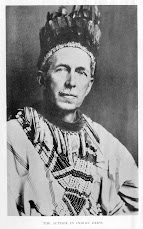
Below is an introductory section from 'Gods Who Were Men' by Ruth Verrill, written and distributed by mimeograph in 1950. In this large work, which can be found in four sections and in entirety on our PDF site,
Ruth Verrill examines a number of relics from the 'New World' which may link back to the 'Old World'. The editor acknowledges no knowledge of archaeology or Biblical studies, but cannot find anywhere any disproof of Ruth Verrill's critical researches.
This editor encourages useful comments and emails on Ruth Verrill's work. Note that it appears that only about two of these 'books' remained until our digital republishing. A copy of the book may be obtained here.
There are hundreds of images in the book. I will try and add a few in the future, The images do appear also in the PDF format of this work.
Gods
Who Were Men
From copy 7 - Dr. Junius
Bird, American Museum of Natural History
image 1
image 2
Being the Second Edition of 'When Gods Were Men'
By
Ruth Verrill
December 1950
Copies
I.
Instituto National de
Antropologie e Historia, Mexico.
II.
Dr.Charles E. Elvers, Baltimore,
Maryland.
III.
(my own copy)
IV.
Rabbi Clifton H. Levy, New
York.
V.
Dr. Earnest Hooton, Dept. Anthropology,
Harvard U.
VI.
Dr. Robert von Heine-Geldern,
Vienna.
VII.
Dr. Junius Bird, American
Museum of Natural History.
VIII.
Dr. Julius Tello, Peru.
IX.
Introduction
The purpose of this book is primarily to identify the many deified
personages of the ancient people of the Old World, to trace their genealogies,
to give their various aliases, to describe their various attributes and their
supposed powers and in as far as possible to explain their identifying symbols
and the origins of these symbols.
The fact that the names and attributes of the man-gods were
identical or very similar both in the Old World and in America centuries before
the Christian era would indicate that the deities of the ancient pre-Incans,
the Toltecs, Aztecs and Mayas and the deities of the ancient Old World people
had a common origin and that there was direct and frequent contact between the
inhabitants of the two hemispheres.
The question of whether or not the early American cultures were
introduced by colonizers from Asia and the
Near East is a most controversial matter. On the other hand we have a number of
scientists who declare positively that all the pre-Columbian races in America
were descendants of migrants who crossed from Asia via the Behring Straits and
who insist that all ancient American cultures were wholly of American origin
and that there was not and never had been any contact with the Old World prior
to the Spanish Conquest.
Who are or were the "pure-blooded American Indians"? If
there were no indigenous human beings in America
prior to the migration from northeastern Asia ,
then the "pure-blooded American Indians" were really pure-blooded
Asiatics. If this is the case, and they did come to America
in prehistoric times when they were in a lower cultural state, why could not
those who yet remained in Asia have followed
them as readily as had the earlier people and why could they not have done so
with increased ease as their cultural knowledge advanced? Is it reasonable to
believe that a migration of culturally undeveloped people could have negotiated
the passage to America
Certain scientists maintain that only a few centuries had elapsed
between the time of the beginnings of these cultures and the arrival of the
Europeans. But they fail to explain how it was possible for nomadic primitive
Asiatics to have spread and increased until they occupied the entire Western
Hemisphere from the Arctic to Tierra del Fuego and from the Atlantic
to the Pacific, and to have developed totally distinct languages,
characteristics, arts and religions all in the space of time allotted to them.
Neither do they explain how, in far less time than would be required today,
these people evolved highly complex and advanced civilizations, erected
thousands of magnificent temples and other structures—and all by most primitive
methods and with stone tools only. But these scientists go even further in
their all American ardor. When a Mayan date glyph is deciphered that puts the
period of its carving back farther than the scientists consider permissible,
they boldly announce that the ancient Mayan sculptor made a mistake of several
centuries when varying the glyphs.
Can anyone with a modicum of common sense imagine anything of this
sort? Even if the actual artisan made such an error it would at once have been
noticed by the priests and would have been corrected. But no, our hard-headed
"pure American" archaeologists set themselves up as knowing more
about Mayan dates and glyphs than did the Mayas themselves, yet, as a matter of
fact, no one can be absolutely certain of the correlation of Mayan dates with
our own, and as far as I know, no two scientists agree on this matter.
As an example of the extreme lengths to which a certain school of
our scientists have gone in order to hoodwink the public and maintain their
claims, they have insisted that the pre-Columbian Americans did not know the
wheel. But wheeled toys and carts had been found in Mexico
The Associate Curator of Anthropology, American
Museum of Natural History, New York City
There is a strong and increasing reactionary group who now admit
that all indications point to ancient contacts between the Old World and
America many centuries before the Christian era, some even admitting that there
are abundant proof that many of the arts, the beliefs, the mathematics, the
religions and the deities were brought to America from Asia and were developed into
the civilizations of Peru, Mexico and Yucatan, and scarcely a month goes by
that some new discovery linking the American with the Old World cultures is not
made.
The material presented in this book merely points out by means of
incontrovertible proofs long established by history, inscriptions, and
sculptures supported by traditions that many, if not most of the Old World god-men
had their exact counterparts at the same period in America. So frequently does this
occur that it cannot by any stretch of the imagination be relegated to the
realm of coincidence.
A coincidence might occur once in a great while but coincidences do
not and cannot occur over and over again not only in a name but in symbols,
attributes, lineage and other details.
Finally quite apart from any light my work may shed upon the
question of the Old World origin of early America’s higher civilizations, I
feel that the material I have compiled is of both scientific and popular
interest, especially as nothing of the sort has ever been previously attempted.
The material holds a great deal of real human interest pointing out, as it does,
how important a part symbolism has played in the deification of personages in
the dim and obscure past and the origins of these symbols.
Ruth Verrill,
Route 1, Chiefland, FL
Chapter
When Gods Were Men
This manuscript is being written with the idea of preserving the
findings I have made during my fifteen years’ research into dim and most
obscure backgrounds of the higher cultures of the Early Americas. That any
shred of knowledge is to be found at all is most amazing. It is a subject that
cannot be found in any libraries’ reference rooms for there is no work covering
the subject. Source material has to be culled from many, many sources; works
written by many scientists and historians, etymologists and theologists, curators
of museums and others.
Material selected for this work has been culled from the works of
reputable persons and most of the data has appeared in various publications.
This compilation is my own original effort. My only collaborator was my
husband. He helped me with the South American material and made many helpful
suggestions. The endeavor has been most tedious but thoroughly enjoyable.
Those who have seen the work we are doing, as well as that which has
been completed say we have more than proved our contention that the higher
cultures of the Americas were introduced by the Sumerians, Phoenicians, Goths,
Aryans or Asiatics, depending on the name preferred. I use the coined name
"Sumerian" throughout this compilation or monograph, though I am
aware of the fact that it was originally a geographical term. It is merely a
matter of convenience.
I do not contend that this race carried out vast projects of
colonization or that they came from one area or even any particular era. They
seem to have originally occupied Pachacamac, Peru in very remote times, though
I doubt if they originated in that area.
The god-king Pachacamac and his wife left Peru Americas
There are those who believe that this remarkable race had its origin
on some lost continent or island that sank and left but a remnant of their race
and culture intact. Some are positive that the race originated in the
table-lands of Eastern Asia, but it would not surprise me if some one finds
proof of their having originated in America
After considerable cogitation I have decided to begin the first
chapter with the most ancient cultures of the Central Andean regions, particularly
those discovered in the Department of Ancash, Peru. Though these findings and
comparisons have been lauded by curators of two institutions whose professions
are archaeology and ethnology, several scientists and a few serious students of
ancient history, one principal of a school, several teachers, one newspaper man
and an editor of a University press among others, there are those who think my
efforts quite a waste of time and energy and all I have achieved, according to
the views of this group, is a rather unusual compilation of nothing more than
mere coincidences. If you, as a reader of this work, feel as the latter group
say they do, please, just to disprove
our contentions, read this compilation of monographs through and prove we are in error. We are quite
willing to have you try.
Chapter 1 Haihayas of Asia and the Huailas or Huaylas of Peru
Chapter 2 Sumerian in our South Western United States?
Chapter 3 Round Towers
Chapter 4 Sea Shells in Ceremony and Religions
Chapter 5 Who were the Toltecs?
Chapter 6 Gorget of Naram-Sin (Narmer) in New Mexico
Chapter 7 Naram-Sin's Portrait Carved in Stone Found in Lake Texcoco, Mexico
Chapter 8 Gods of Early Mexico
Chapter 9 Indar and Engur
Chapter 10 Amenti and Amencay
Chapter 11 Yahuah and Associated Deities of South America
Chapter 12 Summary of Personages Connected with Cultural Development of the Americas
Chapter 13 Trees of Life and Tonalamatls
Chapter 14 Wheels? What Wheels??
Chapter 15 Genesis and the Four Bacabs
Chapter 16 How were the Old Empire Mayas Related to the Mochicas of Peru?
Chapter 17 Maize as Depicted in Ancient Art
Appendix - Fusang
Chapter 1 Haihayas of Asia and the Huailas or Huaylas of Peru
It is our belief, substantiated by history, tradition and other
evidence, that the progenitors of the Huailas of Peru were the ancient Haihayes of the vicinity of the City of
Umma, in an area then known as Southern Babylonia .
In the following pages we offer some of the evidences that have led us to this
belief.
First, however, in order to explain who the Haihayas were, a brief outline of their history is essential.
The priest-king Lugel-Aggisi or Zaggisi, a son of Ukush, (both
Haihaya chieftains) was the ruler of the City of Umma at the time he began the
conquest of his kinsman, Sargon of Agade or King Sagara, as he should be
called. In one of the inscriptions King Aggisi had made is the following: "...(I
have)...conquered the land from the Rising of the Sun to its Setting, and made
straight the path from the Lower Sea (Persian Gulf and Indian Ocean) over the
Euphrates and Tigris into the Upper
Sea Erech
King Uruka Gina died shortly after losing his realm and one of his
wives was about to throw herself upon his funeral pyre when the great and very
noble prophet and priest Aurva begged her to not do so for she was to be the
mother of a mighty emperor and to commit self immolation was unthinkable for
she must preserve the life of her unborn prince.
Priest Aurva being of the same race as King Uruka Gina and a very
learned man and an excellent teacher, took upon himself the task of teaching
the young prince when of suitable age. The priest taught him religious and
civil law, execution of ceremonials and literature and various sciences,
including that of planned warfare.
When Prince Sagara or Guni came of age he waged a terrible crushing
defeat over his Haihaya kinsmen, King Lugal Aggisi, and would have wiped him
and his tribe off the face of the earth along with several other tribes who had
acted in the revolt against his father, but for the plea made by the prince's
family priest.
This would seem to be so, for many years later another king had
trouble with the Haihayas whom it would seem, were predestined to attract
trouble. About 2300 B.C., Haihaya princes, sons of King Arjuna Kartevirya,
killed King Jama-Dagni in a personal feud. This king was succeeded by his son,
Purash-Sin, or Bur-Sin 1, who was also known as Parashu-Ram, the traditional
founder of the hereditary Brahman caste system, which is still the most
outstanding feature of East Indian sociology.
King Parashu-Ram in his wrath over the murder of his father waged a
war of extermination against the Haihaya princes and Sun-cultists and even had
his mother put to death as she also served as a devotee of the Sun-cult. (She
was a granddaughter of the priest-king of Lagash, pateai Cudea.) See next page—
In the area we now know as Palestine
image 3- The Gudea of the old
World and the New—Compare these two.
A full figure statue carved in stone representing Gudea, the
priest-king of the port city of Lagash is shown above at the left. He lived
about 2373-2368 B.C.
The carved head at the right is tilted backward somewhat, causing
the features to appear longer than they actually are. Notice the identical
carving of the eyes, indication of the headdress being a wound or wrapped
turban and traces of it once having been ornamental like that worn by Gudea, showing
just above the space between the brows. This head was discovered by Dr. Matthew
Stirling in Mexico in 1940. (From "National Geographic Magazine")
The likeness is most amazing and it is doubtful if it is just a
coincidence.
A little earlier then the reign of King Sagara, King Shubad’s (King
of Ur ) son, Tizama was reigning in India,
according to Pali records. The latter also bore the following names (among
others), Somaka, Sambhuta, and Tez-car. Tizama’s worship seems to have been
much like that followed by the Haihayas but just what his relationship to the Haihayas
may have been is not stated but the following theory based on historical facts
may offer a reasonable supposition:
If Tizama and his father, Shubad are synonymous with the two supreme
deities of the Mayas, Hunab-ku and his son Itzama it is not at all improbable
that the Haihayas, also called Huhunuri, were Itzama's or Tizama's people
(compare Huhunuri with the name Junin). (J in this case has the sound of H.)
It is not impossible that King Lugal Aggisi sent to India for Tizama, at the time of his conquest of
Sagara’s father and asked Tizama to return to Babylon
or Lagash
However, there seems to have been a very close connection between
the Hualias of Peru and the Haihayas of the Arabian
peninsula .
Now to resume the subject pertaining to Aija and Haiyan in Palestine.
Both of these archaeological sites are of an archaic type and are not very far
apart. Aija, Ai or Aiath as it is variously called, is east of Bethel
. . .
In the Department of Ancash, Peru, in South America
The cultures are arranged in the following manner: Callejon de
Huaylas, Chavin, Chongoyape and Paracas with cultural influence extending from
the coast to the Central Andean region. Dr.Tello states that the archaic, megalithic
cultural type seems to extend from San Augustine in Columbia
to Tiahuanaco, Bolivia and there appears to have been a widespread influence in
historically remote times.
In the Department of Ancash, Peru are several village sites bearing
Old World names, one spelled exactly the same, two spelled almost the same and
several others that are recognizably similar. The Peruvian town of Aija has its
name in counterpart, the town in Palestine called Aija , previously mentioned
and when interpreted meant almost the same thing, 'ruined' or 'destroyed'. The
little town of Recuey in the Department of Ancash has its Bible
Land counterpart in Recah, a place
occupied by a tribe of Judah ,
which undoubtedly was in the vicinity of Aija in Palestine
In the neighboring Department of Junin is a town called Caina; another
town with a Biblical namesake, Cana or
"Place of the Reeds". (see later) Also, in this same Department is
the town of Tarmar , a name closely resembling
Tamyras,.the name of a river between Sidon and Beirut , in Phoenicia, also between Hebron
A town in the Department of Ancash named Huari, has a Biblical
counterpart in the name of a man, Huari, interpreted as "Linen weaver".
This may be of sufficient importance to warrant several quotations from a Quechua
Dictionary that the reader may see some of the words in that language pertaining
to weaving. "A weaver" in the Cuzco, Peru Dialect (one of those
forming the (Quechua language) is AHUAY-Camayok. In the Ayacucho Dialect it is
AKUAC (See page 57,65) (compare with A-NAHUA-AC of the Aztecs) and in the Junin
it is AHUA. In the Junin Dialect a 'weaver' of stockings is Medias (a Spanish
word) HAHUA, in Ancash; "—shuag." In the Cuzco Dialect a weaver of
ponchos is called AHUAK. "To weave—" in the Cuzco, Ayacucho, Junin
and Ancash Dialects is AHUAY. Compare this word with Huari, mentioned above, and
the town of Ancash
The naming of places in a new land after those in the old is a well
known trait and from the evidence given here it would seem that there was no
exception to this trait among these people in Peru
In and near the Department of Ancash are archaeological remains
showing highly distinctive depictions of religious and ceremonial matters along
with carvings of men and women of such an obviously superior type that they
must have been carved to represent actual personages.
Various features of these ancient works of art furnish clues to the
identity of these people and their origin and also serve in tracing their
apparent migrations through several centuries and quite a few countries.
Another, and very important matter pertaining to this subject is
that of the worship of Indar (a son or grandson of the East Indian Lawgiver, Manu)
deified as Mishi, Ishi, Tas, Tashia etc. Some claim this deified personage was
Indar himself, others claim him to have been a son of Indar). The Haihayas or
Hunuhuris worshipped this deified personage, Indar, as he seems to have been
one of their ancient progenitors. The pre-Incas, worshipped him as Enki
(similar to Ea, the Semetic name for deified In-Dur (Indar) and as the
“Cat-god" Mishi. Ishi of the Bible was but another name for Jehovah and
superseded the synonymous name, Baali, "My Master". Ishi has at least
two interpretations, "My Husband" and "Saving".
The various stone carvings representing the "Cat-god" Mishi,
found in the Department of Ancash, Peru are still to be seen and I include
several depictions of this deity with his felines from several parts of the Old
World and for comparison, include several from Ancash.
(image 4) Huarmay, Department of Ancash, Peru.
(image 5) Phrygia's "Tasia" or "Mishi".
(image 6)
This scene is from a carved ivory handle of a stone knife ,found in Egypt
(image 7) From Marka-Kunka, Aija, Huaraz, Department of Ancash.
(image 8)
A pre-Christian depiction of Tasia, from a cross at Hamilton ,
Strath-Clyde, Scotland.
(image 9) Old World
(image 10 page)
I have other depictions of this "Cat-god" from the Old World and from the New, but this may suffice, and
carry sufficient weight to indicate the probability of his having been
transplanted from the Old World to the New. If
this evidence is accepted, it will put this particular Asiatic immigration into
South America in pre-historic times.
A seemingly irrelevant subject leads to additional substantiation of
this subject. It is the horse-shoe-like symbol known as the "earth
bowl". This object is found archaeologically in many forms and in a fairly
large number of places, including areas inhabited by the Mayas, Aztecs and
their kindred tribes. The origin of the "earth bowl" symbol must be
explained in order that a clear idea of its relationship to the present subject
may be understood. Several races, including the Chaldeans, Chino-Turks, Hindoos
and Early Aryans had a tradition that their people came from an area known to
us as the Tarim Basin, a locality north of Tibet
This land is so formed geographically, that it roughly resembles a
huge ’bowl’ or basin. The race with whom this symbol originated preserved the
memory of its form and it is known to us in several forms. One is the so-called
'yoke’ found archaeologically in areas influenced by the early higher cultures
of Mexico
The carved stone statue of a personage at Rurek, Aija and the other
from Aija Huaraz, shows these earth-bowls in inverted position, perhaps to
indicate that the race no longer inhabited the locality. The first mentioned
carries a shield or plaque on which is depicted
1- "Earth
Bowl" from headdress of figure from Aija, Peru. (See photograph given below.)
2- A so-called ’yoke'
from Vera Cruz, Mexico. A highly conventionalized "Earth Bowl"
3- An Aztecan
"Earth Bowl".
4- An Aztecan "Earth
Bowl" as a water symbol.
5- The Mayan symbol,
EK-AHAU, an "Earth Bowl".
6- Conventionalized
"Earth Bowls" on a Toltec pillar from Tula
7- Mexican
"Earth Bowl".
8- "Earth
Bowl" from the figure's costume on a stela at Cerra De Mesa , Mexic. (very
ancient.)
9- An ancient
representation of the “Earth Bowl" formed by the Tarim Basin
image 11
image 12