Monday, 22 August 2011

Ancient American Mysteries in Gold


Again the photos for this article were not acceptable for posting. The photos attached, we took in Costa Rica 2008.

Ancient American Mysteries in Gold

Although treasures have been found, the processes are unsolved

A. Hyatt Verrill

From The Sun; Aug 21, 1932; The Baltimore Sun, supplied by Alan Schenker, digitized by Doug Frizzle August 2011

FROM archaeological expeditions in various sections of Mexico, Central and South America brief news items have come in recent weeks telling of the finding of ancient treasures left by the Aztecs, the Mayas, the Incas and other highly cultured American races of the past.

From burial mounds in Mexico marvelous ornaments of gold, jadeite, crystal and semiprecious stones were obtained recently by archaeologists of the National Museum of Mexico City. Specimens of Incan and pre-Incan handiwork have been found during the last few months by members of the Tiahuanaco expedition of the American Museum of Natural History from New York city.

The University of Pennsylvania Museum expedition to Guatemala has unearthed many remarkable examples of ancient Mayan work, and from Salvador comes word that an archaeological expedition in that country has discovered the tomb of an ancient chieftain, with his throne of carved orangewood and priceless ornaments and insignia of gold and gems. And only last year reports from Guatemala told of the discovery of the grave of an ancient king whose body was incased in a casket of beaten gold.

Probably no races in the world were richer in the precious metal than were the aborigines of middle and South America before the Spanish Conquest. Although the conquerors looted the natives of incredible fortunes in gold, silver and jewels, they obtained but a fifth of the gold, for far more of the yellow metal rests in tombs and graves of departed chieftains and nobles than in the temples and palaces of the living. And although from time to time these buried treasures are found—by both archaeologists and professional treasure-seekers—unquestionably millions of dollars worth of wrought gold still remain in the countless burial places of the ancient Americans.

*

the aztecs, the Mayas, the Incas and many of the less civilized races of ancient America were all masters of the goldsmith's art. And not only were they familiar with all the methods of gold and silver work employed by Europeans; in addition, they possessed a knowledge of several processes entirely unknown to the rest of the world and which today are lost arts.

Although the Spaniards were lured to the conquest of Mexico and Peru by tales of gold in possession of the natives, they were astounded at the vast quantities of precious metals which they found. And while gold to them meant only riches, and while they were far from susceptible to mere beauty or artistry, even the rough, materialistic soldiers could not refrain from expressing their amazement at the intricate and marvelous workmanship of the objects they found. Rarely, however, did the loveliness or the artistic merits of these objects prevent them from being cast into the melting pot. As a result, very few examples of the Mayan, Aztecan or Incan gold and silver work taken by the Spaniards have been preserved.

*

the precious metals received as the ransom for Atahualpa amounted to more than $15,000,000, and while a large portion of this was in the form of bars, ingots and plates, there were great quantities of ornamental and decorative pieces, sacred emblems and idols which caused even the hardened Pizarro to indulge in rhapsodies. But the bulk of these objects was ruthlessly melted down. We may obtain some idea of the quantity of these specimens of the goldsmith's art by the fact that it required fifty native goldsmiths, laboring steadily for thirty days, to reduce the treasures to bullion.

Yet all this was but a small fraction of the gold possessed by the Incas. The most magnificent of their golden objects were those in the Temple of the Sun at Cuzco, which were concealed by the bearers of the precious burden when, en route to Cajamarca with their ransom for the Inca, they learned of Pizarro's treachery and the murder of Atahualpa. None of this stupendous quantity of gold and silver, the boullion value of which has been estimated at $150,000,000, has ever been discovered.

*

many tales have been told regarding the wonders of the Temple of the Sun, and so incredible, are some of these that they have been thought, by some to have been fanciful or exaggerated. But there is documentary proof of the truth of these stories, for in a letter written by a priest—the Fray Alonzo Martinez—who was sent by Pizarro to Cuzco to learn just what was there, the padre describes the contents of the temple as follows:

Above, the great altar was the image of Inti (the sun god) in the form of an enormous disk with a human face cut upon a thick plate of gold. Above the circle projected rays of the same metal, ending in stars of silver. To the right of this image of the sun was that of his woman, the sacred moon, figured with the face of a woman cut upon a plate of heavy silver and whose crown ended in gold stars . . . To one side and the other of the portico of the temple were the twelve chuquthuancos of gold; which were life-sized statues of the Incas who had gone before. The twelfth door of the temples gave entrance to the sacred garden, truly a jewel wonder, wherein, in fantastic communion, were encountered five fountains of gold surrounded by flowers, grass, plants, trees, birds, butterflies, lizards, crawling things and a great diversity of fruits and animals, all of gold and jewels, as well as a great quantity of utensils and implements of silver. The walls of the temple were overlaid with sheets of gold and the ceiling was studded with gold stars. The cornices of the twelve doors and of the windows were of gold, and on the upper part or the temple was a band of gold a yard in width that embraced all the temple—and the mummies of the dead emperors were seated in stone chairs encrusted with gold plates. Moreover, within the last few years several of the golden plates which covered the temple have been found where, apparently, they were dropped and overlooked when the walls were stripped of their golden overlay. Also, the recess in the masonry, which once held the golden band, is still visible. Finally, a few specimens of objects such as those that were in the marvelous temple garden have been discovered. Among these are insects, reptiles and birds of gold; golden ears of maize with husks of silver and a few gold and silver flowers.

But as yet no one has discovered the hiding place of the gold images of the dead Incas and other treasures, although the original golden sun that Fray Alonzo says was above the altar was found in Cuzco when excavations were being made at the Cusi Pampa (plaza) forty years after the Conquest. The Viceroy Toledo was so charmed by the beauty and rarity of this sacred emblem that he penned a letter to the King of Spain, telling of the find and saying that the image (which was shipped to Spain) was such a beautiful specimen of the goldsmith's art, that he prayed it might he preserved intact. Obviously, however, the Spanish monarch regarded the priceless specimen merely as so much gold, and had it melted down.

*

almost the equal of the Cuzco treasures in value and beauty were those at the Temple of Pachakamak, the immeasurably ancient sacred city near Lima. In fact, it was the tales of the gold at Pachakamak which lured Pizarro to the conquest of Peru, for he never heard of Cuzco until he met Atahualpa.

Unfortunately for the Dons, word of their avariciousness reached the holy city ahead of them, so that when they arrived practically every object of precious metal had been hidden by the priests. Yet so much remained and was secured by Hernando Pizarro and his raiders that they actually shod their horses with silver and gold!

In Mexico, Cortez and his followers found nearly as much gold as Pizarro did in Peru, but unlike Pizarro, who was an illiterate swineherd, Cortez was an intelligent, educated aristocrat with a fine sense of the artistic and the beautiful. He so fully appreciated the art of the Aztec goldsmiths that he preserved many specimens and sent them intact to Spain. Very few of these are now in existence, and our only real knowledge of the goldsmith's art in ancient Mexico is derived from the descriptions left by Cortez and his comrades and the examples which from time to time have been discovered in graves, tombs, caves and ruined temples.

*

among the tales which Pizarro heard from the lips of the natives of Panama and which fired him with desire to conquer Peru, were stories of the Incas eating and drinking from vessels of solid gold. That these tales were neither fiction nor exaggerations we may be certain, for innumerable plates, jars, jugs, cups and other dishes and utensils of gold have been found in Peru. In the American Museum of Natural History in New York city, there are a number of jars, carafes and plates of solid gold, all of which were found in one locality in Northern Peru. These are of thin, hammered or beaten metal and, while beautifully made, are not particularly ornate nor elaborately decorated. But in the burial mounds of Chan-Chan, the ancient, ruined capital of the Chimu race, are found wonderful vases, cups and utensils of gold, silver and of an alloy of the two metals. These, although of hammered metal, are elaborately chased or ornamented with repousse work, while many have designs in open work.

This ancient city of Chan-Chan was extremely rich in gold and silver, although the Spanish conquerors secured practically no treasure there. But during the years 1576 and 1592 a single man; Don Alonzo Gutierrez Nieto; secured gold and silver objects worth more than $2,000,000 from a single burial, mound near Chan-Chan, as is recorded in the treasury accounts of Peru.

*

as a general rule, the Incan, pre-Incan, Aztecan and Mayan gold work was of a decorative, ceremonial or religious character rather than utilitarian. Gold had no intrinsic value to these ancient races, and for ordinary purposes silver or bronze was far superior to gold. But gold was the most ductile and easily worked of metals; it did not corrode and, most important of all, its color was symbolical of the sun.

Hence in Peru, the use of golden utensils was restricted to the ruling Incas, the priests of the sun and the nobility, although jewelry and gold ornaments were in almost universal use. And it is in these everyday ornamental objects that we find the greatest variety and best examples of the ancient Peruvian goldsmith's art. Miniature llamas and alpacas in both gold and silver are fairly common.

Brooches, pins, rings, bracelets and anklets, earrings and earplugs, chains and breastplates are all found in tombs and graves with the mummified bodies of their owners, and many of these items are marvelous examples of artistic craftsmanship. Spherical beads of very fine filigree work, beads elaborately chased and carved, and chains of intricately formed links are common, especially in Southern Peru, while in Ecuador there have been found innumerable gold beads so small that they are indistinguishable as beads to the unaided eye. In fact, when these were first discovered in the bed of a stream they were mistaken for grains of virgin gold. Imagine the astonishment of the finders when, upon examining the supposed grains under a lens they were revealed as perfect beads, each perforated and chased. Many of them were composed of several minute spheres soldered together to form grapelike clusters, the whole not larger than the head of a pin and perforated through the center!

A number of these almost microscopic gold beads are on exhibition in the Museum of the American Indian in New York city, where they are displayed under powerful lenses. How the ancient goldsmiths ever managed to construct, drill and engrave, such minute objects is a mystery unless we assume that they possessed a knowledge of lenses made from quartz or other transparent crystals.

*

even more of a mystery, perhaps, are the many gold-plated objects which have been found in and near Chan-Chan in Peru. These utensils and ornaments of copper, bronze and silver, as heavily and perfectly coated with gold as though they had been electroplated, have never been explained. Various theories have been advanced in regard to the method employed. Some have suggested plating with an amalgam, others have claimed that the gold was rubbed or burnished onto the baser metals, and still others have argued that the objects were dipped into molten gold.

But none of these theories fits the conditions and cases. Amalgam plating is not lasting, yet these plated objects have endured for countless centuries; in addition, the coating of gold is thicker than could have been produced by the use of amalgam. Moreover, we have no evidence that these ancient metal workers possessed any knowledge of mercury or its properties.

*

then there is the fact that many of the beads are as perfectly plated on the inner surfaces of the perforations as on the exterior. Gold could be neither rubbed nor burnished into the metal in such places, nor could a thick, even coating of gold be thus applied. The molten gold theory must be cast aside, as the bronze and silver objects are often composed of such thin metal that they would melt instantly if plunged into a bath of molten gold. And, most important of all, several objects have been found which are composed of gold-plated earthenware!

The only explanation that appears tenable is that the Chan-Chan goldsmiths possessed a knowledge of some unknown chemical reagents or else plated the objects by fuming them over some preparation, containing gold, which rendered the metal volatile and capable of being deposited by condensation. At all events, we can safely say that the process is a lost art.

Also, in connection with this mystery, I would call attention to the spherical beads and bells, found at Chan-Chan, and also in Central America, which—whether of copper, gold or silver—are composed of metal scarcely as thick as ordinary writing paper. It does not seem possible that these extremely thin-shelled spheres were cast, and they positively were not hammered or beaten out. It is another unsolved, puzzle.

*

in many localities, as in Costa Rica, Panama and elsewhere, very beautiful golden ornaments and other objects found in the ancient graves present puzzles almost as insoluble as the processes employed by the ancient Peruvians. Among these objects we find some made of hammered gold, others of filigree work, others of cut and carved gold, still others of cast gold and many in which all these methods are combined. Among the cast objects are numerous hollow figures and spherical bells, the latter with perfectly spherical gold tongues cast inside.

Although in a general way the gold and silver work of the Aztecs and the Mayas, as well as that of the less cultured races of Central America and of the Incas, was similar in type and workmanship; each was distinctive in character, in design, in artistic expression and in details.

*

among the Aztecs the personal ornaments and jewelry were more ornate and elaborate than with the Incan races, the latter favoring broad, smooth surfaces and bold designs of a decidedly modernistic character, whereas the Mexican, races preferred cast metal, linked pendants, tiny balls and chains, intricate designs of realistic form and objects of filigree. The Aztec goldsmiths were the most expert of all ancient Americans in fine filigree—an art that still flourishes in Mexico and Yucatan. Among the Chibchas of Columbia platinum was used quite extensively, and alloys of this metal and gold are quite common.

Many persons are under the impression that because the Incas, the Aztecs and other faces possessed such vast quantities of gold they must have had a knowledge of exceedingly rich mines or placers which have become "lost." This, however, does not necessarily follow. It must be borne in mind that gold is practically indestructible, and that the gold in possession of these peoples never left their countries and represented the accumulation of thousands of years. Thousands of Indians, laboring day after day, will produce a very large quantity of gold in the course of many years, even though the source of the metal might carry such a small quantity to the cubic yard that it would not be worth working by present-day methods.

Prehistoric Miss Americas


This article came from a scanned newspaper, so the photos that were attached were unusable. I have substituted in a couple of images from my resources. Sorry if they don't follow the story so well.


Prehistoric Miss Americas

Minnesota’s Murdered Flapper of 18000 B.C. and a Peruvian “Modern”

by A. Hyatt Verrill

The Sun Jan 22, 1933; The Baltimore Sun; researched and collected by Alan Schenker; digitized by Doug Frizzle August 2011.

TWENTY thousand years ago an American girl was murdered in Minnesota. And now, after a lapse of 200 centuries, a steam shovel digging into the bed of an ancient glacial lake to form a motor highway has revealed the crime by unearthing the skeleton of the victim.

To scientists the discovery of the bones of the slain girl is of immense interest and importance, for it proves—as I and others have contended—that human beings differing little from the Indians of today inhabited our continent in that exceedingly ancient time and were more cultured, more like modern men and women than the people of Europe of that period.

But the average person is far more interested in the human, personal side of the discovery. We wonder who that unfortunate young lady was, why she was struck down as she knelt to drink from the ice-cold waters of the lake, whether she was killed by a jealous lover or an enemy of her tribe. We speculate on whether she was as revolutionary in her ideas as the youth of today, if her actions and her attitude caused her elders to shake their heads and declare they didn't know what the world was coming to. We want to know how she lived, what were her recreations and her duties, what she ate and what she wore—for most assuredly a girl dwelling in Minnesota in the very shadows of mighty glaciers must have worn garments of some sort. Unfortunately, however, the clothing she wore when she was murdered has long since vanished, and only a few shell ornaments among the bones are mute evidences that she adorned herself with the jewelry of the period.

*

but if we cannot answer these questions regarding the 20,000-year-old flapper's costume and daily life, we know what other well-dressed American girls wore thousands of years ago, what they ate, how they lived and what their duties were.

Quite recently, when a fancy dress ball was held aboard a steamship northward bound from South America, one of the young lady passengers appeared in a lace gown, with a wrap of creamy lace about her shoulders. When asked what she represented, she replied "Old Lace." And quite appropriately she was awarded the first prize when she explained that both gown and wrap were at least 3,000 years old and had been found on the mummy of a pre-Incan girl in a burial mound in Peru—a girl who had lived and doubtless had flirted and loved and had died more than 1,000 years before the birth of Christ.

It may seem amazing, incredible, that delicate laces and textiles could endure for thirty centuries or more; but in the dry, nitrate-impregnated sands of the Peruvian deserts even the finest, most perishable objects remain perfectly preserved. The garments worn by the 3,000-year-old flapper, as well as the prized possessions interred with her were as perfect when I opened her tomb and lifted her from her grave as on the day when she had been placed within her niche in the great adobe brick burial mound.

Her gown, of old blue and brown lace with an overlaid drapery of old-ivory lace, would have been the envy of any modern debutante, while wrapped about her body and limbs were over thirty yards of cobwebby lace showing two distinct patterns.

Apparently women's ways have changed but little in thirty centuries, for buried with the lace-wrapped body was a hand mirror of polished marcasite with carved and inlaid frame and handle, and a beautifully woven vanity bag containing precisely the same utensils and toilet accessories as may be found within the handbag of any young woman today. To be sure, they were cruder and more primitive in design and workmanship, but doubtless they served their purposes well.

*

within a little container made from a seed-pod was the carmine paint for the girl's lips, together with a beautiful silver spatula for applying the color. Another receptacle made from a small gourd closed with a carved wooden stopper still contained a supply of fine tinted powder with a powder-puff made of soft yellow feathers. Still another container—or perhaps I should say compact—held rouge for the cheeks, with a wooden spatula for applying it. Then there was a curved bronze knife for trimming the young woman's nails, a tapered polished nailstick and a pair of silver tweezers obviously designed for removing superfluous hair. And like the handbag of any modern miss, that of the lace-clad girl of pre-Incan days held all sorts of odds and ends. There were silver and bronze pins, bone needles, hanks of thread, a little carved wooden spoon, a tiny fetish or idol or charm made of carved bone, a silver ring, some sea shells, a string of pearls with broken thread and a hair comb of cactus spines.

*

We usually think that plucked or shaved eyebrows are modern aids to beauty, but this Peruvian girl of 3,000 years ago had her eyebrows as archly shaved and plucked as any young woman of today. Moreover, she had bobbed hair, which was kept neat and in order by a hair net that was still in place. Her fingernails, even in death, showed that they had been tinted and polished. Moreover, she took equally good care of her toenails, for the Peruvian misses of thirty centuries ago were ignorant of silken lingerie and hosiery or even shoes; their little toes, projecting from their rope-soled sandals, were very much in evidence. But the care and attention necessary to keep their toenails attractive was perhaps offset by the fact that they were never troubled by runs in their stockings or corns and bunions on their feet.

Naturally, this beauty of the long dead past wore jewelry—she would not have been feminine if she hadn't. Hers was almost ultramodern in design. About her neck were strings of immense beads of jadeite and lapis lazuli. About her wrists and ankles were bands of embossed silver, and her fingers were covered with heavy gold and silver rings. But her earrings! No girl of today, with pendants dangling to her shoulders, could equal the ear ornaments of Miss Peru of 1000 B. C, who wore immense ear plugs of silver covered with turquoise and mother-of-pearl mosaic. About her forehead she wore a silver fillet covered with mosaic of turquoise and pink shell, and dangling from her pierced lower lip was an ornament of silver set with pearls. But do not imagine that because of all her finery she was merely an idle, pleasure-loving butterfly. There were neither shops, department stores nor modistes in Peru in her day; and while a girl might see fit to array herself in yards and yards of finest lace, all her finery was made by her own hands. And as all the utensils and articles used in life were buried with the dead, we know exactly how this lace-clad flapper employed her busy hours. We know that, unlike so many modem girls, she was a most accomplished and competent little person, highly skilled in the arts of weaving and embroidery, lace making and tapestry. Beside her mummified body enfolded in the many yards of lace were two hand looms, each with a section of partly woven cloth, one holding a piece of tapestry with its half completed embroidery. There were hanks of dyed woolen and cotton thread, knitting needles and a crochet hook.

Obviously death came suddenly and unexpectedly, for the weaving ended abruptly with the yarns of the last portions loosely in place and the final loop of embroidery thread ready to be drawn tight.

*

we even know what the industrious young lady ate in those far-distant days. Beside her body were the highly decorated plates, bowls and cups which she used in life, with earthen pots and carved calabashes, all containing food for her spirit. And despite the thousands of years that had passed since they were placed in the tomb, most of the viands had remained almost unchanged.

There were roasted peanuts and dried red peppers, sweet potatoes and corn, dried meat and fish, white potatoes and aromatic herbs for seasoning. One jar contained the remains of what once had been ciderlike chicha, thoughtfully provided that the girl's spirit might not thirst.

Why or how this lace-robed young woman died, what calamity or illness struck her down in the first flush of budding womanhood, no one can say. Unlike the Minnesota girl, who was murdered 17,000 years before the Peruvian girl was born, the latter's shrunken body showed no marks of violence or injury. Beneath her bobbed black hair with its painted parting the skull was intact and there was no wound visible anywhere. But pestilence stalked abroad through the land in her day, and jealousy burned as fiercely in the hearts of the pre-Incas as in hearts of men and women of the present time, Perhaps some fatal epidemic marked her for a victim or perchance some other flapper, jealous of her beauty, her lace gown or her lovers, may have resorted to poison to rid herself of a rival.

We can merely speculate on such matters. But we know what she wore, what she ate, how she employed her busy hands and how she beautified herself. And we know that she lived and died fully 3,000, years ago, for above her grave and the graves of her people are layers of other ancient burials, while over these are the tombs of the Chimus, and above these are the last resting places of the Incan people, who conquered the Chimus centuries before Pizarro first set foot on the shores of Peru.

And the mummies in these more recent but nevertheless vastly ancient graves show that feminine fashions and styles changed as greatly and as often in the America of the remote past as in the America of the present. The young lady of the lace gown was a Moujik and no doubt a reigning belle of her village. Perhaps she was even a princess or a noblewoman, and hence may have been the best-dressed woman of her day. Yet she would have been considered hopelessly out of style and a decided freak by the Incan girl whose mummy was taken from a grave in the ruined city of Cacamaquilla, near Lima.

*

the moujik girl had been resting in her niche for some ten or twelve centuries when the Inca maiden of Cacamaquilla was laid to rest in the immense burial mould of her people, and in the meantime women's fashions had swung from one extreme to another, just as they do today. And even if the styles did not emanate from Paris or London, the women were forced to follow the decrees of fashion set by a mere man, the Inca in Cuzco. There was a reason for the Inca taking upon himself the dictatorship of feminine apparel. It was essential that the inhabitants of each province and village might readily be recognized, and this was accomplished by means of distinctive styles and colors. Even today the custom persists, and the Women of each district wear a distinctive form of hat. It must have been a big job to design the countless fashions and color combinations for the women of the 20,000,000 inhabitants, and probably the Inca had officials—ministers of women's fashions, they might have been called—to attend to the matter.

However that may be, delicate lace gowns reaching to the wearers' ankles had no place in the Incan community with its hivelike industry and efficiency. Utility was all important and short skirts had come into vogue. That of the girl of Cacamaquilla was of dark-blue woolen cloth edged with orange. Across her shoulders she wore a square cape of orange and blue, with quite modernistic designs of conventionalized figures printed by wood blocks. Upon her head she wore a gay kerchief of finely woven cotton, and about her waist was a woven woolen belt with the ends worked in the form of human heads terminating in fringes.

*

as moccasinlike slippers of leather had replaced the rope-soled sandals of the Moujik girl, it was no longer necessary to waste time polishing and coloring her toenails, but her fingernails were carefully manicured and brilliantly vermillioned. Stockings were still unknown, but the Incan belle had felt that bare legs and arms should be beautified, for on the shrunken skin of the mummy an elaborate design in blue tattooing was still clearly defined. And even if she wore no hosiery she had her garters—woven of wool in geometrical patterns and fringed with tiny silver bells and scarlet and black feathers—which were worn below her knees, where their beauty would not be wasted.

Though the Inca might decree what his female subjects wore in the way of dress, neither Inca nor law could control feminine love of finery and personal adornment. Miss Inca of 10 A. D. or thereabouts was as fond of jewelry as Miss Moujik of 1000 B. C. or Miss America of 1033. She was fairly loaded with necklaces of mother-of-pearl, agate, lapis lazuli, amethyst, turquoise, silver and painted earthenware beads. There were strings of bright-colored seashells, oddly shaped seeds and little cylinders of bone tipped with gaudy feathers.

To protect her from evil spirits and other dangers—and no doubt to serve as love charms as well—there was a string of fetishes or talismen—little grotesque human figures, birds, beasts and fishes carved of bone, shell and jadeite. About her arms and ankles were broad silver bands. Her fingers were covered with silver, bronze and bone rings, and in her ears were huge disks of chased silver.

The kerchief on her head was secured by a silver band with silver bangles and her blouse and cape were fastened with immense silver pins set with turquoise and marcasite. But bobbed hair, plucked eyebrows, painted lips and rouged checks had gone completely out of fashion. In place of a dainty vanity bag containing lipsticks, powder puffs, rouge and hair pluckers, this Incan girl carried a netted bag attached to her belt and containing only useful articles—silver and bronze needles, hanks of colored thread of wool and cotton, a razor-edged sliver of flint, a hair comb of fish bones and that most indispensable feminine utensil, a hand mirror of polished silver.

*

being an incan and a member of a social fabric where industry was considered the most important of all things, this flapper of Cacamaquilla was an even more accomplished young thing than the lace-gowned Moujik girl. In her life there was no such thing as idleness. As every girl of her day was supposed to be proficient in all housewifely duties by the time she was 13, when she was compelled by law to be married, she was doubtless kept busy acquiring skill in weaving, embroidering, spinning, sewing, cooking and the many other duties essential to an Incan wife. And while she had not yet reached marriageable age when death came to her, she had become an adept at weaving. For wrapped in the folds of her coarse cotton shroud was a roll of her lovely tapestry, not yet completed, and beside her mummy was her rectangular work basket filled with spindles, hanks of yarn and the implements used in weaving and carding. Yet she must have found time for recreation, for in her basket also were a number of little bone squares, each bearing a different number of black dots—remarkably similar to the dominoes we use today.

About the time that this young Incan girl was weaving cloth or playing dominoes in Peru, a young Aztec girl in distant Mexico was being taught to spin and weave cotton. Unfortunately the climate of Mexico and Yucatan destroys rather than preserves human remains and textiles. As a result we have little knowledge of what the ancient Mayan misses wore, although it is probable that their fashions 1,000 years ago were much the same as those of today and that the flappers of Chichen Itza, Uxmal and Copan wore loose, one-piece cotton garments elaborately embroidered in floral designs of bright contrasting colors very similar to the costumes of their descendants in Yucatan and Guatemala at the present time.

*

but we do know what the Aztec girls and women wore. Not only did the Spanish conquerors leave descriptions of the Mexican women's dress, but the Aztecs themselves painted them upon their codices or pictographic records. Also, from these booklike strips of painted papyrus we may learn much about the daily lives and occupations of the Aztec women.

On the Mendoza codex preserved in Oxford University, in England, there are several pictures showing a young girl being taught to spin and weave. In the first drawing the miss is wearing the romperlike garments of childhood, and her mother is showing her a cotton spindle with cotton ready to be spun into thread. To indicate that the mother—who is wearing quite modern pajamas—is talking to her daughter, the artist drew her tongue outside of her lips, while an oval object represents a corn cake or tortilla.

In the next scene the girl has changed her costume and wears a blouse like her parent's. And now she has learned to spin thread and as a reward for her industry her mother has given her a tortilla and a half. She must have been an intelligent young lady, for in the third picture she is shown busy at a hand loom with a serape already partly woven. She certainly has earned her reward of the two tortillas shown by the artist. Also, her mother must now consider her a young lady rather than a child, for her boyish bob has been supplanted by luxuriant tresses and her costume is the counterpart of that of her mother—who is still talking.

Friday, 19 August 2011

Where the Wife is Boss

A. Hyatt Verrill was a nationally recognized adventurer and writer by the 1930's. This item comes from The Sun series of newspapers. It included two pictures of native women, but the quality of the copy of the copy...is so low that I am trying to locate replacement images./drf


Where the Wife is the Boss, Admittedly

Central American Aborigines and their Curious Customs

by A. HYATT VERRILL

From Aug 28, 1932; The Baltimore Sun; supplied by Alan Schenker, digitized by Doug Frizzle August 2011.

REPORTS of the recent rescue of two American women from life among the San Blas Indians of Panama have revived interest in these famous aborigines of the Isthmus. The women, it appears, married the Indians, while the latter were in the United States. Dressed in the conventional clothes of the white man, well groomed—and these Indians when abroad are most meticulous in such matters—and speaking English, the aborigines doubtless appeared thoroughly civilized. And if they represented themselves as members of a civilized tribe they did so in good faith.

But when they reached their husbands' village these women discovered that "civilization" is an elastic term and that conditions which an Indian deems civilized are far from fulfilling the expectations of American women. Possibly—or rather probably—the husbands were ostracized by their own people because of their white wives, for the San Blas have always prided themselves upon maintaining the purity of their blood. As a result, possibly, of all this, the Indians deserted their white wives, or at least neglected them, and the unhappy women sent forth a pitiful SOS.

*

Few American Indian tribes have figured more prominently in the news of recent years than these so-called, San Blas. Yet in nearly every case the stories about them have been grossly exaggerated or utterly without foundation. Such was the announcement of the alleged discovery of a race of "white Indians" among the San Blas a few years ago. As a matter of fact, they were neither white Indian's nor any discovery, the "white" Indians being merely albinos who occur among all known Indian tribes. Unlike other tribes, however; the San Blas permit albino children to live, and regard them with a sort of superstitious respect.

Equally without foundation are the oft-repeated tales of these Indians permitting no strangers to dwell among them, of driving white men from their territory, and of their hostility and savagery. For many years trading companies have had representatives among the San Blas, and sight-seeing parties of tourists from Colon and Cristobal visit the Indians regularly.

I have lived for long periods among these aborigines; I have learned their language and have made a study of their customs, home life, religion and ceremonials; I have slept in their homes, have eaten with them, have doctored men, women and children—and I have always found them a most interesting, delightful, friendly and hospitable lot. This, however, is exactly what might be expected, for the Indians of the San Blas Archipelago have been in close contact with white men for over 400 years—ever since Columbus cruised along the coast of Panama. During the days of buccaneers, they rendered invaluable aid to the sea rovers as guides, hunters, fishermen and pilots, for the cruelty of the Spaniards had made them implacable foes of the Dons.

*

From their buccaneer friends and allies they learned seamanship and the English language and when, years later, Yankee whalemen appeared, the Indians proved as useful to the New Bedford, Nantucket and New London skippers as they had been to Morgan, Sharpe, Swan, Ringrose and other piratical skippers of the past. They took to whaling as the proverbial duck takes to water, and they regarded, the high-hatted, frock-coated whale-ship captains with so much respect and admiration that even today their favorite household gods are carved wooden figures with chin whiskers, high "stovepipe" hats and long-tailed-coats. Having acquired a love of ships and of visiting foreign shores, the San Blas men found sailoring exactly to their liking and scarcely a Yankee windjammer sailed the seven seas that did not include one or more San Blas Indians in its crew. And being adepts at picking up languages, many became excellent linguists. On one occasion I heard one of my San Blas boatmen speaking French with a Martinican. "How many languages do you speak?" I asked him. He grinned. "Mebbe ten," he replied.

*

yet throughout all these centuries of dealing, with white men of many nations and wandering over the world; the San Blas have maintained their tribal integrity, have retained their dialect, their faith, the ancient customs and ceremonials and have, until very recently, preserved the purity of their blood. And though they have been ever friendly with all Anglo-Saxons, they nevertheless have always had a smoldering hatred and distrust of people of Spanish blood.

At the time of an incipient rebellion against Panama, one of the subchiefs came to me to ask my advice in the matter.

"Why do you want to revolt and kill the Panamanians?" I inquired after he had stated his case. His reply fairly took my breath away. "Because we don't want to be civilized," he informed me. “We want to live like Americans!”

In the brief uprising that took place, several Panamanian officials were tortured and killed. For, peaceful, quiet, gentle and in many ways civilized as they are, the San Blas, like all Indians, become savages, fiends incarnate, when aroused on the warpath. And heaven knows they have had cause enough to be aroused and to go on the warpath to right the wrongs they had suffered at the hands of the Panamanians, who had exploited them, violated their women, placed Negro police over them, taken possession of their homes and islands and robbed them of their golden trinkets.

That short but sharp uprising, however, was a salutary lesson to the Government of Panama, and drastic changes were made in the treatment of the Indians. Today they are contented, happy and prosperous. The younger members of the tribe, abandoning the customs and conventions of their forefathers, have become ultracivilized. Many of the young men have been graduated from the university in Panama; many of the girls have become nurses in the hospitals or have become self-supporting wage earners elsewhere. Several of the islands have well-laid-out villages of neat houses and straight, wide streets, with artificial lighting, with gramophones and radios, with sanitary rules and street-cleaning brigades—in short, they are learning to "live like Americans," even if that necessitates being civilized.

*

but on many of the islands and on the mainland life goes on as it has for countless centuries; the people dress in their ancient peculiar costumes, the medicine men hold sway and the hereditary chiefs still rule. And here let me digress to state that woman's suffrage has been in vogue among these Indians from time immemorial. According to San Blas law, women hold first place in everything. Descent is by the female line and male ancestry counts for little, as is the case with many tribes. Hence the women literally rule the roost. When a man marries he becomes the virtual slave of his wife's parents until a girl is born of the union. I knew one old Indian fully 60 years of age who worked every day for his father-in-law, for although he had half a dozen children all were boys.

But do not imagine that men are the only workers among the San Blas. Woman may have an exalted place, she may be regarded as man's superior in many ways; but she is no drone. She has the household duties to attend, to—the cooking, washing, cleaning, caring for the children and making the family's clothing; she dresses and cleans the fish and game, grinds the corn, weaves baskets and makes hammocks.

*

The woman is exempt from any heavy manual labor, however. She is not, expected to carry burdens, nor even to bring a bucket of water to her home, wherein she rules supreme. She owns everything—only his hammock, his canoe, his gun, his clothing and his fishing gear actually belong to the subservient male—and he cannot sell, trade or give away anything without the permission and approval of his better half.

Even the chiefs have little control over the women. On one occasion I landed at an island where the Indians were still rankling under treatment received at the hands of Panamanians and had a grouch against all strangers. Scarcely had I stepped ashore before the local chief appeared, fairly bristling with fury, and ordered me off.

*

but the women had caught sight of my trade goods. Chattering excitedly, they surrounded the chief and importuned me to bring my goods ashore and trade. In vain the poor chief protested, stormed and threatened. The women were as keen bargain hunters as any feminine shoppers in a metropolitan department store, and they didn't intend to let any mere man—even if a chief—interfere with their fun. Finding himself utterly helpless in the face of the feminine majority, the old fellow sheepishly rescinded his orders.

On the islands, where modern ideas and civilized conditions have not supplanted the truly aboriginal life and customs, the women still adhere to their picturesque, gaudy costumes, and still wear the heavy gold nose rings; and herein lies an interesting story and one reason for the women's social status. For the nose ring, now a badge of superiority, was once a symbol of servitude and inferiority.

In the olden days, before the coming of white men, these Indians—like their neighbors and distant relatives, the Caribs—were confirmed cannibals and raided other tribes for the purpose of obtaining a supply of fresh meat. At such times the women and girls of the vanquished were made captives, and as it was no small task for the captors to control a bevy of female prisoners, the warriors hit upon the plan of linking their captives together by means of cords through their noses—like so many fractious bulls.

*

of course, the pierced noses identified the women as aliens, and hence inferior beings, once they were established in the villages of their conquerors. But leave it to the women to find a way out of any such situation. And, putting their heads—or their noses—together, the captured women soon hit upon a way. It was very simple. They spoke their own language among themselves and taught it to their daughters, but not to their sons, so that very soon the women of the community had a medium of communication which was unintelligible to the men. As a result, and owing to the fact that females always outnumber males among savage tribes, the women soon had the upper hand and ran things to suit themselves. Instead of being ashamed of their pierced noses they gloried in them, and to draw more attention to the perforations they wore heavy ornamental nose rings.

*

like all Indians, the San Blas are superstitious and believe in a number of good and evil spirits, in omens and signs, and have implicit faith in their medicine men or neles. As medicine the nele uses a most remarkable assortment of objects. Skulls and bones of birds and mammals, teeth, claws, pebbles, bits of water-worn coral, oddly shaped twigs and stones, tubers and seeds, buttons and coins, old doorknobs and electric-light bulbs—all have their places in his medicine kit. Rarely are herbs, decorations or brews prescribed.

The San Blas nele is the original layer-on of hands, and his "cures" consist of rubbing the afflicted portion of his patient's anatomy with the corresponding portion of some defunct creature, or some object which bears some imaginary or real relation to it. Thus a man with a headache is treated by having his head vigorously massaged with the skull of some creature. A doorknob also is deemed a wonderful specific for head troubles, while there is nothing so good for sore eyes as an electric-light bulb.

*

although these Indians are always referred to as the San Blas tribe, this is a misnomer, for there is no San Blas Tribe. The Indians living on the islands of the San Blas Archipelago and the neighboring mainland belong to five separate though related tribes—the Tegualas, Towalis, Tupi-towalis, Toles and Kunas—forming a rather loosely organized confederation, each having its own tribal chiefs, but all speaking the common Towali language. Although ordinarily at peace with one another, intertribal feuds with open hostilities and bloodshed are quite frequent.

Originally all these tribes inhabited the mainland along the rivers, but for purposes of defense from enemies, as well as to avoid the mosquitoes and other insect pests, most of the Indians took to the numerous islands offshore for residential sites, while still cultivating their gardens and fields on the mainland. As islands are not elastic, and as populations increase, most of the islands now are completely covered with the thatched houses of the Indians, with only narrow lanes between them. Some, however, are uninhabited and covered with Coconut trees, which form the wealth of the Indians. The San Blas nuts are famous the world over.

*

probably nowhere in the world are the men more skillful in the handling of open boats. With huge sails spread the Indians will sail their dugouts through a heavy sea and half a gale of wind, steering with one hand and holding the sheet in their toes, and for hour after hour keeping the lee rail within an inch of the water, But never shipping a drop.

To sail the open Caribbean Sea in one of these canoes laden with coconuts for the Colon market, and with a San Blas boy at the helm, is an experience to thrill the heart of any sailor, but is not to be recommended as a recreation for people with nerves.

Wednesday, 17 August 2011

He Cured a Savage's Stomach-ache


This story about AHV was written by another SF writer who wrote in Amazing Stories. I had been looking for this article for some time, although the story is also told in Never A Dull Moment, Verrill's autobiography.

He Cured a Savage's Stomach-ache and Became a Cannibal Chief

From The American Magazine for April 1931, provided by Alan Schenker, digitized by Doug Frizzle, August 2011.

HAVE you ever met Cuviboranandi, chief of the Guaymi cannibals? You may have, if you live in New York. Perhaps you've seen him in the subway, or strolling through Central Park. You may have read some of the more than sixty books he's written on exploration, travel, ethnology, archeology, and heaven knows what. Or you may have seen some of the exhibits of his paintings. For he's a busy author and artist, and dwells in the big city when he isn't penetrating distant jungles, wallowing through tropical swamps, or climbing perilous peaks. And his name, apart from being Chief Cuviboranandi, is A. Hyatt Verrill.

In addition to being a chief of a wild Panama Indian tribe, Verrill is the discoverer of the tremendous and long-extinct "Coclé" civilization in Panama. In 1924 he found, and partly excavated, remains of that amazing and forgotten culture. Then, too, he claims to be the only white man who has seen the fabulously rich gold mine of Tisingal, in Costa Rica, since the Indians butchered the Spanish miners there, long ago, and who has lived to tell of it.

Scores, perhaps hundreds, of white men have paid with their lives for rash attempts to reach this fabulous El Dorado. The long-lost mine lies far up in a savage, unmapped region within the fastnesses of mighty, forest-covered mountain ranges. Its history reeks with romance, blood, torture, death. There, centuries ago, the mailclad Dons from Spain ruthlessly murdered and enslaved the Indians, worked them to death, annihilated them, in their mad lust for gold.

Those Dons hewed their way indomitably through jungles, struggled over mountains, and with superhuman labor and cruelty wrung a flood of gold out of this, the richest mine ever known.

At length came the day of retribution, on which the Indians massacred their oppressors to the last man, swearing death to any white-skin who should ever again seek to lay eyes on Tisingal, Yet Chief Cuviboranandi, alias A. Hyatt Verrill, has laid eyes on it; and he still lives. For, on one of his explorations, after incredible hardships, he happened to reach the dwelling of King Polu, cacique, or king, of the Shayshan Indians, guardians of the secret of the lost mine.

And there Fate intervened, to disclose the perilous secret. For the King's daughter, aged eight, was stricken with an agonizing attack of colic. Verrill cured her. "Come with me!" bade the King. Endless hours Verrill followed him up a pathway of tremendous difficulty, across unknown mountains. At last the King showed him a rough, paved road, the remains of a stockade, moss-covered cannons lying in the jungle. Those cannons bore the date 1515. Talk about your thrills!

"Near by, hidden in rank growth," says Verrill, "lay wealth beyond one's wildest dreams. Gold and the white man's lust for wealth have always been the curse of the Indians, and I am thankful that the secret of this lost treasure-place, the world's richest gold mine, is so effectively guarded."

The Guaymis, Verrill explains, are an exceptionally fine people. They deny being cannibals—now; but they once were, and the way they sharpen their teeth looks mighty suspicious. That sort of sharpening invariably goes with cannibalism.

Never yet conquered, the Guaymis live among mountains that are still for the most part unexplored. Verrill was warned not to go among them, but, in spite of all that, he went. For many days he dwelt as a guest in the house of their Chief Neonandi. He learned that these people are descendants of the Aztecs. And their supreme king—rarely seen by any white man—still bears the ancient title of "Montezuma."

After Verrill had been some time with Chief Neonandi, a huge dance-festival was organized for him, on a remote mountain-top. But just before the festivities the "dance-chief," or medicine man, fell sick.

"I diagnosed his trouble as only colic, and gave him some medicine," said Verrill. "The others gathered about me and watched me reverently, for word had spread that I was doctoring the dance-chief, a most sacred personage. If he sought my help, I must be great indeed!"

Well, the witch doctor recovered, and Verrill's fame grew swiftly. When Montezuma himself arrived for the dance, Verrill found himself a prime favorite. After the dance Verrill was led into a temple, where he witnessed a colorful feast.

At its conclusion, Montezuma stepped forward, arrayed in all his gorgeous regalia, and delivered an eloquent harangue. Then Montezuma and Neonandi grasped Verrill's arms and led him to the altar.

"Was I about to be sacrificed?—This I wondered as they were leading me," said Verrill. "But I was soon reassured, for Neonandi explained that I had been adopted as a member of the tribe. After this, the real show began."

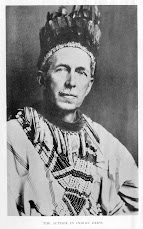
THE dance-chief produced a bead collar and a gorget, which he put around Verrill's neck. Then came a string of jaguar's teeth and a fillet of scalp locks. A painted drum was hung over Verrill's shoulder. Finally, Montezuma deftly drew the tribal marks of the Guaymis across the white man's cheeks, added two round spots below them, and traced a line down his nose; after which the dance-chief set a crown of hair, from the giant ant bear, on his head. "I was absolutely dumfounded," says Verrill, "for I realized I was also being made a 'medicine chief.' Then, when I had swallowed a calabash of chocolate, the ceremony was ended, and I was a full-fledged Guaymi chief, honored as no white man had ever been—and all because I had cured an old Indian's stomach-ache!"

GEORGE ALLAN ENGLAND

Little Lord Fauntleroy


I was recently contacted by Alan Schenker from Nevada and we have been conversing about Verrill. Alan has been following the works of Verrill longer than I, and he is more systematic and scholarly in his approach, including reviews of each work. Alan should be writing this blog, but for now, I'll just continue with the transcription, digitizing of AHV's works as before.
David L. Davenport is a long time correspondent, whom I had not heard from in a year or more. He wrote the article below, and is the only person that I can remember actually met AHV.

Little Lord Fauntleroy and the Professor

By David L. Davenport

From Southwoods magazine, found by Alan Schenker, digitized by Doug Frizzle with slight alterations.

I was about five years old, we lived in the Buckler blocks on Belmont Avenue in Springfield, Massachusetts, when I met our next door neighbour, Professor A. (Alpheus) Hyatt Verrill (better known by Hyatt Verrill).

I was introduced to the professor by my father's best friend, Ernest Buckler. I was scared out of my knickers when I first saw the professor. He wore a mustache and a goatee!

But yours truly, Little Lord Fauntleroy, soon discovered that the professor didn't bite, and he had a beautiful pet owl.

In 1936 A. Hyatt was working at the Webster's Dictionary's Research Center, in Springfield, as an illustrator. I remember him showing me a large poster with his daughter Lola as a Matador in Central or South America. She was the first female bull fighter in the history of the region.

I would make a pest of myself at A. Hyatt's apartment. He continuously sent me home after I over stayed my visits. He was writing a new book, The Heart of Old New England. It was the history of the Connecticut River and its towns, from the Canadian border to the open sea, ending at the light house at Old Saybrook Point.

1 used this book as my guide when 1 planned a canoe trip down the Connecticut River, from the Connecticut lakes at the Canadian border, to my home at Calla Shasta in Agawam. I also traveled through the Windsor Locks Canal and down to the mouth of the river where it merges into the ocean. It is a beautiful river. I've always thought we should have taken care of this natural waterway better than we did over the years. Pollution was the main problem. The Connecticut has cleaned up considerably since conservation has been on the public's mind, and industry stopped dumping waste into the river.

A. Hyatt wrote a series of stories in the twenties, for the pulp magazines. They were adventure stories of a group of boys. They were very popular with the young generation at the time. Reading was very popular. They didn't have TV. Radio Stations used some of his stories for broadcasting programs. Young boys—like myself, would lie on the living room floor in front of our radios and listen to the mysteries of the day. WOW!

The Professor would sit down with me—when he took the time, show me his illustrations and tell me many a story of his travels. I would become spell bound. Hyatt taught me about sea shells, the Maya and the Aztecs Indians, marine animals and fish. Hyatt also sparked my interest in insects of all kinds. I began looking at the ground and was fascinated with the insect kingdom. My mother was not too keen about me collecting bugs (especially different sizes of spiders). My mom would find all kinds of dead bugs inside my knickers pant legs when she did the wash. My knickers always had holes in the bottom of the pockets. Anything I put into my pockets would fill up my pant legs. I can still see my Mother hanging the knickers up on her clothes line and beating them with her carpet beater, to get rid of the riff-raff (junk).

One little incident about the professor that I can remember happened one day when my father and his friend Ernest Buckler went for a hike in Forest Park on a mushroom hunt. Off we went with me riding on their shoulders. We spent most of the day and returned home with two huge bags of mushrooms. Neither Dad nor Ernest were sure how to tell which of the mushrooms were poisonous! So we all headed to A. Hyatt's apartment. The Professor dumped the whole pile of mushrooms on the kitchen table and started to examine each mushroom. It was a surprise to all of us when the professor announced, "NONE OF THEM ARE MUSHROOMS!" Needless to say, we left disappointed, groaning about a lost dinner. We thanked him and while we were walking back to our apartment, Ernest stopped dead in his tracks and started laughing. He popped up with this question:

"Say, you don't suppose Hyatt told us all those mushrooms were bad so he could eat them himself?"

My father and his best friend would laugh about that story over and over throughout their later years.

A. Hyatt became very good friends with my father and Ernest. Ernest had been to the professor's home in the Everglades, Florida. His daughter was young at the time. She showed off her pet to Ernest. It was a black panther! The house was built out of thatch, and full of specimens from the jungle.

Ernest, who owned the building, gave the professor a space in the cellar of our block, and the three men all spent many an evening in the professor's wood-working shop, watching him make bowls, lamps, and weird figures. He would illustrate and paint them with ancient Inca and Mayan figures.

I still have a small desk pencil holder, a beautiful owl, which he carved out of a solid piece of wood and painted. Somehow I have been able to keep this precious item through the years

Hyatt painted many paintings of the American Indians, Maya people, and the Aztec nation. My mother had a couple of paintings by Hyatt on our living room wall.

There is a vast collection of works by Alpheus Hyatt Verrill (1871-1954). His name pops up when wonders of the world are brought up, even today, though most of his books are out of print. He wrote over 190 transcripts, stories, articles and books. Many books can still be found in the library. He also wrote many volumes of non-fiction in the natural sciences and anthropology. He produced fiction and science fiction in pulp magazines during the 1920s and 1930s. One, called, "Bridge Of Light," was re-issued in 1950 in hard cover. It was reviewed in the New York Times, and was a delight to read. It is virtually a script for a movie in the genre of "Indiana Jones and the Raiders of the Lost Ark." A series of Indiana Jones movies followed from his books.

He also wrote a non fiction book, "My Jungle Trails," and another interesting book, "Strange Customs, Manners and Beliefs." I would engross myself in some of these books and envision myself as the hero, solving all the problems of the world. SUPER FAUNTLEROY, BOY WONDER!

A. Hyatt Verrill has been credited with having invented the autochrome process of natural color photography in 1902.

Hyatt's father was a Professor of Zoology for many years at Yale University. When Hyatt attended Yale, he was taught by his own father.

A. Hyatt Verrill died in Chiefland, Florida on November 14, 1954. He is written up in the free Wikipedia encyclopedia, on the Internet. Used copies of his books are available on Amazon.com as well as eBay. Hyatt's books are still interesting to read.

The professor was a great friend and mentor when I was 5-8 years old. He developed my interest in many things that I would never have had an opportunity to find on my own. Sadly, my family moved and we lost track of the professor.

Today I sometimes wonder how much more the professor could have accomplished if he had written all of his information with a modern day computer. Lord Fauntleroy misses the years spent in his youth with the professor. In a few short years, I obtained a great education from a great man.


Blog Archive

Countries we have visited