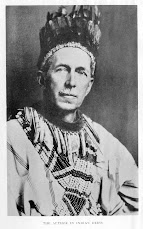
Panama of Today was published first in 1927.
It is essentially a revision of Panama,
Past and Present, dated 1921. The major differences being the addition of
many new pictures and chapters. Those include: 7-Cristobal and the Canal Zone;
10-Through the Interior by Motor Car; 14-The Indians of Panama. There appear to
have been six issues of these books.
It is apparent that the
chapter on Indians of Panama is based on Verrill's research notes from the Museum
of the American Indian. The photographs are by the author as are the paintings
which may also have been intended for MAI before Verrill's fateful dismissal
from his ethnological research assignment. MAI became branch of the Smithsonian
Institute, titled the National Museum of the American Indian./drf
The
Indians of Panama
Chapter XIV from Panama of Today, 1927.
by A. Hyatt Verrill
Prehistoric inhabitants. Remains. Ancient cultures. The Garden of
Eden of America.
Indians of Balboa’s day. Indians of today. Number of tribes. Languages.
Relationships. The San Blas tribes. The Kunas or Chuçunaques Juarros. The
Chokois. The Coclé Indians. The Yalientes or Boorabbis. The Shayshans. The
Tisingal mine. The Guaymís. Aztec influence or blood. The Bogenahs.
To many persons, the aborigines of Panama are one of its most
interesting features. That the Isthmus has been inhabited for countless
thousands of years and was, perhaps, the birthplace of prehistoric American
civilizations, makes the present-day Indians all the more interesting, both
from a popular and a scientific viewpoint.
Throughout Panama,
vestiges of a vast population of historic races are found, and as these are
obviously of many different races and cultures, and of many distinct periods,
we know that the Isthmus was inhabited for countless centuries, and that the
prehistoric inhabitants reached a high state of culture in Panama long
before the Mayas, the Aztecs or the Incas.
In Chiriqui and elsewhere are countless graves or “guacas,” as I
have mentioned in a previous chapter, and the stone work and the pottery, as
well as the golden ornaments found in these, show a high degree of artistic and
cultural development. In Veraguas, a wholly distinct culture and a different
race existed, while in Coclé prehistoric Panamanian culture attained its
highest development. Strangely enough, very little in the way of prehistoric
remains have been found further east and south than Coclé, and apparently the
entire areas now known as Panama and Colon provinces were uninhabited by
cultured races. Who the long dead races were, whence they came or what their
fate, we cannot state positively. In certain ways some of their arts show a
marked similarity to both Mexican and South American cultures, but the bulk of
the material is wholly distinct. No one can yet say definitely whether the more
northerly and southerly peoples influenced those of Panama
or whether the better known civilizations of Central and South America had
their beginnings in Panama.
But recent discoveries in archeology, made by the author in Panama, seem to
indicate that Panama may have been the Garden of Eden of America, the spot
where the most ancient inhabitants of middle America had their beginning, and,
developing a high state of culture, migrated north and south and laid the
foundations for the highly advanced civilizations of Mexico, Guatemala,
Colombia and Peru.
Unfortunately, the prehistoric races of Panama left no hieroglyphs, no
inscriptions that can be deciphered, and they left no great stone buildings or
pyramids as far as known. What we learn of them, we must learn from studying
their carvings, their ceramics, their graves, their implements and the massive
stone monuments they left.
And we have little more in the way of reliable records regarding the
Indians of Panama when the Spaniards first arrived on the Isthmus. The Dons
were far more interested in looting the natives and destroying them than in
studying their customs, relationships and languages. Here and there, in the old
writings, we find mention of certain tribes; some of their dialects were recorded,
and occasionally some priest or more scientifically inclined person recorded
items of interest regarding the Indians. But as a whole, the Spaniards looked
upon the natives as inferior pagans and either enslaved them or slaughtered
them at every turn. Of the several hundred tribes which inhabited the Isthmus
in the early Spanish days, over one-half were completely exterminated within a
quarter of a century, and today only those remain who managed to hold their own
against the Europeans and who maintained their tribal independence.
Later, came the buccaneers, and these Englishmen, finding the
Indians ready allies in any attempt against the hated Spaniards, always treated
the aborigines well and were friendly with them. Moreover, among the wild and
lawless corsairs were many men of education and scientific attainments. Such
men as Esquemeling, Wafer, Ringrose, and more especially Dampier, the buccaneer
naturalist, left long and accurate accounts of the Indians of their day, and
from these we know that many of the tribes have changed but very little in
customs, language or life since the days of the buccaneers.
But despite the efforts of the Dons to exterminate the Indians,
despite four hundred years of Spanish and Spanish-American dominion, there are
still fully one hundred thousand Indians of pure blood within the Republic of Panama.
To most people this will come as a distinct surprise, and it is
still more surprising to learn that there are at least fifteen distinct tribes
living on the Isthmus, many of them as primitive, as aloof and as wild as in
the days of Balboa.
Of all the Panama
Indians the best known and the ones about which the greatest amount of
misinformation has been circulated are the so-called San Blas. In Colon especially, one
hears hair-raising tales about these people. It is said that they never allow a
stranger to pass a night within their territory, and that they kill all
outsiders who attempt to penetrate their district. One writer has gone so far
as to describe the San Blas Indians as maintaining a constant vigil about their
country with sentries posted on guard with Mauser rifles. Another wrote a book
and many magazine articles relating the most thrilling experiences and
hairbreadth escapes encountered in visiting these Indians, while still another
tried to convince the public, and scientists as well, that among the San Blas
was a huge colony of “white” Indians. As a matter of fact the San Blas are a
peaceful, semi-civilized (and many wholly civilized), people who dwell upon the
islands and the adjacent mainland of the San Blas gulf, and who are in constant
communication with Panamanians and Americans. They visit Colon regularly, and a number may always be
seen about the streets of that city. There are trading stations on the islands;
a large banana estate is in the heart of the San Blas district, and a large
proportion of the Indian men have served on American whaling and merchant ships
and on vessels of all nations.
The majority speak English more fluently than Spanish, and many are
equally proficient in other tongues. Indeed, one Indian whom I employed had
traveled all over the world and spoke at least ten European languages. Many
have resided in New York and elsewhere in the United States,
and, with few exceptions, they welcome visitors and have no objection to any
one staying a day or a week among them. In fact many of the islands are model
up-to-date settlements with straight, well-kept streets which are cleaned and
swept daily, with village improvement societies, club houses dance halls, schools,
street lights, phonographs and all other appurtenances and ideas of
civilization. And it is a common thing for parties from Colon,
Cristobal and Panama
to visit the Indians and secure curios, souvenirs, photographs etc. During a
recent carnival at Colon I saw two San Blas chiefs with their wives and
children driving about in an automobile and thoroughly enjoying the
merrymaking, which, it must be confessed, savored far more of primitive
savagery than any of the customs of these Indians. And today, scores of San Blas
boys and girls are attending the various schools in Panama City and are proving the most
intelligent and ambitious of scholars.
Strictly speaking, there is no San Blas tribe. The Indians so-called
belong to the Towali, or as it is sometimes called, Tule, confederation made up
of the four sub-tribes of the Kuna race. The four sub-tribes are the Kunas, the
true Towalis, the Tupi-towalis and the Tegualas. Although, through
intermarriage and admixtures, there is no hard and fast line drawn between the
four, and in one settlement representatives of all may be found, still certain
islands and certain districts are occupied wholly by one or another of the
sub-tribes. So, too, all speak and understand the common Towali tongue,
although the Kunas adhere to their own dialect among themselves, and the older
people of the various sub-tribes still retain a knowledge of their own original
tongues. The emblem of the confederation is a four pointed star, each point
representing one of the tribes and its relative position, the Kunas to the
south, the Tupi-towalis to the east, the Towalis to the north and the Tegualas
to the west.
In many customs and habits the four subtribes vary considerably,
and, with few exceptions, all the tribesmen still retain their ancient rites,
dances, decorations and traditions. At dances they wear feather crowns,
elaborate bead, bone, teeth and other decorations, and paint their faces as in
days of long ago. The medicine man or “Lele” still holds sway and is regarded
with implicit belief and faith, and the various wooden and terra cotta idols or
fetishes are still used. These, however, are not worshiped or regarded as
sacred, but are merely proxies which, under certain conditions, are supposed to
have the power of taking the place of living persons, becoming, so to speak,
possessed of a spirit. Thus a so-called “god” placed at the doorway of a hut is
supposed to keep guard and prevent unwelcome persons or evil spirits from
entering during the owner’s absence. Likewise, a medicine man visiting a
patient will place a wooden image under the sick person’s hammock so that it
will act in the doctor’s stead until he comes again. And if an image proves
inefficient the Indian does not hesitate to chop it to bits or to mutilate it
and make another to take its place.
The men, when not attending dances or ceremonials, dress in
conventional trousers, ready-made shirts, or more often shirts of San Blas make
with tucks at shoulders and sleeves and chest, and for head gear don straw or
palm-leaf hats many sizes too small for them. A battered Derby is a great favorite, but no matter what
the head gear, the San Blas prefers to have a hat that balances precariously on
the top of his occiput. No doubt this is a relic of old days when the feather
crown was the universal headdress of the Indians, for the feather crown
invariably perches on the top of the head. When at home, the men also wear huge
diskshaped or crescent-shaped earrings of thin gold. The women, however, still
adhere tenaciously to their national costumes,—except on the thoroughly
civilized islands, which is far more picturesque and attractive than any
European dress. The costume consists of a loose smock-like blouse or “mola” of
brilliant hued cloth beautifully fashioned in elaborate designs in a sort of appliqué
work, or rather, one might say, intaglio. In making these, a number of layers
of vari-colored cloths are stitched together. The patterns or designs are then
cut away through one, two or more layers, thus exposing the colors beneath, and
the edges hemmed down with stitches so fine as to be scarcely visible. The
patterns are more or less heraldic although so conventionalized as to be
scarcely recognizable, the central motif representing the totem or clan mark of
the woman’s family. Often, too, all manner of odd patterns will be embodied in
the design. Arabic and Roman numerals, letters of the alphabet, Chinese
characters, airplanes or, in fact, anything that strikes the maker’s fancy. The
sewing on these molas is so fine and even that it seems incredible that it is
all hand work. But, more remarkable still, the sewing is all done at night by
the uncertain light of flickering oil dips.
In addition to the mola a short knee-length, skirt-like garment is
worn consisting of a hand-dyed and stamped strip of heavy cotton cloth wrapped
about the thighs. When fully dressed, or when not working, the woman wears a
second strip of gaudy cotton or calico wrapped about the hips and falling to
the ankles and exactly like the sarong of the Javanese. About the neck are
draped dozens of strings of beads, shells, teeth, fishbones and coins; immense
gold disks are worn in the ears; a heavy gold nose ring of triangular shape
hangs over the upper lip, and a brilliant red and yellow bandana handkerchief
is draped, in Egyptian fashion, over the head and shoulders, while legs and
arms are tightly bound with ligatures of beads so wound on as to form elaborate
patterns of many colors.
Among some of the sub-tribes the women’s hair is close cropped when
married, whereas among others it is worn long through life. In all cases, the
woman rules among the San Blas tribes. She is law unto herself; even the chiefs
have little control over the female members of the community; all descent is by
the female line, and mere man amounts to very little. When a man marries he is
virtually the slave of his father-in-law until a female child is born of the
union, and I knew one old fellow nearly sixty years of age who was still
working for his father-in-law, for although he had half a dozen boys no girl
had arrived in the family. Moreover, a man owns practically nothing outright.
All his possessions are, legally, so to say, the property of his wife or
mother, and he cannot trade or sell them without feminine permission. For
students of the woman suffrage and feminine emancipation problems, the San Blas
offer a remarkable field for investigation.
Although today peaceful and quiet, desiring only to be left to
themselves and to work out their own problems and salvation in their own way,
yet in times past the Towali tribes were fierce and savage fighters. They are
of Carib stock, and, like all the Caribs, were noted for their warlike
tendencies, their superb skill in building and using boats (they are still
marvelous sailors, especially in small craft) and their cannibalism. Indeed,
the nose rings of the women are survivals of the old cannibal days.
In ancient times, when these Indians raided another tribe, the men
were killed, and usually eaten, while the younger women were carried away as
prisoners. In order to handle their captives more readily and yet not hinder
their movements, the prisoners’ noses were pierced and they were strung
together like unruly bulls. In this way the pierced nose became the mark of an
alien woman in the tribe, and it was but a step to the nose ring, which,
originally a badge of servitude, later became a mark of distinction, for from
slaves the women became rulers. Very probably the San Blas women originally
possessed a distinct dialect unintelligible to the men, as do the women of
other Carib tribes, but today this no longer exists. In the San Blas tribes the
early buccaneers found ready allies, for the Indians, who had suffered at the
hands of the Spaniards, were ready to join anyone who might help them wipe out
old scores against the Dons. To the Indians’ help, much of the buccaneers’
success was due, and without their aid many of the most famous piratical
exploits on the Isthmus would have been impossible.
Even today, the San Blas people cherish anything but friendly feelings
for the Panamanians or any race of Spanish blood. Several uprisings have
occurred, usually, I am sorry to say, due to the overbearing or short-sighted
policy of the Panama
government, while the last revolt was incited and fostered by an ill-advised and
wholly irresponsible American who was later deported, and the unfortunate
misunderstanding, during which several Panamanians were tortured and killed,
was smoothed out without further bloodshed. At the commencement of this trouble
I was conversing with a Teguala chief who was in some doubt as to the wisdom of
joining forces with the malcontents and came to Panama City to ask my advice. His reply to my
query as to why the Indians were about to rise was as amazing as it was
amusing. “We don’t want to be civilized,” he stated. “We want to live like
Americans!"
Why, it may be asked, have so many tales been told of these Indians
if they are so well known and so closely in touch with civilization? All the
misinformation and fiction circulated about the San Blas are due to the popular
confusion of these people with their relatives the Kunas. Although so closely
related, and members of the same confederation, yet the true Kunas of the
Interior of Darien are very different in customs, temperament and life. But
even among the Kunas there is a vast amount of variation. The so-called “tame”
Kunas dwell in harmony with their neighbors, and are as friendly and peaceful
as the Towalis or Tegualas, whereas their neighbors the “wild” Kunas of the
upper Canazas and Chucunaque valleys are aloof, semi-savage and do not welcome
visitors, either white, black or colored. But they are not one-half as
dangerous or as savage as they have been painted.
 Their so called “forbidden district” is more of a myth than a
reality, and there is no evidence to prove that they have ever killed or
injured a white man, although strangers entering their territory are warned off
and are threatened. No one with any sense of justice can blame the Indians for
this, for wherever civilized man has entered Indian
territory the Indians have suffered and have lost all. Very wisely
the Kunas have decided that to permit one white man to enter their land means
the entry of more, and they have no intention of letting gold and rubber
seekers exploit their country and destroy their independence, their lives and
their moral code. But once their confidence has been won, and they are sure the
stranger seeks neither gold, lands nor other riches, they are friendly,
hospitable and peaceful. Moreover, like all Indians I have met, once they are
friends they are friends for all time. During the past year, while in Panama, three of the Kuna chiefs from the
headwaters of the Chucunaque journeyed all the way to Panama City to see me, having heard of my
presence through San Blas tribesmen whom I had visited. Constant communication
is maintained between the Kunas and the San Blas tribes, and in the homes of
the most remote Kunas one may see sewing machines, alarm clocks, and other
articles of civilization which have been brought in by the San Blas. Indeed,
several of the San Blas chiefs are also high officials of the Kuna tribe, while
Kunas of the Chucunaque are not infrequently to be seen among the Indians of
the San Blas villages, for it is a short, and, for an Indian, an easy journey
from the coast to the Kuna country.
In color, the Kunas are lighter than the average San Blas tribes,
although the latter vary from a coppery brown to a pale olive, according to
tribe, and many of the women, and especially the young girls, are no darker
than a brunette Caucasian, a fact that was noticed and dwelt upon by Dampier,
Ringrose and others. The Kunas also average taller and are better proportioned
than the coast Indians, which is to be expected as forest tribes are usually
larger than seacoast tribes. Also, among the Kunas and San Blas, as among their
neighbors and all Central and South American Indians I have studied, albinos
are not unusual.
It is probable that the percentage of these freaks is no greater
among these tribes than among others, but owing to conditions and customs they
appear to be more numerous. Today, albinos among these tribes are not destroyed
at birth, if indeed they ever were, and, in the case of the island Indians, the
albinos are more in evidence as every individual of a settlement or village may
be seen by a visitor. But that anyone at all familiar with biology or with
Indians could ever have been deluded into mistaking these abnormal beings for a
distinct race seems preposterous. Brown fathers and mothers may have tow-headed,
white-skinned, partially albino children, and they are most repulsive freaks.
Owing to lack of pigment in the skin they do not tan but burn in patches or
blotches; their eyes are weak and squinting, their skins are rough and pimply
and they may be best described in the words of one observer who stated that they
resembled “peroxide Swedes with barber’s itch.”
Not far from the Kuna country, and even wilder and more feared by
the natives than these tribesmen, are the Juarros, a nomadic, brown-skinned
tribe of which very little is known. They are in no way related to the Kunas,
the San Blas or the Chokois, and speak a dialect wholly distinct from all other
Panama
tribes. They are strictly a hunting race, use extremely long blow guns and
powerful bows and arrows and have seldom been seen by white men. Three
individuals whom I met in the jungle, were peaceful but shy. But they gladly
exchanged a blow gun, a bow and arrows and a feather headdress for beads and
tobacco. They could not or would not give much information regarding their
homes or their habits, stating merely that they were on a hunting trip, and
that their country was somewhere about the headwaters of the Savanna River.
Most numerous of all the Darien tribes of the interior are the
Chokois, a good natured, peaceful brown race which extends far into Colombia
and in Panama has spread as far westward as the lower Bayano River. Though even
more in contact with civilization than the Kunas, yet the Chokois in many
respects are far more primitive. Both men and women are practically nude, the
men wearing merely a breech doth, or at times a ragged shirt, and the women a
strip of calico about the waist and falling to the knees. To the visitor who
has never seen primitive savages at home the Chokois will prove most
interesting, especially as their villages are easy of access and they welcome
strangers. Short, thickset, with slender limbs and wonderfully developed chests
and shoulders; with coarse hair falling to their shoulders; with brown skins
painted; with huge earrings of beaten silver, the Chokois completely fulfill
one’s ideal of the primitive Indian. But nearly all speak Spanish, they have
adopted most of civilized man’s vices, and they are far from over cleanly in
habits or persons. Their houses, raised on posts ten feet or more above the
earth, are reached by notched logs, and their home life is of the simplest.
Scattered about, or hung on rafters, are baskets, earthen pots, dried corn and
bundles of rice, and rolls of the soft bark cloth which the Indians use as beds
and blankets. Squatted on the split cane floors are the women, cow-eyed,
stupid-faced, and surrounded by their naked youngsters. In one corner of the
hut a slow fire burns and beside it an ancient, shriveled hag cooks food in a
huge earthen pot. Fastened to posts, standing in corners and tucked into
crevices of the thatch, are queer figures carved from wood and gayly painted,
the household gods or fetishes of the Indians. There are gods for everything;
gods of the hunt, of crops, of the house, of the children, of the dance, of
fertility, of weather, of sickness, of health and of marriage. But it is when a
dance or a feast is in progress or preparation that the Chokois are seen at
their best. Then they are decked out to rival Solomon in all his glory and the
lilies of the field as well. Fathoms of bright colored beads are draped over
their shoulders and across their breasts; broad belts of beadwork encircle
their bodies; gaudy bead head bands are about their black hair; on their heads
are immense crowns of painted wood or bamboo strips; their arms and legs are
weighted down with silver ornaments; necklets of mother-of-pearl and silver are
about their throats, and their skins are painted with every color of the
rainbow.
 In sharp contrast to these primitive tribes of Darien
are the Coclé Indians of the province
of Coclé. Of a very different race from either the Chokois or the San Blas
tribes, the Coclé Indians are the most highly civilized of all Panama tribes, despite the fact that for years
they fought relentlessly against Spain and managed to hold their own
at that. Today, as I have already mentioned in another chapter, they have
forgotten their own tongue and live in a far more civilized manner than their
Panamanian neighbors. They are the most industrious inhabitants of the province
and the only ones who till the soil, raise crops and gather rubber and other
forest products. All profess Christianity, but they still retain some of their
ancient beliefs and customs. They weave excellent hats, baskets and “chakaras”
or bags, make bridles, saddle-pads and ropes of fiber and horsehair,
manufacture splendid baskets and earthenware, and are adepts at wood carving.
Once a year they don weird dance costumes of bark cloth with grotesque masks
fitted with horns and the jaws and teeth of wild animals, and take part in the
tribal “Kukwa” or devil dance. This dance, which has its counterparts in Peru, Boliva and elsewhere in South
America, is supposed to exorcise all evil spirits for the ensuing
year. The idea seems to be to out-devil the devil, to frighten him and his
satellites by the dancer’s horrible appearance, and to drive out any lingering
spirits by beating and lashing everything animate and inanimate wherein the
spirits might have sought refuge.
Prancing and shouting, waving their arms, striking to right and left
with long-handled whips, the dancers are truly enough to put any self-respecting
devil to flight. And, oddly enough, the Coclé Indians have selected the
Catholic feast day of Corpus Christi
as the most propitious date for their devil chasing, thinking no doubt that no
devil could withstand both their antics and the Christian Holy Day.
 Further west and north, in Bocas del Toro province, and especially
about the shores of Almirante
Bay and the Valiente
Peninsular, are the so-called Valiente Indians, or more properly the Boorabbis.
These Indians, while still retaining their tribal integrity and independence,
as well as their ancient customs and their own tongue, are partially civilized
and are quiet, peaceful and industrious. They dwell in neat huts placed here
and there in the jungles near the shores of bays and rivers, and live mainly by
hunting and fishing, though all raise enough fruits, vegetables, rice, etc.,
for their needs. They belong to the Guaymí race, but differ in many ways from
the true Guaymís and are wholly distinct from the Darien tribes. Ordinarily both men and women
dress in more or less conventional clothes, though the dresses of the women are
usually typically Indian in gaudy colors and ornamentation. But at dances,
ceremonials, and when among themselves, the men wear feather headdresses and
beautifully woven bead collars and breast ornaments, as well as plumes on arms,
necklaces of teeth, girdles of human hair and numerous charms or fetishes. Both
sexes paint their faces, the tribal mark being a line extending from the cheek
to the bridge of the nose on both sides of the face, and both sexes sharpen
their teeth. This custom, common to many tribes, is supposed to preserve the
teeth. Perhaps it does, for the sharpened teeth prevent particles of food
lodging between them and causing decay, and I have observed many very old
Indians whose sharp-pointed teeth were in perfect condition. The teeth are not,
however, filed to points, as is usually thought, but are chipped off by means
of a stone and are then rubbed or filed smooth. In color, the Boorabbis are a
light ochre, the women often pale olive, and they are better proportioned and
larger than the San Blas tribes.
 They make excellent dug-out boats, use cleverly designed harpoons
and fish spears, as well as powerful bows and arrows, but do not use knowledge
of English and adopted English names. And throughout the years that have
passed, the Indians have handed down their knowledge of English and their
English names with many if not all the old-time obsolete words and expressions.
And to this district also, came many of the refugees from the ill-fated Walker filibustering expedition to Nicaragua.
Settling among the friendly, English speaking Indians, these American
adventurers also left their influence. Once, in a remote spot, I came upon an
aged woman, apparently white, living, except for her servants, alone in a tiny
but neat house in a clearing in the jungle. She spoke perfect English, and to
my amazement informed me that she was Mrs. Smith and an American. Inquiry
elicited the information that her grandfather had been one of Walker’s men and that the family had never
left the little farm and home he had established in the jungle.
Besides the Borrabbis, another and wholly different tribe dwells
within the confines of Bocas del Toro. These Indians whose territory is about
the head waters of the rivers along the Costa Rican boundary, are the
Shayshans, also known as Palenques or Terribis. Formerly a large tribe, the
Shayshans, at the time I visited them in 1924, had been decimated by influenza,
and the tribe then numbered but forty-five individuals. As nearly all of these
were suffering from the malady, or from tuberculosis which followed in its wake,
the tribe may by now be practically extinct. The Shayshans are very different
in every respect from all other Panama
tribes. Many words of their tongue are distinctly Maya, their feather
headdresses, worn on the forehead, are very similar to the headdresses depicted
in Maya sculptures, and their noses are strongly aquiline.
Perhaps they are of Maya ancestry, or again the tribe may have been
greatly influenced by the Mayas who had outlying colonies as far southward as Costa Rica. In
color the Shayshans are copper-brown, varying to ochre-brown in the women. They
are short, sturdy but well proportioned race, far quieter and more taciturn
than the other tribes, and, in many ways far more intelligent than the average
Central American Indian. They are strictly a forest dwelling people, their neat
houses raised a few feet above the earth being built here and there on high
bluffs near the mountain streams. They are ruled by a chief or cacique who
appoints a number of ministers or councillors, each representing the chief in a
certain district, and all records, accounts and other data are kept by means of
knotted strings. Although excellent hunters, using powerful bows and arrows,
and blow guns in which clay pellets are used in place of darts, yet they depend
largely upon forest fruits and vegetables for food. A wild potato, dwarf
bananas, the nuts and flowers of the “piva” palm, native almonds, cacao and
some corn and rice are their mainstays. In preparing cacao, the beans are
roasted and ground and are boiled, the liquor being used like coffee. Their
arts are comparatively few and their handicraft is rather crude. Baskets,
chakara bags and some pottery, as well as grass or palm hammocks, are made, and
they possess a wide variety of cleverly designed flutes, thistles and other
musical instruments. Nearly all of the tribe speak some Spanish, and, with few
exceptions, all wear, at ordinary times, clothing obtained through trade with
the Indians nearer the Bocas del
Toro or Costa Rican settlements.
They are a friendly, peaceful, hospitable race, although in times
past they were valiant fighters, and they strongly discourage strangers who
wish to penetrate the interior of their district. Rumor has it that this is
because they know the location of the famous lost Tisingal Mine and do not wish
to have it rediscovered.
This ancient mine was, if we are to believe the old records, the
richest gold mine the world has ever known. Having been destroyed by the Indian
slaves, who revolted and massacred their Spanish masters, the Tisingal has been
lost to man, and almost to memory, for centuries. Time and time again, some
wanderer has reported finding it, and expedition after expedition has gone
forth to locate it. But in every case they have failed. Some have been
destroyed by sickness and some by hostile Indians. Some have never been heard
from, and the lost mine still remains hidden deep within the mountain forests.
Whether or not the Shayshans know the secret of Tisingal, I cannot state. But,
during my stay among these Indians, a chief who had become very friendly guided
me far into the jungles to a spot where there were the ruins of an ancient
Spanish fort, a paved road and two antique bronze cannons half buried in the
earth. These, he insisted, were the outlying fortifications that guarded the
old mine. But he insisted that the “Doraks,” whom I later suspected were
synonymous with the Shayshans, would destroy any stranger who attempted to
locate Tisingal. How much of this was truth and how much fiction or imagination
I do not know, but I am thoroughly convinced that I was nearer to Tisingal than
any other white man has ever been and that I really looked upon the Spanish
guns that once guarded the fabulously rich mine.
By far the most independent, the most superior and the least known
of all Panama
tribes are the mountain Guaymís of the unexplored interior of Chiriqui
province.
Although the Guaymís of the outlying Indian district are in constant
communication with the Panamanian settlements, and are familiar figures in
David, Remedios, Tole and other towns, which they visit for the purpose of
disposing of their wonderful pita-hemp bags, their coffee and their other
products, yet their fellow tribesmen of the interior mountains are almost
unknown to the outside world. Few strangers have ever attempted to enter far
into their territory, and tales wilder than those related of the San Blas and
Kunas are told of these mountain Indians. Weird stories are told of cities of
strange people buried in the heart of the mountains, of head hunters, of
cannibals, and of how the Guaymís kill all who have the temerity to try to
enter the Indian zone. The majority of such tales are, of course, purely
imaginary, but there is no doubt that the average stranger is far from welcome,
and that many men have been warned out of the country with threats of dire
results if the warnings were not heeded. Within the past few years a party of
ornithologists from the American Museum of Natural History in New York City were driven out of the Guaymí
district when, after having received permission to enter, a member of the party
was seen panning the sand in a stream. Suspecting that the bird collecting was
merely a ruse to enter the country, and that the Americans were really
searching for gold, the Indians promptly took measures to insure the strangers’
hurried departure.
During my stay of many weeks among the Guaymís of the most remote
and inaccessible districts I found them a splendid lot, far superior in every
way to all other Central American Indians I have met, and in many ways much
like our own southwestern tribes. Being strictly mountain Indians, and wholly
unfamiliar with boats, and possessing excellent horses, the Guaymís are
muscular, well built and proportioned and are tireless mountaineers.
They are dignified in manner and have the erect, free and
independent appearance of an unconquered race. In color they vary from a dark
olive to an ochre-brown, but average lighter-skinned than the other Panama tribes.
 Like the Boorabbis, who are of the same parent stock, the Guaymís
sharpen their teeth. In many other habits and customs the two tribes are
similar, and there is constant communication between the two tribes, although
each speaks a distinct dialect. Both tribes take part in the stick-dance or
“balsaria,” and many of the headdresses and other adornments are common to both
tribes; but aside from such similarities the two are wholly distinct. There are
no Guaymí villages, the houses being isolated and often several days’ travel
apart, and as they are usually well hidden in the mountains it is difficult to
believe that there are fully twenty-five thousand Guaymís under the rule of the
three head chiefs, each of whom is supreme in his own district, although all
the tribe and the two lesser chiefs acknowledge the sovereignty of the king or
high-chief known as Montezuma. This name in itself would suggest either Aztec
blood or Aztec influence. But, in addition, about forty per cent of Guaymí
words are distinctly Aztec; the insignia of the chief is the feather crown of
the long green tail feathers of the Quetzal,—sacred bird of the Aztecs, and the
spear throwing-stick still used by the Guaymís, and which, among the Aztecs was
called “Atlatl,” is known by the Guaymís as " 'Natdlei." Personally I
am convinced that the Guaymís are of Aztec lineage, perhaps the descendants of
an ancient Aztec colony or outpost.
The Guaymí houses are strongly built with walls of split timber and
high peaked roofs of thick grass thatch, and are very large, often over sixty
feet in length by thirty feet in width. Along one or more of the walls are a
number of small platforms raised a few feet from the floor and partitioned or
screened off by palm mats. Each of these is occupied by a family or an
individual, so that the main building is, in effect, an apartment house and may
contain as many as thirty or forty Indians. Unlike most Indians, the Guaymís
are cleanly and enforce sanitary regulations. The houses are always built in
such a position as to prevent drainage from reaching the drinking water supply,
and all washing and bathing are done below the point where the drinking water
is obtained and down stream from it.
No domestic animals, except the dogs, are allowed in the houses; the
earth floors are swept and cleaned constantly; food and water are kept in
receptacles on platforms or suspended from hooks overhead and out of reach of
dirt and dogs, and latrines are maintained at some distance from the house.
Ordinarily the women wear loose Mother-Hubbard-like dresses of
bright colored cloth obtained through trade with the Boorabbis or with the
outlying Guaymís, and decorated with appliqué designs in contrasting colors.
The men wear short blouse-like shirts of the gaudiest hues elaborately
decorated with appliqué work; and trousers of home-spun cotton or cloth with
red, white, blue, green and yellow appliqué designs down the seams of the legs.
Both sexes, however, strip to a loin cloth when traveling in rainy weather or
when in their homes, and both sexes at times wear palm-leaf hats closely woven
in attractive designs of black and white. About the crowns of these, bands of
feathers are worn, thus giving the effect of a feather crown. As a matter of
fact, the Guaymí hat is a direct evolution from the feather crown, for, by
adding a top, the palm-leaf framework of the crown became a hat. Very often,
too, the band of feathers is worn without the framework, and for certain dances
and ceremonials this is always the case. Although feathers of various colors
and of many species of birds are used, those of the great egret and the Quetzal
or resplendent trogan are confined to the use of chiefs, the Quetzal feathers
indicating a tribal chief whose rank is indicated by the number of feathers and
the admixture of feathers from other birds, while the egret plumes denote that the
wearer is a dance chief. In addition to these, headdresses of hair from the
tail of the giant ant-bear are used by the medicine-chiefs. Often, however, a
man may combine the ranks of tribal chief, dance chief and medicine-chief, and
thus he may wear any one of the official headdresses, according to the occasion
and the capacity in which he is acting.
Both sexes paint or rather decorate their faces with black and red
designs, and as all the designs used have a special significance and it is
important that they should always be the same, carved wooden stamps are used
for imprinting the patterns on the skin. When fully dressed for state
occasions, for a dance or a ceremonial, the Guaymí man is a brilliant and
strikingly glorious barbaric figure. Upon his head is the feather crown of
brilliant feathers; his face is half hidden under elaborate patterns of red and
black paint; about his neck, and covering his chest, are collars of magnificent
beadwork; hanging from his headdress over his shoulders, and about his waist as
well, are braided scalplocks; his prowess as a hunter is shown by the strings
of jaguar, puma and peccary teeth about his neck; his highly decorated blouse
and trousers are ablaze with color; an almost priceless chakara bag of red,
yellow and black,—so tightly woven as to hold water, hangs at his side and, if
a ceremonial dance is to take place, he carries a painted drum, a cow-horn
trumpet and a gourd rattle, while on his back is strapped the stuffed skin of
an ocelot, a jaguar, an otter or some other creature, decorated, like the
wearer, with bead collars, feathers and scalplocks.
These stuffed animal skins serve a very useful and necessary purpose
in the dance. The favorite dance is the stick-dance compared to which our foot
ball is a gentle game. As one Indian prances and leaps about to the shrilling
flutes, the sonorous horns, the shaking rattles and the throbbing drums,
another Indian strives to bowl him over by throwing a seven-foot pole, sharp at
the end and about three inches in diameter. If the dancer dodges the missile,
the thrower exchanges places with him, but in case he is struck or knocked down
the poor rascal must continue to serve as a target until he succeeds in dodging
the stick. At such times the stuffed animals serve to protect the wearer’s
spine from injury. Broken limbs and bruised and cut bodies count for little,
and, as the back and spine are protected—the dancer’s back always being turned
to the stick thrower—serious injuries and fatalities are rare.
During my stay among the Guaymís a special ceremonial and dance was
arranged for my benefit and in my honor. At this ceremonial, which was held in
a special “temple” or ceremonial house erected on a mountain top, nearly two
thousand Indians were present, and the head chief, Montezuma, attended in
person. All these tribesmen had been summoned by means of knotted strings of
braided palm fiber. These were of white, or black, and of various black and
white patterns, the colors and designs indicating the class of message, while
the knots conveyed the details. Not only was I permitted to witness the entire
ceremonial, which was of a most sacred nature, but I was also initiated as a
member of' the tribe with the rank of medicine-chief. Having been rechristened
“Cubiboranandi” which, freely translated, means the white man-who-came-over-water-and-became-a
chief, I was decked with all the insignia and regalia of my new station. Thus
having become a full-fledged Guaymí I took part in the ceremonial dance which
followed. And all because I had cured the old dance chief who was suffering
from colic!
I have already mentioned the throwing-stick used by the Guaymís.
With this a Guaymí can hurl a six foot throwing-spear with incredible force and
accuracy, and although they have excellent bows, they prefer the spear and
throwing-stick whenever possible. Living as they do, among the most broken and
rugged of mountains, and at an altitude of from four to five thousand feet, the
Guaymís, as I have said, are born mountaineers. At dead of night they will traverse
their country, afoot or on horseback, covering enormous distances and following
trails, which, in the daytime, make one’s head swim. But the Guaymís think
nothing of moving in stygian darkness over crumbling hogbacks less than two
feet in width and with yawning thousand foot precipes on either side.
Although excellent hunters yet the Guaymís depend mainly on
agriculture and possess well cultivated fields of rice, corn and vegetables,
groves of coffee and cacao, and numerous halfwild cattle and tough, wiry
mountain ponies.
Last of the more interesting tribes of Panama are the Bogenahs, a strange,
almost unknown race totally distinct from all others on the Isthmus, and,
perhaps,—indeed probably,—the most ancient and primitive of all. They are
undersized, with long arms and slender limbs; orange-brown or copper-brown in
color; with thick lips, flat noses, oblique eyes, narrow foreheads and with the
lackluster eyes and unintelligent expressions of apes. Their hair is extremely
thick, and coarse, and the men have straggling beards and mustaches which give
them the appearance of Tibetans or other Mogols. They have no fixed homes,
roaming here and there, subsisting on any game they can secure, and eating
grubs, beetles, lizards or any living thing as readily as fish, birds or other
game. Their houses, erected only as shelters during the rainy season, are rude
shacks of palm-leaf thatch; they have no arts or industries, and they are as
inveterate thieves and as mischievous as monkeys.
Today the tribe is almost extinct and numbers but a few hundred
individuals who live in the heart of the Guaymí country. Here they are kept in
almost complete subservience by the Guaymís. They can have no chiefs of their
own and are regarded as little better than animals by the Guaymís. But, despite
this, they have managed to retain their tribal integrity, as well as their own
language, their own customs, life and weapons. Indeed, so firmly fixed are
these that, instead of the Bogenahs acquiring a knowledge of the Guaymí tongue,
the superior Guaymís have been forced to learn the Bogenah dialect in order to
communicate with their inferior neighbors.

 1928.
Digitized by Doug Frizzle, April 2014.