Showing posts with label Martinique. Show all posts

Friday, 23 March 2012

What We Saw -Part3


Times do change a bit. I don’t think that 11 and 14 year old girls drink coffee today.
What We Saw in the West Indies        Part III
THE DIARY OF TWO REAL GIRLS ON A REAL TRIP
By Lola and Valerie
From Everyland magazine, Mar. 1917; researched by Alan Schenker; digitized by Doug Frizzle, Mar, 2012.

IT seems strange to sleep on shore again. We were so tired last night we were glad to go to bed early. Our beds have mosquito-nettings all around them and, as there are many mosquitoes here in Dominica, we have to be careful to jump quickly into bed before the mosquitoes do, and to close the opening in the nets. We liked doing this so much that we tried it over and over, until we grew to be quite expert.
We got up at about five and went out on the veranda to see the sun rise. The streets were full of people coming in from the country with loads of fruits and vegetables in trays on their heads. Children were going back and forth from the hydrant at the corner with buckets of water on their heads, for the people carry everything, big or little, on their heads instead of in their hands. It looks so funny to see a big black woman walking along with empty hands and with a cake of soap or a bottle of oil balanced on her brightly colored turban. One little girl had such a pleasant, smiling face and waved her hand to us so prettily. All the people are very polite; they bow and smile and say, "Howdy, missy," or, "Bo' jour," whenever they meet us. There is the greatest chattering all around, and I really think the early morning is the nicest part of the whole day down here.
From the veranda, or gallery, as they call it here, we saw a sad little funeral procession which seemed very strange to us as the people all walked instead of going in carriages as they do at home. Mother told us that when she was here before they didn't even have a hearse, but carried the coffins through the streets on men's heads. The people have a very funny name for the hearse; they call it the "dead machine."
Early this morning we went down to the river to watch the washer-women at work. There were whole rows of them, standing up to their knees in the water, soaping the clothes on flat stones, and then pounding them up and down against the rocks. They have special ways of doing laundry work and never make any change. Monday the clothes are washed, Tuesday they are bleached, Wednesday they are starched, on Thursday and Friday they are handed over to an ironer, and on Saturday they are sent home. They are beautifully done in spite of the rough treatment.
Thursday we were wakened early by father who said he had a surprise for us and to hurry and dress in just khaki bloomers and blouse. It was barely daylight, and after we'd had coffee and toast, which the maid always brings to the room, we were ready to go downstairs. There we found three horses all saddled—for mother did not go— and were told we were to take a trip into the interior to a place called Mountain Lake. As soon as we were outside the town, we entered a great lime grove, and for nearly an hour the road led through gardens and under cocoa trees. Then we began to climb the mountains and very soon we were far above the river and the air grew cool and fresh. There was so much to interest us along the road that the time passed very quickly. Sometimes we rode under the shade of giant bamboo trees, and we thought them very beautiful, but when we reached still higher and came to forests of tree ferns we decided they were even prettier. In many places the road followed along the edges of precipices and we could look down from our horses' backs to the bottoms of ravines which, father said, were a thousand feet below. Everywhere was forest with the funniest kind of great trees with their trunks spreading out in broad, thin pieces like planks or boards, and with their branches all covered and draped with vines and orchids. It was all very damp and still, and sometimes we heard wild pigeons cooing in the woods, and once father had us stop and listen to a beautiful bird-song that sounded like a flute. Father said it was the "mountain whistler" and was a very shy, rare bird only found in Dominica. We also saw many humming-birds darting about the orchid and begonia flowers along the path and, when we stopped at a spring for a drink, we found a tiny humming-bird's nest fastened on the under side of a fern leaf. Sometimes the road was very steep and slippery and the horses had to scramble to keep from falling over the precipice, but they were so sure-footed and so used to making the trip that we were not a bit frightened.
When we had been riding about three hours, we reached the highest part of the road and suddenly found ourselves in a thick mist. We thought it was fog, but it was really a cloud passing over and keeping everything damp and cool. When the sun shone again, we saw a lovely lake lying near the road in the midst of the forest, with great wooded mountains on every side. This was Mountain Lake, and father said it was really an old volcano filled with water and that it had no outlet and no inlet. It looked very pretty there in the mountains. We sat in the shelter of a little house beside the road and ate our lunch, while clouds drifted across the lake and sometimes hid it from us. After lunch we rode on for some distance, until we could look down on the other side of the island and could see the Atlantic Ocean. Then, as it was time to return, we rode back toward Roseau and reached home just about dark with fine appetites. We were dreadfully tired though, and were glad to go to bed early.
We spent Friday with father and mother at a lime estate. We were very much interested in seeing how the limes were crushed to make lime juice and in watching the women and girls pressing the oil from the limes under the trees. The funniest thing was to see the oxen and cows eating the lime skins after they had been crushed in the mill. We picked a big basket of limes for ourselves and gathered a bunch of scarlet lilies that grow everywhere beneath the lime trees.
In the evening after dinner the people who worked on the estate gave a native dance in the moonlight for our benefit. The band played the queerest sort of instruments. One man sat on a big drum and beat it with his hands, another played a triangle, another a flute made from bamboo, the fourth shook a rattle made of a calabash filled with stones, and the last one rubbed a stick up and down a rough piece of tin like a huge nutmeg-grater. The music was weird, but it just suited the black men and women who danced about, chanting wild, strange songs in patois and English. For our special benefit they sang, to the tune of "John Brown's Body," all about "John Brown's donkey," who "had a red morocco tail, so he could not march along."
We have left Dominica and are passing Martinique now. The captain is running the ship close to shore, so we can see the ruins of St. Pierre, which was destroyed by an eruption. We can't see much except a few ruined walls, for the bushes have grown up and hidden most of the dust and ashes that covered the town. Father pointed out Mount Pelee, the volcano which destroyed the town, but it doesn't look a bit dangerous now. It is lovely and smooth sailing, for back of the islands the wind cannot roughen the sea, and it's as calm as a lake, and such a lovely, deep blue color!
This afternoon we reached the capital of Martinique, Fort de France. It's very Frenchy. Everything is bright-colored and gay, but the streets are not so clean as in the English islands. The prettiest part of the town is the savanna with the statue of Empress Josephine in the center. Father told us she was born on a sugar estate across the harbor, but we did not have time to go over to see her old home.
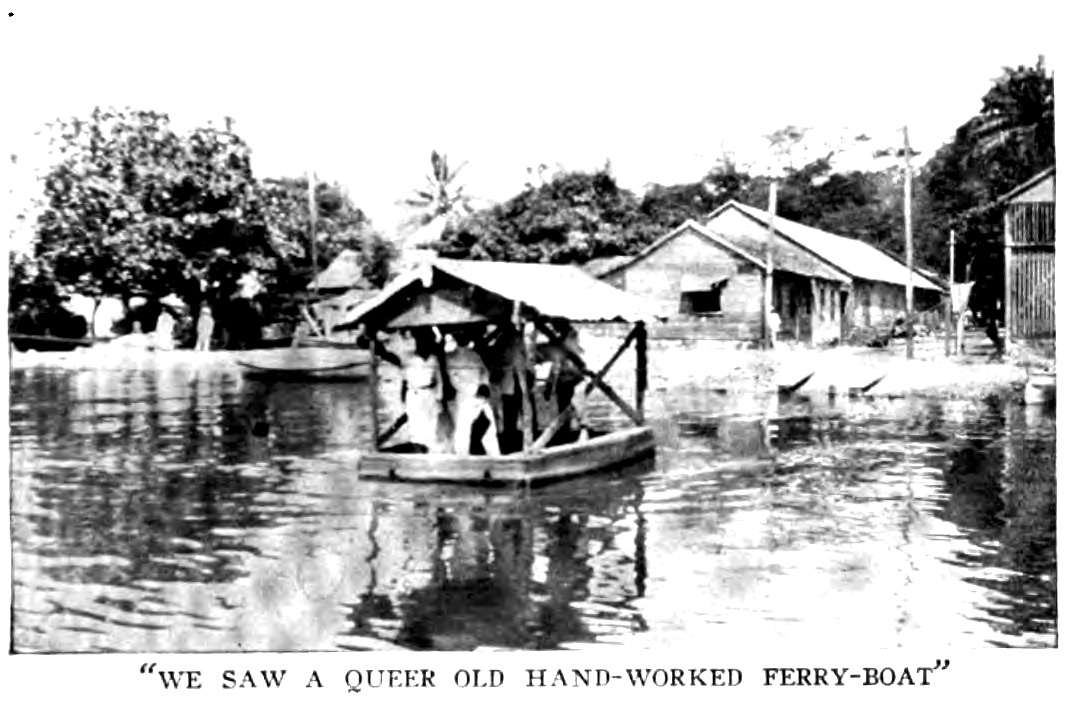
We saw a queer old hand-worked ferry-boat which Valerie snapped, and were sorry we could not play in it, as it seems just like a little house.
We left Martinique yesterday, and this morning when we woke up, we found the ship tied up to the dock at Castries, the capital of Saint Lucia.
The first things we noticed were the huge piles of coal which covered the docks and almost hid the little town beyond. It seems that Saint Lucia is most important as a coaling station and lots of steamers come here to get coal. We were most interested in watching the people coaling a ship behind ours. They were nearly all women and were the blackest people we have ever seen. Each woman carried a great basket of coal on her head and hurried from the piles up a plank and onto the ship, where she dumped it into the bunkers and ran back with the empty basket for another load. They worked so fast that they looked just like a stream of black ants running along the dock and up and down the gang-planks to the ship. The men worked hard, too, shoveling the coal from the piles into the baskets, but every one seemed to enjoy the work. Once, when there was a moment's pause, one of the men picked up his shovel and, holding it like a banjo, played tunes upon it with a bit of coal, while all the women danced about.
We left St. Lucia yesterday noon. This morning at sunrise our ship came to anchor at Barbados. It seemed very low and flat after the other islands, for the highest part is on the other side and that's only hilly. We found a beautiful hotel right on a lovely, white, sandy beach, and we have already spent hours in the warm, pale blue water and hate to come out and dress, even to take motor trips over the island.
There is a funny little car line that goes right past the hotel. The people call it a tram line, and the cars are queer little things drawn by mules. The ladies here, all wear long, colored chiffon veils to protect their eyes from the dust and the glare of the sunlight on the white roads.
The island is so flat and the roads, cut from the lime rock, are so smooth, that it's fine for driving or motoring about. We went for a long motor drive and everywhere passed by cane fields with great windmills standing up against the sky. An object of special interest was a huge lion carved out of the natural rock on a high hill. We climbed up on it and had a fine view from the lion's back.
There is a beautiful breeze blowing all the time, so the island is never very hot. All the palms that border the roads bend the same way, as the wind always blows from one direction.
The people here call the island Little England, and it is no wonder, for the city is very busy and all the shops are up to date and seem to have everything one could possibly wish to buy. Father tells us Barbados is one of the most thickly populated spots in the world and that many of the inhabitants have to work hard to keep from starving. They certainly all seem to be very busy.
One of the nicest things we've tasted in the islands are the flying-fish cutlets here at Barbados. We had seen flying-fish alive nearly every day, and now we've eaten them, for they are a national dish at Barbados. Another funny thing the people eat is the sea egg, a kind of sea-urchin. Some boys were gathering them and they gave us some, which we cooked on the beach, but we didn't like them very much, as they are too salty and sandy.
We have taken our last bath in the lovely water this morning, for we are sailing this afternoon. We are really very sorry to leave, as we've grown to love Little England even in the short time we've been here. Our next stop will be South America, for we are going direct from Barbados to Demerara, in British Guiana.
(To be continued)

Sunday, 11 March 2012

Beche's Fishing


Beche's Fishing
Beche, The Carib Boy   Part II.
By A. Hyatt Verrill
From Everyland magazine, Vol. VII, No. 4, March 1916. Digitized by Doug Frizzle, Mar. 2012.

TO Beche the arrival of the fishing-boats was always a delightful event. He loved to help pull the light dugout canoes upon the smooth, black beach; he was filled with excitement over the huge tuna, dolphins, and swordfish, and never tired of admiring the wonderful, gorgeous colors of the brilliant-hued tropical fish which filled the baskets in the boats.
Sometimes, among the more common fish, Beche would find strange things. Slimy, ugly octopuses, or devil-fishes, with their eight sucker-covered arms, were often caught, for the repulsive creatures are considered good eating by the Caribs and after being pounded to a pulp between two stones are made into stew. At other times great, clawless, red, blue, and yellow lobsters, gigantic, scarlet crabs, or huge, eel-like morays were among the sea denizens brought in, and Beche never knew what queer creatures he might find when the fishermen arrived.
Ever since he could remember Beche had been on hand to welcome the fishing-boats, and once he had gone with his father to the fishing-grounds far out to sea. Beche could swim like a fish and had no fear of the water or of boats; but when the forest-covered mountains of his island home grew faint and hazy in the distance and a new and strange land loomed above the eastern rim of the sea, he was filled with a strange dread lest the boat would be unable to return and he would be carried to the other land. He wondered what it was like;—if the dim mountain peaks were that great country called England where the king lived. When he asked about it his father laughed and told him it was Martinique. Then Beche looked with interest at the pearly land, for he remembered a time when the day had grown black as night and dust and ashes had fallen from the sky and every one had trembled with deadly fear until word came that Pelee had become angry and had devastated a place called Martinique. At that time Beche had no idea where Martinique was; but now he realized that it was in view across the dancing waves and he grew frightened and begged his father to take him home before the black ashes should again rain down and hide the sun. Throughout the day, while the boat bobbed about upon the waves and the fishermen were busy hauling in their lines, Beche had kept his eyes glued upon the distant land. At last the canoes were headed toward the sinking sun, and the green forests of Beche's own home grew plainer with each forward plunge of the boat, until the keel grated upon the beach and the Carib boy again felt safe beneath the waving palm-trees.
Since then Beche had never wished to go forth with the fishermen, but often, as he helped unload the canoe, he longed to catch fish himself. On the day of which I am telling he determined to go fishing the next day and as soon as the boats had left the next morning he set diligently at work to carry out his plans.
A short distance from the shore a number of tall, straight trees grew upon a little hillside, their great, hand-like leaves shining silvery-white as the trade-wind waved them back and forth and exposed their under sides. To these trees Beche made his way, for he knew that they were soft and easily cut and were as light and buoyant as cork. With his machete the Carib boy soon felled two of the Trumpet Trees or "Pipiris," as he called them, and by means of a tough, native vine he dragged them down the hill to the shore.
It was slow, hard work, and several times the little fellow stopped to rest before he reached the shore with the two tree trunks.
Soon the logs were cut into several pieces, and placing these side by side Beche laid light poles across them and bound all firmly together with tough vines. With little trouble he pushed the affair into the water, where it floated and rose and fell in the little waves. Wading knee-deep into the sea Beche clambered aboard the raft and gave a glad little shout as he found it supported his weight without any trouble.
Paddling the raft to the beach he hauled it beyond reach of the waves and prepared to make his fishing-tackle. A long coil of the same vine which he had used as a kite-string, served for the fish-line, and a short search above the sand of the beach soon disclosed a small lump of "ironstone" which would serve for a sinker. To make a hook was far more difficult and Beche longed for a real steel hook, such as the fishermen used. He knew his father had plenty, but he also knew that they were too highly prized to be given to boys for play, and that it would be useless to ask for one until he had proved his ability as a fisherman. But the problem didn't trouble the Carib boy for long. He remembered that near his hut there was an empty box and that in this box were nails, and in a few moments he had drawn two of the wire nails from the wood and was busily hammering them with the back of his machete. The hooks that resulted from his work were rough and crude but Beche felt greatly pleased with them and hurried off to get the bait. This was easy, for he had only to turn over a few stones to find some small crabs which he dropped into an empty coconut-shell and then, with the stem of a palm-leaf for a paddle, the Indian boy shoved his raft into the water, clambered on board and paddled it into a quiet cove behind a little coral reef. Baiting his hook he dropped the line into the water, and, squatting upon the edge of his queer craft, he peered down into the sea. The water was so clear and transparent that Beche could see the bottom many feet beneath and he became so interested in watching the many strange objects upon the bed of the sea that he quite forgot about his fishing. Upon the rocks below grew masses of bright yellow, red, and green coral; for corals are not white when living, but are as bright-tinted as flowers. Among the corals waved great purple sea-fans and black sea-rods. Giant, cup-shaped brown sponges stood here and there; purple and blue and scarlet sea-anemones waved their delicate tentacles from crevices of the reefs and bright-red crabs crawled slowly about, searching for bits of food. In one spot a school of yellow and black coral-fish flitted back and forth like a flock of butterflies; blue and purple angel-fish swept past like graceful birds, and a big, red-spotted grunt nosed about in the white sand searching for shell-fish. The sight of the fish reminded Beche of his purpose, and carefully baiting his nail hook with a crab he lowered it over the side of the raft close to the grunt. He could see the line, the sinker, and the baited hook quite plainly, and he dropped it so close to the clumsy fish that the busy creature was startled and darted back with fright. The crab smelled good, however, and after a moment's hesitation the grunt opened his great green and purple mouth and gulped down bait and hook together. Beche gave a quick, hard tug at the line and shouted with joy as he felt the big fish pulling hard at the other end of the vine. The fish tried hard to escape, but Beche's hand-made hook was caught fast, and very soon the boy had pulled the flapping creature upon his raft and was gloating over his prize like any civilized boy over his first fish.
When Beche again looked over the side of his raft he found a number of fish had gathered, for the struggles of the grunt had churned up the mud and sand and many tiny worms, shells, and crabs had been exposed and had attracted the hungry fish. Again baiting his hook Beche lowered the line among the fishes, and watched them eagerly as they flitted about and nibbled at the bait. Time and again he jerked at the line, thinking a fish had bitten, but each time the wary creatures darted to one side and the hook swung harmlessly upwards. Several times the bait was nibbled from the hook, and over and over again the Carib boy drew up the line, placed a fresh crab on the hook, and again dropped it into the sea. The sun beat down upon his bare brown back, he was getting hungry, and yet only the single grunt had been the reward of his work. He was beginning to think that it was useless to go on fishing and that he would never catch anything more when suddenly a great, gray, shadowy form moved slowly out from a crevice among the corals. For an instant it hung motionless and then rushed forward and Beche was almost jerked from his raft as the line came taut. With all his strength the boy pulled on the vine, but the fish was almost as strong as Beche and he panted and perspired as inch by inch he drew in the line while the raft spun round and round, dragged by the struggles of the huge fish. Gradually the fish gave way, the line came up more readily, and Beche could see the silvery flash of his prize close to the surface of the water. The boy wondered how he could haul the big fellow over the edge of the raft and as he was very tired he fastened the line to one of the cross-pieces to rest his hands and arms. Then, for the first time, he looked about and as he did so he gave a wild cry of fright and terror. He was no longer close to shore in the quiet cove; but was rising and falling on the ocean swell a mile from shore, and the little huts where his people lived were mere specks against the greenery beyond the distant thread of white surf. Beche was terribly frightened; he had never been so far from home alone, and he could feel the freshening breeze that was sweeping him farther and farther from land. He turned to pull in the anchor-line so he could paddle toward home, but it was gone; and then he knew that it must have slipped from the raft as he struggled with the fish and that the current and tide had drifted him from the cove while he had been so intent upon his catch that he had not noted his surroundings. Seizing his rude paddle he tried to make headway and for an hour worked diligently with tight lips and pounding heart. Still the shore grew fainter and fainter, and Beche, realizing that he was being carried farther from home every moment, threw his tired body upon the raft and sobbed and sobbed, until weary, hungry, and heartbroken he fell asleep.
Beche awoke with a start, and gave a hoarse cry of surprise and delight as he glanced about. The sun had set behind the mountains, but it wasn't yet dark, and the raft was motionless, grounded upon a pebbly point of land. Tall coconut-palms clashed their leaves softly in the evening breeze, wooded hills rose steeply from the shores, and under the palms Beche caught sight of a little wattled hut. The dull glow of a fire threw rosy lights among the trees, and before a pot upon the coals squatted a woman. It was all strange to the Carib boy; he had never seen the spot before; but from the direction of the hut came an appetizing odor of roasting breadfruit and broiling fish, and Beche, famished and tired, scrambled ashore and ran toward the woman.
"Eh, eh!" she cried in soft Creole French, as she turned at the sound of his footsteps, "You make me 'fraid, yes." Then, catching sight of his features, she exclaimed,
"Ma foi! You Ca'ib boy, yes. How you come here? You come by boat, no?"
"Ai!" cried Beche, "I hungry; please give me to eat," and without waiting for permission he seized a roasted plantain from the ashes and devoured it ravenously.
The stout, beturbaned colored woman looked at him in wonder as he gulped down the hot food.
"Oui Papa!" she exclaimed as Beche helped himself to a huge piece of breadfruit, "You hungry for true, yes! Where from you make to come, Ca'ib?"
Between mouthfuls Beche explained his plight, while the sympathetic negress muttered little cries of surprise or pity.
"Don't to make 'fraid, Ca'ib," she said, when Beche had finished his story. "Soon when Jean come with he canoe he take you safe to you home. You come far for true. You at Pointe Bouchere. Soon like my man come he take you back."
His hunger satisfied Beche's head began to nod and his eyes closed, and lifting him in her strong brown arms Matilde carried him to her hut and laid him tenderly upon her bed.
Beche did not wake up when big, laughing, black Jean came home. He did not feel himself carried to the canoe and placed gently upon a bed of palm leaves, and as Jean pulled with long, steady strokes over the moonlit sea the Indian boy slept undisturbed.
He was aroused by glad shouts, and opened his eyes to the glare of flaring torches and to see his own mother and father beside him.
Beche leaped up and threw his arms about his parents with a shout of joy. Then he remembered about his fishing. "Eh! Papa Moin," he cried proudly, "I fisherman for true now. I build one little boat and make to catch two big fish."
 

Saturday, 10 March 2012

The Diving Boys of the Caribbees


The Diving Boys of the Caribbees
A. Hyatt Verrill
From Everyland magazine, Feb. 1916 (V7#3). Digitized by Doug Frizzle, Mar. 2012.

HOW would the boy readers of Everyland like to spend all their days diving into the sea? It would be lots of fun in summer, but how about winter? you say.
Winter doesn't trouble the boys about whom I'm going to tell you, however, as their winters are just as warm as their summers, for these boys live in the West Indies where it's always warm.
Whenever a steamer arrives in a West Indian port the diving boys swarm about the ship, begging the passengers to toss over pennies or small coins. No sooner does a coin touch the water than splash! splash! splash! the brown bodies flash into the blue sea, and the water is so clear and transparent that one can watch the boys as they swim down. It's very funny to see their brown legs kicking like so many big frogs, and the white soles of their feet twinkling like queer fish, as their owners scramble for the coins at the bottom of the sea.
Seldom indeed does a coin touch bottom before a boy grasps it, and, tucking it into his mouth, the lucky rascal bobs up, shaking the water from his woolly head and grinning from ear to ear. Black, brown, and yellow, the diving boys are the happiest chaps in the world, and between dives they amuse the laughing passengers on the ships by cracking jokes, cutting funny capers, and singing the latest ragtime and popular songs in the quaintest, queerest of Creole dialects.
In every port one sees the diving boys, and whether Danish, English, French, or Dutch subjects, they are one and all care-free, happy-go-lucky, grinning youngsters who find diving for coins the easiest way of earning the few pennies necessary to provide for all their wants.
Clothing troubles them not at all, for a few rags are all they need where it's always summer; food costs almost nothing, and enough mangos, bananas, and sugar-cane to fill their stomachs can be purchased for half a cent, and for a penny or two they can buy enough fish, beans, and yams to furnish full meals for a day. Even houses are unnecessary luxuries for these boys, for shelter is only needed to keep off the rain, and the diving boys are just as comfortable and sleep just as soundly when curled up on bales or barrels under the waterside sheds as if sleeping in the daintiest of beds.
Their sole possessions are their boats, and these are as interesting and amusing as the boys themselves. In some of the islands the boats are quite excellent craft, and two or three hoys own one boat in common and work together, but in other islands the boats are the funniest, quaintest looking home-made affairs you could imagine.
Sometimes they are three-cornered things made by nailing three boards together with other boards nailed across for a bottom, while in other places the boats look more like coffins than anything else. These are built by the boys themselves and are made from old boxes and packing-cases begged from the merchants. Of course they leak like sieves, but the boys manage to keep them from sinking by bailing every few moments with a calabash or coconut-shell, and as the owners are in the water quite as much as they're out of it they don't mind if their craft are wet.
But rude as the boats are they are often brightly painted and are sometimes elaborately fitted up, and the boys frequently show wonderful skill and ingenuity in doing this work. In St. Lucia one often sees the tiny craft equipped to imitate men-o'-war or battleships. Dried palm buds serve as life-boats, pieces of bamboo do duty as funnels and masts, guns are whittled from sticks of wood, and tin cans serve as turrets. Even anchors, windlasses, semaphores, davits, and all the other fittings of a real battleship are counterfeited by means of odds and ends picked up along the water-front or docks, and the miniature war-ships have quite a realistic appearance. They are all named after famous British or American men-o'-war.
As one watches the boys paddling about in their queer craft it seems marvelous that they don't upset, but the boys are as good sailors as swimmers and row or even sail their boats about without the least trouble and never tip over. Of course it wouldn't hurt them if they did capsize, for they are just as much at home in the water as on the land. All the West Indian colored folks are fond of the water and swim splendidly, but the diving boys are the most expert of all. It doesn't trouble them in the least to swim down and walk about on the bottom, or to tie a rope around an anchor or some other object far beneath the waves; and it's a common feat for them to dive down on one side of a ship, swim under the keel, and catch a coin thrown from the opposite side before it touches bottom. Before the eruption of Mt. Pelee in 1902 the diving boys of Martinique were famous throughout the West Indies, but the same awful blast that destroyed St. Pierre killed all the diving boys who had gathered about the ships in the harbor of the doomed town.
To-day there are few diving boys at Martinique, but there are plenty of them at all the other islands, and as long as passengers and tourists visit the West Indies and there are pennies to be thrown over, the diving boys will be on hand to ply their queer trade in their funny boats.

Blog Archive

Countries we have visited