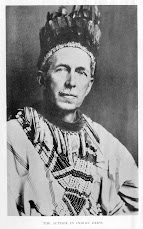
Showing posts with label cacao. Show all posts

Tuesday, 10 January 2012

The Story of Chocolate


The Story of Chocolate
By A. Hyatt Verrill
From Everyland magazine, January 1917. Digitized by Doug Frizzle, Jan. 2012.

WHEN the Spaniards first landed in Mexico and Central America they found the native Indians using a drink which the Spaniards had never before tasted. The Aztecs called it chocolati, and today we call it chocolate but very few who eat chocolate or drink cocoa ever stop to think how it is made.
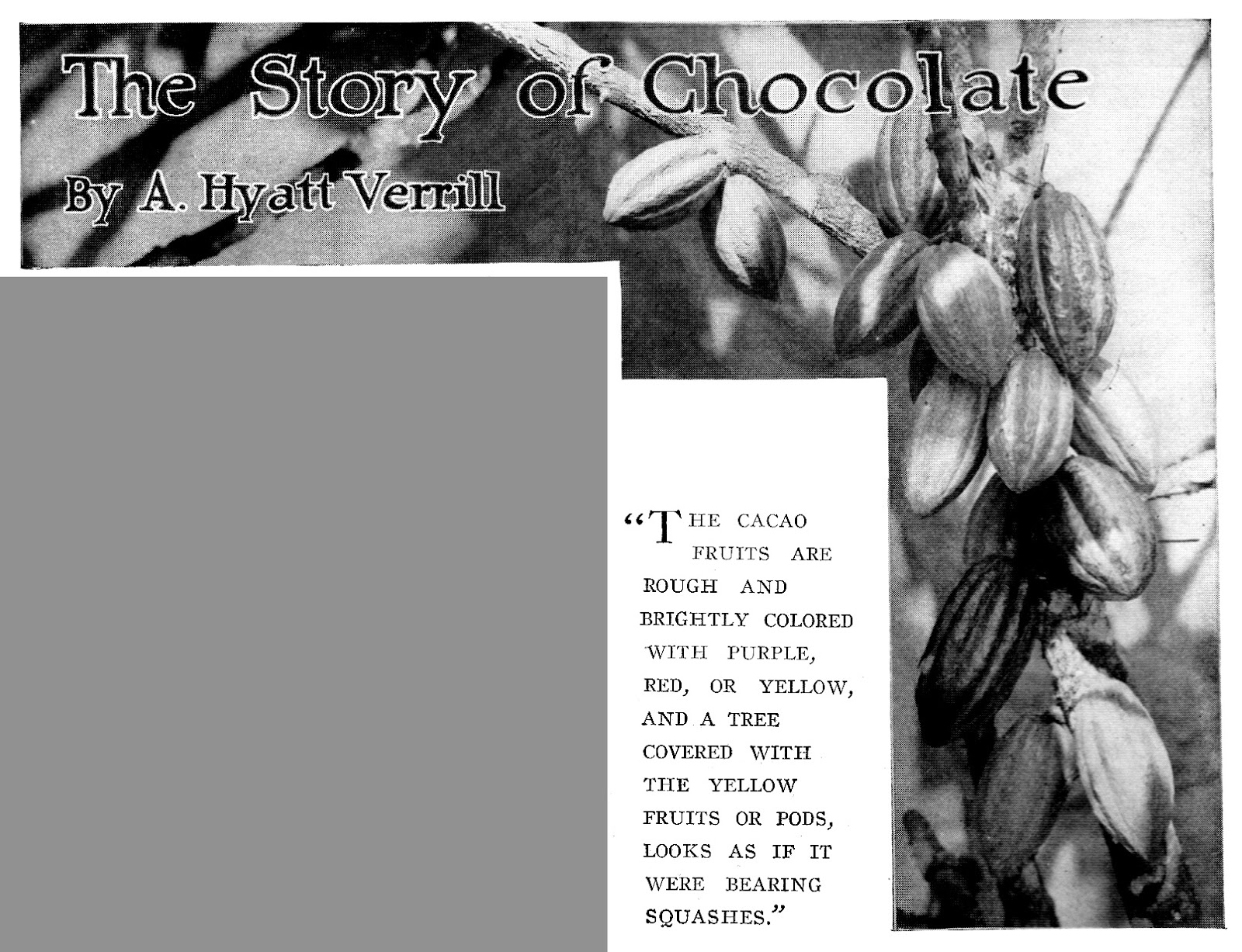
If you have once seen a cacao tree,—for cocoa and chocolate both come from this same tree,—you will never fail to recognize the tree again, for there is no other tree like it. It is a very pretty tree, with rich green leaves, which are bronze red or purple when young, but the queerest thing about it is the way in which the flowers and fruit grow. Instead of budding from the ends of twigs, the cacao flowers sprout directly from the rough bark of the limbs and trunk, and the fruits look very funny hanging everywhere upon the bark as if tacked on. The cacao fruits are rough and brightly colored with purple, red, or yellow, and a tree, covered with the yellow fruits or pods, looks as if it were bearing squashes.
Within the pods is a mass of white slimy pulp, and in this are many brown seeds or beans. The ripe pods are very carefully cut from the trees,—for if broken or torn off, the trees are injured—and, as fast as cut, they are gathered in baskets and carried to some spot where they are dumped in piles to be opened. This is done by men with big sharp knives called machetes (mah-chay'-tayz), and as each pod is split open the pulp and seeds within are dumped into trays or baskets. As soon as a basket is full of the pulp it is carried to the "sweating-house," where the pulp is dumped into boxes with holes in the bottoms and which are covered over with leaves or matting. After a few days they are changed to another box, where they are left for two or three days more, by which time the soft, white pulp has entirely disappeared and the beans have changed to a rich purple color. This process is called "fermenting," and a great deal of care is necessary in fermenting the beans, for, if badly or carelessly done, the cocoa or chocolate will be poor and the beans will not bring a high price.
When the seeds are properly fermented, they are spread upon huge trays to dry, and as the least rain or dampness injures the beans, the drying trays are usually made with wheels running on tracks, so that the trays with their loads of beans may be quickly run under a shed in case of a shower. As the beans are drying in the bright sunshine they are raked about by men who walk among the beans barefooted and shuffle and tread them about to smooth and polish them. On many of the smaller estates the beans are dried on cowhides, placed on the ground, or in trays placed beside the road, and one may often see chickens, dogs, sheep, cattle, and children scratching and playing about in the beans. This seems like a very dirty method of drying anything which is to be used for food, and many people who see the beans with animals or barefooted black men walking about in the trays, think that cocoa or chocolate must be very filthy. But this is not the case, for, when the beans reach the factory or mill to be made into cocoa or chocolate, the outer skins with all the dirt are removed. The cocoa and chocolate we buy in the stores are made in big factories and go through numerous machines and many processes, but in the countries where the cocoa trees grow the people make the chocolate by pounding the beans in a mortar. Then they add sugar and a little cinnamon or vanilla, and mix the ground beans into paste with water and roll them into little sticks or cakes. When these are dissolved in water and milk, they make a very rich but nourishing drink, exactly the same as the Spaniards first tasted in Mexico nearly half a thousand years ago. Nowadays cocoa is grown in so many places and in such large quantities that it is not as valuable as it was once. In former days in the West Indies the theft of cocoa was punishable by death, and in some countries the cocoa beans were used as money.

Saturday, 1 October 2011

Vegetable Life in the Tropics 2

VEGETABLE LIFE IN THE TROPICS

A. HYATT VERRILL

Popular Science, Oct 1, 1898; Researched by Alan Schenker, digitized by Doug Frizzle, October 2011.

In a former article I have already-mentioned the lianas, but doubtless it will prove of interest to many, to learn that the "rattan," so much used in making chairs, baby carriages, etc., is nothing more nor less than one of these long, trailing vines carefully cut and dried. Although rattan itself is very useful,—almost indispensable I might say,—to civilized man, yet many of the lianas are even more valuable in their natural state.

Every one has doubtless noticed the numerous, tiny holes in the end of a piece of rattan. These are really minute tubes running the entire length of the vine and serving as veins through which the sap flows. If you cut off a living liana, a steady stream of sap will issue from these tubes, until the fluid, which is usually of a yellowish or whitish color, coagulates and forms a coating or scab across the injured end, exactly as does the blood of an animal or human being. It is oftentimes poisonous, but in two or three species, it is as transparent, cool and refreshing as the purest spring water. Many a time have I slaked my thirst with this cool and wholesome draught, drawn from Nature's storehouse by a single stroke of my machete.

Strange as the drawing of water from a living vine may appear, there is another tropic vegetable which furnishes a yet stranger drink; this is a handsome palm tree, known as the "travellers' palm." From this palm, when an incision is made, there issues a thick, white sap, looking and tasting much like fresh cows'-milk. This milk is very nutritious, and because of its value to travellers in the tropics, the French Government has set out fine specimens of this Madagascan tree at intervals along all the roads in the French West Indies.

Although coco-nuts and cocoa are both well known in every northern household, yet many people who daily use these two useful products of the tropics, find it difficult or impossible to exactly describe the difference between the two. The coconut is the fruit of a tall and graceful palm tree, a familiar sight in nearly every tropical landscape, and too well known to necessitate any description, whereas the cocoa,—or more properly cacao,—is the powdered seed of a small and handsome tree, bearing no resemblance whatever to the coco-palm.

Perhaps no cultivated tree presents such an odd and striking appearance as the cacao, and nobody who has ever seen one will forget it or mistake it for anything else. The tree itself grows to a height of twenty or twenty-five feet, with a rather smooth and slender trunk, thick, bushy and symmetrical top, and handsome, broad oval leaves of a deep purple or bronze color. Instead of growing at the ends of the branches or twigs as do most blossoms, the cacao flowers bud out directly from the bark of the limbs and trunk. The flowers are small and insignificant, but the fruit, shaped like a cucumber, grows to a large size, in the better varieties 8 or 10 inches in length and 3 or 4 inches in diameter.

Moreover, the fruit is brilliantly colored orange-red and yellow, and under favorable conditions fairly covers the tree, presenting a very odd and beautiful sight. The fruit or pod is completely filled with a soft slimy pulp in which the cacao-beans are imbedded. When first taken from the pods these beans, and the pulp as well, emit a fetid disagreeable odor. After being separated from the pulp, the beans are placed in large wooden trays and exposed to the sun to dry. These trays are usually set on the ground, outside the huts of the natives, and as they are entirely unprotected, are walked over time and again by sheep, pigs, dogs, and bare-footed children. In fact, a necessary part of the curing process, is to have the negro-laborers tread out the beans, in order to impart a rich, brown color and gloss to their surface. Consumers of cocoa, however, need have no compunctions as to eating or drinking cocoa on this account, as the outer skin is removed in the process of manufacture.

A well-known plant in our conservatories and hot-houses is the "century-plant." It is from a variety of this plant that the famous "pulque,"—the favorite beverage of the Mexicans,—is made, but, although the Mexican cultivates the "Agave" or "maguey" mainly for its sap, yet he puts it to many another use. The maguey to the Mexican Indian serves as many useful purposes as does the reindeer to the Laplander. From the juice he procures his drink and liquor, from the roots a coarse but nutritious flour, while from the fibre of the leaves he weaves mats and clothing, which he sews with a thread and needle from the same source.

When the Indian tears his garment, he does not have to wait until he reaches his humble home to repair the damage. Cutting a leaf from the nearest maguey, he pounds away the fleshy, green pulp between two stones, leaving the slender, sharp spine at the point of the leaf and the numerous fine, strong fibres attached thereto intact, when lo and behold, he possesses a needle and bundle of tough threads ready to hand!

Many another strange plant, with as many strange uses, can be found in the tropics of America, but wonderful as they are individually, nothing is so incredible as the remarkable vitality and rapid growth of the tropical trees. In many places the climate is so favorable and the soil so rich and conducive to rapid growth, that almost any stick, if placed upright in the earth, will spring into life.

In some portions of Central America this is particularly noticeable. Here one may see mile after mile of fences, apparently composed of growing trees, which upon a closer examination will prove to have once been barbed wire, the fence-posts having branched out and grown into good-sized trees. It is hardly to be believed that telegraph poles will grow, yet such is the case and many a Central American telegraph pole bears at its top a crown of green-leaved branches, which have sprouted since the last visit of the linemen. Here in the northland, where we expend so much time and labor in trying to make trees grow, we find it hard to imagine it difficult for the Spanish Americans to keep them dead, yet in many of these countries one of the greatest difficulties encountered in railroad work has been to prevent the railway ties from sprouting!

Friday, 23 October 2009

On Chocolate


This week there is Chocolate all over my blog!

I have had “Foods America Gave the World” on my desk for six months now. It is one of Verrill’s vintage nonfiction reads – it is a classic American. For some reason I have never found another book like this, a description of the history of all foods American (see FoodsIntroIndex for the Table of contents and introduction).
I have never understood why Google, etc. had not digitized the book – they have digitized over a dozen of his other books.
He wrote “Foods . . .” in collaboration with Otis W. Barrett a trained botanist and horticulturalist who was the Agricultural Director in Puerto Rico. Barrett also wrote, so I picked up “Tropical Crops” which he penned in 1928.
I have browsed the book and after a bit I started to compare the chapters on Chocolate or cacao, or cocoa.

In 2008, Gail and I visited Central America for most of a month. Nearing the end of the trip, in Copan, Honduras, we saw our first Cocoa (chocolate) tree, complete with a pod of chocolate seeds. It is a long way from these pods to some of the chocolates we see now.
That is what the three blogged titles below explain. I apologize for the clarity of the video, it’s old, and it’s 15 minutes long, but it does a great job in explaining the chocolate process.

Blog Archive

Countries we have visited