 The Four Stragglers – Part1
FEBRUARY 1 1923
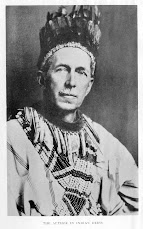
AUTHOR OF “THE MIRACLE MAN’’
Illustrated by Dudley Gloyne Summers
In this story a Cockney flower girl becomes a petted doll.
PROLOGUE The Four of Them
THE crash of guns. A Battle. Dismay. Death. A night of chaos.
And four men in a thicket.
One of them spoke:
“A bloody Hun prison, that’s us! My Heavens! Where are we?”
Another answered caustically:
“Monsieur, we are lost—and very tired.”
A third man laughed. The laugh was short.
“A Frenchman! Where in hell did you come from?” “Where you
and the rest of us came from.” The Frenchman’s voice was polished; his English
faultless. “We come from the tickling of the German bayonets.” The first man
elaborated the statement gratuitously: “I don’t know about you ’uns; but our
crowd was done in good and proper two days ago. Heavens! Ain’t there no end to
’em? Millions! And us running! What I says is let ’em have the blinking Channel
Ports, and let us clear out. I wasn’t noways in favor of mussing up in this
when the bleeding parliament says up and at ’em in the beginning, leastways
nothing except the navy.”
“Drafted, I take it?” observed the third man coolly. There
was no answer.
The fourth man said nothing.
There was a whir in the air. . . .closer. . . .closer; a
roar that surged at the ear drums; a terrific crash near at hand; a tremble of
the earth like a shuddering sob.
The first man echoed the sob:
“Carry on! Carry on! I can't carry on. Not for hours. I’ve
been running for two days. I can’t even sleep.”
“No good of carrying on for a bit,” snapped the third man.
“There’s no place to carry on to. They seem to be all around us.”
“That’s the first one that’s come near us,” said the
Frenchman. “Maybe it’s only—what do you call it?—a straggler.”
“Like us,” said the third man.
A FLARE, afar off, hung and dropped. Nebulous, ghostlike, a
faint shimmer lay upon the thicket. It endured for but a moment. Three men,
huddled against the tree trunks, torn, ragged and dishevelled men, stared into
each others’ faces. A fourth man lay outstretched, motionless, at full length
upon the ground, as though he were asleep or dead; his face was hidden because
it was pillowed on the earth.
“Well, I’m damned!” said the third man, and whistled softly
under his breath.
“Monsieur means by that?” inquired the Frenchman politely.
“Means?” repeated the third man. “Oh, yes! I mean it’s
queer. Half an hour ago we were each a separate bit of driftwood tossed about
out there, and now here we are blown together from the four winds and linked up
as close to each other by a common stake—our lives—as ever men could be. I say
it’s queer.”
He lifted his rifle, and, feeling out, prodded once or twice
with the butt. It made a dull, thudding sound. “What are you doing?” asked the
Frenchman.
“Giving first aid to Number Four,” said the third man
grimly. “He’s done in, I guess. I’m not sure but he’s the luckiest one of the
lot.”
“You’re bloody well right, he is!” gulped the first man. “I
wouldn’t mind being dead, if it was all over, and I was dead. It’s the dying
and the thinking about it I can’t stick.”
“I can’t see anything queer about it.” The Frenchman was
judicial; he reverted to the third man’s remark as though no interruption had
occurred in his train of thought. “We all knew it was coming, this last big—
what do you call it?—push of the Boche. It has come. It is gigantic. It is
tremendous. A tidal wave. Everything has gone down before it; units all broken
up, mingled one with another, a melee. It has been sauve, qui peut for
thousands like us who never saw each other before, who did not even know each
other existed. I see nothing queer in it that some of us, though knowing
nothing of each other, yet having the same single purpose, rest if only for a
moment, shelter if only for a moment, should have come together here. To me it
is not queer.”
“Well, perhaps, you’re right,” said the third man. “Perhaps
adventitious would have been better than queer.”
“Nor adventitious,” dissented the Frenchman. “Since we have
been nothing to each other in the past, and since our meeting now offers us
collectively no better chance of safety or escape than we individually had
before, there is nothing adventitious about it.”
“Perhaps again I am wrong.” There was a curious drawl in the
third man’s voice now. “In fact, I will admit it. It is neither queer nor
adventitious. It is quite—oh, quite!—beyond that. It can only be due to the
considered machinations of the devil on his throne in the pit of hell having
his bit of a fling at us—and a laugh!”
“You’re bloody well right!” mumbled the first man.
“Sacre!” said the Frenchman with asperity. “I don’t
understand you at all.”
The third man laughed softly.
“Well, I don’t know how else to explain it, then,” he said.
“The last time we--”
“The last time!” interrupted the Frenchman. “I did not get a
very good look at you when that flare went up, I’ll admit; but enough so that I
could swear I had never seen you before.”
“Quite so!” acknowledged the third man.

ALIGHT, lurid, intense for miles around opened the
darkness—and died out. An explosion rocked the earth.
“Ammunition dump!” said the Frenchman. “I’m sure of it now.
I’ve never seen any of you before.”
The third man sat with his rifle across his knees now. The
fourth man had not moved from his origina! position.
“I thought you were officers, blimy if I didn’t, from the
way you talked,” said the first man. “Just a blinking Tommy
and a blinking Pi-loo!''
“Monsieur,” said the Frenchman, and there was a challenge in
his voice. “I never forget a face.”
“Nor I,” said the third man quietly. “Nor other things;
things that happened a bit back—after they put the draft into England, but
before they called up the older classes. I don’t know just how they worked it
over here—that is, how some of them kept out of it as long as they did.”
“Sacre!” snarled the Frenchman. “Monsieur, you go too far! And—monsieur appears
to have a sense of humor peculiarly his own—perhaps monsieur wil be good enough
to explain what he is laughing at?”
“With pleasure,” said the third man calmly. “I was laughing
at the recollection of a night, not like this one, though there’s a certain
analogy in it for all that, when an attack was made on—a strong box in a West
End residence in London. Lord Seeton’s, to be precise.”
The first man stirred. He seemed to be groping around him
where he sat.
“Foolish days! Perverted patriotism!” said the third man.
“The fami y jewels, the hereditary treasures, gathered together to be offered
on the altar of England’s need! Fancy! But it was being done, you know. Rather!
Only in this case the papers got hold of it and played it up a bit as a
wonderful example, and that’s how three men, none of whom had anything to do
with the otners, got hold of it too—no, I’m wrong there. Lord Seeton’s valet
naturally had inside information.”
“Blimy!” rasped the first man suddenly. “A copper in karky!
That’s what! A bloody, sneaking swine!”
It was inky black in the thicket. The third man’s voice cut
through the blackness like a knife.
“You put that gun down! I'll do all the gun handling there’s
going to be done. Drop it!”
A SNARL answered him—a snarl, and the rattle of an YY object
falling to the ground.
“There were three of them,” said the third man composedly.
“The valet, who hadn’t reached his class in the draft; a Frenchman, who spoke
marvellous English, which is perhaps after all the reason why he had not yet,
at that time, served in France; and—and some one else.” “Monsieur,” said the
Frenchman silkily, “you become interesting.”
“The curious part of it is,” said the third man, “that each
of them in turn got the swag, and each of them could have got away with it with
hardly any doing at all, if it hadn’t been that in turn each one chivied the
other. The Frenchman took it from the valet, as the valet, stuffed like a
pouter pigeon with diamonds and brooches and pendants and little odds and ends
like that, was on his way to a certain pinch-faced fence named Konitsky in a
slimy bit of neighborhood in the East End; the Frenchman, who was an Englishman
in France, took the swag to a strange little place in a strange little street,
not far from the bank of the Seine, the place of one Pere Mouche, a place that
in times of great stress also became the shelter and home of this same
Frenchman, wTho—shall I say?—I believe is outstandingly entitled to the honor
of having raised his profession to a degree of art unapproached by any of his
confreres in France to-day.”
“Sacre nom!” said the Frenchman with a gasp. “There is only
one Englishman who knew that, and I thought he was dead. An Englishman beside
whom the Frenchman you speak of is not to be compared. You are——’’
‘7 haven't mentioned any names,” said the third man
smoothly. “Why should you?”
“You are right,” said the Frenchman. "Perhaps we have
already said too much. There is a fourth here.”
'‘No,” said the third man. 'T had not forgotten him.” He toyed
with the rifle on his knee. "But I had thought perhaps you would have
recognized the valet’s face.” "Strike me pink!” muttered the first man.
“So Frenchy’s the blighter that did me in, was he!”
‘Tt is the uniform, and the dirt perhaps, and the very poor
light,” said the Frenchman apologetically. “But you — pardon, monsieur, I mean
the other of the three—I did not see him: and monsieur will perhaps understand
that I am deeply interested in the rest of the story.”
The third man did not answer. A sort of momentary weird and
breathless silence had settled on the thicket, on all around, on the night,
save only for the whining of some on-coming thing through the air. Whine. . .
.whine tc-ksae. The nerves, tautened, loosened, were jangling things. The third
man raised his rifle. And somewhere the whining shell burst. And in the thicket
a minor crash; a flash, gone on the instant, eye-blinding.
The first man screamed out :
"Great Heavens! What have you done?”
"I think he was done in anyway,” said the third man calmly.
"It was as well to make sure.”
The first man whimpered.
"Monsieur," said the Frenchman, “I have always
heard that you were incomparable. I salute you! As you said, you had not
forgotten. We can speak at ease now. The rest of the story—•”
The third man laughed.
"Come to me in London—after the war,” he said, “and l
will tell it to you. And perhaps there will be—other things to talk about.”
"I shall be honored.” said the Frenchman. “We three!
I begin to understand now. A house should not be divided
against itself. Is it not so? We should go far! It is fate to-night that—”
“Or the devil,” said the third man.
My Heavens!” The first man began to laugh—a •racked, jarring
laugh. “After the war, the blinking war —after hell! There ain’t no end, there
ain’t no—”
And then a flare hung again in the heavens, and in the
thicket three men sat huddled against the tree trunks, tom. ragged and
dishevelled men, but they were net staring into each others’ faces now;
---------------------
they were staring, their eyes magnetically attracted, at a
spot on the ground where a man, a man murdered, should be lying.
But the man was not there.
Th» fourth man wa3 gone.
BOOK I.
SHADOW YARNE
CHAPTER I.
Three Yearn Later
T'HE East End being, as it were, more akin to the technique
and the mechanics of the thing, applauded the •’raftsmanship; the West End. a
little grimly on the part of the men, and with a loquacity not wholly free from
nervousness on the part of the women, wondered who would be next.
“The cove as is runnin’ that show," said the East End,
with its tongue delightedly in its cheek, “knows ’is wye abaht. Wish I wa3
’im!"
“The police are nincompoops!” said the masculine West End.
“Absolutely!”
“Yes, of course! It’s quite too impossible for words!” said
the female of the West End. “One never knows when one’s own—do let me give you
some tea, dear Lady Wintern
From something that had merely been of faint and passing
interest, a subject of casual remark, it had grown steadily, insidiously, had
become conversationally epidemic. All London talked; the paper's
talked—virulently. Alone in that great metropolis, New
Scotland Yard was silent, due, if the journals were to be
believed, to the fact that that world-famous institution was come upon a state
of hopeless and atrophied senility.
With foreknowledge obtained in some amazing manlier, with
ingenuity, with boldness, and invariably with success, a series of crimes,
stretching back several years, had been, were being, perpetrated with insistent
regularity. These crimes had been confined to the West End of London, save on a
few occasions when the perpetrators had gone slightly afield—because certain
wealthy WestEnders had for the moment changed their accustomed habitat. The
journals at spasmodic intervals printed a summary of the transactions. In
jewels, and plate, and cash, the figures had reached an astounding Jotal, not
one penny of which had ever been recovered or traced. Secret wall safes, hidden
depositories of valuables opened with obliging celerity and disgorged their
contents to some apparition which immediately vanished. There was no clu?. It
simply happened again and again. Traps had been set with patience and
considerable artifice. The traps had never been violated. London was accustomed
to crimes, just as any great city was; there were hundreds of crimes committed
in London; but these were of a genre all their own, these were distinctive,
these were not to be confused with other crimes, or their authors with other
criminals.
And so London talked—-and waited.
IT WAS raining—a thin drizzle. The night was uninviting
without; cozy within the precincts of a certain well known West End club, the
Claremont, to be exact. Two men sat in the lounge,in a little recess by the
window. One, a man of perhaps thirty-three, of athletic build, with short-cropped
black hair and clean-shaven face, a onetime captain of territorials in the late
war, and though once known on the club membership roll as Captain Francis
Newcombe was to be found there now as Francis Newcombe, Esquire; the other, a
very much older man, with a thin, gray little face and thin, gray hair, would,
on recourse to the club roll, have been found to be Sir Harris Greaves, Bart.
The baronet made a gesture with his cigar, indicative of
profound disgust.
“Democracy!” he ejaculated. “The world safe for demmocracy!
I am nauseated with that phrase. What does it mean? What did it ever mean? We
have had three years now since the war which was to work that marvel, and I
have seen no signs of it yet. So far as I--”
Captain Francis Newcombe interrupted the Baronet— “And yet,”
he said, “I embody in my person one of those signs. You can hardly deny that,
Sir Harris. Certainly I would never have had, shall I call it the distinction,
of being admitted to this club had it not been for the democratic leaven
working through the war. You remember, of course? An officer and a gentleman!
We of England were certainly consistent in that respect.While one was an
officer one was a gentleman. The clubs were all pretty generally thrown open to
officers during the war. Some of them came from the Lord knows where. T. G’s.
they were called, you remember—Temporary Gentlemen. Afterward—but of course
that’s another story so far as most of them were concerned. Take my own case. I
enlisted in the ranks, and toward the latter end of the war I obtained my
commission I became a T. G. And as such I enjoyed the privileges of this club.
I was eventually, however, one of the fortunate ones. At the close of the war
the club took me on its permanent strength and, ergo, I became a—Permanent
Gentleman. Democracy! Private Francis Newcombe— Captain Francis
Newcombe—Francis Newcombe, Esquire.”
A RATHER thin case!” smiled the baronet. “What I was about
to say when you interrupted me was that, so far as I can see, all that the
world has been made safe for by the war is the active expression of the
predatory instinct in man. I refer to the big interests, the trusts; to the
radical outcroppings of certain labor elements; to—yes!”—he tapped the
newspaper that lay on the table beside him— “the Simon-pure criminal such as
this mysterious gang of desperadoes that has London at its wits’ ends, and
those of us who have anything to lose in a state of constant apoplexy.”
Captain Francis Newcombe shook his head.
“I think you’re wrong, sir,” he said judicially. “It isn’t
the aftermath of the war, or the result of the war. It is the war, of which the
recent struggle was only a phase. It’s been going on since the days of the cave
man. You’ve only to reduce the nation to the terms of the individual, and you have
it. A nation lusts after something which does not belong to it. It proceeds to
take it by force. If it fails it is punished. That is war. The criminal lusts
after something. He flings down his challenge. If he is caught he is punished.
That is war. What is the difference?” The baronet sipped at his Scotch and
soda.
“H’m! Which brings us?” he suggested.
“Nowhere!” said Captain Francis Newcombe promptly. “It’s
been going on for ages; it’ll go on for all time. Always the individual
predatory; inevitably, in cycles, the cumulative individual running amuck as a
nation. Why, you, sir, yourself, ’ a little while ago when somebody here in the
room made a remark to the effect that he believed this particular series of
crimes was directly attributable to the war because it would seem that some one
of ourselves, some one who has the entree everywhere, who, through being
contaminated by the filth out there, had lost poise and was probably the guilty
one, meaning, I take it, that the chap finding himself in a hole wasn’t so nice
or particular in his choice of the way out of it as he would have been but for
the war—you, Sir Harris, denied this quite emphatically. It—er —wouldn’t you
say, rather bears me out?”
The old baronet smiled grimly.
“Quite possibly!” he said. “But if so, I must confess that
my conclusion was based on a very different premise from yours. In fact, for
the moment, I was denying the theory that the criminal in question was one of
ourselves, quite apart from any bearing the war might have had upon the matter.”
The ex-captain of territorials selected a cigarette with
care from his case.
“Yes?” he inquired politely. The old baronet cleared his
throat. He glanced a little whimsically at hi? companion.
“It’s been .a hobby, of course, purely a hobby; but in an
amateurish sort of way as a criminologist I have spent a great deal of time and
money in—”
“By Jove! Really!” exclaimed Captain Newcombe. “I didn’t
know, Sir Harrris, that you—He paused suddenly in confusion. “That’s anything
but a compliment to your reputation though, I’m afraid, isn’t it? Á bit raw of
me! I—I’m sorry, sir.”
“Not at all!” said the old baronet pleasantly; and then,
with a wry smile: “You need not feel badly. In certain
quarters much more intimate with the subject than you could
be supposed to be, I am equally unrecognized.”
“It’s very good of you to let me down so easily,” said the
ex-captain of territorials contritely. “Will you go on, sir? You were saying
that you did not believe these crimes were being perpetrated by one in the same
sphere of life as those who were being victimized. Why is that, sir? The theory
seemed rather logical.”
“Because,” said the old baronet quietly, “I believe I know
the man who is guilty.”
The ex-captain of territorials stared.
“Good Heavens, sir!” he gasped out. “You—you can’t mean
that?”
“Just that!” A grim brusqueness had crept into the old
baronet’s voice. “And one of these days I propose to prove it!”
“But, sir”—the ex-captain of territorials in his amazement
was still apparently groping out for his bearings— “in that case, the
authorities—surely you—”
“They were very polite at Scotland Yard—very!” The old
baronet smiled dryly again. “That was the quarter to which I referred. Soc’ally
and criminologically—if I may be permitted the word—I fear that the Yard regards
me from widely divergent angles. But damme, sir”—he became suddenly
irascible—“they’re too self-sufficient! I am a doddering and interfering old
idiot! But nevertheless I am firmly convinced that I am right, and they haven’t
heard the end of the matter—if I hrve to devote every penny I’ve got to
substantiating my theory and bringing the guilty man to justice!”
Captain Francis Newcombe coughed in an embarrassed way.
The old baronet reached for his tumbler, and drank
generously. It appeared to soothe his feelings.
“Tut, tut!” he said self-chidingly. “I mean every word of
that—that is, as to my determination to pursue my own investigations to the
end; but perhaps I have not been wholly fair to the Yard. So far, I lack proof;
I have only theory. And the Yard too has its theory. It is a very common
disease. The theory of the Yard is that the man I believe to be guilty of these
crimes of to-day died somewhere around the middle stages of the war.”
“By Jove!” Captain Francis Newcombe leaned sharply forward
on the arms of his chair. “You don’t say!”
npHE old baronet wrinkled his brows, and was silent for a
moment.
“It’s quite extraordinary!” he said at last, with a puzzled
smile. “I can’t for the life of me understand how I got on this subject, for I
think we were discussing democracy—but you appear to be interested.”
“That is expressing it mildly,” said the ex-captain of
territorials earnestly. “You can’t in common decency refuse me the rest of the
story now, Sir Harris.”
“There is no reason that I know of why I should.” said the
old baronet. “Did you ever hear of a man called Shadow Varne?”
Captain Francis Newcombe shook hi? head.
“No,” he said.
“Possibly, then,” said the old baronet, “you may
remembertherobbery atLord Seeton’s place? It was during the war.”
“No,” said the other thoughtfully. “I can’t say I do. I
don’t think I ever heard of it.”
“Well, perhaps you wouldn’t,” nodded the old baronet. “It
happened at a time when, from what you’ve said, I would imagine you were in the
ranks, and—however, it doesn’t matter. The point is that the robbery at Lord
Seeton’s is amazingly like, I could almost say, each and every one of this
series of robberies that is taking place today. The same exact fore-knowledge,
the hidden wall safe, or hiding place, or repository, or whatever it might be,
that was supposedly known only to the family; the utter absence of any clue;
the complete disappearance of —shall we call it?—the loot itself. There is only
one difference. In the case of Lord Seeton, the jewels—it was principally a jewel
robbery—were eventually recovered. They were found in the possession of Shadow
Varne. But”—the old baronet smiled a little grimly again— “the police were not
to blame for that.”
CIR HARRIS GREAVES, amateur criminologist, re^ verted to his
tumbler of Scotch and soda.
Captain Francis Newcombe knocked the ash from his cigarette
with little taps of his forefinger.
“Yes?” he said.
“It’s a bit of a story,” resumed the old baronet slowly.
“Yes, quite a bit of a story. I do not know how Shadow Varne got to Paris; I
simply know that, had he not taken sick, neither he nor the jewels would
everhave been found. But perhaps I am getting a little too far ahead. I think I
ought to say that Shadow Varne, though he had never actually up to this time
been known in a physical sense to the police, had established for himself a
widespread and international reputation. His name here, for instance amongst
the criminal element of our own East End wasa sort of Talisman, something to
conjure with, as it were though no one could ever be found who had seen or
could describe the man. I suppose that is how he got the name of Shadow. Some
must have known him, of course, but they were tight lipped; and even these, I
am inclined to believe, would never have been able to lay fingers on him, even
had they dared. He was at once an inscrutable and diabolical character. I would
say, and in this at least Scotland Yard will agree with me, he seemed like some
evil, unembodied spirit upon whom one could never come in a tangible sense, but
that hovered always in the background, dominating, permeating with his
personality the criminal world.”
“But if this is so, if no one knew him. or had ever seen
him.” said the ex-captain of territorials in a puzzled way, “how was he
recognized as Shadow Varne in Paris?”
“I am coming to that,” said the old baronet quietly. “As you
know very well, in those days they were always poking into every rat hole in
Paris for draft evaders. That is how they stumbled on Shadow Varne. They dug
him out of one of those holes, a very filthy hole, like a rat —like a very sick
rat. The man was raving in delirium. That is how they knew they had caught
Shadow Varne— because in his delirium he disclosed his identity. And that is
how they recovered Lord Seeton’s jewels.”
“My word!” ejaculated Captain Francis Newcombe. “A bit
tough, I call that! My sympathies are almost with the accused!”
“I am afraid I have failed to make you understand the
inhuman qualities of the man,” said the old baronet tersely. “However, Shadow
Varne was even then too much for them —at, least temporarily. A few nights
later
he escaped from the hospital; but he was still too sick a
man to stand the pace, and they were too close on his heels. He had possibly,
all told, a couple of hours of liberty, running, dodging through the streets of
Paris. The chase ended somewhere on the bank of tne Seine. He was fired at here
as he ran, and though quite a few yards in the lead, he appeared to have been
hit, for he was seen to stagger, fall, then recover himself and go on. He refused
to halt. They fired and hihim again—or so they believed. He fell to the
ground—and rolled over the edge into the water. And that was the last that was
ever seen of him.”
“My word!” ejaculated the ex-captain of territorials again.
“That’s a nice end! And I must say, -with all due deference to you, Sir Harris,
that I can’t see anything wrong with Scotland Yard’s deduction. I fancy he’s
dead, fast enough.”
“Yes,” said the old baronet deliberat ly, “I imagined you
would say so; and I, too, would agree were it not for two reasons. First, had
it been any other man than Shadow Varne; and, second, that the body was never
recovered.”
“DUT,” objected Captain Francis Newcombe, “if, as you
believe, the man is still carrying on, having been identified once, he would,
wouldn’t you say, be recognized again?”
“Not at all!” said the oldbaronet decidedly. “You must take
into account the man’s sick and emaciated condition when he was caught, and the
subsequent hospital surroundings. Let those who saw him then see the same man
to-day, robust, in health, and in an entirely different atmosphere, locality
and environment! Recognized? I would lay long odds against it, even leaving out
of account the man’s known ingenuity for evading recognition.”
The ex-captain of territorials nodded thoughtfully.
“Yes,” he said, “that is quite possible; but,even granting
that he is still alive, I can’t see—”
“Why should I believe he is at the bottom of what is going
on to-day here in London?” supplied the old baronet quickly. “Perhaps
intuition, perhaps the mystery about the man that has interested me from the
time I first heard of him in the early days of the war, and which has ever
since been a fascinating study with me, has something to do with it. I told you
to begin with that my proof was theory. But I believe it. I do not say he is
alone in this, or was alone in the Lord Seeton affair; but he is certainly the
head and front and brains of whatever he was, or is, engaged in. As for the
similarity of the cases, I will admit that might be pure coincidence, but we
know that Shadow Varne did have the Seeton jewels in his possession. The
strongest point, however, that I have to offer in a tangible sense, bearing in
mind the man himself and his hideously elusive propensities, is the fact that
there is no absolute proof of his death. Why wasn’t his body recovered? You
will answer me probably along the same lines that the Paris police argued and
that were accepted by Scotland Yard. You will say that it was dark, that the
body might not have come to the surface immediately, and under the existing
conditions, by the time they procured a boat and began their search, it might
easily be mised. Very good! That is quite possible. But why, then, was not the
body eventually recovered in two or three days, say—a week, if you like? You
will say that this would probably be very far indeed from being the first
instance in which a body was never recovered from the Seine. And here, too, you
would be quite right. But I do not believe it. I do not believe it was a dead man
or a man mortally wounded, or a man wounded so badly that he must inevitably
drown, who pitched helplessly into the water that night. I believe he did it
voluntarily, and with considered cunning, as the only chance he had. Go into
the East End. Listen to the stories you will hear about him. The world does not
get rid of such as he so easily! The man is not human. The crimes he has
committed would turn your blood cold. He is the mos" despicable. the most
wanton thing that I ever heard of. He would kill with no more compunction than
you would break in two that match you are holding in your hand. Where he came
from God alone knows, and—”
A club attendant had stopped beside the old baronet’s chair.
“Yes?” said the old baronet.
"I beg pardon. Sir Harris, but your car is here,”
announced the man.
“Very good! Thank you!” The old baronet drained his glass
and stood up. “Well, you have heard the story, captain.” he said with a dry
smile. "I shall not embarrass you by asking you to decide between Scotland
V ard and myself, but I shall at least expect you to admit that there is some
slight justification for my theory.”
HT HE ex-captain of territorials, as he rose in courtesy,
* shook his head quietly.
“If I felt only that way about it,” he said slowly, “I
should simply thank you for a very interesting story and your confidence. As it
is. there is so much justification I feel impelled to say to you that, if this
man is what you describe him to be. is as dangerous as you say he is, I would
advise you. Sir Harris, in all seriousness, to leave him —to Scotland Yard.”
"What!” exclaimed the old baronet sharply. “And let him
go free! No, sir! Not if every effort I can put forth will prevent it! Never,
sir—under any circumstances!”
Captain Francis Newcomb? smiled gravely, and shrugged his
shoulders.
“Well, at least, I felt I ought to say it,” hesaid. “Good
night. Sir Harris—and thank you so much!”
“Good-night, captain!” replied the old baronet cordially. as
he turned away. “Good-night to you, sir!”
Captain Francis Newcombe watched the other leave the room,
then he walked over to the window. The drizzle had developed into a downpour,
with gusts of wind that now pelted the rain viciously at the window’ panes. He
frowned at the streaming glass.
A moment later, as he moved away from the window, he
consulted his watch. It was a quarter past eleven. Downstairs he secured his
hat and stick, and spoke to the doorman.
“Get a taxi, please, Martin,” he requested, “and tell the
chap to drive me home.”
He lighted a cigarette as he w’aited, and then under the
shelter of the doorman’s umbrella entered the taxi.
It was not far. The taxi stopped before a flat in a
fashionable neighborhood that was quite in keeping with the fashionable club
Captain Francis Newcombe had just left. His man admitted him.
“It’s a filthy night, Runnells,” said the ex-captain of
territorials.
Runnells slammed the door against a gust of wind.
“You’re bloody well right!” said Runnells.
CHAPTER 2 An Iron in the Fire
IT WAS a neighborhood of alleyways and lanes of ferocious
darkness: of ill-lighted, baleful streets, of shadows; and of doorways where no
doors existed, black, cavernous and sinister openings to inner chambers of
misery. of squalid want, of God-knows-what.
It was the following evening, and still early—barely eight o'clock.
Captain Francis Newcombe turned the corner of one of these gloomily lighted
streets, and drew instantly back to crouch, as an animal crouches before it
springs, in the deep shadow’s of a wretched tenement building. Light footfalls
sounded; came nearer. Two forms, skulking, yet moving swiftly, came into sight
around the corner.
Captain Francis Newcombe sprang. His fist crashed with
terrific force to the point of an opposing jaw. A queer grunt—and one of the
two men sprawled his length on the pavement and lay quite still. Captain
Francis Newcombe’s movements were incredibly swift. His left hand was at the
second man’s throat now, and a revolver was shoved into the other’s face.
The tableau held for a second.
“A bit of a ‘eushing’ expedition, was it?” said the
excaptain of territorials calmly. “1 looked a likely victim, didn’t I? Just the
usual bash on the head with a neddy, and then the usual stripping even down to
the boots if they were good enough—and mine were good enough, eh? And I might
get over that bash on the head, or my skull might be cracked; I might wake up
in one of your filthy passageways here, or I might never wake up! What would it
matter? It’s done every night. You make your
living that w’ay. And who’s to know who did it?” His grip
tightened suddenly on the other’s throat. “Your kind are better dead,” said
Captain Francis Newcombe, and there was something of horrible callousness in
his conversational tones. “You lack art; you have no single redeeming feature.”
It was as though now he were debating in cold precision with himself. “Yes, you
are much better dead!”
“Gor’blimy, guv’nor, let me go,” half choked, half
WHO is the FOURTH Straggler? That is the tantalizing,
mystifying puzzle in this story. Can you guess it before the author lays the secret
before you? This is not a war story. It is the first novel the author of “The
Miracle Man” has written since “Pawned.”
whined the other. “ We wasn’t goin’ to touch you. No fear!
Me an’ me mate was just goin’ round to the pub for an ’arf-pint—”
“It would make a noise,” said Captain Francis Newcombe
unemotionally. “That is the trouble. I should have to clear out of here, and be
put to the annoyance of waiting a half hour or so before I could come back and
attend to my own affairs. That’s the only reason I haven’t fired this thing
off, and I’m not sure that reason’s good enough. But it’s a bit of a fag to
argue it out, so— don’t move, you swine, or that’ll settle it quicker still!”
His fingers, from the other’s throat, searched his own waistcoat pocket, and
produced a silver coin. “Heads or tails?” he inquired casually. “You call it.”
“My Gawd, guv’nor,” whimpered the man, “yer don’t mean that!
Yer wouldn’t shoot a cove down like that, would yer? Yer wouldn’t do that!”
“Heads or tails?” The ex-captain of territorials’ voice was
bored. “I shan’t ask you again.”
The light was poor. The man’s features, save that they were
dirty and unshaven, were almost indistinguishable; but the eyes roved
everywhere in hunted fear, and he lumped the fingers of one hand together and
plucked with them in an unhinged way at his lips.
“I—no!” gurgled the man. “My Gawd!” His words were thick.
His fingers, plucking, clogged his lips. “I carn’t— —” The mechanism of the
revolver intruded itself—an unemotional click. The man screamed out. “No,
no—wait, guv’nor! Wait!” he screamed. “’Eads! Gawd! ’Eads!”
CAPTAIN FRANCIS NEWCOMBE examined the coin; the sense of
touch, as he rubbed his fingers over it, helping out the bad light.
“Right you are!” he said indifferently. “Heads it is! You’re
in luck!” He tossed the coin on the pavement. “I’d keep that, if I were you.”
His voice was still level, still bored. “You haven’t got anything, of course,
to do any sniping with, for anything as valuable as that would never remain in
the possession of your kind for more than five minutes before you would have
pawned it.” He glanced at the prostrate form of the thug’s companion, who was
showing some signs of returnmg consciousness. “I fancy you’ll find his jaw’s
broken. Better give him a leg up,” he said, and, turning on his heel, walked on
down the street.
Captain Francis Newcombe did not look back. He traversed the
murky block, turned a corner, turned still another, and presently made his way
through an entrance, long since doorless, into the hallway of a tenement house.
It was little better than a pit of blackness here, but his movements were
without hesitation, as one long and intimately familiar with his surroundings.
He mounted a ricketty flight of stairs, and, without ceremony, opened the door
of a room on the first landing, entered, and closed the door behind him. The
room had no light in it.
“Who’s there?” demanded a weak, querulous, female voice.
The visitor made no immediate reply. The place reeked with
the odor of salt fish; the air was stale, and an offence that assaulted the
nostrils. Captain Francis Newcombe crossed to the window, wrenched at it, and
flung it viciously open. I
A protracted fit of coughing came from a corner behind him.
“Didn’t I tell you never to send for me?” he snapped out in abrupt
menace.
“ ’Ow, it’s you, is it?” said the woman’s voice. “Well,I
ain’t never done it afore, ’ave I? Not in three years I ain’t.”
“You’ve done it now; you’ve done it to-night—and that’s once
too often!” returned Captain Francis Newcombe savagely. “And before I’m through
with you, I’ll promise you you’ll never do it again!”
“No,” she answered out of the darkness. “I won’t never do it
again, an’ that’s why I done it to-night— ’cause I won’t never ’ave another
chance. The doctor ’e
says he is sure I ain’t goin’ to be ’ere in the mornin’. .
Captain Francis Newcombe lit a match. It disclosed a tallow
dip and a piece of salt fish on a battered chair— —and, beyond, the shadowy
outline of a bed. He swept the piece of fish to the floor out of his way,
lighted the candle, and, leaning forward, held it over the bed.
A woman’s face stared back at him in the flickering light; a
curiously blotched face, and one that was emaciated until the cheek bones
seemed the dominant feature. Her dull, almost glazed, gray eyes blinked
painfully in even the'candle rays; a dirty woollen wrap was fastened loosely
around a scrawny neck, and over this there straggled strands of tangled and
unkempt gray hair.
“Well, I fancy the diagnosis isn’t far wrong,” said the
ex-captain of territorials critically. “I’ve been too good to you— and
prosperity’s let you down. For three years you haven’t lifted a finger except
to carry a glass of gin to your lips. And now this is the end, is it?”
THE woman did not answer. She breathed heavily. The hectic
spots on her cheeks burned a little wider. Captain Francis Newcombe set the
candle back on the chair, and, with his hands in his pockets, stood looking at
her. His face exhibited no emotion.
“I haven’t heard yet why you sent for me,” he said sharply.
“Polly,” she said thickly. “I wanter know wot abaht Polly?”
Captain Francis Newcombe smiled without mirth.
“My dear Mrs. Wickes,” he said evenly, “you know all about
Polly. I distinctly remember bringing you the letter she enclosed for you in
mine ten days ago, because I distinctly remember that after you had read it I
watched you tear it up. And as your education is such that you cannot write in
return, I also distinctly remember that you gave me messages for her which I
was to incorporate in my own reply. Since then I have not heardfromPolly.” The
woman raised herself suddenly on her elbow, and, her face contorted, shook her
fist.
“My dear Mrs. Wickes!” she mimicked furiously through a
burst of coughing. “Yer a cool ’un, yer are. That’s wot yer says, yer stands
there an’ smiles like a bloomin’ hangel, an’ yer says, ‘my dear Mrs. Wickes!’
Curse yer, I knows more abaht yer than yer thinks for. Three years I’ve watched
yer, an’ hif I’ve kept my tongue to meself that don’t say I don’t know wot I
knows.” “Indeed!” Captain Francis Newcombe shrugged his shoulders. He smiled
slightly. “Then I should say, if it were true, that it is sometimes dangerous,
Mrs. Wickes— to know even a little about some things.”
The woman rocked in the bed, and hugged her thin bosom
against a spasm of coughing that came near to strangulation.
“Bah!” she shouted, when she could get her breath. “I ain’t
afraid of yer any more. Curse yer, I’m dyin’ anyhow! It’s nothin’ to you wiv
yer smug smile, except yer glad I’ll be out of the wye—an —an’ it ain’t nothin’
to me either. I’m sick of it all, an’ I’m glad, I am; but afore I goes I wanter
know wot abaht Polly. Wot’d yer tyke her awye for three years ago?”
“For the price of two quid paid weekly to a certain Mrs.
Wickes, who is Polly’s mother,” said Captain Francis Newcombe composedly; “and
with which the said Mrs. Wickes has swam in gin ever since.”
Mrs. Wickes fell back exhausted on her pillow.
“Wot for?” she whispered in fiere 3 insistence. “I wanter
know wot for?”
“Well,” said Captain Francis Newcombe, “even at fifteen
Polly was an amazingly pretty little girl—and she showed amazing promise. I’m
wondering how she has developed. Extremely clever youngster! Don’t see, in
fact, Mrs. Wickes, where she got it from! Not even the local desecration of the
king’s English—in spite of the board schools! Amazing! We couldn’t let a flower
like that bloom uncultivated, could we?”
The woman was up in the bed again.
A GUTTER brat!” she cried out. “An’ you says send ’er to
school wiv the toffs in America, ’cause there wouldn’t be no chance of doin’
that ’ere at 'ome; an I says the toffs don’t tyke ’er kind there neither. An
you says she goesasyerward,an’yer can get ’erin,onlyshe ’as to forget abaht
these ’ere London slums. An’ she ain’t to write no letters to me except through
you, ’cause hif any was found down ’ere they’d turn their noses up over there
an’ give Polly the bounce.”
“Quite right, Mrs. Wickes!” said Captain Francis Newcombe
imperturbably. “And for three years Polly has been in one of the most exclusive
girls’ seminaries in America—and incidentally I might say I am arranging to go
over there shortly for a little visit. If her photographs are to be relied
upon, she has more than fulfilled her early promise. A very beautiful young
woman, educated, and now, Mrs. Wickes—a lady. She has made a circle of friends
among the best and the wealthiest. Why even now, with the summer holidays
coming on, you know, I understand she is to be the guest of a school friend in
a millionaire’s home. Think of that, Mrs. Wickes! What more could any woman ask
for her daughter? And why should you. for instance, ask more to-night? Why this
eleventh hour curiosity? You agreed to it all three years ago, Mrs. Wickes—for
two quid a week.”
“Yes,” said the woman passionately, “an’ I’m probably goin’
to ’ell for it now! I knowed then yer wasn’t doin’ this for Polly’s sake, an’
in the three years I kept on knowin’ yer more an’ more for the devil you are.
But I says to meself that I’m ’ere to see Polly don’t come to no harm, but—but
I ain’t goin’ to be ’ere no more, an’ that’s wot I wants to know to-night. An’
I asks yer, wot’s yer game?”
“Really!” Captain Francis Newcombe shrugged his shoulders
again. “This isn’t very interesting, Mrs. Wickes. And in any case, I fail to
see what you are going to do about it, or what lever you could possibly bring
to bear to make me divulge what you are pleased to imagine is some base and
ulterior motive in what I have done. It is quite well known among Captain
Newcombe’s circle that he is educating a ward in America. It is—er—rather to
his credit, is it not?”
“Curse yer wiv yer smooth tongue!” said Mrs. Wickes wildly.
“I knows! I knows yer got a game—some dirty game wiv Polly in it. Yer clever,
yer are—an’ yer ain’t human. But yer won’t win, an’ all along Polly. She won’t
do nothin’ that ain’t straight, she won’t. Polly ain’t that kind.”
“Oh, as to that, and granting my wickedness,” said Captain
Francis Newcombe indifferently, “I shouldn’t worry. Having you in mind, Mrs.
Wickes, I fancy even that would be quite all right—blood always tells, you
know.”
“Blood! Blood’ll tell, will it?” The woman was rocking in
the bed again. She burst into harsh laughter. It brought on another, and even
more severe, strangling fit of coughing. “Blood’ll tell, will it?” she choked,
as she gasped for breath. “Well, so it will! So it will!”
Captain Francis Newcombe stared at her from narrowed eyes.
“What do you mean by that?” he demanded sharply.
But Mrs. Wickes had fallen back upon her pillow in utter
exhaustion. She lay fighting painfully, pitifully now for every breath.
“What do you mean by that?” repeated Captain Francis
Newcombe still more sharply.
AND then suddenly, as though some strange premonition were
at work, all fight gone from her, the woman threw out her arms in a broken gesture
of supplication
“I’m a wicked woman, a bloody wicked ’un I’ve been. Gawd
forgive me for it!” she whispered. “Polly ain’t no blood of mine.”
Captain Francis Newcombe rested his elbows on the back of
the chair, and smiled coolly.
“I think,” he said evenly, “it’s my turn now to ask what the
game is? That’s a bit thick, isn’t it—after three years?”
The hectic spots had faded from the woman’s face, and an
ominous grayness was taking their place. She was crying now.

“It’s Gawd’s truth,” she said. “I was afraid yer wouldn’t
’ave give me the two quid a week hif yer’d known I ’adn’t no ’old on ’er. Polly
don’t know. No one knows but me, an’—” Her voice trailed off through weakness.
Captain Francis Newcombe, save that his eyes had narrowed a
little more, made no movement. He watched her without comment as she struggled
for her breath again.
“I didn’t mean to ’ave no fight wiv yer, Gawd knows I
didn’t. Gawd knows I didn’t send for yer for that. I only
wanted to ask yer wot abaht Polly, an’ to ask yer to be good to ’er, an’— an’
tell yer wot I’m tellin’ yer now afore it’s too late. “An’—an’—” She raised
herself with ^ a sudden convulsive effort to her elbow. “Gawd, I—I’m goin’
now."
With a swift movement Captain Francis Newcombe whipped a
flask from his pocket, and held it to the woman’s lips.
She swallowed a few drops with difficulty, and lay still.
Presently Mrs. Wickes’ lips moved.
Captain Francis Newcombe, close beside the bed now, leaned
over her.
“A lydy ’er mother was, an’ ’er father, ’e was a gentleman
born, ’e was. I —I don’t know nothin abaht em except she was a governess an’ ’e
’adn’t much money. Neither of ’em ’adn’t no family accordin’ to ’er, an’
countin’ wot ’appened she told the truth, poor soul.
Again Mrs. Wickes lay silent. Her lips continued to move, but
they were soundless. She seemed suddenly to become conscious of this, and
motioned weakly for the flask. And again with difficulty she swallowed a few
drops
“Years ago this was.” Mrs. Wickes forced the words
with long pauses between. “ ’Ard times came^ on em. ’E got
killed in a haccident. An’ she took sick after Polly came, an’ the money went,
an’ she wouldn’t ’ave charity, an’ she got down to this, like us ’uns ere,
tryin^ to keep body an’ soul together on the bit she ’ad left. An she died, an’
I took Poíly. Two years old she was then. There wasn’t no good of tellin’ Polly
an’ ’ave er gi\e ’erself airs when she ’ad to go out an’ do ’er bit an earn
something. Polly Wickes—Polly Wickes—the flower girl. Flowers—posies—pretty
posies—that’s where yer saw ’er—”
The woman’s voice had thickened; her words, in snatches,
were incoherent:
“Polly Wickes—Polly Wickes—Polly Gray—Polly Gray ’er name
is—Polly Gray. I got the lines an the birth paper. I kept ’em all these years.
’Ere! I got ’em ’ere.”
“W'here?” said Captain Francis New'combe tersely.
“ ’Ere!” Mrs. Wickes plucked feebly at the edge of the bed
clothing. “ ’Ere!”
Captain Francis Newcombe thrust his hand quickly in under
the mattress. After a moment’s search he brought out a soiled envelope. It bore
a faded superscription in a scrawling hand. He picked up the candle from the
chair and read it:
“Polly’s papers which is God’s truth,
Mrs. Wickes ‘X’ her mark.”
He tore the envelope open rather carefully at the end. It
contained two papers that were turned a little yellow with age. Yes, it was
quite true! His eyes travelled swiftly over the names:
“Harold Morton Gray____Elizabeth Pauline Forbes .
There was a sudden sound from the bed—like a long,
fluttering sigh. Captain Francis Newcombe swung sharply about. The woman’s arm
was stretched out toward him; dulled eyes seemed to be striving desperately in
their fading vision to search his face.
“Polly!” Mrs. Wickes whispered. “Be—be good to
Polly—be good to—”
The outstretched arm fell to the bed covering—and Mrs.
Wickes lay still.
Captain Francis Newcombe leaned forward, holding the candle,
searching the form on the bed critically with
Continued on page 62 his eyes. After a moment he
straightened up.
The Four Stragglers
Continued from page 21
Mrs. Wiekes was dead.
Captain Francis Newcombe replaced the papers in the
envelope, and placed the envelope in his pocket. He set the candle back on the
chair, blew it out, and walked across the room to the door.
“Gray, eh?” said Captain Francis Newcombe under his breath,
as he closed the door behind him. “Polly Gray, eh? Well.it doesn’t matter, does
it? It’s just as good an iron in the fire whether it’s— Wickes or Gray!”
CHAPTER 3
Three of Them
TWENTY-FIVE minutes later, Captain Francis Newcombe stood at
the door of his apartment. Runnells admitted him.
“Paul Cremarre here yet?” demanded the ex-captain of
territorials briskly.
“Yes,” said Runnells. “Been here half an hour.”
With Runnells behind him, Captain Francis Newcombe entered
the living room of the apartment. A tall man, immaculately dressed, with a
small, very carefully trimmed black moustache, with eyes that were equally
black but whose pupils were curiously minute, stood by the mantel.
“Ah, monsieur!” He waved his arm in greeting. “Saint!”
“Back, eh, Paul?” nodded Captain Francis Newcombe flinging
himself into a lounge chair. “Expected you, of course, to-night. Well, how’s
Pere Mouche?” “Ah!” murmured the Frenchman. “That is another story! I am afraid
it is true that his back is really bending under the load. He has done amazingly;
but though the continent is wide, it can only absorb so much, and there are
always difficulties. He says himself that we feed him too well.”
Captain Francis Newcombe frowned. “Well, he’s right, of
course! Leduc and Colferre, eh? I don’t like it! If we needed anything further
to back us up in our decision lately that it was about time to lay low for a
while, we’ve got it here. There is to-morrow night’s affair, of course, that
naturally we will carry through, but after that I think we should come to a full
stop for, say—a six months’ holiday. Personally, as you know, I’m rather
anxious to make a little trip to America. I’ll take Runnells along as my man
for the looks of it. He can play at valeting and still enjoy himself if he
keeps out of mischief—which I will see to it”—Captain Francis Newcombe’s lips
thinned—“that he does! That will account for the temporary closing up of this
apartment here. And you, Paul—I suppose it will be the Riviera for you?”
The Frenchman shrugged his shoulders. “Ah!” he said. “As to
that I do not know, but what does it matter?” He laughed good humoredly. “I
have no attraction such as monsieur with a charming ward in America. I am
oft.hedesolate, one of the forlorn of the earth in whom no one has more than a
passing interest.”
EXCEPT Scotland Yard and the Prefecture,” said the
ex-captain of territorials with a grim smile.
“You’re bloody well right!” said Runnells gruffly. “I don’t
know how, but it’s true. Let the cops nose a cold scent for a while, I says. I
can do with a bit of America whenever you’re ready!”
“Quite so!” said Captain Francis Newcombe. “It’s in the air.
Like Runnells,
I do not know exactly where it comes from, but I know it’s
there.”
“Monsieur,” said the Frenchman, “I have often wondered about
the fourth— stragglers, I think you called us that night—about the fourth
straggler.”
“You mean?” demanded Captain Francis Newcombe sharply.
“Nothing!” said the Frenchman. “One sometimes wonders, that
is all. The thought flashed through my mind as you spoke. But it means nothing.
How could it? More than three years have gone. Let us forget my remark.” He
flicked the ash from his cigareette. “Well, then, as I am the only one left to
speak, I will say that I too agree. For six months we do not exist so far as
business is concerned-— after to-morrow night. I have made a promise to the
little Pere Mouche that when I return he shall eat a ragout from a veritable
gold plate, and that Scotland Yard—”
The doorbell interrupted the Frenchman’s words.
Runnells left the room to answer the summons. He was back in
a moment with a card on a silver tray, which he handed to the ex-captain of
territorials.
The card tray was significant. Captain Francis Newcombe
glanced first at Runnell’s face, frowned—then picked up the card. His eyes
narrowed as he read it.
DETECTIVE-SERGEANT MULLINS New Scotland Yard

He handed the card coolly to Paul Cremarre.
“Everything all right so far as you are concerned?” he
demanded in a low, quick tone.
THE Frenchman smiled at the card in a curious way, handed it
back, and lighted a fresh cigarette.
“Yes,” he said.
A minute later, Runnells ushered in a thick-set,
florid-faced man.
“Sergeant Mullins, sir!” he announced, and withdrew from the
room.
The sergeant looked inquiringly from one to the other of the
two men.
“I’m sorry to intrude, gentlemen,” he said. “It’s Captain
Newcombe, I—” Captain Francis Newcombe waved his hand pleasantly.
“Not at all, sergeant!” he said. “I am Captain Newcombe.
What can I do for you?”
“Well, sir,” said the man from Scotland Yard “even if the papers
hadn’t been full of it all day, you’d probably know about it anyway, being as
how you were a friend of his. it’s Sir Harris Greaves, sir—Sir Harris’ murder.”
Captain Francis Newcombe, as though instinctively, turned
toward an evening paper that lay upon the table, its great headlines screaming
the murder across the front page.
“Good Heavens, sergeant—yes!” he exclaimed. “It’s a shocking
thing! You’ve read it, of course, Paul?”
“I’ve never read anything like it before,” said the
Frenchman grimly. “The most wanton thing I ever heard of! Absolutely
purposeless!”
“Exactly!” agreed Captain Francis Newcombe. “But you'll
pardon me, sergeant, if I appear a bit curious as to why you should have come
to me aboutit.” “Well, sir,” said Sergeant Mullins, “that’s simple enough. You
are the last one as had any conversation with Sir Harris before he was
murdered.”
Captain Francis Newcombe stared at the Scotland Yard man in
a puzzled way. “I am afraid I don’t quite understand, sergeant,” he said a
little helplessly. “According to the published accounts, Sir Harris was stabbed
in his bed, presumably during the early morning hours, though no sound was
heard, and the crime wasn’t discovered until his man went to take Sir Harris
his tea at the usual hour this morning. But perhaps the accounts are
inaccurate?”
“No, sir,” said Sergeant Mullins; “as far as that goes,
they’re accurate enough. The doctors say it must have been somewhere between
two and three o’clock in the morning.”
“Quite so!” said Captain Francis Newcombe. “That is what I
had in mind. Sir Harris left the club shortly before I did. I have no exact
idea what the hour was, though the doorman would probably be able to say, but I
am quite certain it could not have been later than half past eleven.”
“It wasn’t even as late as that, sir,” said the man from
Scotland Yard seriously. “Ten after eleven, it was, when Sir Harris left; and
you, sir, at a quarter past. But I didn’t say, sir that you were the last one
as spoke to Sir Harris alive. Conversation was what I said, sir—and a lengthy
one too. One says a lot in an hour or so, sir.”
“Oh, I see!” said Captain Francis Newcombe, with a smile.
“Or, rather—I don’t! What about this conversation, sergeant?”
“Well, sir, if you don’t mind,” said Detective-Sergeant
Mullins, “that’s what I’d like to know—what was it about?”
“Well, if it’s important, I’ll try to remember,” said
Captain Francis Newcombe gravely. “The shows, of course, and the American Yacht
race, horses, a hunting lodge Sir Harris had in Scotland, and-—yes. I believe that’s
all, sergeant. But it’s quite a range, at that.”
Detective-Sergeant Mullins inspected the bottom button of
his waistcoat intently.
“Sir Harris was a bit of a criminologist in his way, as
perhaps you’ve heard, sir?” he said.
“Yes, I believe I have heard it said that was a hobby of
his,” nodded Captain Francis Newcombe. “But I wouldn’t have known it from
anything Sir Harris said last night, if that’s what you mean. The subject
wasn’t mentioned.”
“Nor any crime? And particularly any particular criminal?”
prodded, the Scotland Yard man.
Captain Francis Newcombe shook his head.
“Not a word,” he said.
Detective-Sergeant Mullins looked up a little gloomilyfrom
hiswaistcoat button.
“I’m sorry for that,” he said.
“So am I, if it would have helped any,” said the ex-captain
of territorials heartily. “But what’s the point, sergeant?”
WELL, you see, sir,” said the Scotland Yard man, “with all
due respect to the dead, Sir Harris fancied himself a bit, he did, along those
lines. Some queer notions he had, sir—and stubborn, as you might say. He’s got
himself into trouble more than once, and the Yard’s had its own time with him.
He’s been warned, sir, often enough—and if he was alive, he wouldn’t say he
hadn’t. It’s what he’s been told might happen. There’s no other reason, as far
as we’ve gone, why he should have been murdered. It looks the likely thing that
he went too far this time, and got to know more than some crook took a notion
it was safe to have him know.”
Paul Cremarre smiled inscrutably at the Scotland Yard man.
“I take back what I said about it being a purposeless
murder, sergeant,” he murmured.
“Yes, sir,” said Detective-Sergeant Mullins. “Well, I fancy
that’s all, gentlemen. Good-night, gentlemen!”
_ Detective-Sergeant Mullins’ foot steps died away in the hall.
Captain Francis Newcombe’s dark eyes rested unemotionally
upon the Frenchman. The Frenchman leaned against the mantel and stared at the
end of his cigarette. The front door closed, and Runnells came back into the
room.
“Now, Runnells,” said the Captain “we will talk
about—to-morrow night.”
CHAPTER 4 Gold Plate
A MOTOR ran swiftly along a country road.
Two men sat in the front seat.
“My friend Runnells,” said one of the two quizzically, after
a silence that had endured for miles, “what the devil is the matter with you
to-night?”
“I don’t know,” said Runnells, who drove the car. “What the
captain was talking about last night, maybe—the things you feel in the air.” i(
“Bah!”said Paul Cremarrecomposedly. “If it is only the air! For three years we
have found nothing in the air but good fortune.”
“That’s all right,” Runnells returned sullenly. “If you want
to know, what it is that has got into me, I’ll tell you. I know everything’s
fixed for to-night, maybe better than it’s ever been fixed before—it ain’t
that. It’s last night. It’s damned queer, that bloke from Scotland Yard showing
up in our rooms!”
“Ah!” murmured Paul Cremarre. “Yes, my Runnells, I too have
thought of that. But you were at home the night before, when Sir Harris Greaves
was murdered, you and the captain, were you not? It is nothing, is it? A mere
little coincidence— yes? Y ou should know better than I do.” “There’s nothing
to know,” said Runnells shortly. “It’s just the idea of a Scotland Yard man
coming to our diggings. Like a warning,somehow, it looks.” “Yes,” said Paul
Cremarre. “Quite so! And the headlights now—hadn’t you better switch them off?
And run a little slower, Runnells. It is not far now, if I have made no mistake
in my bearings.” Darkness fell upon the road; the motor slackened its speed.
“You Were speaking of the visit from Scotland Yard,” resumed
the Frenchman calmly. “You were at home, of course, when Captain Newcombe
returned from the club the night before last at— what time was it, he said?”
“Oh, that’s straight enough!” grunted Runnells. “He came in
about half past eleven, and we were both in bed by twelve. I’ve told you it
ain’t that. What would he have to do with sticking an old toff like Sir Harris
that never done him any harm?”
“Nothing,” said Paul Cremarre. “I was simply thinking that
Sergeant Mullins’ theory reminded me of something that you, too, may perhaps
remember.” “What’s that?” inquired Runnells.
“A rifle shot that was fired one night in a thicket when the
Boche had us on the run,” said Paul Cremarre.
Runnells swung sharply in his seat and shouted hoarsely:
“What d’you want to bring that up for to-night? I—curse it—I
can see it out there in the black of the road now!”
They both remained silent for some minutes.
“I mean nothing,” said Paul Cremarre, “except that Captain
Francis Newcombe is a man like no other man in the world: that he is, as I once
had the honor to remark—incomparable.”
Runnells grunted over the wheel. “Slower,Runnells,”ordered
the Frenchman. “If I am not mistaken, we are arrived. The lodge gates can’t be
more than a quarter of a mile on, and the bit of lane that borders the park
ought to be just about here—yes, there it is!”
RUNNELLS stopped the motor; and then, with the engine
running softly, backed it for a short distance from the main road down an intensely
black, treelined lane.
“That’s far enough,” said Paul Cremarre. “We can’t take any
risk of being heard from the Hall. Now edge her in under the trees.”
“What for?” grumbled Runnells. “It’s so bloody dark, I’d
probably smash her. She’s right enough as she is. There’s a fat chance of any
one coming along this here lane at two o’clock in the morning, ain’t there?”
“Runnells,” said the Frenchman smoothly, “I quote from the
book of Captain Francis Newcombe: ‘Chance is the playground of fools.’ Back her
in, my Runnells.” ., „
“Oh, all right! said Runnells—and a moment later th e lane
was empty.
Still another moment, and the two men, each carrying two
rather large-sized, empty travelling bags, began to make their way silently and
cautiously through the thickly-wooded park of the estate. It was not easy going
in the darkness. Now and then they stumbled. Once or twice Runnells cursed
fiercely under his breath; once or twice the Frenchman lost his urbanity and
swore softly in his native tongue.
To be Continued.