From the Little Folks Illustrated Annual, 1899. Digitized by Doug Frizzle Aug 2010.
THE cold north wind whistled through the vines of the veranda and scattered the dried blue honeysuckle berries on the ground. Eric stood by the window watching the falling snow. "Oh, papa," he cried suddenly, "come see these birds!" Eric's father laid down his book and went to the window. In the vines, and hopping about on the snow-covered ground, were a number of birds eating the berries and chattering to one another in low tones. Some of these birds were dull olive and yellow; others were dressed in brilliant red, their bright feathers showing like blood against the soft white snow. "These are Crossbills, Eric," said he, "and if you look at them you will see why they have such a queer name." Presently one of the pretty creatures came close and Eric called, "Oh, I see now—the bird's bill is all twisted." Eric's father laughed. "It is not twisted," he said, "but the ends are bent past each other." "Well," said Eric, "why are they like that, instead of straight?" Eric's father drew a chair to the window and took his little boy on his knee. "Crossbills," he said, "live in the far north— they only visit here in winter. They feed on pine and fir seeds and use their scissor-like bills to chip off the scales of cones so as to reach the seeds beneath. When pine-cones are scarce, they come to the shrubbery near houses to feed on the berries. In their forest-home there are few people, and they are never harmed, so they are always tame and fearless of man. "And there is a very pretty little legend, Eric, that tells how the Crossbills first came by their queer beaks and red feathers. When Christ was taken out to be crucified all the birds and animals were grieved, but only one, a plain little brown bird, tried to help Him. This little bird stayed near the Cross, and when the cruel nails were driven through the Saviour's hands he fluttered down and tugged and pulled to draw them out. But though he struggled until his little bill was bent out of shape, and his feathers dyed with the Lord's blood, he failed to start the nails. But Christ saw his efforts and smiled and thanked him. And ever since, says the legend, the bird's feathers have been red and its bill crossed. A. Hyatt Verrill.
One of the marvels of modern mechanism has been the development of the gas engine, and a few paragraphs can very profitably be devoted to the history of this machine, which occupies such an important place in the industrial life of the present day.
Soon after the discovery of the piston, attempts were made to employ it for other powers than steam. Huyghens (1629-1695) tried to utilize the explosive force of gunpowder as early as 1680. Illuminating gas was later tried by many inventors. In 1799 Le Bon, a clever French artisan, patented a gas engine, which employed a piston and cylinder, took illuminating gas from a reservoir, mixed it with atmospheric air and exploded it by means of an electric spark on alternate sides of its piston. His engine was automatic and theoretically all right but the high price of illuminating gas and the difficulties of generating electricity rendered his engine impractical from a financial standpoint, though considering the state of the general mechanic arts of that time, the Le Bon engine was an excellent one. In 1860, sixty years after Le Bon, a man named Le Noir obtained a French patent for practically the same engine, but it used one hundred cubic feet of gas per horse-power-hour. As gas for the test cost about $2 per thousand feet and coal $6 per ton, the fuel for the gas engine cost several times as much as the fuel to do the same work by steam. A Parisian inventor, Hugon, produced an engine which was slightly more economical than Le Noirs.In 1867 Otto and Langen, of Cologne, exhibited at the Paris Exhibition a gas engine which consumed thirty-eight cubic feet of gas per horse-power-hour. This was a great improvement over the LeNoir and Hugon type of engine but was intolerably noisy. The cost of fuel, too, was still too high. Brayton, in 1872, patented a gas engine or more strictly speaking a hot air, for he used largely the expansive force of hot air. The Brayton engine was eighteen per cent more economical than the Otto and Langen engine and worked without any of the distracting noise of the latter. In 1876 Otto brought out a new engine in which was embodied the famous Otto Cycle (a definite series of motions constantly, repeated) the method in general used today. It was found that if the gas and air were subjected to a heavy pressure and then exploded, the resulting force was much greater than under less pressure. The essential feature of the Otto Cycle is the application of this principle. It was advocated by Barnett in 1838, tried by several, and successfully applied by Otto in 1876. During the past thirty or forty years the development of the gas engine has been rapid. One by one have difficulties been overcome; step by step has progress been made nearer and yet nearer perfection has the engine been brought, until today gas or gasoline engines are simple and easy of operation, and are used widely for all purposes where power in moderate quantities is required.
It would he interesting to trace the development of stationary gas engines and of automobiles, but for the present we will confine our attention to marine engines operated on gasoline or kerosene. Not so many years ago the departure of a fishing fleet for the Banks of Newfoundland meant the unfurling of countless sails to the wind, the noiseless gliding of the graceful schooners with their fair sails set to catch the faintest breeze. In former days a fishing fleet presented an artistic picture of exceeding beauty. Today the beauty has given place to the modern boat, which goes rapidly to sea to the rhythmic chug, chug, of the efficient, up-to-date gas engine.
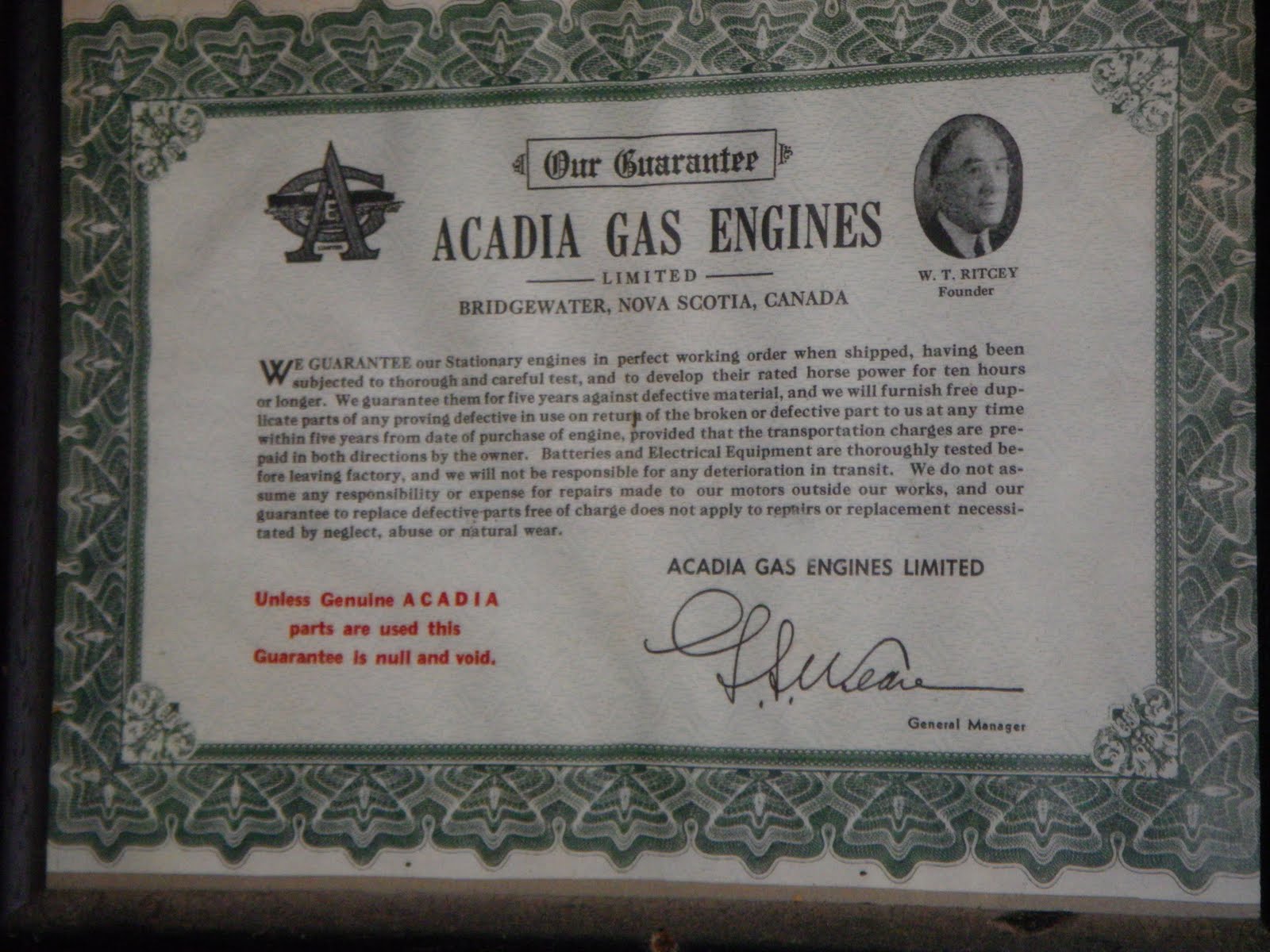
It was recently the pleasure and privilege of the writer to visit the plant of the Acadia Gas Engines, Limited, of Bridgewater, Nova Scotia, and to trace step by step the process which takes gray iron, brass, steel, bronze and copper, and converts them into a marine gas engine which provides cheap, efficient and reliable power at very moderate cost.
Of course the beginning of anything is the thought, the idea, which take shape in blue prints, plans, sketches, figures. Few things worth while happen by chance. The idea of making gas engines at Bridgewater, of building up a great industry on the banks of the La Have, had its birth in the mind of the present general manager and president of the company. Mr. W. T. Ritcey, who in 1908 established the business in Bridgewater.
It will be impossible to describe in detail each step in the process of making an Acadia gas engine. Such a task is quite beyond the writer to whom a gas engine has always been a thing of mystery. We will, however, touch upon a few of the more important things and will describe with some particularity the chief parts of that wonderful machine; which has done so much to make the fisherman's life pleasant and happy.
In an upper chamber in the Acadia plant, from plans and blue prints, the wooden, brass, and aluminum patterns of the various parts which compose theAcadia engine are manufactured. These patterns go to the foundry, a structure one hundred by forty six feet in size. To the casual observer this shop resembles an ordinary stove foundry, but closer inspection a number of important differences. Not only do we find an iron furnace, as in a stove foundry, but brass furnaces as well. There the molding of the parts for an engine offers greater difficulty than in the case of a stove, for the reason that an engine is much more complex. The mold of the outside of an engine cylinder, for instance, is fashioned in ordinary molding sand by the use of the wooden pattern. The molds for the bore and water jacket, are made by mixing sand, core oil and other ingredients together, molding the sand into the required shape in what are called core boxes, and then baking these cores for about twenty five minutes in an oven having a temperature of 200 degrees Fahrenheit. When it comes from the oven this core can be handled without breaking, provided care is exercised. The cores are placed in the flask or wooden case containing the molds.Everything is carefully prepared, the two parts of the flask are clamped together and all is readiness for the cast.In the top of the flask is an aperture through which the liquid metal runs, the casting being done as in the case of stoves and ranges.The heat of the molten metal burns up the oil used in making the core mold, and the sand falls away from the casting, the same as the green sand, which has been mixed with water. In theAcadia plant castings are made three times a week, an average of five and a half tons of gray iron being used each time. About seven hundred pounds of brass is cast each working day.
After being taken out of the flasks, the castings are carried to a machine known as a mill to be cleaned, later being taken to the machine shop, where very interesting work is done.
Upon entering the machine shop, one is attracted by a very large machine, which suggests a turret on a man-of-war. This is a Bullard vertical boring and reaming machine, specially designed for the purpose of boring gas engine cylinders. After being bored the outside surfaces or bosses of the cylinder are milled to make perfectly square and true joints, and they are then drilled by the use of a machine called a jig, which accurately places each hole and makes them strictly interchangeable. Various operations follow in quick succession, until finally the cylinder goes to the paint shop where it is cleaned and painted later going to the basement where the water jacket is tested.Eventually the cylinder finds itself in the erecting shop where the assemblers do their work.The water jacket of theAcadia cylinder has a large space completely encircling the combustion chamber, which ensures a cool piston, avoiding the possibility of over heating and making the oil more efficient.
The principle parts of the gas engine are of course the cylinder, crook cases, crank shaft, connecting rod, piston, igniter and carburetor. We have referred to the cylinder and now we will describe briefly the other parts of theAcadia engine.
The crank cases are made of cast iron and are surfaced on milling machines or by heavy shapers giving a true surface. They are designed for large bearings which are made of a high grade babbit metal, reamed to standard size and guaranteeing a perfect running bearing. The crank case of each Acadia engine has either one or two large hand holes which permit quick removal of the connection rod.
By referring to the cut of the crank case herewith the reader will note the design of the top and bottom crank cases, which gives a split bearing and which affords an opportunity of removing the liners and taking up the wear and having a tight bearing.
Acadia crank shafts are drop-forged from specially designed dies and made of open hearth steel by the largest drop-forging company in the country. The bearings are large and made to exact size; the cranks are guaranteed against breaking.
The connecting rods are of the I beam design and are made extra long to eliminate the lateral strain as much as possible. The rods are made of a high mixture of bronze, which is designed to withstand the severe shocks and stresses set up by the force of the explosions, and does not crystallize under such conditions. The wrist pin end is made to fasten the pin securely to the connecting rod and the crank pin end is fitted with bearings of the best quality of white metal, and so constructed that any wear occurring may be readily taken up or adjusted by the removal of liners.
Acadia pistons are the same high grade iron as the cylinders so that the expansion is the same. They are of the trunk pattern, being extra long and having a curved baffle plate to prevent the entering charge from mixing with the exploded gases. The rings are ground true and are eccentric, so that they will expand with equal pressure against the walls of the cylinder, making a perfect compression. The piston bushings in which the wrist pin turns are the best quality of Phospor bronze and are interchangeable.
The make and break igniter is a special feature of theAcadia engine on account of its simplicity. The number of parts used in its construction are reduced to a minimum and each part can be removed and replaced at little expense. The igniter in held in place on the motor by two steel studs and nuts, and is provided with a copper gasket so that a slight strain on these nuts will make a tight joint The spark points can be readily adjusted without removing the igniter and the electrical current cannot be short circuited by water, which has much to do with the superior operation of the engine.
All Acadia engines are designed to lubricate through the gasoline supply, which is the most reliable and accurate method. The heavy duty types are also fitted with sight feed oilers which oil the cylinder and wrist pin in piston, and the crank pin is lubricated by means of a centrifugal ring oiler which is a positive lubrication.
Acadia combined kerosene and gasoline injector carburetor has proved a great success because of its simplicity and efficiency, and its adaptability to any of the thousands of two cycle engines in use. This carburetor is attached to the engine by means of one connection only and will burn kerosene with equally an good results as any carburetor, either kerosene or gasoline in use at the present time.
The Acadia is of the two cycle or two stroke design, which eliminates gears, cams, valves, etc., thus affording the most simple construction. Nearly every part going into the construction of this excellent engine is manufactured in the Acadia plant, the only exceptions being the necessary electrical apparatus, and small parts such as screws and bolts, which are manufactured by specialists in that line of work.
After being assembled the engine is taken to the testing shop, where it undergoes a most rigid test lasting from one to five hours. Later the engine is painted, numbered, crated and made ready for shipment.
The growth of the business of the Acadia Company has been remarkable. Starting in a small way in 1908, only ten years ago, this concern today enjoys the distinction of being the largest manufacturer of two cycle gas engines in Canada. The corporation was originally called the Acadia Gas Engine Company, Limited, but upon re-organization in May, 1917, the name was changed to the Acadia Gas Engines, Limited. The authorized capital is $200,000 in common stock and $100,000 in bonds. So far $150,000 in common stock and $75,000 in bonds have been issued. The Company is incorporated under a Nova Scotia charter and is conducted in a way to merit the approval of its patrons and its shareholders. Nearly night thousand Acadia engines are now in use and that number is being increased yearly by about twenty four hundred. The company's turnover this year will be upwards of $700,000 and the day is not far distant when the output will reach the million mark. The most popular engines manufactured by them are the 1, 2 and 3 cylinder variety with make and break spark.Acadia engines are mostly found throughout theMaritime Provinces, theGaspe coast of Quebec, Newfoundland and Labrador. Three years ago a branch office was opened in St. John's. Newfoundland, with Mr. David 0. Neill, manager, and Mr. R. W. Ritcey. superintendent. The present officers and directors are as follows: President and general manager, Mr. W. T. Ritcey; secretary treasurer, Mr. M. S. Lohnes; R. W. Elliott, Halifax; Frank W. Elliott. Middleton. N. S.; C. A. Hubley; D. H. Ritcey, Bridgewater; William Duff, M. P.,Lunenburg. The company employ nearly a hundred men, on an average, and pay out upwards of one hundred thousand dollars per year in wages.
The plant of the company is conveniently located, the buildings are admirably adapted for their purpose, the machinery particularly well arranged and the system of work of undoubted excellence. In a word their facilities for manufacturing gas engines are splendid and one can well understand the reason that their business has grown seven thousand percent in a decade. A growth so wonderful, so phenomenal, must be the result of undoubted merit. The Acadia gas engine has assuredly "made good."
During the past summer a splendid garage, built of concrete blocks, has been erected. This building is 55 by 61 feet and two storeys in height. On the first floor is a well equipped garage, while on the second floor is stored "United" Stationary gas engines. American machines, of which the Acadia Company are Newfoundland and Eastern Canadian distributors and who sell large quantities. They are also selling agents for that excellent car the Chevrolet, selling seventy during the present year, with splendid prospects for large sales in the years to come. The company are also selling agents for theMaritime Provinces for the celebrated Ford-Smith Form-a-truck which solves delivery problems.
In addition to the manufacturing of internal combustion engines, Acadia Gas Engines Limited also manufacture vessels' heaving outfits, power hoists, winches, lobster pot hoists, etc.
This industry is one of the most important in Eastern Canada and without doubt has a bright future before it. With the development which must of necessity take place in the fishing industry the demand for reliable, efficient gas engines will increase rapidly.Having had ten years of unique and wonderful success and with the experience which this success has brought, the Acadia Company are in a particularly favorable position to supply the demand for high grade gas engines which will do the work that is expected of them. To increase from a turn over of $10,000, the sales of 1909, to an output of $700,000, ten years later, is surely progress rapid enough to satisfy the most ardent advocates of Maritime industrial progress, advancement and development. With so courteous, capable and energetic a president and general manager as Mr. W. T. Ritcey; with so reliable, painstaking and obliging a secretary treasurer as Mr. M. S. Lahnes; with an office force of undoubted ability, and a band of expert, faithful mechanics, Acadia Gas Engines Limited is to be heartily congratulated, for the future assuredly holds big things for the flourishing manufacturing industry on the banks of the beautiful La Have.
From Nova Scotia Blue Book and Encyclopedia – published by Historical Publishers Association 1932 (A book first encountered at The Halifax Club, May 2010)
BIOGRAPHIES
ACADIA GAS ENGINES, LIMITED, BRIDGEWATER, N.S.— An old established firm and leader in its line which is manufacture of Acadia two and four cycle marine and stationary engines, vessels' heaving outfits, hoists, winches, lobster pot hoists, etc.
This concern occupies 65,000 square feet of space and has 65 employees. It does a large trade in Eastern Canada and British Columbia. Fifty percent of the business is exported. Business started in 1908 with 3,400 square feet for plant.
Officers are: W. T. Ritcey, president and general manager; D. A. O'Neil, vice-president and sales manager; J. E. Hirtle, secretary and treasurer.
THE PHINNEY MUSIC CO., LIMITED, HALIFAX, N.S.— Few firms in Canada can boast of as long a record of service to the musical public as The Phinney Music Co., Ltd. Established at Lawrencetown, Annapolis Co., away back in 1872 by the late Mr. N. H. Phinney, this firm has had a continuous growth, and has for many years held the position of the leading music house of the Maritimes. The present officers of the company are J. A. C. Moore, president and manager; E. F. Lordly, secretary-treasurer and manager of the sporting goods department; V. S. Josey, director.
The Phinney Music Co., Ltd. advertise a complete musical service, which with them is a statement of fact, for not only do they carry a large stock of high grade pianos, phonographs and radio receivers, but they also have a very complete line of small instruments, records and sheet music. In addition to this they maintain a strictly modern service department which is equipped to handle any and all repairs to musical instruments from the violin to the pipe organ.
In 1924 a Sporting Goods Department was opened, specializing in high grade sporting goods and in 1931 an electric department was added, featuring electric refrigerators and washing machines.
From the inception of the firm in 1872 until this present day their name has been synonomous with fair dealing, honest value, courteous and efficient service.
Independent of their successful commercial activities, the directors have always shown a deep interest in civic and community affairs. They are convinced that Nova Scotia is by nature the finest country in the world and all their efforts are directed toward making it a yet brighter and happier place in which to live.
John Alexander Campbell Moore of Halifax, president of the company, is of pioneer stock, his grandparents coming, two from the north of Ireland and two of Scottish descent. He was born in Mechanic Sett, King's County, N.B., son of John and Frances (Cochrane) Moore. He attended the public schools at Mechanic Sett and at Lawrenctown (AnnaCounty) Nova Scotia. He was brought up on a farm, taught public school for one year, spent a short time in lumbering and joined Phinney Co. in 1910. He began as office assistant, then was accountant, manager credit department, secretary-treasurer, manager. In 1928 he organized the present company, taking over the business of Phinney's, Ltd., and becoming president and manager of the new company.
Mr. Moore was married at Lawrencetown (AnnapolisCounty), October 20, 1915, to Georgina Uniacke Whitman, daughter of Mr. and Mrs. C. B. Whitman, and grand-daughter of the late Hon. William C. Whitman, former member Nova Scotia Legislative Council. They have one child, Marion Frances Moore, born March 20, 1920.
He is a Mason, St. Andrew's Lodge, No. 1, A. F. & A. M, R.N.S. Scottish Rite — Valley of Halifax. He is also a member of the Rotary, City, and Halifax (Curling) Clubs. Is a member of the J. Wesley Smith Memorial Church and at present treasurer, and was in charge of the Young People's Work for three years. Hobbies are curling, fishing and books.
Associated with him as directors of the company are Messrs. E. F. Lordly, secretary-treasurer, and Verner S. Josey.
Mr. Lordly is a Halifax boy who began his business career with the Royal Bank of Canada, resigning from there to become office manager for the Phinney Co. Upon the opening of the Sporting Goods Department Mr. Lordly was appointed manager. His keen interest in every form of sport made this department a success from the start. It has grown steadily and has been an immense asset to sport lovers of Nova Scotia who are now able to procure locally the best known makes of English and American sports equipment.
Mr. Verner S. Josey is also a native of Halifax. As a very young man he became connected with the Sales Department of Nerlich & Co. of Toronto and travelled theMaritime Provinces in their interests for several years, resigning to accept a position with A. M. Bell as manager of their toy department. In 1918 he became associated with the Phinney Co. as manager of the Music Department. In this capacity he has taken a particular interest in radio broadcasting and has had charge of the broadcast programs of the company, with the result that "The Phinney Cabinet of Melody" has become one of the most popular features on the air from Halifax station CHNS.
Link – Nothing to do with Verrill, one of Gail’s projects is The Bay Grandmothers, the local branch of Grandmothers to Grandmothers: A Campaign of the Stephen Lewis Foundation. Linda Wills, a good friend just visited Africa and reports.
Photos – From around home (Nova Scotia), found/saved a Northern Spring Peeper while mowing the lawn. Also attended the inaugural Halifax meeting for the Maritime Butterfly Atlas. Here are pictures, each depicting all of our butterfly prospects.
E-published – Bimshaw, The Pirate is a full novel that was serially published in the juvenile magazine The American Boy, 1918. Long ago segment 1 of the six was put on the blog. Now all six parts have been included. Since the novel was never published as a book, it will join the Verrill reprint series at a later date, a work in progress. Here are the links to the serial. 1, 2, 3, 4, 5, 6.
E-published the fiction Yo! Ho! And A Bottle of Rum. A tale about determination and luck, and making money in the 1920s. Taking a tug from New York City to theWest Indies, these adventurers have quite a time!
Additions to the library – The Young Collector’s Handbook – published in 1948, this book is not yet available digitally, and it is reasonably rare. This link is to a scan and the description from the dust jacket. Interesting that he wrote The Boy Collector’s Handbook in 1915. Bet there are some differences as there are today.—update…well it ends up that we have both books. Verrill was a good one for recycling. The books appear to be identical, but published almost 35 apart, including the photos, with the exception of adding a Chapter 13. One of the sections is on “Concentrating On One Person”, who would do that?
Additions to bibliography – American Journal of Science – 1901 and 1907… two new references. From The American Boy 1908 December – the Story of Chocolate. Link to latest Articles, and Books.
E-published, only the second stand alone poem of Verrill’s that we have located. (there are some poem/songs in a few novels, etc.) This was just located; unlike most of his work which appeared in magazines concurrently, this appears to be a standalone submission and it is his very late years.Honest-Buccaneer
Book published by Stillwoods, The Radio Detectives Series – Books 3 & 4. This book is includes the final two stories of the four, from 1922. The catalogue of ‘world libraries’ indicates that there are only four copies of the original work by Verrill. For that reason, a reprint was thought to be necessary. Of course, alternatively, you can read this 250 page book online, for free.
The book or hard copy storefront is Stillwoods. Some prefer the feel and convenience of paper.
(PLEASE remember that most of the images in my blog and my newsletter are hyperlinked, that is clickable, to higher resolution imaging.)
From The American Boy magazine, April, 1919. Digitized by Doug Frizzle May 2010.
CHAPTER XIII (Continued) – Part 6 of 6
GROMMET LEGS!" I shouted, as I caught sight of him who sprang upon our deck, and, dashing forward, grasped his hand.
For a moment he peered at me narrowly beneath his bushy brows. "Aye, an' who be ye?" he asked, and then, as it dawned upon him, cried, "By glory! 'Tis the dead come back; 'tis Bim—"
"Hist," I warned him in a whisper, "speak not that name." And in a louder voice I cried, "Aye, 'tis me —Geoffrey Greaves, old shipmate. By the bones o' Drake! 'Tis wondrous tale ye must ha' to tell, Ben."
"Gad! but it does me ol' eyes good to look ye in the face," he roared. "How be ye, lad, and where be the boy, Brand? Sink me! but it seems but yesterday since I saw ye carted off amongst the dead i' Nevis; and after all these years to find ye a-comin' i' the nick o' time to help win my ship and treasure from these bloody mutineers."
As we talked I'd led him aft into my cabin, for I had no mind that the gaping men who stood about should hear our talk, or chance word let slip, which might tell them what we'd been ill times long past. Then, safe within the cabin, I told to Ben my tale, relating all that had occurred from that time when, struck down by the Redcoat's pistol ball, I'd last seen Grommet Legs, until I'd come unto the harbour.
To all this he listed, now and then uttering a word of wonder or surprise, and when I'd ended he exclaimed:
" 'Tis wondrous, lad—aye, passing wondrous—an' to think o' ye an’ Brand a-bein' freed by yon earthquake! Aye, 'twas a miracle—naught else. And ye a-gettin' o' King's pardons, and most of all a-turnin' up here all standin' i' the nick o' time to run afoul o' your ol' shipmate. By glory, lad! 'Tis the hand o' Providence as guided ye, naught else, and ye can lay to that. An' now I'll spin my yarn—'tis strange enough, but naught 'long-side o' yourn.
"When the Redcoats bore us down, Brand and me, they lugged us off to town, as ye know, but as we went my mind was ever busy a-thinkin' o' means to win free, and many a hint I gave to him as had me in tow of treasure I'd hid. I could easy see his mouth a-waterin' o'er the thought of it, an' when they clapped me under hatches i' the prison I heard him a-whisperin' to the turnkey. Ye were a bit inexperienced, lad, an' had no chance aside, for ye was cast i' the well afore ye'd gained thought or speech. But I was a wise ol' fox, lad, an' knew the power o' gold and I misdoubted they'd do me harm, an' they thought by parleyin' they'd gain the treasure as I'd hid.
" AN' SO it fell out; they threated an' blustered for a bit, but I laughed i' their faces an' held my tongue. The more they talked the more I knew they'd do naught—they'd ha' no chance to put their fists i' loot o' mine an' they did me harm, and torture'd help 'em not, for wi'out me at the helm they was all aback and e'en if they drew the names o' the spots by rack or fire they'd no be sure of finding o' the loot. So arter a bit they hoisted flag o' truce and began a-trying to make terms with me.
"For a bit we backed an' filled, a-strivin' to get to wind'ard o' one another, for I swore I'd no gi' hint o' where the loot lay an' they no gave safe conduct for Brand as well as me. Faith! an' I'd ha' made terms for ye as well, Bimshaw, but wi' me own eyes I'd seed ye cast i' cart among the dead an' they swore ye was a'ready buried—which was mortal truth, save ye was buried alive i'stead o' dead—an' deep grieved I was to think on it. At last they came to terms an' all was ready for a-signin' o' the papers, when along comes the earthquake an' carried away all standin', and sends 'em to Davy Jones like a ship what's struck 'twixt wind and water. An' where was I, ye ask; why. a-settin' on a bench i' the prison yard a-eatin' o' good grub wi' a mug o' ale alongside, an' whilst others was a-prayin' an' a-screechin' as walls tumbled 'bout their ears, I grabs up my bench an' sets a course for high land. 'Twas a rum feelin', lad—a monstrous rum feelin'—to be a-footin' it over ground as rose an' fell like waves o' the sea, and more 'an once was I hove down on my beam ends. An' then, with a rush an' a roar, comes the sea and catches of me in the stern like a jolly boat i' heavy surf. But wi' my fine bench to hold me up I floated atop o' the crest and was dropped down safe an' sound, but a-blowin' like a grampus, athwart a palm tree. Then a-droppin' o' the bench, for 'twas no time to be a-settin' down to rest, I bore off up the hill and afore next wave came a-roarin' in I was high an' dry i' a snug berth i' the cane. 'Twas monstrous dark and naught could I see o' town or sea, and then comes the thunder an' the hurricane, an', a-crawlin' on hands an' knees, I made to loo'ard under bare poles and come to anchor i' a bit o' cave i' the bluff. When day broke never a sight o' town could I see, naught was left, an' all the shore was deep wi' wreckage an' bodies. Here an' there was livin' folk a-searchin' for friends or kin, or a-ravin' an' a-screechin' at the fate as had befell 'em. But I hadnaught to grieve for—I was free —an' none gave me heed or thought i' their trouble, an', thinkin' only to escape from off the island, I made my way by path an' by cane field to our place. 'Twas but a blackened ruin and my heart misgave me as I thought o' the happy days we'd had there, an' now none but me left. The cutter was safe, though driven aground by the storm, an' gatherin' a load o' fruit an' yams an' a-fillin' a jug wi' water, I piled 'em in the boat, and arter a bit o' trouble shoved her off an' set sail.
'"Twas St. Croix I made for, and, gainin' the islan' safe, I told u' the ruin o' Jamestown an' found berth as bosun aboard a ship bound for New England. For years I sailed the seas i' merchantmen, a-workin' up to mate an' a-savin' o' my money, until six months agone when we ran afoul o' pirates off the Barbary Coast. By the Jolly Roger! 'twas a sweet fight, but the blackamoors were naught like the Brethren, lad, an' we won the day an' took their ship to boot—though many a one we lost and our standin' riggin' was a wreck. Our cap'n was among the slain and wi' my share o' prize money, and what I'd saved, I bought a interest i' the ship and took my place as master.
"And so, wi' a stout ship to command and a-tradin' through the islan's, I set my mind on a-gatherin' o' the loot I'd buried here and there i' days long gone, for I'd had enough o' piratin'; an' swore I'd leave the sea an' live in peace an' honesty the rest o' my days.
"The loot as I'd hid i' Beata an' Tortuga I put safe aboard an' then sailed for here, but the men were a pack o' ruffians an' cutthroats, and thinkin' to ha' the treasure to theysel's they mutinied an' sought to murder me an' those as stood by me. But we beat 'em off, an', takin' to their boat, they gained the ship an' trained the guns upon us, and all the rest ye know."
AND NOW we'd heard one another's yarns, we talked of future plans, and hard I strove to have him come with me and dwell together with us at our home. But he would have naught of this, and shook his head to all my pleas.
"Nay," said he, "ye an' Brand ha' pardons, but I ha' none. Long ha' I lived i' dread o' comin' to a pirate's end, and I ha' no mind to dwell where there be laws or hangmen, lad. Naught would gladden me more—ye know that well—but I ha' other plans i' mind. Wi' the wealth I ha' I'm a-settin' course to a bit o' land where none lives, SwanIsland, 'tis called, a sunny spot wi' palms an' white beaches as no nation owns. An' there I mind to make my home an' live an' die i' peace. Wi' a crew o' blacks to work the soil, and a trim bit o' craft to sail forth when I list, I'll be mine own king, law, and master. But I'll sail along o' ye, Bimshaw, till the last o' the treasure's safe under hatches, and right glad I'll be to welcome ye and Brand and his lady to my little kingdom, an' ye mind to make sail an' visit me."
Thus finding him firm, for Grommet Legs was not one to yield, once his mind was made, I let him have his way and promised we would visit him ere long. Then, having set the captives ashore to be marooned, and having placed some of my crew upon Ben's ship to take their places, we sailed forth together from the bay.
To every isle and cay whereon we'd hid ill-gotten gains in days of old, we cruised, and marvelous was the treasure that we garnered. Doubloons and pistoles, louis d'or and pieces of eight; bullion from many a mine of gold and silver; trinkets and gewgaws; sacks of uncut emeralds; bundles of richest silks and bales of velvet; flashing gems and jewel-encrusted arms of rich hidalgos, and pearls that shone like prisoned moonlight—aye, a treasure worthy the ransom of a king.
And so, at last, together we came unto theBahamas, and glad indeed was I that I had borne in mind the way the noseless one had steered theAdventure, when fleeing before the Dons, through the treacherous channels.
But even though I'd noted well the course and landfalls, yet I had not the chart on which I'd marked it, and slowly and with great care we picked our way between the reefs and shoals towards that isle whereon we'd hid the last of all our plunder, the loot from Santa Ysabel.
And as we anchored in the little bay and once again I looked upon the palm-fringed beach, the years were swept away and in my mind I seemed once more to stand beneath the Jolly Roger a pirate captain, flushed with late victories—for naught had changed; each rock and tree I recognized, and 'neath the shadow of the palms I saw the ruined hut wherein my crew had lived when on the isle.
No hand had found the hidden cave; within it our treasures were untouched, and as I looked again upon the jewels of the Donna Mercedes my heart sickened at thought of wrongs I'd done, while through my dark thoughts came a light of joy that I had saved her and her courtly father. And much I wondered would that act, in her eyes, in part redeem my past, and from my lips went forth a silent prayer that it was so.
Also was I glad that the pretty baubles had fallen not to other hands, that never would they be bartered for debauchery or vice, but would find a fitting resting place with her whom Brand had chosen for his mate.
Perchance old Grommet Legs read what was passing in my mind, as fondly and reverently I lifted the jewels in my hand, or mayhap he'd planned already to send a token unto Brand. Whichever 'twas he roused me from my thoughts by speaking:
"Look ye here, lad," he cried, "I ha' enough an' to spare an' I mind to gi' Brand's lady a bit o' present as well as ye. Take ye these chests o' mine an' gi' 'em to the lad an' his wife from me. Aye, an' my share o' Margarita's pearls as well. Doubloons an' bullion serve me better than such womanly trinkets, and 'twill do my ol' heart good to know she be a-wearin' o' some bit o' mine about her pretty neck. Women be ever fond o' such things, lad, an' I be far too ol' to think o' taking-woman to wife mysel'"—the old fellow chuckled at the thought—"so gi' 'em to her as we both love for sake o' Brand."
"Aye, gladly will I gi' them in your name," I cried, "even though ye be a villainous old pirate who thinks so little o' old friends he'll no come to make their hearts glad by dwelling with 'em." And then, like two beardless boys, we fell to laughing and joking in the cave, while about us the jewels in their chests flashed back the flare of our torches in a thousand hues.
CHAPTER XIV
WHEN, at last, with all our riches safely stowed, we sailed forth from the cay, our hearts grew heavy with thought of again parting, for though we'd been Godless, black-souled pirates in the past, yet, tough old rascals that we were, our love and friendship were passing great.
For long years had we faced death and peril together, in many a hard-won battle had we fought shoulder to shoulder; through many a storm-tossed sea and lashing hurricane had we stood watch upon the heaving decks of theAdventure, and a score of times and more each had saved the other's life. Through fair wind and foul we'd shared the rough life of the Brethren 'neath the Jolly Roger, and, together, we'd left the sea and settled down to dwell in peace in Nevis, and to forget our black deeds.
Not till we'd been hounded by the Redcoats had we parted, since first we'd met under Hawkins' colors, and ever like brothers had we been. And when, on that wild and fearful night, I'd drawn Brand upon my bit of wreckage and had found that Ben was gone, my heart had been sore grieved indeed, to think my rough-and-ready old comrade was no more. Then, when through such strange ways I'd once more found him hale and hearty, joy such as I'd not known for years was mine; and now again we were to part, for Grommet Legs still vowed he'd never dwell where law might reach him, and naught could sway him from his plans. So, together, we sailed southward through the Windward Passage and past CapeTiburon, and heaving-to in Navassa's Lee we said our last farewells. Then towards the east I steered, and to the south and west his ship bore on, and each upon his after deck we stood, while wider and wider swept the sea between, until, beyond the ocean's rim, the gleaming sails dropped down and out of sight.
But though I'd parted with my old-time shipmate, yet the thought of once more greeting Brand, and her whom he was bringing back to share our home, drove much of my regret from out of my mind.
Moreover, in my heart, I knew full well old Grommet Legs were better off and safer in his lair upon the tiny distant isle than with us upon the plantation, and I'd no doubt he'd be happier as well. Glad was I to think the grizzled old pirate had given up the corsair's life, for he'd plenty of money to spend the rest of his days in peace and was ever too kind-hearted and too true to be tempting the hangman's noose by such villainous ways. But I'm getting off my course, and must 'bout ship and tack, for what passed through my mind is of little moment, and, truth to tell, I can say naught, for it ill becomes me to prate or preach, who, for so many years, was a notorious captain 'neath the black flag.
At last, one morn, the dim and cloud-like loom of land was seen ahead, and hourly it grew and took on form until, by midday, the towering, green-clad mountains and lovely valleys of our home were close aboard.
But I had no mind to enter at the port with all my store of treasure, for well I knew 'twould raise the curiosity of those about and questions would be asked which would be full hard to answer.
And so, the wind being light in the lee of the land and the afternoon waning, we drifted idly along the coast until, night falling, we worked into the cove afore the plantation, and, coming to anchor close to the beach, prepared to land the precious cargo I had brought.
For long we labored in the darkness, the crew rowing the chests and sacks ashore and my slaves carrying them to the vaults beneath the house. Perchance it may seem strange that I feared not my men might betray me, but with my wealth I knew full well I could buy their silence for all time, and none I had whom I knew not or could not trust, or who had not been with me for many years. But most of all I trusted to the power of gold. Long had I dealt with wild and reckless men, and with those of peaceful lives as well, and while some might bite the hand that fed them, yet few are those who think of aught but their own welfare, and so long as my men gained more from me than would befall them did they carry the tale of my loot to others, I dreaded not they would tell aught of my cruise or of what they'd seen thereon.
I'll not gainsay I had misdoubts at times, but there was naught else I could do—lest I followed the villainous ways of some and killed them all when they had served my turn. So, paying them well in good gold, and promising that they would never want and that each month would receive a goodly sum, I gave up all doubts and cast worries aside.
Having landed all the treasure, we hoisted anchor, and, with the freshening breeze of dawn, sailed onward to the town. None guessed what vast wealth lay hid beneath the house, and well content was I that it was safely there and ready to Brand's use, for I minded it should be all his, save a good store of golden coin I set aside for such youngsters as might be his in future times.
Then, everything being accomplished, I set myself to await his coming with his bride.
And when at last the ship that bore them came into the port I knew it not, being engaged upon a distant part of the plantation, and so, ere I dreamed that they were near, a coach drew up before the gallery steps and from it Brand leaped down.
Filled with joy, I hurried down the steps, but ere I reached him a dainty lass stepped forth beside him.
AT SIGHT OF HER my heart seemed to stand still, my tongue was robbed of speech, and my knees trembled weakly 'neath my weight, for the lovely lady whose hand rested on Brand's arm was Mercedes !
Aye, 'twas she beyond a doubt, though wondrous beautiful she'd grown during the years that had passed by since last I saw her. Those eyes, which once I'd seen so filled with mortal terror of the ruffian standing over her, were now soft and glorious with love, and those sweet lips, from which had come that piteous cry for mercy, now parted in a smile of happiness and joy.
For a space I stood there, wide-eyed and gaping like the dolt I was, and then upon my muddled brain it dawned that though I knew her, yet she knew me not, and, gathering my wits together, I greeted Brand and Mercedes in such words as I could find tongue to utter. But if I was wonderstruck at sight of Mercedes, 'twas naught to that wonder which was soon to fill her, when, within the house, I brought forth and laid my wedding gifts before her.
With little cries of pleasure and delight she lifted the lustrous pearls of Margarita; her eyes gleamed and her breath came short through parted lips as she saw the myriad colored fires shot forth from diamonds, emeralds, and rubies, and, like a child, she clapped her hands and laughed, as from their resting place she drew trinket after trinket of dull, yellow gold ablaze with gems.
One chest yet remained, a rough case in which I'd placed the casket I'd found in Santa Ysabel, and this Brand opened for her.
A single glance she took within, and then her face went white, her eyes grew wide, and with a strange, half startled cry she turned and gazed with puzzled, searching look into my face. "Where, oh, Uncle Geoffrey, where—" she cried, and then her eyes lighted with sudden knowledge, and, ere I knew what she was about, she flung herself upon me and pressed a kiss upon my leathery old cheeks.
"Now I know," she cried in her pretty foreign way, as, half sobbing, half laughing, she clung to me. "You are the dear, good Señor who saved me from that dreadful pirate at Santa Ysabel. Oh, I'm so glad, so happy, yes. My thoughts have been of you so many times, and who you were, and if I'd ever see you more I wondered, and now—now, I find you my own Uncle Geoffrey."
'Twas wondrous reward for the little I had done, and happy was my heart to think that all unwittingly I'd given joy to her to whom I owed so much.
There's little more to write. To Mercedes I frankly told my past, sparing not to bare my villainy, but she, dear little lady, forgave me my black days of wickedness, and vowed I was no pirate, but a gallant gentle-man, at which I roared with laughter. And then from her own lips I heard the story of how she and her courtly father had flown from Santa Ysabel until the pirates left. How the Viceroy, accusing him of cowardice, had sent him forth to Spain in chains (and my blood boiled hot within me as I heard, for if ever brave man drew breath, 'twas the old Don).
And then, continuing her tale, she told me how, beset by storm, the ship had driven north; how, fearing 'twas foundering, the cowardly crew had taken to the boats and left her and her father to their fate, and how, at last, sturdy, kind-hearted men had seen the drifting vessel from the shore and, going forth through the perilous surf, had rescued the two and brought them safe ashore.
There, finding those amid whom they had been cast more kindly than those of their own race, they settled down and in Virginia had prospered and had dwelt in peace and happiness. At last the old Don, dying, had left Mercedes mistress of a fair estate, but heartsick, sad, and lonely, until Brand found her and brought her love and happiness anew.
MANY YEARS have passed since Brand brought Mercedes into our home and never since has aught come out of the past to haunt us or to mar our lives.
And, looking back, I know how wonderful are the ways of God, and through what strange and crooked channels must one cruise when fate is at the helm. Thus, from my villainy has come good; from sack and slaughter has come love and joy and, from my ill-gotten gold, has come charity and help to the unfortunate. Black-hearted pirate have I been—mayhap naught I have done or may ever do will wipe the bloodstains from my hands and soul—but to Brand and Mercedes my past matters not; to their youngsters, who clamber o'er my knees and beg for yarns, I be naught save a wrinkled, gray-headed playfellow, and, when the time comes and I set sail for my last port, I'll fear me not to pass that bar beyond which none may see.
I have now published over 35 books. They are by authors from the past, the books were rare so I have made them available in paperback or as ebooks. They are available at Lulu.Com, more particularly they are listed here. Doug's Bookstore
Printing from this blog appears to be challenging.
I recommend that you click and drag (select) all the text that you want. 'Ctrl' + 'C' to copy. Then open an empty WORD document on your computer and 'Ctrl' + 'V' to paste. You should then print with page previews... This suggestion may save a few trees - blog articles tend to run on and not be space efficient.
and the Outboard Boys Series. The Boys, Terry, Martin and Warren, were created by Roger Garis and appeared in the four-book series published in 1933 and 1934. The Boys used their powerful outboard motors to solve mysteries and have adventures, etc.