 The Bar-Z Hold-Up!
By Jack Holt
From The
Modern Boy magazine, dated 23 February 1935, #368, Vol. 15. Contributed by Keith Hoyt via his
son and my good friend, Brian. Keith died last week so I hope you will
appreciate his dedication at the end
of the story…Digitized by Doug Frizzle, January 2013.
Young
PERCIVAL ULYSSES WOODGER
finds the Wild West Wilder even than
HE expected — choc-a-bloc with desperate bandits—and LAUGHS!
"Great Guys for a Joke!"
“IS—is—is—wheee!—is the Wild West very wild?" stammered Percival
Ulysses Woodger, as the buggy swung
down the trail from Rattlesnake Bend Railroad Depot towards the Bar Z Ranch.
"We Britishers, you
know, sort of conceive the life of a
cowpuncher to be full of hair-raising battles with cattle thieves and
b-b-b—whee!—bad men and outlaws and things.
"The lawless element, we
have been given to understand, in this part of the
world far exceeds the orderly
workaday folk who earn their daily
bread in an honest fashion."
Bud Elton, boss of the Bar Z outfit, grinned.
 "Don't you believe them tales, son," he laughed. "This little
lump of Texas
ain't more lawless nor New York,
Chicago—or
even London,
where you hail from. It's true we
have a particular brand of crook and roughneck around this part of the world what's—how d'you say it?— sorter more
picturesque than the reg'lar run of
thugs.
"But he ain't any less
or more of a bad lot jes' because he wears a big hat an' totes hisself around
on a cayuse."
"I rea—I rea—wheee!—I
realise that. What I mean is—"
"Sure, I know what you
mean, but I can assure you the life
of the normal waddie is mainly
humdrum, son. Cow-nursin' is jes' a reg'lar round of routine, like any other job. Fence ridin', ropin' in strays, brandin',
twice a year rounding up the beeves,
eatin' frijoles and bacon, singin' to a punctured accordion, an' occasionally
ridin' to town to blow in your payroll—that's the
normal life of a cow-poke to-day. No. The beef trade ain't the romantic
business it's cracked up to be."
Percival gave his usual
whistle to suppress his bad stammer before replying:
"How disappointing!
Still, everybody describes their own
particular profession as dull, I believe."
There was silence for a short
while, except for the rhythmic
clatter of the lank mare drawing the buggy along the
rough Texas
trail. Presently Bud Elton spoke again.
"And what might be your
profession, mister?"
"Why," smiled
Percy, after whistling, "I'm afraid—well, the
only profession I have at the moment is as a sort of roving vagabond. I left my home in England,
you know, to teach my uncle a lesson. He said I wasn't capable of making my own
way in the world, so I made up my
mind to run away for six months to show him he was wrong.
"My last port of call
was Houston City, where I was able to be of some
assistance to the National Bank there, and hearing I was keen to see a bit of the real West, they
repaid me for my services, very kindly, by arranging for this visit to your
ranch—which I'm sure I'm going to enjoy immensely."
"I hope so," said
Bud generously. "I can only say you're right welcome,
pard. Me an' the boys'll do all we
can to make your stay interesting. But as regards rustlers and bad men and
such—well, we can't supply those—"
"Not even—whee!—a little
shoot-up?" Percy grinned.
"Not even that, Mr.
Woodger. Less the boys like to stage
one special for your benefit. They're great guys for a joke, my boys."
“Well—whee!" grinned
Percy. "I suppose I'll just have to be satisfied with the ordinary routine of a cattle ranch. At any rate,
I'm pleased to see you wear the
traditional garb. You know, when I arrived in Houston
and saw what a modern city it was, I began to doubt there
were any real cowboys left! Is that the
Bar Z over there?" he
added, pointing to a collection of huts and corrals dimly visible across the prairie-land.
"Sure, that's my outfit,
pard. And that dim smudge you can jes' see on the
horizon is my main herd—the finest
section of beef in this neck of the
woods, though I sez it myself. I'm proud of 'em!"
They chatted on until they came to the
ranch—the tanned, bearded cattle-breeder
with a cluster of laughter-wrinkles round his kindly grey eyes and Percival
Ulysses Woodger, looking just as cheerful and undaunted as he did on the day he started out on his memorable journey from London,
five thousand miles away.
"And now," said Bud
Elton, when the buggy finally came
to a standstill within the corral
fence that marked the immediate
boundary of the Bar Z, "let me
introduce you to the outfit. That's
'em—that ornery-lookin' gang of hoss-thieves lookin' all bashful over yonder.
"Hey, boys! Step right
over and meet our English guest. Hope you've all got clean shirts on and washed
behind your ears!"
The group of cheerful-looking
cow-punchers came over and were introduced to Percy.
"This is Tiny
Waters," said Bud Elton, with a gesture towards a lank, six-foot specimen
of Western wiriness. "He's my top-hand. Fancies hisself as a humorist,
but, believe me, his wisecracks wouldn't raise a grin from a
laughin' hyena. See Tiny on a hoss, though, an' you forgive him his humour
immediate. Best brone' man and roper in the
county!"
"Shucks, boss,"
said Tiny, fidgeting bashfully.
"This is Dude,"
said Bud, introducing another.
"Has social ambitions, has Dude. Tries to play the
guitar and sing opera and always wears a clean collar Sundays."
"Aw—quit hazin',
boss!" grinned Dude.
"This here's Zack
Rogers. The beeves is scared stiff of him, which ain't to be wondered at when
you glimpses his handsome
frontispiece. But it ain't on that account. He's a champ bull-dozer. Carried
off first prize at Yuma
only last fall."
Percy shook hands with the grinning Zack.
"This chunk of rawhide
is denounced by the name of Jan
Peek. Drop of Swedish in Jan somewheres—
you can see it when he washes his face—but there
ain't a better cowhand ridin' the
ranges.
"We define the following article," continued Bud, pointing
to a smiling cattleman with drooping- whiskers, "as Pizen-oak Pete. Pizen-oak
is an old stager. Been in the cow
business since he was breeched."
"Powerful glad to
meetcher, pard!" said Pizen-oak.
"There's another scoundrel in this outfit," said Bud,
"but he's that small in dimensions we often mislay him. Where's Slim,
boys?"
"In the feedhouse, boss," grinned Zack Rogers.
"Hey, Slim, come show yourself!"
The hail was answered by the appearance of a round head in the doorway of a shack that was the cowboys' dining quarters. The head, of course,
had the customary
body attached to it, as Percival Ulysses presently saw. But what a body!
"Slim" was so fat he could hardly squeeze through the feedhouse door. He waddled over to Percy and
shook him by the hand, beaming all
over his large round face.
"Slim came from out East," explained the
joking boss of the ranch.
"Thought ranch life would get his figure down. We let him try ridin' with the herdsmen for a bit—that's why we got so many
knock-kneed and bow-legged hosses around the
ranch—and then we decided he was
bending our ridin'-stock out of all recognition, so we made him our cook and
nursemaid. Slim feeds us and gets our hot-water bottles of a night."
"I'm—I'm—wheee!—I'm sure
Mr. Elton exaggerates," smiled Percy. "Anyhow, I'm very pleased to
meet you, Slim!"
"The pleasure is mutual,
I'm shah!" said Slim, in a surprisingly affected voice. "It is indeed
a great —nay!—a stupendous treat, if I may say so, to meet a real gentleman
among all these hooligans!"
"You see," grinned
Zack, "Slim ain't forgot his swell Eastern eddication. He always speaks in
that high-toned way!"
"Very aristocratic
family, Slim's," put in Tiny, the
alleged humorist. "Once removed from
a vizcount—and once removed to the
town gaol for disturbing of the
peace on Independence Day!"
"Kindly," said
Slim, with dignity, "reserve your witticisms for a more fitting audience.
May I show you to your quartahs, Mr. Woodger?"
"Th-th-th—wheee!—thanks!"
said Percy.
"Mr. Woodger's bunking
down in the mansion," said Bud
Elton, indicating the ranch-house.
"Everything's arranged. If you follow Slim, pardner, he'll lead you to
your bed-roll."
Percival thanked the boss of the
Bar Z and followed Slim into the
"mansion."
Planning a Shoot-Up!
THE rest of that day Percy
spent in an enjoyable tour of the
ranch, riding on a quiet horse beside Tiny Waters, the
"top-hand," or foreman, of the
outfit. Tiny pointed out to him all the
interesting details of a cowboy's daily work, studding his conversation with the wisecracks on which he prided himself.
Percy, in his turn, talked to
him much as he had talked to Bud Elton on his trip from
Rattlesnake Bend—that is, on his mistaken conception of the
West as a place bristling with two-gun men—with killers, outlaws, and desperate
characters.
Tiny's playful nature could
not resist the temptation to pull
Percival's leg.
"Did the boss tell you that, now?” said he, not a flicker
of a smile on his face. "Say though, he told you wrong, Mr. Woodger! This
hyer bit a rangeland is the most
lawless in the hull south-west. Yeh,
sure! Guess the ole man was scairt
of frightening you away, that's what! "Why, only t'other
day me an' the boys had to fight for
our lives agin a horde of desprit Mexicans. Yeh, sure! Bullets was aflyin’
thicker nor wasps round a jampot. Most never a week passes without we have to
lynch some guy for get'n obstreper—obstreper—for
g't'n het-up an' loosin' off his shoot-iron into somebody.
The lawlessness is sure sump'n awful, Mr. Woodger, hereabouts. Yeh, sure!"
Percival looked surprised,
but made no comment.
"Yeh," continued the leg-puller, "and the
mortality among sheriffs and state and federal officers round these parts is so high, Mr. Woodger, that the gov'ment supplies 'em each with a free coffin as
part of their regulation
equipment."
This seemed rather tall to Percy, but he was too polite to say so.
"Do—do—do—wheee!—do you
think it would be advisable for me to go about armed, then,"
said Percy, "during my stay here? I had imagined from
the way Mr. Elton spoke that there was no need."
"Say," answered
Tiny, with a look of horror, "it's jes' plain suicide to walk about without
a coupler six-guns! Why, there might
be a desprit character lurking behind that very clump o' mesquite now. I guess
I saw it move jes' then!"
Tiny Waters drew one of his
long-snouted revolvers impressively and pointed it at the
bush indicated.
"Come
outer that, you coyote, or I'll let fly!" he shouted.
Percy chuckled as a rabbit
darted out of the bush and bounded
in fright across the rangeland. Tiny
put away his gun without a suspicion of a smirk.
"Only a
jackrabbit," he said, "but it don't do to take no chances in these parts. 'Tain't healthy! Shoot first an'
converse afterwards is my motter. We mighter bin frozen meat right now if that
guy had started shootin'!"
"W-w-what guy?"
"Why, the guy that mighter bin there
if it hadn't bin a jackrabbit!" replied Tiny.
"I th—I th—wheee!—I
think I see what you mean," said Percy, his puzzled expression giving the lie to his words.
Throughout the tour of the
ranch, Tiny continued to give impressive details of the
imaginary desperate encounters of the
neighbourhood, until at last Percy left him, to take his evening meal in the ranch-house, with the
impression that he really tad struck one of the
hottest spots in the whole Wild
West.
"Anyhow," Percival
told himself philosophically, "I wanted to see the
real West. It seems to be wilder than I thought. I must take the first opportunity of procuring myself a couple
of revolvers for protection. Nothing like being on the
safe side!"
Within the
cowpunchers' feeding quarters the
humorist of the Bar Z was telling
his colleagues of the innocent way
Percy had swallowed his yarns.
"Say, though, but you
should've seen him lap it up! It was most all I could do to stop me face
crackin' with innard laughter! Yeh, sure! I told him—"
"I think," said
Slim, who was serving the punchers
with their supper, "such
untruths are in fright-fullay baad taste. Mr. Woodger is ah guest. It is, if I
may say so, not at all a hospitable attitude—"
"Aw—shucks! Can your
high-falutin' grammar, dook," said Zack Rogers. "There ain't no harm
in it, an' the guy looks a good
sort—mostlike he'll enjoy the joke
same as us when he finds out. He wanted the
West to be wild, didn't he?
"Well, it's only sorter
charitable, if you look at it thataway, not to disappoint. Why, I've a mind to take my guns and go
shoot-up Rattlesnake Bend right now, jes' so's he can have an eyeful of what
he's hankerin' after!"
"Say, though, that's an idea!" chipped
in Tiny. "Why not?"
"H'm!" said Pizen-oak
laconically. "Try shootin' up Rattlesnake with Sheriff Dawson about, and
your hospitality will end up in the
town stew!"
"All right,
granddad," said Tiny. "We needn't really shoot-up Rattlesnake to give
our guest the treat he's hankerin'
after; we can stage a nice little private hold-up for his benefit right here on
the Bar Z! What say, boys?"
Zack Rogers, Dude, and Jan
Peek signified that they were
tickled by the idea. Pizen-oak
seemed doubtful, and Slim frankly disapproved.
"I refuse to lend myself
to such ruffiahnly practical jokes," said he.
"Say, fatty,"
grinned Tiny, giving him a dig in his balloon-like abdomen,
"nobody wants to borrow you. Your supple boyish figure ain't quite the style for a hold-up man."
"Tehah!" said Slim.
"There's a fine chance
to pull the works to-morrow,"
went on Tiny. "The boss is ridin' over to Dutton's outfit to see about the shipment of that herd o' beeves he sold him
recent. Me an' Zack and you, Jan, an' Dude—"
"Dude ain't in on
this," grunted Pizen-oak. "Me an' him's got to take our reg'lar trick
on the range. There's a ditchin' job
to do to-morrow."
"O.K. Then me an' Zack
and Jan here'll see it through. Gee! I guess we're gonner enjoy ourselves.
Soon's the boss has cleared out,
we'll make some excuse and ride out
like we got business to do. Maybe if we could change our duds now—"
"I absolutelay refuse,"
protested Slim, "to be a party to such a hobbledehoyish scheme. I feel it my duty to warn Mr. Woodger—"
"If you do,"
grinned Tiny, "I shall feel it my duty to sling your sylphlike form into the hoss pond!"
Rival Desperadoes!
THE three practical jokers—Tiny
Waters, Zack Rogers, and Jan Peek—watched eagerly for the
going of their boss about his
business to Dutton's ranch the
following day. He went about midday, and the
three began to make preparations for the
fake hold-up they had planned for
giving Percival Ulysses the Western
excitement he seemed to expect.
Pizen-oak and Dude were out
on the ranges tending the herd, so there
was no risk of obstruction from that
quarter. Slim, however, was proving a bit of a handful.
"I tell you I refuse to
countenance this practical joke," he insisted for the
twentieth time. "It's baad taste to raag a visitor in such a fashion. As
soon as you have gone I shall make it my business to warn him!"
"Aw—see here,
Slim," protested Zack. "Be reasonable. We're only tryin' to amuse the guy and give him a taste of the Wild West as he's seen it at the cinema. You gotter entertain a guest, ain'tcher,
now? An' if you can entertain yourselves at the
same time
"The principle of the thing," said Slim, "offends against
good taste. Besides, if you're going to start flourishing firearms and—"
"Shucks, nobody'll get
hurt. We're loaded with blank."
"Nevertheless—"
" 'Tain't no use trying
to argy wi' him," chipped in Jan Peek. "Grab him an' lock him up
where he can't interfere!"
"Youse a genius,
Dutchy," chuckled Tiny Waters. "Why didn't we think of that
beautifully simple solution of the
problem before? Grab him, boys!"
"Desist!" yelled
Slim as the three boisterous
cowpunchers made a dive at him "I refuse to lend myself—"
"On this hyer 'casion,"
laughed Tiny, as they bore the stout cook of the
Bar Z to the ground and seated themselves upon his tummy, pending further instructions from
their practical-joker-in-chief,
"you're not going to be lent.
"You're jes' sorter
gonner be put in storage where you can't make trouble. Bring him to the bunkhouse, boys. He won't be able to skip that
hideout!"
The three muscular cattlemen
lifted the hefty chunk of protesting
avoirdupois that was Slim and bore him bodily across to their
sleeping quarters. The bunkhouse was a long, stoutly built shack with only one
door, and two windows so small that Slim couldn't get out through them. There was a fanlight in the
roof, but that was right out of reach, and there
was nothing available to climb up on.
"He won't get loose from here," grinned Tiny. "Heave-oh,
boys!"
They slung Slim through the open door like a sack of coals. He landed with a
bump within and said "Ouch!" and then
the bunkhouse door had slammed and
he heard the key turn in the lock.
"Ruffiahns!" he
cried. "Release me immediatelay! I protest!"
"Jes' you keep right on
protestin'," cried Tiny Waters, "till we get back. S'long, Slim. See
you at supper. Come on, boys. Git
your hosses. This is where we depitise as desprit bandits!"
The three jokers mounted their horses and rode over to the
ranch-house, where they knew they would find Percival Ulysses Woodger. They
hailed him from their saddles, and presently Percival appeared on the veranda.
"Me an' the boys has got a bit o' business to see to,"
explained Tiny. "You'll be all alone on the
ranch, Mr. Woodger, for an hour or two, so I thought I'd better warn you 'case
you get some of them there
desperadoes I was tellin' you about."
"Oh!" said
Percival, in a tone that was not at all self-assured. "Th-th—wheee!—thanks
awfully! I'll—I'll—er—keep my eyes skinned."
"Here," said Zack,
passing one of his guns to Percy. "Take this gat—you may need it."
Percy took the gun gingerly. "B-b-b—whee!—but surely I'm
not all alone on the ranch? What
about Slim?"
"Oh—Slim!" said
Tiny, with a sad shake of the head.
"Poor Slim—he's gotten one of his attacks on him."
"Attacks?"
"Yeh, sure' Didn't you
know? Slim suffers sump'n awful from
fits, and while he has 'em he's powerful dangerous. If you hear him yelling or
shouting for help, Mr. Woodger, you give him a wide berth. S'long, Mr. Woodger!
"By the way, they
say Two-gun Egbert, the mad killer,
is around these parts, and Ruiz,
that bloodthirsty rustler, and his mob. Apart from
that there's nothing to worry about.
Don't mind us leavin' you for a while, does you?"
“Of—of—wheee!—of course not,”
answered Percival. "Still, I—er hope you won't be long."
" 'Bout four or five
hours, but if you feels nervous or wants assistance, Pizen-oak and Dude are out
there on the
ranges only three miles off. S’long, Mr. Woodger."
"S-s-s-s—whee!—so long!”
The three cowboys wheeled their horses and rode away. Percival watched them until they
disappeared round a bend of the
trail. Then he looked at the big
Colt revolver in his hand, a little doubtfully.
"H'm! This doesn't seem
much of a protection against Two-gun Egbert, the
mad killer, and—what's it?—Ruiz and his gang. I sincerely hope neither gent thinks of paying the
Bar Z a call this afternoon!" he muttered.
Then he placed the gun in his coat pocket and returned into the ranch-house.
THE three jokers from the
Bar Z Ranch little knew that their
going was watched. A mile down trail they
passed a heavy clump of mesquite concealing three men, who watched their going with interest.
"We better stay away from the
ranch about an hour." Tiny was saying as the
three rode by. "No good bein' too sudden, or he might tumble."
"O.K.," grinned the other
two as they trotted on.
Three evil faces watched them until they
were out of sight. No, it was not Two-gun Egbert, the
mad killer, nor yet Ruiz and his gang. These men were much more dangerous and
more solid than those mythical desperadoes of Tiny Waters' imagination.
Red Grange, the outlaw and gaolbird, was "wanted" in
four counties of the State of Texas;
"Snitch," his long-nosed companion,
had similar claims to notoriety, and it was said that Six-gun Gallagher, the third man, would have to hang three times before
his murderous misdeeds could be fairly avenged.
These three had been watching
the Bar Z for days, waiting their chance. They knew, as the
whole neighbourhood knew, that Bud Elton had just put over a big deal in cattle
with Dutton's outfit, and that two thousand dollars had changed hands and was
now tucked away somewhere in the Bar Z ranch-house!
These gentry required money very
urgently just then, for the net was tightening around them,
and unless they could sneak across the border into Mexico they
knew they would shortly find themselves face to face with a party of Texas State
marshals. Yes, they needed money,
and they had no scruples about their methods of getting it. Even another killing or two meant nothing to these three, so long as they
could escape over the border.
“That only leaves the fat cook and the
lodger!" grinned Grange, when Tiny and his pals had passed. "They're
easy meat. We can shoot our way through them
like a pound o' drippin'. The boss left the
ranch this mornin'. Two of 'em is out on the
ranges with the cattle. Them three
sez they won't be back for an
hour."
"Well," replied
Snitch, "what're we waitin' for?"
They left their hiding-place and began to make their way to where they
had tethered their
horses. A few moments later they had mounted and were riding back down the trail towards the
Bar Z Ranch and that desirable two thousand dollars.
Locked in the Bunkhouse!
PERCIVAL ULYSSES WOODGER had
hardly returned into the ranch-house
when one of Slim's powerful yells penetrated to him from
the bunkhouse.
"Poor fellow!" thought
Percy. It must be terrible to suffer from
such attacks. I must say I feel far from
comfortable, being left alone with
all these desperadoes about, and
with a man suffering from
fits!"
Percy stuck his bead outside the ranch-house again and listened. Slim was now
thumping on the heavy bunkhouse door
and yelling to be released at the
top of his voice:
"Mr. Woodger! Mr.
Woodger! Hailp! Hailp!"
"Dear me!" Percy
told himself. "He seems to be calling for me. I suppose I'd better ignore
him, as I was told."
Percy took a seat on the veranda steps and tried, with difficulty, to
feel at ease. But he couldn't sit for long and listen to those appealing calls
for help.
"Per-per—wheee—perhaps
I’d better go and try to comfort
him. It surely can't do any harm."
So Percy walked over to the cow-punchers' sleeping quarters, and, during a
lull, took his usual whistle to steady his speech, and tapped gingerly on the door.
"Coo-ee, Slim!" he
said.
"Oh, thenk goodness, Mr. Woodger!" came Slim's
muffled voice from within. "Those
ruffiahns have locked me in!"
"All right, Slim. Just
keep calm. Why not lie down and rest a bit?" said Percy soothingly.
"You shouldn't get yourself excited, you know."
"Excited!" shrieked
Slim. "Mai goodness! This is too much!"
"There, there!" Percy said hastily. "I didn't—I
didn't—wheee!—I didn't mean to excite you. Just do as I say, now, and perhaps
you'll feel better."
At this point Slim resumed
his thumping on the door, yelling:
"Let me aht! Let me aht! It's most important! Oh, you
merst, Mr. Woodger—you merst!"
"Slim—Slim—wheee!—you
mustn't carry on like this! It isn't good for you, you know. I don't know
what's the correct treatment for
fits, but I'm sure getting yourself all worked up—"
"Fits!" cried Slim,
sounding as if he was really suffering from
one! "Fits! Fits! Did you say fits? Raally, this is too murch—"
"Well, that's—wheee!—what's
wrong with you, you know. Your pals told me that I wasn't to—"
"Mai goodness!"
gasped Slim. "Mr. Woodger, they
didn't tell you thaat? It's—it's prepostrous! I've never had a fit in mai lafe.
It's a foul untruth! Oh, the
scoundrels! The absolute villains to say such a thing about me!"
"W-why," stuttered
Percy, "aren't you having a fit? I really thought you—"
"Mr. Woodger, this is
all part of their dastardly scheme!
I'm speaking the truth. Let me aht
of hyar, and I'll tell you all. But you merst let me aht. It's most
important!"
Percy was thoughtful for a
few seconds. After all, Slim might be speaking the
truth. There were two sides to the
question. He only had it on Tiny's assurance that Slim had temporarily gone off
his rocker. Surely it was not good for Slim, in any case, to be imprisoned in the bunkhouse, with no one to comfort him. On the
other hand, if he suddenly went
berserk on being released—
"If I—whee!—let you out,
will you promise to be good ?"
said Percy.
Slim gulped, and swallowed
his pride.
"All right," he
said, as calmly as he could. "But I assure you it's not true abaht mai
having fits. I'll tell you all abaht it when I'm free. I can't keep on bawling
through this wooden door."
"Very well," called
Percy. "But how am I to get you free?"
"Thar's a skylight in' the roof, but I can't reach it. If you can get on to
the roof and haul me up—"
"I'll try!"
Percy walked round the bunkhouse and located a drainpipe. By dint of
careful manoeuvring he managed to scramble up the
pipe on to the roof, crawl to the open fanlight, and look down upon Slim.
"You—whee !—certainly
look all right!" he observed.
"I am all right,"
replied Slim. "Lean dahn and give me a hand up."
Percy leaned through the fanlight and extended a helping hand, and by
standing on the very tip of his toes
Slim could just grasp it.
"Now," said Slim,
"pull me up!"
Percy pulled mightily. He had
forgotten that Slim was about four times his own weight. The result of Percy's
heroic efforts was to pull himself clean through the
fanlight into the interior.
With a yell he hurtled down
on top of Slim, and the two of them hit the
floor with a bump.
"G-g-g-gosh!"
stuttered Percy, sitting up and feeling his bruises. "How—whee!—did that
happen?"
"Oh, mai head!"
moaned Slim, "You fell on mai head!"
"S-s-s-s—whee!—sorry,"
said Percy, scrambling up. "Well, here's a pretty to-do. I'm locked in as well,
now!"
The two stared at each other in blank amazement at this new predicament.
Slim sat down on one of the bunks, nursing his head.
"And this all comes of that Tiny Waters and his practical jokes!"
he moaned. "I merst tell you, Mr. Woodger—they're
plotting some scheme to give you a
scare—"
Rubbing his bruised head,
Slim told Percy about the plot of the jokers.
"The—whee!—rascals!"
chuckled Percy. "I had a sort of suspicion Tiny was pulling my leg
yesterday. Gosh, though! I wish we could get out of here and give them a whacking surprise!"
IT was while Slim and Percy
were locked in the bunkhouse that
Red Grange, Snitch, and Six-gun Gallagher arrived at the
Bar Z. They looked round suspiciously as they
dismounted, but all was quiet.
Cautiously, the three real desperadoes crept towards the ranch-house and tiptoed across the veranda. Grange flung open the door, his gun thrust forward ready to fire.
"O.K.!" he murmured,
finding the ranch-house deserted.
"I think we got an easy break. Come
right in, boys, an' we'll locate that dough in no time."
The three entered the ranch-house, closing the
door behind them.
“I—WHEE!—have an idea," said
Percy, inside the locked bunk-house.
"Do you think you could hoist me on your shoulders, Slim? I think I can
just about grab the edge of the fanlight and draw myself up on to the roof."
"I'll try—but don't
forget I want to get aht, too!"
"Y-y-yes. I know a way I
can manage that!"
So Slim stood upright and
Percy climbed on his back and thence
on to his fat shoulders.
"Whee! Do you mind if I
step on your head?" said Percy, balancing precariously. "Another couple of inches will do it."
"Not at all,"
answered Slim, with a tinge of sarcasm. "Pray do as you wish, Mr. Woodger.
Try and avoid stepping on the bump
you've just made by falling on it, though, won't you?"
Percy placed a foot on Slim's
head and then made a wild grab at the edge of the
fanlight above. He succeeded in clutching it, but Slim went staggering, leaving
Percy dangling in the air.
Percy dragged himself up, and
after a deal of gasping and scrambling succeeded in getting back on to the roof. He disappeared for a few seconds and then his face appeared again at the open fanlight.
"Are you—whee!—all
right?"
"Perfectlay,"
groaned Slim, "apart from a
kick in the face—"
"Whee! Hang on, then. I'll have you out in two ticks. I think the jokers must have arrived already and gone into the ranch-house to look for me. There's three horses
here."
Percy disappeared then, and presently the
unhappy Slim saw him again at the
skylight.
"Here—whee!—catch
this!" Percy said, throwing a length of lasso down. "Put the loop round your body, and I'll have you drawn up
in no time. The other end is tied to
a horse's saddle. You're too heavy for me to pull up alone, y'see."
Slim passed the noose of the
lasso over his shoulders and settled it under his armpits.
"Now I'll just lead the horse a few yards away," said Percy,
"and you'll be drawn up through the
skylight. But don't make a noise. If they
hear us it'll spoil everything."
Percy disappeared, and there were faint sounds of him scrambling off the roof to the
ground. A few moments later Slim
felt the pressure of the rope under his armpits. It tautened suddenly and
Slim's twenty stone sailed into the
air.
Bump! went Slim's head
against the ceiling, and Slim gave a
howl. The hauling business had happened so suddenly that he had no time to
guide himself through the skylight,
with the result that his head went
smack against the ceiling!
Slim hung near the ceiling of the
bunkhouse with the rope still
tugging at him and trying to draw him through the
skylight. The pressure of it was overpowering. Slim felt his chest would burst
with the strain, and in spite of his
semi-dazed condition from the blow on the
head, he yelled for help at the top of
his voice.
 In due course, Percy
reappeared. "What's—whee!—holding you up, Slim?" he asked.
"The rope—it's strangling
me! I'm ch-choking! I'm—gloop!—suffocating! I'm——"
"All right," said
Percy, "don't lose your head!" and started hacking frantically at the rope with his penknife. As the last strands parted, thud! went Slim to the floor of the
bunkhouse, evoking further yells from the
unfortunate cook of the Bar Z.
"S-s-s-sorry!" said
Percy, from the
skylight, when Slim had recovered sufficiently to sit up and moan. "I'll
—whee!—I'll get another rope. Hang
on. I'll have you out all right!"
Percy hurried away, and in a
few moments was back again with a
new lasso, the noose of which he
insisted upon Slim again putting round himself. The fat cook did so, fixing the rope over his arms.
"This time I'll lead the horse more slowly," said Percy.
"So-d-don't be afraid. Just ease yourself gently through the skylight when you're high enough."
Slim's only comment was a moan. Percy disappeared, and then Slim was again drawn up, more steadily, towards
the skylight. He managed to hit the hole correctly this time. But—he had omitted to measure his girth against the width of the
opening.
Slim's head emerged into the great wide world, but his nether regions remained dangling in the bunkhouse. The pull of the
rope only served to jam him tighter in the
skylight. In desperation he called out.
"Shush! Wheee! Don't
make such a noise!" admonished Percy, appearing again on the roof. "What's up now?"
"I'm—I'm stuck!"
gasped Slim. "The skylight isn't large enough for me to get through!"
"So—so—it isn't!" said
the surprised Percy. "I never
noticed that!" .
Percival tugged at Slim, but
he would not budge. He tried shoving him back through the
skylight, but was equally unsuccessful.
"Here's a to-do!"
said Percy thoughtfully. "You're stuck fast. You won't come out and you won't go in!"
"For goodness' sake stop
that horse pulling at the rope! It's
jamming me tighter every second!" yelped Slim.
So Percy nipped off the roof again, and to Slim's relief the rope presently slackened. But Percy did not
return to the roof at once, and when
he did finally reappear before the
unhappy Slim and undid the rope, he
wore a rather sheepish grin.
"I—I—whee!—I say! I am
an ass, you know! I've just walked round the
front of the bunkhouse and
discovered that the key's been in the door all the
time! I never noticed it!"
"Oh," groaned Slim,
"this is too murch!"
Bruised and Battered Bandits!
MEANWHILE, within the ranch-house the
three thieves were getting cross. They had ransacked it, but could find no sign
of a hiding-place for the money. And
their search had been so intent that
they had failed to notice the weird and wonderful series of sounds which came
from the
bunkhouse across the way as Slim
received his various bumps.
"I tellya the money's here some-wheres,"
growled Red Grange, "and we're gonner get it! It's no good searehin'
around like this. It must be hidden some
place. Best way out is to find some
guy and stick him up and make him tell!"
"Swell notion!" they agreed, and the
three left the ranch-house in search
of somebody to "stick up."
By now Percival Ulysses
Woodger had opened the door of the bunkhouse with the
key that had been there all the time, and was endeavouring manfully to haul Slim
back into the room by the
legs. But Slim was jammed tight. He simply would not budge.
The three thieves heard these sounds of tremendous straining within the bunkhouse, and crept towards the open door—and just then
Percy came to the door!
For a moment
he felt startled, for the three
looked very sinister—their faces
covered to the eyes with silk
scarves, and with long-nosed, fierce-looking weapons in their
hands. But Percy remembered the
jokers!
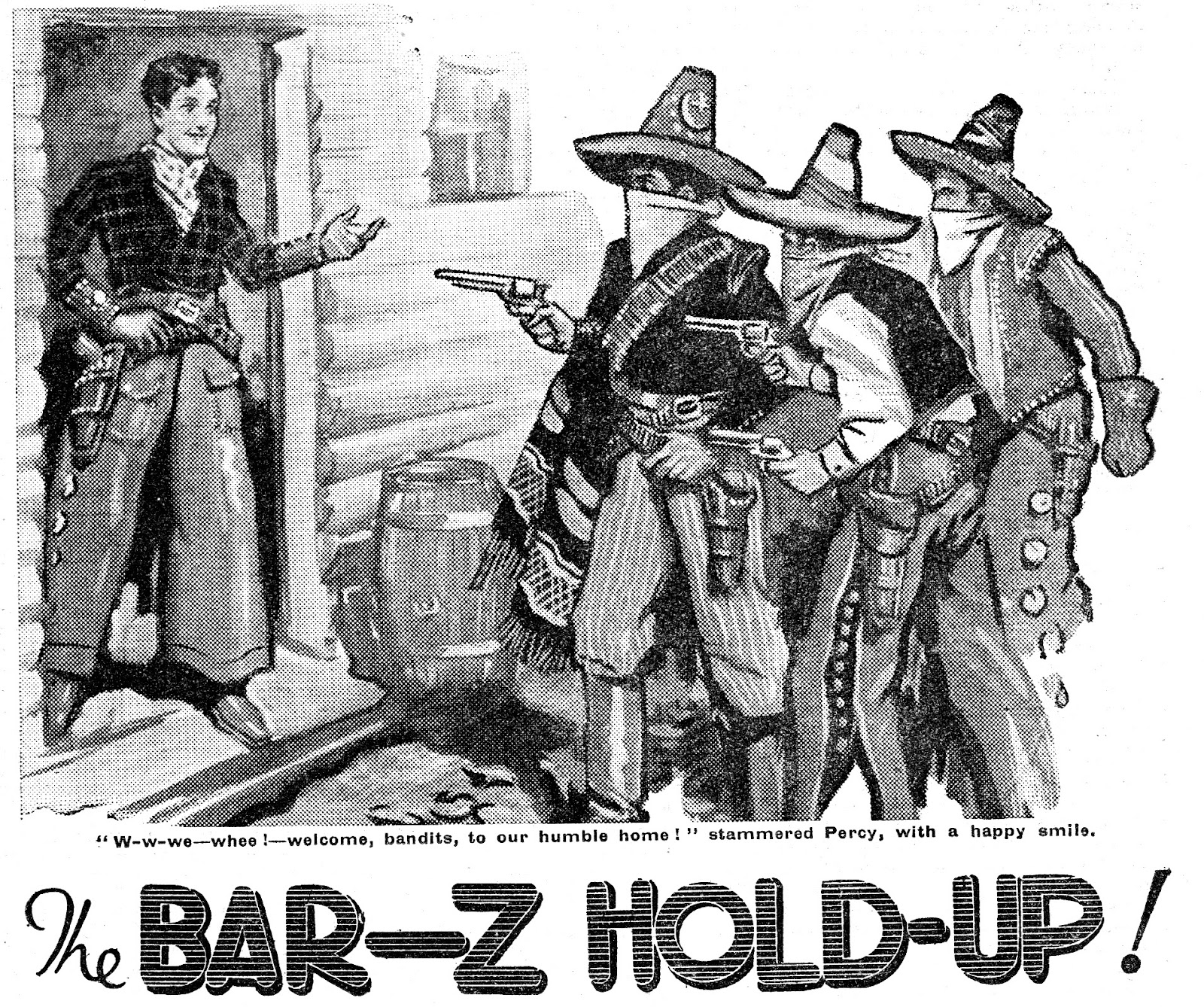
"W-w-wel—whee!—welcome, bandits, to our humble home!"
he smiled pleasantly.
"Funny guy, huh?"
snarled Red Grange. "Well, you won't feel so smart in a minute. Where's
that money hidden? Quick, tell us, or we—"
"I believe,"
continued Percy happily, "it is deposited in the
old oaken chest along with the
family mortgage."
"I’ll give you three minutes to tell us where
that money's hidden!" gritted Gallagher.
Percy backed into the bunkhouse as the
desperadoes advanced, the muzzles of
their three guns only a foot from his chest.
"How—wheee!—how would
you like to shoot me, gentlemen?" continued Percy, posing as for a
photograph. "Front face or profile? How do I look best?" Then he
burst out laughing. "It's—it's no good, boys. I—whee!—I can't keep this up
any longer. Your little game's rumbled. I know your guns are only loaded with
blank."
"Blank!" growled
Bed Grange, "See here, Mr. Wise-guy, jes' park your eyes on that little
winder over there! I'll show you how
many blank bullets is in my gun!"
As Percy looked towards the window indicated Grange levelled his gun at it
and pulled trigger. A crash, a stab of flame,
and the glass of the window shattered to bits.
"Now," began Red
Grange, "maybe you'll tell us—"
 At that point his sentence
came to an abrupt conclusion. Something
that felt like an avalanche descended suddenly upon the
bandits, and the three of them went sprawling in a heap, yelling with surprise
and alarm.
Percival Ulysses blinked.
Where but a moment ago had stood the three unpleasant-looking bandits was a confused
mass of waving arms and legs, on top of which reposed Slim.
The shock of the revolver explosion had somehow
jerked him loose from his wedged
position in the skylight, and he had
descended suddenly upon the heads of
the three thieves who, until the moment
he struck them, had been totally
unaware of his presence.
"That—wheee!—that was a
splendid idea, Slim!" cheered Percy, seeing that the
cook's enormous weight had pinned the
three men beneath him. "Just keep where you are for a moment. These jokers are in a lovely position to
receive a little well-deserved chastisement!"
Percy looked about him and
presently found a nice piece of flexible board, with which he proceeded to
smite the projecting rears of the squirming figures beneath Slim.
"This"—whack!—"is
to teach you jokers" —whack!— "a lesson"—whack! whack!—"
not to tell tall tales and play"—whack!—"practical jokes on your
visitors! Hallo! What's up now?"
Percival's attention, and
that of Slim, was suddenly diverted by a terrific din outside the ranch-house. They looked out, and to their amazement saw three horsemen prancing about,
firing their guns in the air and shouting at the
top of their voices in a
blood-curdling way.
"G-g-good heavens!"
gasped Percy. "More bandits?"
"Bandits mai foot!"
said Slim. "That's Tiny Waters and the
others; I recognise their horses!"
"Then—then—whee!—who're these
fellows?" gasped Percy, pointing to the
squashed and battered thieves wriggling beneath Slim's form.
"You know," said
Slim, "I do believe they're
real bandits! Quickly—go and tell those silly asses to stop making chumps of themselves out thar and come
to mai assistance!"
Half an hour later, with the three battered and bruised bandits safely locked
in a corral waiting to be transferred to the
Rattlesnake Bend gaol, Tiny Waters and the
two other jokers were explaining, a
little sheepishly, how it had all happened, to Bud Elton, who had returned on
hearing the news, and to the Sheriff of Rattlesnake Bend.
Slim and Percival Ulysses
Woodger looked on with a superior air and filled in the
story from their
point of view, thereby casting not a
little glory upon themselves.
"Well," said Bud
Elton, "it's a dinged good thing I thought of taking that money with me
this afternoon! I nearly left it in the
drawer of my desk. And see here, boys"—this to Tiny and the two others—
"next time you want to play a joke please don't leave the ranch deserted."
"Yes—wheeee!" said
Percival Ulysses. "The West isn't quite so wild as I thought, but it's
quite wild enough, on the
whole."
"It isn't half so wild
as I was," grunted Slim, feeling his many bruises, "when I got stuck
fast in that skylight!"
Next Saturday, Perry launches
out as a Gold-Miner, and provides you with a hundred-percent Fun and Excitement!
HOYT, Charles Keith—Passed away on Friday,
March 8, 2013, in QEII Health Sciences Centre in Halifax. Born in North
Sydney, on April 19, 1921, son of Wilbert V. and Hazel K. (Ryder)
Hoyt. After high school he joined the
Royal Canadian Air Force in 1939 and served as both an instructor while in
Canada and as a radar officer overseas where he met his future wife, Patricia “Paddy"
Margaret Page who served in the
WAAF. After the war, discharged from the
RCAF as Lieutenant, he earned a BSc and MSc in Physics at Dalhousie University.
During this period he went back to England and convinced Paddy Page to
marry him. He then went on to earn a
PhD in Physics at MIT. He returned to Dalhousie in 1955 to join the Physics Dept., focusing his work in optics, and
retiring as Professor in 1986. He enjoyed teaching and many of his students
maintained contact with Keith long after their
time at Dalhousie. He is survived by children, Susan (late Lewis) Pickett,
Moncton, N.B.; Brian (Petra Rykers)
Hoyt, Stillwater Lake; Louise (Ted) Mussett, Dartmouth, and Allen Hoyt,
Montreal; sister, Hazel Braman, North Sydney; grandchildren, Peter (Jenna)
Hoyt, Johanna (Ross Bain) Hoyt, Michelle Mussett, Elliot Mussett and Jonathan
Mussett; nieces, Nancy, Deborah and Catherine.
He will be missed by special four-legged friends, Bella and Jimmy. He was
predeceased by his wife of 61 years, Paddy and his stepbrother, Kaye Lemoine. He had a strong interest in
music and played the French horn as
an amateur musician for many years. He had a great curiosity in, and
appreciation of the natural world,
especially animals of all types. Cats held a special place in his heart.
Although in later years his vision failed him, he maintained a strong mind,
keen wit and good humour to the end.
Cremation has taken place. No visitation or service by request. In lieu of
flowers, donations may be made to two organizations strongly supported by Paddy
and Keith in the last three decades
of their lives: the Bide Awhile Animal Shelter Society, Dartmouth, and Oak-lawn
Farm Zoo, Aylesford.