Showing posts with label Inuit. Show all posts

Thursday, 14 June 2012

How the Fog Came


   How the Fog Came
By A. Hyatt Verrill
Author of "Harpers Aircraft Book," "Harpers Wireless Book," etc.
From Everyland magazine, Legends of the Northland, March 1915. Digitized by Doug Frizzle, June 2012.

It was dreary winter time in the Arctic, and the icy gales whistled around the little group of igloos (snow houses), drifting the fine snow about them until nothing but their low, rounded tops showed above the dazzling white surfaces which stretched away for countless miles to the frozen shores of the Arctic Ocean.
Just within the tunnel-like entrances to the huts the dogs huddled together, now and then howling dismally at the storm without or snapping at one another in a wolfish, savage manner. Within the little dwellings built of blocks of frozen snow, it was warm and comfortable, with no sound or sign of the blizzard raging outside. Near the center of each house stood a rude stone lamp filled with whale-oil, and with a row of moss about its edge. This moss served as the wick, and from this primitive stove the occupants of the house received their warmth and light.
 All around the inside of the igloo was a bench of ice, covered with the skins and furs of foxes, bears, seals, and wolves. On this bench sat the women; among them old Nepaluka, her wrinkled face bent close to the deerskin shirt which she was patiently stitching with a sharp bone needle and sinew threads. Near her was Newilic, her son, busily at work upon a walrus tusk, which under his deft fingers was being transformed into a long snow-knife. Between these two sat Kemiplu, Newilic's motherless daughter, a chubby brown-eyed lass of five years, playing with a horn dipper and a handful of bright pebbles.
Finally the grandmother finished the last seam, and, placing the completed shirt aside, sank back among the furs. The little granddaughter had tired of her simple toys, and cuddling up to the old woman, begged for a story. The grandmother smiled and gathering the little bundle of fur-wrapped humanity in her arms said:
"And of what shall I tell you, little daughter? Shall it be of Ukla the great bear who made the fog; of Nowgaluk the gull who ate the whales; or why the crow is black and the loon speckled?"
"O tell me of Ukla, Ananating!" (Grandmother), cried the child delightedly, and her busy father looked up from his work and listened attentively, for the simple Eskimos love their quaint old legends and never tire of hearing them repeated.
"Many, many winters ago," began the old woman, "there was a great white bear named Ukla. He and his wife lived many days' travel to the west in a great skin house upon a rocky plain, and all about the house were the skulls of men and women; for wicked old Ukla loved human flesh, and every night he traveled far across the land to the homes of our people. He would kill those whom he could find outside their huts, or would steal the bodies of the dead, and, fastening a rope of skin about their feet, would drag them across the rocks and hills to his home.
"Sometimes he was seen by the Eskimos, but oftener they saw only his giant footprints in the moss and snow, or found the graves deserted and empty. For many years this had gone on, and, although the people held medicine feasts and asked the Great Spirit to help them, yet he seemed displeased and answered not their prayers.
"Many times also the people lay in wait and tried to kill the robber bear with their spears and arrows, but Ukla was a great anti-coot (magician), and the bone-tipped weapons fell back bent or broken from his shaggy sides. At last the Eskimos were in despair, when one day a tall fair stranger came among them and said.
" 'Take heart, for I will rid you of this Ukla.'
"Then the Eskimos danced and beat their drums and rejoiced, and the stranger said to them:
" 'Tomorrow I will pretend to die and you must wrap me in skins and bury me among the stones, and when Ukla comes let him depart in peace with me.' Then the people grew very sad and sorrowful, but he answered them saying, 'Weep not, for soon I will return, and never after shall Ukla rob the graves of the Eskimos.'
"Then the people did as the stranger told them, and, wrapping the stranger in skins, placed him among the stones and departed to their homes crying aloud as if in sorrow. In the evening the great bear, having heard their cries, came across the hills to the village and, finding the body of the stranger, he fastened his rope about the man's heels and started homeward. But the man spread out his arms and grasped at stones, and although Ukla pulled and tugged he could travel but slowly, and every few miles he was compelled to stop and rest from his labors. Then as he looked at his burden he would shake his head in wonder.
" Ah,' he would say to himself, 'who would think such a small man would weigh so much; but he must be fat and fine indeed! What a grand supper he will make!' And thus encouraged by the thoughts of the fine feast he would have, he would again start onward. At last he reached his home and dragging the man within the door threw him into a corner, and tired out with his hard work crawled into his sleeping-bag, telling his wife they would feast in the morning.
"After a time the stranger opened his eyes to look about, but Ukla's wife, who was trimming the lamp, saw him and cried out to her husband:
" 'This man is not dead—he is looking about.'
"But Ukla was very tired and answered sleepily,
" 'Oh, man dead, man frozen stiff.'
"Then the man kept very quiet indeed, and when the bear's wife turned away he caught up Ukla's knife and leaping forward killed her. As she fell the bear awoke, and the man, throwing down the knife, dashed through the door and across the rocky plain while the bear followed close at his heels, panting and growling terribly as he ran.
"At last, run as fast as he might, the man found the bear was constantly gaining and would soon overtake him. Now this stranger was a mighty magician, and as he ran he caused a great hill to rise between himself and Ukla, and as the bear climbed slowly up one side the man ran swiftly and easily down the other; but when Ukla reached the top he curled up and rolled swiftly down the side of the hill and nearly caught the man again.
"Then the stranger caused a mighty river to flow between himself and his pursuer and sat down upon a stone to rest. When Ukla reached the farther side he roared and growled with rage, and in a great voice called out,
" 'How, O man, did you cross the river?'
"And the man laughed and answered, 'I drank my way across.'
"When Ukla heard this he plunged into the stream and drank and drank until at last he made a dry path across the torrent and crawled slowly up the other bank. But his long hair was wet and heavy, and his body was greatly swollen with all the water he had swallowed, so that the man feared him not, and taunted him. Then the bear grew very angry, and with growls like icebergs clashing in a storm he cried out, 'Ugh, even though I am so sodden that I cannot overtake you, yet you shall not escape me,' and giving himself a mighty shake he burst, and the water which he had swallowed flew in all directions and caused a thick fog over all the land.
"Now the man was greatly troubled, for all the hills and plains were hidden from his eyes and he knew not which way to turn. But having skinned the bear he grasped the shaggy hide in his hands and waved it many times about his head, thus making a great wind which drove away the mist. When he reached the village of the Eskimos great was the rejoicing and the men did not work and the women did not comb their hair for three days and three nights, but danced and beat drums and feasted. For many years the stranger dwelt among the Eskimos and taught them many things, and performed many great and brave deeds, but of these I will tell you some other day, for now it is time to sleep, little daughter."
As the old woman ended her tale the little brown eyes were closing, and the grandmother laid the child tenderly among the soft rich furs to dream of the good brave stranger and mighty Ukla the "Fog Father."

Friday, 1 June 2012

How the Reindeer Lost Their Tails


How the Reindeer Lost Their Tails
By A. Hyatt Verrill
Everyland magazine, Vol. VI, No. 4; September, 1915; column ‘Legends of the Northland’. Digitized by Doug Frizzle, June 2012.
Author of "An American Crusoe," "The Cruise of the Cormorant." Etc.

Little Kemiplu was learning to sew. Her grandmother, old, wrinkled Nepaluka, was mending skin garments and the child, with a bone needle and sinew thread, was amusing herself by stitching odd bits of fur together. At last the little girl arose, toddled to the old woman's side and proudly held forth the result of her work for approval. Upon a bit of dark sealskin she had fastened strips of white hare and when the grandmother saw it she burst into a low laugh.
"Ai, ai!" she exclaimed, "It is like the feathers of the ptarmigan when he changes from his brown coat of summer to the white of winter. Or is it that Amook has stood beside thee, little daughter, and has laid his hands upon the skin and left white marks where his fingers rested?”
Kemiplu threw down her handiwork and climbed into her grandmother's lap.
"O, tell me of Amook and the reindeer," she begged, "and of why the ptarmigan turns white in winter."
"Very well, little daughter," said the old woman. "Thy father's clothes are mended and my eyes are weary, and perchance the stranger has never heard of Amook."
"Many ages ago," she began, "before the Eskimos first came to the land, all the reindeer were brown from head to tail and all wore long, bushy tails like the foxes. In those times there lived a mighty magician named Amook who owned all the animals and birds. All creatures roamed at will except the reindeer, but these Amook kept hidden in a great hole in the earth. Every day Amook would come forth from the hole, and after pulling a big stone over the entrance to his home, he would travel all about to care for his creatures. In those days the birds and animals were all of one color and when winter came and the snow fell their brown bodies were plain against the snow and the creatures saw one another afar and it was easy indeed for the owls and hawks to see the ptarmigan and kill them and for the foxes to see the hares and devour them. At last so many were killed that Amook grew fearful lest his live things would all be destroyed and he would be without food to eat or skins and furs to wear. So Amook, the magician, gave many days to thought and made many spells, until, by touching the hair of an animal or the feathers of a bird, he could make the brown change to white like the snow. Then, when winter came, Amook would go forth throughout the land and would call to the birds and the creatures far and near. As they came to his call he would stroke them with his hands and their color would change and they would go forth from him white and spotless. But soon Amook was again greatly troubled for when spring came and the snow melted and the brown rocks and gray moss were to be seen, the white creatures were like spots of snow upon the land and fell easy prey to their enemies. From far and near the beasts and birds flocked to their master crying aloud for help in their troubles and begging him to make them brown once more.
"So Amook made another spell in his hole beneath the earth, and when he came forth and touched the birds and animals, behold! they were changed from white to brown as before.
"So, as each winter came, Amook went forth across the land and changed the brown of birds and animals to white; and again, when the winter had passed and the wild geese came to the northland, he went forth again and changed the white once more to brown.
"But some of the creatures were wary and would not come at their master's bidding, and Amook was hard put to chase and capture them. It was thus with the great bear, for he loved his white coat which Amook had given him and which helped him to hide upon the icebergs and the floes; and try as he would Amook could not catch him in the spring to once more turn him brown. So, too, the great white owl; in his white coat he could perch motionless upon a rock, and birds and beasts would think him but a piece of ice and unsuspecting would approach within easy reach. Time and again did the magician creep close and strive to catch the owl, but never did he grasp him, although the tips of his fingers touched the feathers as the owl flapped away; and to this day you may see the round brown spots, left by Amook's fingers upon the feathers of the owl. The weasel, too, timid and suspicious, but too cowardly to disobey his master, crept sneaking from the rocks and crouched snarling to the earth as Amook passed his hands over the fur, and the tip of his tail, being hidden in the rocks, to this day remains black, while his belly that was pressed to the earth is white throughout the seasons. Many other things—the geese and ducks and snipes, the hawks and the gulls—flew southward ere Amook came forth to work his spell of whiteness and came not north again until the spell of brown was spent, and so their colors changed not with the year. But the hare and the fox, the ptarmigan and the weasel, came at Amook's call and grew cunning and hid from their enemies through the magic of the Anticoot.
"Through all this time the reindeer, deep within their hole, remained brown, for under the earth there was no winter and no summer. One day, as Amook returned to his hole beneath the earth the raven, flying by, saw the magician step out of sight. Always curious he wondered what Amook had hidden in the earth and after pondering he flew to his friend the fox. 'Ai, ai!' he exclaimed, 'Tell me, O brother, what your master keeps in his home beneath the earth. You, whom he fondles and strokes to white or brown must know.' But the fox knew not and said so to the raven. This made the black bird more curious yet. 'Why have you never found out, O brother?' he exclaimed, 'Have you never wondered where this Amook gets the power to turn brown white and white brown? Think you, O brother, how fine it would be to know the secret of his power. With it in thy paws thou couldst change color at will and like the owl pose as a bit of snow in summer or a bare rock in winter. Truly, O little friend, you would find hunting easy.' Now the fox was a born thief and most cunning withal, and the words of the raven set him thinking. At last he spoke. 'With thy help, O black brother, I may find out. We will hide close by the hole of Amook and when he comes forth thou wilt fly far into the air and croak loudly, and when the magician looks up at the sound, I will place a bit of rock beneath the cover to the hole so it will not close tightly, and when Amook has passed on we will enter his dwelling and steal the charm!'
"So it came to pass that, when Amook again went forth, the cunning fox lurked close at hand, and in the air above the great black raven croaked hoarsely. Even as the two had planned, the magician looked up to see why the bird called out, and the fox slyly slipped a bit of rock into the edge of the doorway to Amook's home. So, when the magician pushed the stone shut, the bit of rock stopped it from closing and an opening was left which Amook did not see. Then, when the magician had gone far, the raven descended and with his friend the fox entered the dwelling of the magician. After a long time they came to a great valley and there they saw the herd of reindeer—all brown and with bushy tails—feeding upon the fresh moss. The fox and the raven were filled with wonder at the strange creatures with the branching horns; and the deer, who had never seen another creature other than Amook, were filled with wonder as great and with some fear at sight of the white fox and the black bird.
"But the raven with his flattery and the fox with his cunning soon overcame the fears of the deer and talked with them. The deer knew nothing of the magician's spell, for they had never been changed to white; and the fox and raven—finding the deer dull and stupid—began to tell them of the wonders of the outside world. At last the simple deer were interested and longed to go forth, and they followed the fox and raven to the opening in the rocks.
"One after the other they squeezed through, and just as the last one had come forth Amook came home. When he saw that the deer had escaped, he rushed forward and with outstretched hands tried to push the deer back into the hole; but the deer—pleased at the outside world—struck at him with their feet and where his hands had touched their foreheads broad white marks appeared, for Amook had been forth to turn all creatures white for the coming winter and the charm was still upon his hands. Then Amook, running about, seized the deer by their tails and strove to pull them back into his home. The deer struggled and tugged and all at once their tails broke off in Amook's hands and the magician, tumbling head over heels, rolled into the opening beneath the stone.
"Then the deer pushed the bit of rock from beneath the stone door which fell into place and shut Amook up forever. But, as the deer's leader closed the rock door, one of the prongs of his antlers was caught between the stones, and in drawing it forth it was bent and twisted in front of the deer's face.
"And so, little daughter, to this day every reindeer has a twisted part of each horn before his face and a stubby tail, and where Amook grasped the deer's tails and struck their foreheads in the long ago the white patches still remain."

Why the Crow is Black and the Loon Speckled


 Why the Crow is Black and the Loon Speckled
‘Legends of the Northland’ column, Everyland magazine, June 1915. Digitized by Doug Frizzle, May 2012.
By A. Hyatt Verrill
Author of "An American Crusoe" "The Cruise of the Cormorant,"etc.

The spring was approaching in the Arctic, and little flocks of snowbirds were twittering outside the igloos on the snow. Soon the Eskimos would be moving into their skin houses and would live much of the time out-of-doors, but it was still cold and dreary, and the people were glad to seek the shelter of their ice huts save when fishing or hunting. In Newilic's home old Nepaluka, ever busy, stitched steadily away at a pair of sealskin moccasins while her son bound a tough thong of skin about the cracked stock of his ancient rifle given him by a whaler in exchange for musk-ox and bearskins.
Little Kemiplu played about, running here and there, tumbling among the heavy robes and furs and filling the close, smoky air with childish laughter. Presently she spied a pot of black soot carefully set aside for future use, and unnoticed she dipped her chubby fingers in the thick black mass and, pleased at its appearance, daubed it over her round little cheeks. Then, running to her grandmother, she proudly exhibited the results of her first attempt at self-adornment. The gentle, patient old woman dropped her work and threw up her hands in amazement:
"Hail Ai!" she cried, "what is this, you naughty little one? Are you a little imp, or is it a little crow I see? Ah, Kemiplu, you are indeed like the crow. Never quiet for a moment, and now you are as black as when the loon was through with him."
All unabashed Kemiplu cried out in glee.
"Oh, Ananating," (Grandmother), "tell me the story of the crow and the loon!"
The old woman picked up the pet of the household in her arms and exclaimed:
"Ah, you little tease, you have wasted the father's black and have daubed your face, and what now but your grandmother must reward you with a story! Well, my old eyes are tired with the sewing, and 'twill serve to keep you from further mischief, so I will tell you the tale you desire."
"Many moons ago," began the old woman, "all the birds were of one color, white like the snow, and all the beasts were of one color, brown like the rocks. One day the crow, while stealing bits of skin from the village of the Eskimos, saw the medicine-man, as he pierced the skin and rubbed in the black for the tattoo.
" 'Ah,' said the crow, 'how beautiful do the men make themselves, while we birds are ugly white and one can scarce be known from another!' Flying off he soon saw his friend the loon, and stopped for a chat.
" 'Ai! Ai!' he cried, 'I have been watching the Eskimos and have seen how the men-creatures make themselves beautiful. What a shame that you and I cannot do likewise!'
"Now the loon is a very wise bird; indeed, he might be called a medicineman among the feathered people, and when he heard the crow's story he exclaimed:
" 'And why, brother, should we not also use the black pot and paint our bodies ? If you, who are so wily, will steal the pot of color, we will try.'
"So the crow flew back to the village of the Eskimos, and watching his chance he stole the pot and made off with it. Then the loon said:
" 'You, brother, have seen the man use this thing and must know how to use it better than I. Tattoo me first and I will watch you work, and then when you are through and I have learned the trick I wall tattoo you.' " So the crow took the little sharp bones and dipped them in the black and commenced to tattoo the loon's neck. The loon squawked in pain but he stood still patiently while the crow decorated his neck with black stripes and dots and made neat black squares upon his back.
"Then the loon took up the bone points and told the crow to stand still while he worked out a pattern. But the crow—always a coward—danced and hopped at the first prick, and the needle slipped and made an ugly, scraggly mark. So the loon, who is ever quick-tempered, cried out, 'Stand still, or I will throw the pot at you!'
"Then for another while the crow was quiet, but soon he again began to move and squirm, and the loon, seeing all his beautiful lines and dots rubbed and spoiled, grabbed up the pot of black and threw it at the crow, and the soot spreading and running over him blackened all his feathers as he flapped, squaking, away.
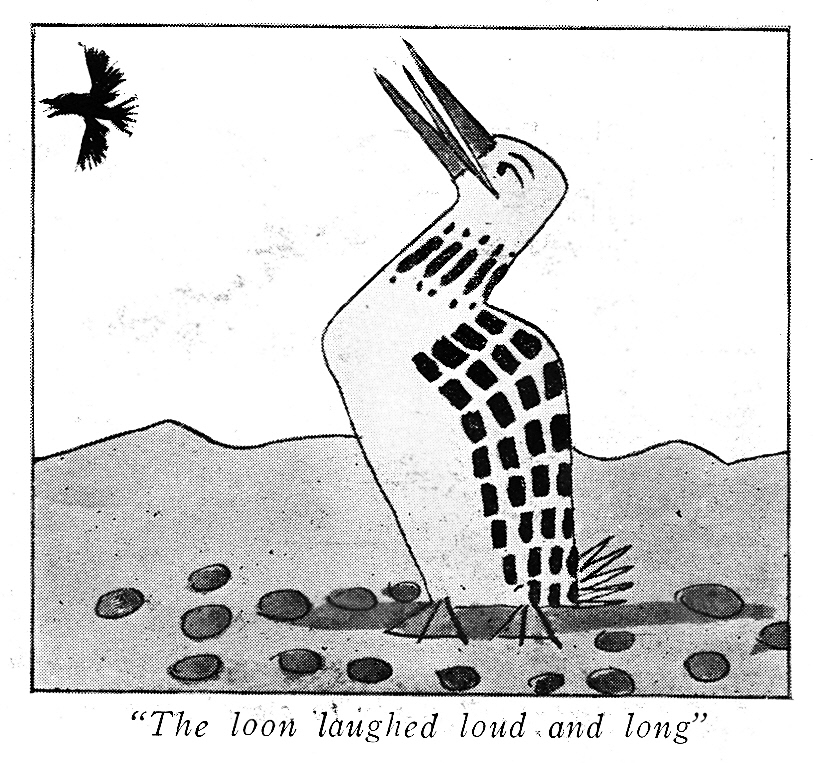
"And as the ugly black bird flew off, the loon, thinking of his own fine tattoo marks laughed loud and long; and even to this day the crow is black and the loon is speckled, and ever as the loon sits on the calm water and sees the reflection of his pretty black and white feathers he thinks of the long ago and laughs in wild glee.
"And now, little daughter, if you are like the crow surely your father is like the loon, for even as he looks upon your black face his sides shake with laughter, so I will clean you lest he burst with merriment."
Thus closing her tale with a fling at her fat, good-natured son, she began the difficult task of removing the black stains from Kemiplu, and presently tucked the child among the robes to dream of things even more wonderful than her grandmother's old legends.

Blog Archive

Countries we have visited