Showing posts with label everyland. Show all posts

Friday, 1 June 2012

Why the Crow is Black and the Loon Speckled


 Why the Crow is Black and the Loon Speckled
‘Legends of the Northland’ column, Everyland magazine, June 1915. Digitized by Doug Frizzle, May 2012.
By A. Hyatt Verrill
Author of "An American Crusoe" "The Cruise of the Cormorant,"etc.

The spring was approaching in the Arctic, and little flocks of snowbirds were twittering outside the igloos on the snow. Soon the Eskimos would be moving into their skin houses and would live much of the time out-of-doors, but it was still cold and dreary, and the people were glad to seek the shelter of their ice huts save when fishing or hunting. In Newilic's home old Nepaluka, ever busy, stitched steadily away at a pair of sealskin moccasins while her son bound a tough thong of skin about the cracked stock of his ancient rifle given him by a whaler in exchange for musk-ox and bearskins.
Little Kemiplu played about, running here and there, tumbling among the heavy robes and furs and filling the close, smoky air with childish laughter. Presently she spied a pot of black soot carefully set aside for future use, and unnoticed she dipped her chubby fingers in the thick black mass and, pleased at its appearance, daubed it over her round little cheeks. Then, running to her grandmother, she proudly exhibited the results of her first attempt at self-adornment. The gentle, patient old woman dropped her work and threw up her hands in amazement:
"Hail Ai!" she cried, "what is this, you naughty little one? Are you a little imp, or is it a little crow I see? Ah, Kemiplu, you are indeed like the crow. Never quiet for a moment, and now you are as black as when the loon was through with him."
All unabashed Kemiplu cried out in glee.
"Oh, Ananating," (Grandmother), "tell me the story of the crow and the loon!"
The old woman picked up the pet of the household in her arms and exclaimed:
"Ah, you little tease, you have wasted the father's black and have daubed your face, and what now but your grandmother must reward you with a story! Well, my old eyes are tired with the sewing, and 'twill serve to keep you from further mischief, so I will tell you the tale you desire."
"Many moons ago," began the old woman, "all the birds were of one color, white like the snow, and all the beasts were of one color, brown like the rocks. One day the crow, while stealing bits of skin from the village of the Eskimos, saw the medicine-man, as he pierced the skin and rubbed in the black for the tattoo.
" 'Ah,' said the crow, 'how beautiful do the men make themselves, while we birds are ugly white and one can scarce be known from another!' Flying off he soon saw his friend the loon, and stopped for a chat.
" 'Ai! Ai!' he cried, 'I have been watching the Eskimos and have seen how the men-creatures make themselves beautiful. What a shame that you and I cannot do likewise!'
"Now the loon is a very wise bird; indeed, he might be called a medicineman among the feathered people, and when he heard the crow's story he exclaimed:
" 'And why, brother, should we not also use the black pot and paint our bodies ? If you, who are so wily, will steal the pot of color, we will try.'
"So the crow flew back to the village of the Eskimos, and watching his chance he stole the pot and made off with it. Then the loon said:
" 'You, brother, have seen the man use this thing and must know how to use it better than I. Tattoo me first and I will watch you work, and then when you are through and I have learned the trick I wall tattoo you.' " So the crow took the little sharp bones and dipped them in the black and commenced to tattoo the loon's neck. The loon squawked in pain but he stood still patiently while the crow decorated his neck with black stripes and dots and made neat black squares upon his back.
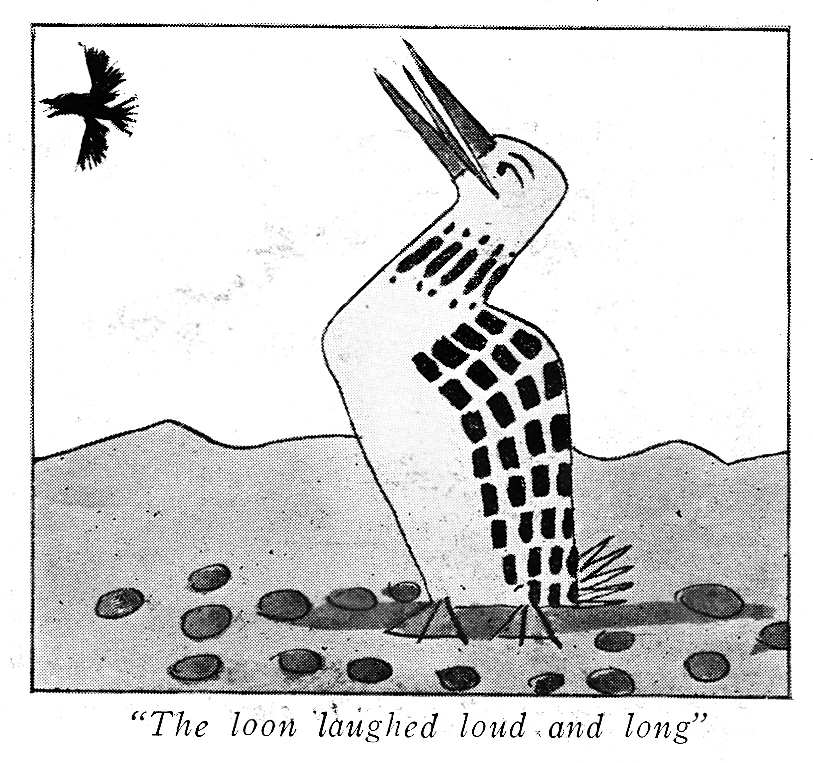
"Then the loon took up the bone points and told the crow to stand still while he worked out a pattern. But the crow—always a coward—danced and hopped at the first prick, and the needle slipped and made an ugly, scraggly mark. So the loon, who is ever quick-tempered, cried out, 'Stand still, or I will throw the pot at you!'
"Then for another while the crow was quiet, but soon he again began to move and squirm, and the loon, seeing all his beautiful lines and dots rubbed and spoiled, grabbed up the pot of black and threw it at the crow, and the soot spreading and running over him blackened all his feathers as he flapped, squaking, away.
"And as the ugly black bird flew off, the loon, thinking of his own fine tattoo marks laughed loud and long; and even to this day the crow is black and the loon is speckled, and ever as the loon sits on the calm water and sees the reflection of his pretty black and white feathers he thinks of the long ago and laughs in wild glee.
"And now, little daughter, if you are like the crow surely your father is like the loon, for even as he looks upon your black face his sides shake with laughter, so I will clean you lest he burst with merriment."
Thus closing her tale with a fling at her fat, good-natured son, she began the difficult task of removing the black stains from Kemiplu, and presently tucked the child among the robes to dream of things even more wonderful than her grandmother's old legends.

Saturday, 24 March 2012

Lola's and Valerie's Pets


Lola's and Valerie's Pets
By A. Hyatt Verrill
Photographs by the Author
From Everyland magazine, Nov.1918; researched by Alan Schenker, digitized by Doug Frizzle, Mar. 2012.
OF course many readers of EVERYLAND remember Lola and Valerie, the girls who traveled through the West Indies and wrote about their trip for Everyland. Since then they have lived for nearly two years in British Guiana in South America, and while in that faraway land, they had some of the most interesting and curious pets you can imagine.
Of course they had parrots, for Guiana is famous for its great variety of parrots. Even right about the big city of Georgetown and in the public gardens, you can see wild parrots and parrakeets flying about among the trees. Lola's and Valerie's parrots were not the common green Pollys which most people see, but were gorgeous birds of many colors and with the funniest and most interesting ways.
First there was Caesar, a little green and orange parrakeet that Valerie bought in the big Georgetown market on her first visit to South America. Caesar has made the long journey back and forth between New York and South America four times; and when his mistress is in the United States, Caesar travels everywhere she goes in the motor-car; so he has toured all over New England. He is so accustomed to traveling that he knows he's going on a trip just as soon as his mistress commences to pack her trunk, and he gets excited as a child. Unlike most parrakeets Caesar is a great talker. He's never tired of saying “pretty boy," "bad boy," and "pretty, pretty, pretty." and when he's excited he cries "Hurry up! Hurry up!" or "Come on! come on!" over and over again. He also yells, "Hip, hip hooray!" and whenever he sees wagons passing he calls, "Cash paid for rags." He is very tame and likes to be petted and fondled, but he is terribly jealous and is as peevish as a spoiled child if he doesn't receive enough attention.
Lola's first parrot was Boy Blue, a lovely bird with blue back and purple breast, and with the most beautiful scarlet and blue wings and tail. He has traveled almost as much as Caesar, and he talks almost as well, and he whistles like any schoolboy. But while Caesar's voice is shrill and harsh, Boy Blue's is soft and low. He has great, mild, brown eyes and looks very gentle, but he has a bad temper and snaps and bites at strangers although he lets his mistress handle him and play with him by the hour. Then there was Robert, a huge blue and yellow macaw, who was a perfect baby in his love for being petted and who constantly begged everyone to "scratch pretty Robert."
But the funniest parrots of all were two roly-poly creatures which the girls called Tweedledum and Tweedledee. These little chaps had green backs and white breasts with orange-yellow necks and black caps, and a little band of yellow across the chest and on the legs; so that Valerie used to say they looked exactly like little dwarfs dressed in green coats, yellow trousers, and yellow cravats. Tweedledum and Tweedledee couldn't talk, but they mimicked every bird, beast, and sound they heard like regular mocking-birds, and they were as frolicsome and playful as little kittens. They rolled over and over, pretending to fight each other: they hung head down by one leg and spun round and round, and chased their own tails in the funniest way. But strangest of all, they always slept snuggled down side by side on the floor of their cage.
Last, but by no means least, was Juanita, a magnificent sun parrot. Juanita had a green back and a purple breast and a gray head, but on the back of her head was a wonderful crest of crimson and blue feathers which she could raise until it formed a gorgeous, fan-like crown. Juanita could not talk well, but she was very gentle and lovable, and best of all, she could do all sorts of funny tricks. She stood on her head when told to, or she lay on her back and played dead, and then, when she was told to "come to life," she hopped up and raised her lovely crest and whistled, as pleased as could be at the fun.
But the parrots were not the only bird pets which Lola and Valerie had in their South American home. There were Toto, the toucan, whose story has been told in Everyland, and two other big, black, white, and scarlet toucans, besides two smaller ones with soft green and brown dresses. The toucans were always amusing, for they looked very droll with their enormous beaks, and the girls never tired of tossing them bits of food or paper balls, which they always caught in their big bills. Toucans are very funny birds and sleep with their beaks buried in the feathers of their backs and with their tails folded up over all, so they look for all the world like round balls of feathers. They are very lively, active creatures and make the funniest barking and yelping sounds, just like puppies, and they are always hungry. They are fond of bananas, and it is very funny to see one of these queer birds swallow a whole banana at one gulp. Whatever a toucan eats he first tosses into the air; then he catches it in his beak and gulps it down, and he is just as expert in doing this with a tiny seed as with a big banana.
Another funny bird the girls owned was the sun bittern, a dainty creature with mottled brown, yellow, and black feathers, and red, yellow and black wings which he spread out until they looked like a rising sun. He had long, slender, yellow legs and the slenderest neck you could imagine, and he walked mincingly about like a dainty lady. When frightened, the sun bittern crouched down, opened his sharp bill, and swayed his neck and hissed just like an angry snake, but he was really a very gentle, harmless creature. The sun bittern loved insects, and he spent most of his time catching flies. It was very funny to see him stalk silently toward a fly until within striking distance; then out darted his slender neck like a streak of lightning, and Mr. Fly disappeared as if by magic. Sometimes, too, the sun bittern stood for hours motionless, with the tip of his bill against the ground, or he would stand quietly and sway back and forth on his slender legs like an elephant in the zoo.
Valerie didn't care so much for the sunbird as for Peter. Peter was a funny, white-headed tree-duck, a real live "Quacky Doodles" only he never quacked like ordinary ducks but whistled in a queer, plaintive way.
But the most interesting of all the bird pets was Warri, the trumpet-bird. He was a very sleek, genteel-looking creature with a soft, gray back and velvety black head, breast and neck, and with a little spot of metallic green and purple feathers on his breast. He was about the size of a Bantam hen, with long slender legs and a slender neck and with the biggest, brightest, black-eyes you ever saw.
He was very tame and wandered at will about the yard and house, and whenever any one appeared, he came racing forward with his wings half spread and making a queer, deep, trumpeting noise in his chest. He loved to take charge of the chickens and bossed them about like a regular tyrant, and strangest of all, he was terribly feared by even the most pugnacious old roosters. If a strange rooster appeared, the trumpet-bird instantly rushed at him, and although he didn't have spurs, he could strike so hard with his big feet and peck so viciously and was so swift in his motions that no rooster could resist him. He would attack a marauding hawk, or even a dog or cat, just as readily. For this reason the natives of South American countries always keep trumpet-birds with their chickens, for they feel sure that as long as one of these creatures is on guard, no enemy will dare molest the fowls.
Besides all these birds and several others I have not mentioned, there were the four-footed animals, some of which could scarcely be called pets at all. First, there was the armadillo, a stupid but funny beast. His only ambition was to be left alone, and he slept nearly all the time. It made every one laugh to see the queer chap burrow into the ground, for he could dig so quickly that he disappeared almost instantly, and it was all a person could do to pull him out again.
Then there was the huge ant-bear which the girls named "Fluffy Ruffles." I doubt if there is any stranger animal in all the world than the ant-bear. It has no neck, and its head is all nose, while it walks with its huge front claws bent back, and when it sleeps it wraps itself in its enormous bushy tail. The ant-bear has no teeth, but it has a slender snake-like tongue nearly a yard long; with this it laps up the ants upon which it lives, while its powerful front feet and strong claws are used in digging out the ants and tearing their nests to bits. Nature created the ant-bear to feed on ants, and it is proof against their bites. It also has a very ugly and unsociable disposition and a most uncertain temper. Sometimes Fluffy Ruffles would let a person stroke her head, but at other times she would rear up on her hind legs and strike viciously with her front claws. When an ant-bear does this, it is very dangerous. Even the big, spotted jaguars fear it; so you can imagine that Fluffy Ruffles was not a favorite pet with the girls and that they always kept well out of her reach.
Very different was Jimmy, the tapir. Jimmy was only a baby a few weeks old, a fawn-colored chap spotted with white, and the dearest little fellow you ever saw. He followed the girls about like a dog, answered to his name when called, and just loved to be petted and stroked. The only sound he could make was a low, shrill whistle, and his favorite food was bread and milk. His body was short, but his head was large and it tapered into a flexible nose that was shaped something like an elephant's trunk, only very much shorter. Do you wonder that Jimmy was a constant source of amusement and pleasure for the girls?
Of course Lola and Valerie could not take all these strange pets with them to the United States; so they decided to keep just Caesar and Boy Blue, and the others were sent to the Zoological Park in New York. If any of Everyland's readers visit Bronx Park, they will see Juanita and Robert and Toto and all the rest—even Jimmy the tapir, although you'd never recognize him, for he has lost his pretty white spots and has grown to be a big, brownish-gray beast altogether too large for any girl to hold in her arms.

Wednesday, 21 December 2011

The Gull That Ate the Whale


Finding Everyland magazine was a bit of a search fluke. The magazine was published from 1909 to 1928; published by Interchurch World Movement of North America, it was ‘for boys and girls’. AHV not only wrote a number of stories including fables for the magazine but also edited a letters column for some time. This tale is the first received and prepared. Here are some of the pages in PDF format./drf

The Gull That Ate the Whale

This story is third in the series "Legends of the Northland." The illustrations are made by the author from the Eskimo drawings which he secured with the folk-tales from the Eskimos.

By A. Hyatt Verrill

From Everyland magazine June 1916. Digitized by Doug Frizzle December 2011.

IT was summer-time the Northland. The bays and coves were no longer icebound, but sparkled in the sunshine. Upon the vast, barren, rocky plains lichens and moss had taken on a tinge of green. About the pools formed by melting snow among the rocks coarse, grasslike sedges had sprung up, and only in the shadow of ledges and ravines were patches of gleaming snow to be seen.

Flocks of twittering snowbirds flitted here and there, hoarse-voiced ravens sunned their black plumage upon the rocks, baby sandpipers ran nimbly along the beaches, and snowy gulls and terns wheeled and uttered querulous cries above their nesting-places on the rocky cliffs.

Weeks before, the last of the igloos (snow houses) had been abandoned by the Eskimos, and close to shore the people were dwelling in their summer tents of skins. Upon the beach the kiaks (canoes) were drawn, and upon the racks the catch of salmon was being spread to dry.

Old Nepaluka, too feeble to work, dozed in the doorway of her tent while Kemiplu her granddaughter played with the shining pebbles at the water's edge. Presently she tired of her play and toddling to her grandmother tugged at the old woman's clothes and begged for something to eat.

"Ai, ai!" exclaimed Nepaluka, rising stiffly, "Thou art ever hungry, little daughter." From the tent she brought a strip of dried meat and handing it to the child again seated herself. As she watched Kemiplu eagerly devouring the tidbit, a smile flitted over her brown, wrinkled face.

"Take heed that thou dost not choke, thou little glutton," she remarked, laughing. "Remember Nudlauk the gull!"

Her appetite appeased, the child snuggled close to her grandmother with a sigh of satisfaction. "O tell me of Nudlauk, Ananating (grandmother)," she begged.

"Very well, little daughter," replied the old woman. "When thou art older thou mayest see the lake and the bones of Nudlauk and the whale and will know that the tale is true.

"A great many ages ago," she continued, "before even the Eskimos lived in the land, there was a great gull named Nudlauk who flew daily across the hills and seas. So large was she that seals and walruses were her prey, and even the bears and wolves and reindeer were to her as but mice and partridges to the great white owls. From the sea, far toward the setting sun, would Nudlauk carry her prey, for to her giant wings the two days' journey was but an hour's flight. Then, standing with one foot on each of two hills, she would tear and eat the creatures she had caught and would feed them to her young.

"At last the seals and bears and walruses were all but destroyed, and, learning wisdom from the fate of their fellows, they would dive beneath the waves or hide among the crevices of the rocks upon the first sight of the gull or the first sound of her beating wings. Unable to get food,—for Nudlauk was slow and clumsy and of little wit,—the great gull became lean with hunger, and each day went farther on her hunting, for far and near all creatures knew her and hid themselves in fear.

"At last, alighting on a mighty iceberg far out upon the sea, she saw, spouting in the waves, a school of whales. Now Nudlauk in all her wanderings had never seen a whale before and she was filled with wonder at sight of the great creatures. 'Ah!' she thought, 'What fine great ogjugs (seals) are these. I will catch one and have a fine feast!'

"So, watching her chance, she swooped and grasped the largest whale in her beak and flapping heavily, for she was weak with hunger, she rose in the air and started homeward.

"But the whale was filled with water and very heavy, and soon the tired gull was forced to stop and rest. As soon as the whale felt himself upon the land he spouted great streams of water, which formed a little pond among the rocks. Again the gull grasped him and started onward for her home beyond the hills.

But ever and anon she stopped and laid her burden down, and at each spot the whale spouted and formed a pond, and one may still see all these little ponds about the country, even to this day. "At last, weary and worn, she reached her home and cried aloud to tell her hungry young that food was at hand. But in her absence the wolves and bears had come, and finding the young gulls weak and helpless, had killed and devoured them; so now, at Nudlauk's call, there came no answer, and soon she saw the mischief that had been done.

"Then in anger and sorrow she screamed aloud until the hills shook and the waters were ruffled as by a wind and the wolves and bears shivered and whimpered with fear within their lairs. But Nudlauk, always a glutton and now very hungry with her long flight, soon forgot all about her young and only a desire to eat filled her foolish brain.

"Grasping the whale by the head she tossed him upward and gulped him down, whole and living, even as do the little gulls to-day when they swallow fish. But the whale, seized with terror, spouted and squirmed and struck out with his mighty flukes and opened wide his great jaws, which stuck in Nudlauk's throat and choked her.

"Gasping for breath and deathly sick the great gull fluttered and struggled, splitting the granite ledges and tearing up the ground, until, unable to get the whale either up or down, she at last fell dying to the earth.

"There between the hills lie her bones and those of the whale which caused her death, and beside the pond that the whale made by his spouting one may see them bleached and white among the black rocks."

Blog Archive

Countries we have visited