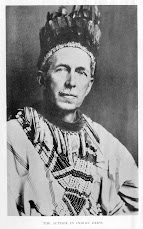
The Tribal Relationship of
the Akawoias
By A. Hyatt
Verrill.
Timehri, June 1917. Researched by Alan Schenker, digitized by
Doug Frizzle, May 2012.
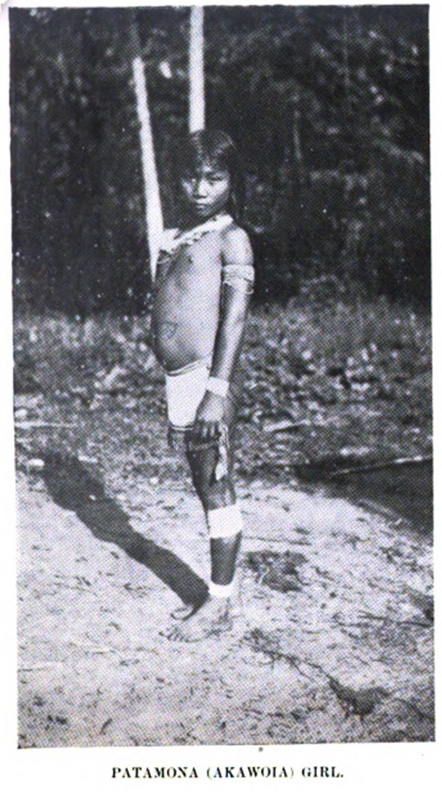 Of all the
tribes of British Guiana the most numerous, the
most widely distributed and the
richest in sub-tribes are the
Akawoias or, as they call themselves, Kapohn (The People). Of all the
tribes of British Guiana the most numerous, the
most widely distributed and the
richest in sub-tribes are the
Akawoias or, as they call themselves, Kapohn (The People).
There is scarcely any portion
of the colony where Akawoias are not
found, with the exception of a
narrow strip along the coast, and their benabs are scattered through the forests from
the Courantyne
to the Venezuelan border and
southward to the savannas of the Rupununi. But though so widely distributed
throughout this colony they do not
occur in Dutch Guiana, Brazil or Venezuela, unless the
Akurias of Dutch Guiana and the
Arekunas of Venezuela are related tribes,—and they
may be considered as strictly British Guiana Indians, the
only tribe in fact which is indigenous and confined to the
colony.
For this reason alone they are of particular interest, and moreover, it is
not at all improbable that they
represent the original aborigines of
British Guiana, a race distinct from all the
neighbouring tribes and neither of
Carib nor of Arowak stock.
To be sure, many ethnologists
and others have classed the Akawoias as belonging to the
Carib race; but I see no valid reason for so doing and in every case, if we
examine the evidence put forth in
support of this classification, we will find it lamentably inadequate and not
borne out by facts.
Schomburgk,
im Thurn, Brett and Brinton all class the
Akawoias as Carib stock; but Schomburgk
was hardly an authority on tribal relationships; im Thurn jumped at conclusions
and accepted hearsay superficial resemblances as proofs; Brett, though a
careful observer in some matters had
little knowledge of ethnology and was far more interested in saving Indians'
souls than in preserving scientific data, while Brinton had never visited the Guiana Indians and possessed no first hand
knowledge; but culled his information from
earlier authors. Moreover, all of these
writers depended entirely upon linguistic resemblances for their determinations of relationship between the tribes, a most inadequate and misleading method
unless supported by other evidence
and carried out with an intimate knowledge of local conditions and familiarity
with the people themselves.
During my investigations
among the British Guiana Indians I
have spent much time among the
Akawoias and their sub-tribes and
have made a very careful and detailed study of the
Kapohn nation. Moreover, I have been so fortunate as to find several isolated
villages never before visited by white men and in which the
Indians were living absolutely primitive lives. It was also my privilege to
live among the Carib Indians of Dominica some
thirty years ago when the insular
Carib dialect was still in use and there
was a large number of pure-blooded survivors of the
tribe, while, during my stay in British Guiana, I have visited and studied
nearly all the uncivilized Caribs of
the North West District. From my intimate acquaintance with the two races I am convinced that they are in no way related and that the Akawoias are a distinct and separate race,
probably the oldest of the tribes of Northeastern
South America, and it is my purpose, in the
present paper, to explain my reasons for this assumption and to point out the evidence in support of my theory.
In the
first place the Kapohn or Akawoia
nation is divided into numerous sub-tribes, each more or less distinct in
habits, customs, arts, industries,
handiwork and dialects, although all consider themselves
as belonging to the Kapohn nation.
Moreover the Akawoias consider themselves
absolutely distinct from the Carinya or Carib race; but claim relationship
with the Arekunas, Makushis,
Atoradis and others and state that these tribes are mixtures of Carib and Kapohn stock,
the offspring of Carib women captured by the
Akawoias in the days of constant
warfare between the two tribes.
Although we can place very
little credence on Indian tradition or legends, yet this particular belief
seems borne out by investigations and it is, moreover, a perfectly natural and
plausible explanation of the tribal
relationships.
But leaving these other
tribes and their connection with the Kapohn aside, the
number of recognized sub-tribes of the
Akawoia race prove the antiquity of the tribe, for distinct sub-tribes are not quickly
formed and require many centuries of separation from
the parent tribe before they acquire distinctive names and fixed
characteristics.
 It is also a noteworthy fact
that such sub-tribes do not exist to any extent among either
the Caribs, Arowaks or other British Guiana
tribes. It is also a noteworthy fact
that such sub-tribes do not exist to any extent among either
the Caribs, Arowaks or other British Guiana
tribes.
Unquestionably there were once more of the
Akawoia sub-tribes than exist to-day for Brett mentions the
following:
Karatimkoa, Passonkos, Yaramoonas,
Guaicas (Waikis), Komorahnis, Skamanas,
Kamarokotas, True Akawoias, Patamonas, Etooekos
Of these,
the true Akawoias, the Patamonas, the
Guaicas and the Kamarokotas are the only tribes existing in any numbers to-day
although, as before mentioned, it is questionable if the
Arekunas and Akurias are not offshoots of the
Kapohn, or, at least, a mixture of Akawoia and Carib stock. Very probably too some of the
sub-tribes mentioned by Brett and others
were synonymous, for the
pronunciation of an Indian word is difficult to convey in print, and besides, the Indians frequently have two or more words with
one meaning.
From
a linguistic standpoint a superficial comparison
might easily lead one to assume that the
Akawoias are of Carib stock, and, if we depend upon the
comparative vocabularies given by
Brett or Brinton, the relationship
of the two tribes seems established.
For example, in the following table there
is a striking similarity of Carib and Akawoia words:
Table No. 1.
Words similar
in Various Dialects. *
But it is just as easy to select an equal
number of words totally distinct as shown by the
following:
Table No. 2.
Dissimilar
Words.
* The
spelling used in these tables is
that adopted by the various Scientific
societies. The letters have the
Spanish or Italian sound, "U" is always like "oo";
"Ai" like "eye"; "A" like "Ah"; "E"
as in "tell”; "I" as in "pig"; "O" as in
"globe".
In each table Akuria words
have been given for comparison and
in every case there is a marked
similarity between these and the Akawoia, in fact the
very limited Guaica vocabulary which I have secured is so similar to the Akuria that the
differences are impossible to reproduce, while the
Patamona dialect differs only from the true Akawoia in pronunciation and a few minor
details.
So too, the Arowak equivalents have been given in Table No.
1 where they even remotely resemble the Akawoia or Carib words whereas in Table 2 and in
the following table, 3, Arowak and
Warrau words are given to illustrate their
absolute variance and to prove at once the
impossibility of any relationship between these
two tribes and the Akawoias.
Table No. 3.
Comparison of Akawoia. Carib. Arowak. and Warrau
words.
From
the foregoing it will be seen that there is no more resemblance between the equivalent words in Akawoia and Carib in Table
No. 2 than between the Carib and
Arowak or Warrau and hence, by language alone, we might just as well consider the Arowak, Warrau and Carib races as one as to
consider the Akawoias and Caribs of
common stock. At any rate the linguistic evidence is just as strong against as
for the assumption that the Caribs and Akawoias are related.
It is not at all surprising
that a certain number of Akawoia words should resemble, or even be identical
with those in the Carib tongue for the Caribs, as is well known, overran the country in the
past and the races they conquered might readily have adopted words from their
conquerors’ tongue, exactly as the
Britons adopted many Latin words, or, on the
other hand, the
Caribs may have incorporated Akawoia words in their
dialect just as the inhabitants of the Southwestern United States and California use
many Spanish words in every day conversation and which, by long usage, are now
recognized as United States English and are to be found in Webster's
dictionary.
Still another matter which should not be overlooked is the fact that the
Caribs were not always the victors
and that, whether they won or not, a certain number of men must have
been made prisoners, to remain with the
conquering tribe and by ultimate intermarriage and amalgamation add portions of
their tribal tongue to that of their adopted tribe.
The very fact that the languages are similar in certain respect helps
to prove my contention that the
Akawoias were the original
aborigines of the interior and were
in no ways connected with the
Caribs, for it is natural that the
tribe with whom the Caribs most frequently fought would adopt the greatest number of Carib words or vice versa.
So too, the Akawoias must have been
a numerous powerful and long established nation to have met the
Caribs and still exist through centuries of warfare upon the
same territory as that occupied by their
ancestors. That they were such is
admitted by the Carib legends and the number and power of the
tribe can be still better appreciated if we bear in mind that they were the
nearest neighbours of the Caribs
inland, and must have been exposed to their
attack more frequently than any other
people of the interior. Indeed, the Kapohn formed a sort of human barricade between the coastwise Caribs and the
savannah tribes and through which the
Caribs were obliged to force a bloody way to reach the
hinterland Indians.
Had they
been of Carib stock, or had their
language been very similar to the
Caribs; a peace or an alliance would have been formed between the two tribes and yet, as far as known, the Kapohn and the
Carinya were always deadly enemies and no mention is made of any peace between them, either
in the Carib or Akawoia legends.
But the
most important factor bearing on the
similarity of words in the two
dialects is that the Akawoias have
always been noted as traders and nomads,
gypsy-like in their wanderings
throughout the length and breadth of
the land. Moreover they were not always peaceful barterers, but forced their presence and their
dealings upon other tribes by dint
of arms, evidently believing that might made right and compelling
weaker races to do business, willy-nilly.
Whenever we find a tribe or a
race with such bartering tendencies we find some
common medium of speech in use, for the success of a trader among strangers depends
largely upon his ability to converse with them.
Hence there is nothing more natural
than that the bartering, nomadic Kapohn should have developed a language which
could be understood by the tribes
with whom they
dealt and that the other tribes should likewise have become accustomed
to certain essential words and expressions in Akawoia. There is almost
conclusive evidence that such is the
case, for to-day, the Akawoias
dialect is the lingua-franca of the forest Indians
and is understood by practically every tribe in the interior of British Guiana.
But while Arekunas, Akawoias,
Akurias, Myangongs, Makushis and others
can converse readily, yet the true
Caribs cannot understand pure Akawoia nor can a member of the Kapohn understand the
Carib tongue, and yet many authorities would have us believe they are of the
same race and that their dialects
are much alike.
As I have already mentioned,
linguistic resemblances or distinctions are often misleading, if taken by themselves; but if such points are supported by other evidence in the
shape of customs, life, tradition,
handiwork, religious ceremonies etc., it is quite a different matter.
Let us then
compare the
similarities or differences of the
Carib and Akawoia races as regards such matters.
Unfortunately many of the primitive customs,
arts and other important
peculiarities of the Indians have been
lost through contact with civilization and Christianity and it is questionable how
much we can depend upon the
descriptions or illustrations of early writers in forming an opinion as to the Indians’ ways in the
past.
Many of these old authors were apparently keen observers and
took a great interest in
the aboriginies; but the area of their
investigations was limited and their
judgment and assumptions were superficial while their
illustrations, even if accurately drawn, were often so altered by the engravers as to render them
valueless as evidence. Moreover customs
and fashions have their vogue among
savage tribes, as well as among civilised races, and hence we can only judge of
the accuracy of such matters by the facts as we find them
to-day.
But before taking up the life, customs
and handiwork of the tribes it may
be well to compare their physical characteristics.
To be sure, little reliance
can be placed upon physical development or peculiarities as a means of
establishing tribal or racial relationships, for local conditions and
environment have a tremendous influence upon the
colour, form, proportions and physiognomy
of the human race; but distinct
changes, due to such causes, require countless centuries before they become
fixed characteristics and, even then,
closely related tribes usually possess certain physical resemblances.
The Akawoias and Caribs
however are totally different, save that both tribes have straight black hair
and dark eyes, traits common to
nearly every American aboriginal race, and are far more distinct, in physical
characters, than are the Caribs and
Arowaks. In order that the
differences may be more readily appreciated I have tabulated them as follows:
Physical
Characters of Akawoias and Caribs.*
* Brinton says: "The physical
features of the Caribs assimilate
closely to those of the Arowaks.
They ere taller and more vigorous but are beardless and have the same variability in colour of skin.” This is far
from correct. Both the insular and mainland Caribs have well-developed
beards and many of the Arowaks have
quite luxuriant mustaches. Even a casual observer can readily distinguish a Carib
from an Arowak.
In a word the Akawoias are of an ancient type, of low stature,
short lower limbs, broad faces, small eyes, prominent
brows and low foreheads whereas the
Caribs are a more highly developed type with well developed limbs, broad
foreheads, oval faces and medium stature. It is however a very difficult matter
to convey an intelligent idea of the
physical peculiarities
or appearance of a man or woman by
words but by a comparison of
photographs of the two races the vast difference can be at once distinguished.
But it is in the handiwork, customs
and architecture of the Caribs and
Kapohn that we find the most
striking contrasts.
Whereas the Caribs build neatly thatched or wattled houses
with walls, the Akawoias use open
shed-like benabs of crude, or at least very primitive, construction. The dances
of the two tribes are distinct, the Parasara and Bimiti of the
Akawoias being unknown to the Caribs
while the Wahnoo dance is peculiar
to the latter.
Both tribes use bows and
arrows, as do all the Guiana Indians,
but the Caribs also employ lances or
javelins and harpoons which are unknown to the
Akawoias. Both tribes use drums; but they
are distinct in form and method of manufacture and the
Caribs' fiddles, or their
counterparts, are never seen among the
Akawoias, save where they have been
borrowed from neighbouring Caribs.
(Here it may be of interest to call attention to Brinton's statement that,
"no Indian tribe uses stringed instruments," an erroneous assumption
as Italian harps, fiddles and other
stringed instruments were in use by various tribes when first visited by
Europeans.)
In common
with the Makushis, Wapisianas,
Arekunas and nearly all the interior
tribes the Akawoias wear feather crowns and feather
capes or mantles and employ feathers
extensively for decorative purposes. The Caribs on the
other hand do not wear feather crowns, but have distinct head-dresses of
upright feathers. They never use feather mantles and seldom
use feathers to any extent for
decorations. Some of the old prints show Caribs decked in feather crowns and capes but I have never been able to
find any trace of either among the Caribs, save where Akawoias had married into or
lived with the tribe, and old Caribs
with whom I have conversed state
that feather crowns of the Akawoia type, or feather
capes, have never been used by the
true Caribs.*
The Carib tribal mark, a tuft
or patch of the white down of the King Vulture on the
forehead, is never used by any of the
Kapohn people and the Carib
headdress of braided and tasselled cotton is not in use by any Akawoia tribe or
sub-tribe.
The bead apron or queyu of the
Akowoia women, and worn by the females of nearly every British
Guiana tribe, is never worn by the
Caribs, the women
of this tribe wearing a cloth lap supported by a bead belt. The lap of the Carib men is fringed and ornamented, supported
by woven cotton belts, and is very distinct from
the lap of any other tribe.
* Brett figures and decription Caribs,
Arowaks, Akawoias, Arekunas and other
tribes as wearing feather crowns.
His illustrations depict the Indians
with various forms of crowns, some
with feathers standing upright
instead of horizontally; others with
two or more long feathers in front
and others with a few upright feathers on the
forehead. Some of these forms are now unknown while the upright feathers
are confined to the Akurias and
Caribs in British Guiana and the
Trios in Surinam.
The halo-like crowns with long feathers
in front are peculiar to the
hinterland tribes. Possibly the
bunches of feathers on the forehead are supposed to represent the Carib tribal mark of white vulture down. Brett
also speaks of nose ornaments worn by the
Arekunas, but I have never found an Arekuna with such decorations and the Arekunas insist they
are never worn by members of the
tribe. They are in use among the
Wapisianas and some other tribes, however.
Tattooing, almost universal
among the Akawoias is never seen
among the Caribs and the painted decorations of the
latter are purely ornamental and have no significance, as far as can be
ascertained.
Practically all the Carib women,
and many of the Carib men have the lower lip pierced and wear pins or labrets in the aperture and while this custom is said to be followed by some
of the true Akawoias I have never
seen it and members of the tribe
state positively that pure-blooded Akawoias never wear labrets.
Immensely heavy necklaces,
formed of numerous strings of beads held together
by rings carved from palm nuts, are
universally worn by Carib women but
are entirely lacking among the
Akawoias, while the Carib women's method of dressing the
hair, in a flat coif on the back of the head, and decorating it with bright ribbons or
cotton strings is confined entirely to this tribe.
Many of the customs
and arts, as well as weapons and handiwork of the
Caribs and Akawoias are common to
all the British Guiana Indians; but
in every case they are distinctive
of the tribe and the most casual observer could note the difference between the
Carib and Akawoia objects.
Among such articles are the clubs, bows, baskets, hammocks, rattles,
pottery, cotton fringes to necklaces of teeth, calabashes, wooden stools, etc.;
but the distinctions, although
obvious upon examination, are impossible to describe.
Of much more interest and
importance is the fact that Wurali
poison and blow guns, used extensively by the
Akawoias and other tribes, are not
employed by the Caribs who openly
express contempt for the Akawoias as
poisoners. For the sake of comparison the
following table will prove of interest.
* Many of the
Patamonas wear pins in the lower lip
but the true Akawoias consider the Patamonas an inferior and mongrel race. It is
very probable that the Patamonas have acquired the
habit through contact with the Makushis
for it is far commoner among those
inhabiting the borders of the Makushi country than among the Patamonas elsewhere. I consider the Patamonas a mixture of Akawoia and some other
tribe, perhaps Arowak, while the Guaicas
or Waikis are undoubtedly a mixture of Akawoia and Carib.
To sum up, the evidence in support of the
assumption that the Akawoias are a
distinct race from the Caribs is as follows.—
1. A dialect in which the majority of words are distinct.
2. Marked differences in
physical characteristics.
3. Ancient enmity and
irreconcilable hatred between the
tribes.
4. Totally different dances,
religious and ceremonial rites and traditions.
5. The use of Wurali poison
by one tribe and not by the other.
6. Symbolical and significant
tatooing by one and not by the other.
7. Distinctive types of
permanent houses.
8. The unique use of laps by the Carib women
and the use of queyus by the Akawoias.
9. The universal use of feather crowns and mantles by the
Akawoias and not by the Caribs and the headdresses of upright feathers
of the latter.
10. The tribal mark of white
vulture down employed by the Caribs
and not by the Akawoias.
11. The cotton coronets used
only by the Caribs.
12. The nomadic, trading propensities of the Akawoias.
13. The use of stringed
instruments by Caribs and not by Akawoias.
14. Harpoons and javelins
used only by the Caribs.
15. Distinct forms of
ornaments, weapons, ceremonial clubs, etc.
In contradiction of this theory, and in support of the
claim that the Caribs and Akawoias
are of common stock, we have the following:—
1. Certain words identical or
similar.
2. Physical characteristics common to all South American tribes.
3. Statements and
illustrations by early writers of questionable accuracy.
4. The use of certain
weapons, implements, utensils, etc., such as metapees, baskets, bows and
arrows, hammocks, etc., which are common
to all British Guiana and most South American
tribes.
5. The theory
that the Caribs originated in South
America, probably near the Orinoco delta, which is not borne out by investigation.
Certainly it must be admitted
that the preponderance of evidence
is in favour of my claim that the
two tribes are of distinct origin and once we accept this as a fact great light
is thrown upon the relationships of the other
British Guiana tribes. For, instead of being compelled to class them
as of Arowak or Carib stock, we can explain all puzzling features by an
intermingling of Arowaks, Caribs and Akawoias, or by offshoots of these tribes which have developed certain features
which are distinctive. Thus, the
true feather crown is typically
Akawoian; but was once used by the
Arowaks and is still in use by the
various interior tribes; but is not and never was used by the Caribs. On the
other hand the
head-dress of upright feathers is
peculiar to the Carib and Akuria
tribes and while the latter
linguistically are almost identical with the
Akawoias yet in physical characters, colour, many customs
and arts and in handiwork they are
strikingly Carib. In still other
matters they are distinctly Arowak
and there is no doubt in my mind
that they are descended from some
marauding horde of Caribs who became cut off from
their fellow tribesmen and,
surrounded by Akawoias and Arowaks, gradually acquired some
of the characteristics of their neighbours. Likewise the
Makushis, although linguistically Carib, have many features strikingly Akawoian.
|
||||||||||||||||||||||||||||||||||||||||||||||
Showing posts with label Timehri. Show all posts
Showing posts with label Timehri. Show all posts
Friday, 18 May 2012
The Tribal Relationship of the Akawoias


Saturday, 30 January 2010
Glimpses of the Guiana Wilderness - 1918
GLIMPSES OF THE GUIANA WILDERNESS.
A. Hyatt Verrill.
Your Excellency, Mr. President, Ladies and Gentlemen:
It is a great deal easier to show interesting pictures than to say interesting things, and I have no doubt you would rather see my pictures than to hear me talk, so I shall try to show as many slides as I can and say just as little as possible.
The only trouble has been to select the pictures, for there are so many interesting and remarkable places and things to be seen in this colony that it's a mighty difficult matter to pick out the most interesting. Moreover, I have had but four days in which to select my views, have the slides made and colour them, and hence I am limited in the number I can use.
Every part of the interior is so different from every other part that in order to obtain an intelligent idea of the country, one must travel here, there, and everywhere. So I shall give you glimpses of various places and shall jump from spot to spot, regardless of time or distance.
It may be just as well to begin near home and I will start with the most important river, from a commercial viewpoint,—the Demerara. My first view is a typical scene on the Demerara River, a timber raft floating past Christianburg with its saw-mill in the distance. The only motive power of this craft is the tide, the long sweeps being used merely to guide the raft, and by this slow and tedious method the lumber is floated down to the coast from the distant forests of the hinterland.
The next slide shows a man felling a greenheart tree. Note the staging built about the tree so the chopper may work above the out-jutting, buttress-like roots. As yet the timber resources of British Guiana are scarcely touched, and there are vast forests full of valuable trees which are now worthless, owing to the difficulties of transportation, and which would prove a source of great wealth if railways were in operation.
Another picture shows one of my camps in such a section. From my hammock in this camp I counted 55 greenheart trees, every one of which would have squared to 18 inches or larger.
This next picture is not a parody of "Washington crossing the Delaware,'' but shows the people of Mallali going to church. For some unknown reason the church is on the opposite shore of the river from the settlement and the devout Mallalians risk a ducking every time they attend services. It looks as if these people had solved the problem of getting a quart into a pint, even if their pint is a punt.
Another glimpse of the Demerara River, shows a scene near the source of the river above Canister Falls and where the broad river, which flows past Georgetown, dwindles to a mere brook which one may step across.
But the Demerara is one of the least interesting of British Guiana streams, so we'll step across to the Essequebo and take a flying trip up the Mazaruni. Everyone who goes up the Mazaruni starts from Bartica and in this picture we have a couple of gold-diggers' boats preparing to leave Bartica for the placers far back in the interior.
The next picture shows one of the gold-diggers or “pork-knockers" at work washing out gold from the gravel of a placer. This particular pan rewarded the pork-knocker with over a pennyweight of gold, but often they work for days without getting a cent's worth. Pork-knocking is no “get rich quick" scheme and an average of one dollar a day is doing very well.
After leaving Bartica the first interesting spot we see is the Penal Settlement. Every inhabitant of Georgetown should envy the prisoners their situation. It's a great pity that the capital was not built on this high, fine spot or on some similar spot instead of on the mudflats.
Here is a view of the settlement while in the next we see the popular superintendent, Mr. Frere, being “filmed" for the motion pictures with the prison quarry in the background.
The Mazaruni is a very beautiful river; to my mind the finest in the colony, but navigation is slow and difficult owing to the numerous falls and rapids. Going up stream the boats must be hauled through the falls by means of ropes, except at Caburi, which is shown in this slide. Here a portage has been provided around the cataracts and the boats are hauled overland, as illustrated in the next picture.
Coming down the river, however, is far more exciting, and progress is swift, for unless the rapids are very bad the boats are run through them as illustrated in this slide. Marvellous skill is required on the part of captain and bowman when the boat dashes with express train speed through the rock-filled, tumbling waters. In a few hours going down one often covers the same distance which required days of toil in going up.
This is a famous landmark on the Mazaruni, known as "Crapo Rock" or "Frog Rock." Many of the rocks in the rivers are worn into grotesque shapes by the water and many strikingly resemble the forms of animals. Note the high-water mark far up on this rock and which indicates the rise of the river during the rainy season.
Between the rapids are many long stretches of still water such as in this scene. The marvellous reflection of the foliage in the dark brown water is the greatest beauty of such spots, for every detail is mirrored to perfection and it is almost impossible to say where water ends and land begins.
The Mazaruni is one of the best rivers of the colony for fish and game, and in the forests along its banks one sees many striking and beautiful birds and strange animals. One of the most remarkable of these is the giant ant-eater or ant-bear. This chap has an enormously long tongue with which it laps up the ants, as shown in this photograph. The queer creature is impervious to ant bites, and many a time, when I accidentally have stepped in an ants' nest, I have envied the ant-bear. He's a pretty formidable beast, too, and when angry or wounded can inflict terrible wounds with his powerful hooked front claws. Even the jaguar gives the ant-bear a wide berth.
But to me, the human denizens of the bush are far more interesting than even the birds and beasts, and it was for the purpose of studying the Aboriginal Indians that I have made my numerous trips into the interior. On the lower Mazaruni there are few Indians but above the falls, and back in the bush on the small creeks, are numbers of Indians living as primitively as did their forefathers before Europeans stepped ashore on the New World. My picture shows an Indian shooting fish, with bow and arrow, the common method of obtaining fish, and very expert the Indians become in this art. The most remarkable part of the feat is their ability to sec the fish in the foaming water of the rapids. Sometimes, when no fish are visible, the Indians call the fish by beckoning with their hands and whistling. I don't pretend to say why this attracts the fish, but it usually does so, nevertheless.
Another method of hunting employed by the Indians, is by means of the blowpipe and deadly poisoned arrow. With this silent weapon the Indians kill both birds and animals. They are incredibly accurate marksmen, and I have seen an Akawoia put five darts into a visiting card at 50 paces. The basket on the man's side contains the poisoned darts which are very carefully guarded, as cold or damp injures the poison. The Wurali, as it is called, is prepared with a great deal of secrecy and ceremony, and the exact method of its preparation is known only to a few individuals. It kills almost instantly, a bird struck by the dart usually fluttering but feet before it falls, but it is not poisonous to eat. It is said that, by administering doses of cane juice and salt its effects may be overcome, but I have yet to find an Indian who would demonstrate this antidote on himself.
Most of the Indians now use guns. Here is a husky Indian hunter of the Waika tribe bringing in a bush hog or peccary, but ammunition is expensive and far back in the interior the Bucks still use the blowpipe and bows and arrows to great extent. The hunter shown in this picture was a wonder and he performed one feat which still puzzles me. He started out with seven cartridges and returned with four bush hogs, two akuries, a parrot and three cartridges!
This picture shows an Akawoia in full dancing costume, feather crown, feather mantle, necklace and dance trumpet. The object on the end of the trumpet is a bit of wood carved to represent armadillo. Each dancer bears a different animal and in the dance is supposed to go through the antics and make the noises typical of the creature he represents. One can imagine the difficulty this man would have; think of trying to make a noise like an armadillo, or a lizard, or imitating a sloth!
Here is another Acawoia in a very different costume, that of the parasara dance, and which is made of palm leaves. This is probably the only photograph ever taken of an Akawoia wearing this costume. During the dance the head covering is turned down and conceals the wearer's face. The object in the left hand is the dance drum and that in the right is the rattlestick. After the dance the suits are hung upon fallen trees in the rivers or on stumps in the fields to keep off evil spirits.
But dancing is only a very small part of an Indian's life. He must hunt and fish, fell trees for fields to plant, build his houses, make baskets and weapons and perform many other duties, for despite popular belief, the Buck is not an idler until he is Christianized and civilized, and the women do no more than their share of labour. It is their duty to till the fields, prepare food, spin cotton, weave hammocks and rear the children. The principal food is cassava and the preparation of this staple is very interesting. In the picture is seen the first step in the process, a girl grating the roots on a grater made of a board into which bits of stone are fastened with cement-like wax.
The next step is to remove the poisonous juice from the pulp, which is done by means of the metapee, as illustrated in this photograph. The pulp is placed in the metapee which is then suspended and is stretched out by means of a lever and a woman's weight. The juice extracted is preserved and used in making cassareep and starch.
Next the compressed material is broken up and made into a coarse meal by rubbing it through a basket work sifter, as shown here, after which it is spread in round, thin cakes on a stone or iron and baked over a slow fire, as is illustrated in this picture.
How the Indians first discovered that a deadly poisonous root could be transformed into a nutritious food is one of the unsolved puzzles of Indian history. Certainly it could not have been by experiment, for the experimenters would have succumbed to their experiments long before they discovered the process.
This slide shows another Indian woman at another of her daily tasks, squeezing sugar cane in a primitive mill consisting of post and lever.
The women also do a great deal of the droghing and they carry as large or even larger loads, than the men. Here is a girl with a 140 lb. load ready for a 20-mile jaunt over a mountain. I was anxious to see how she descended the steep mountainside, bowed under her load, but she soon outdistanced me; the load apparently not inconveniencing her in the least.
To many people all Bucks look alike; but in reality, every tribe has distinct characteristics by which its members may be recognized. The pictures I have shown are all of Akawoias, a tribe peculiar to British Guiana. Very different are the Caribs shown in this picture. In many ways the Caribs are superior to all other tribes of Guiana. Their women are the only ones who do not wear the bead aprons or queyus, but instead use cloth laps. The men's laps are also distinctive, being ornamented and fringed, but the most characteristic mark of the true Carib is the tuft of white King Vulture down worn on the forehead, as may be seen in this photograph.
Returning to Bartica, we'll start off on another trip up the Essequibo. Nowadays few people travel up this river from Bartica on account of the dangerous falls between Bartica and Rockstone. It was to avoid these that the railway was built from Wismar across to Rockstone. But I have made the trip several times without mishap and think it one of the most interesting and exciting trips in the colony. When Mr. Runcie was here I carried him by this route to Kaietuerk Falls, for one of the principal objects of his visit was to film the boat trip through the Essequibo rapids, which I described in Harper's Magazine for January. This slide shows how our boat was hauled through an enormous whirlpool, while the next view shows the men building a rude palm-leaf shelter or "bush-tent” over the boat.
On the islands in the rapids of the Essequibo are many beautiful orchids. Here is a photograph of a fine specimen with over 180 flowers on one plant, while the next view shows a spider monkey on a dead tree being "filmed." A nearer view of the unwilling subject shows it trying to "look pleasant."
Among the most striking and typical features of the tropical forests are the "bush ropes" or lianas. The picture shows how large those vegetable cables grow and also how they are attached by roots to the trees and grow downwards. How these gigantic vines grow is often a puzzle to those unfamiliar with them. One gentleman told me he couldn't understand how slender vines could sprout straight up through the air and catch hold of a tree a hundred feet above the earth.
Having passed safely through the falls the traveller arrives at Rockstone, of which I show a view, and here I obtained some very remarkable pictures on my last visit, for I had the good fortune to see Indians eating "Cooshie ants." These ants swarm but once a year and the Indians consider the big, winged females, or queens, a great delicacy. It was a wonderful sight to watch the Indians hopping about among the ants, their legs streaming with blood from the bites, while they caught the queens and pulled off wings and jaws. When a good supply was gathered they retired to a safe distance and munched the ants in comfort. It was a sight few men have witnessed for queen Cooshie ants are so rare that only a few specimens are preserved in the great museums. To find a nest of swarming Cooshie ants and Indians on hand to eat them, was a coincidence little short of marvellous. The ants taste like condensed milk I discovered.
At Rockstone we were joined by Father Cary-Elwes and his Makushie Indians who accompanied us as far as Kaietuerk where he left us and continued on to his distant mission.
Never have I travelled with a more enjoyable companion, for Father Cary-Elwes is a most lovable, a most human and a most remarkable man. Throughout his wanderings in the wilderness he has not missed Mass in seven years and every morning a rude altar was erected, and Father said Mass for his three Makushies. Very impressive was this simple service in the dim forest with the pink sky of dawn overhead and the silvery chimes of the Bell birds ringing from the tree tops.
My next picture shows a bit of the Potaro River from the Tumatumari rest-house. Tumatumari is a beautiful spot with the four cataracts, separated by wooded islands, just beneath the rest-house windows. It could be made into the most attractive winter resort in the tropics, and if provided with adequate accommodations and easy and rapid transportation, it would draw countless visitors from the north, especially if a road was constructed from here to Kaietuerk.
People, who have never been far from the coast, are prone to think of British Guiana as a flat country, but a trip up such a river as the Potaro will dispel all such illusions. Here great mountains rise on every hand, often with their summits hidden in the clouds.
Kukuieng (Hawk's Nest) is perhaps the most striking, owing to it« castle-like form, but there are scores of others just as lofty and just as massive, and all converging to form a fitting gateway to the world's greatest cataract.
At Pakutuerk we accomplished the impossible and pulled our boat up through the falls and at Amuktuerk we found a big camudi coiled upon the rocks at the landing place as if waiting to welcome us. After being duly "filmed" he was killed and proved a good load for five husky Indians, as shown in the picture. He measured 18ft. 9in. in length, 29 inches in circumference and weighed 280 odd pounds.
Still another bit of luck was in securing this picture of a crocodile basking beside a pool, while a still more striking picture was obtained when, in hauling through a particularly bad stretch, we had as neat a washout as anyone could wish. It wasn't nearly as much fun at the time as it seems now, however.
But despite such little inconveniences we reached Tukuit safely in due time. Tukuit is in the midst of magnificent scenery and directly across the river from the rest-house. A cataract springs from the verdured mountain crest and plunges down for hundreds of feet to the forest above the clouds. This in itself would be considered worth the entire trip in most parts of the world; but in the presence of mighty Kaietuerk it pales into insignificance.
It's a fearful climb up the mountain-side to the plateau, and it's a shame that the way has not been improved and a road built from Tumatumari to the falls. Even a decent path from Tukuit would be a great improvement. As it is, one has to scramble and even crawl for several miles up a stony, slippery, log-choked, fissure-filled gully at an angle of about 60 degrees. In Kaietuerk you have an asset worth millions, a sight which should attract visitors from every corner of the earth, and yet, nothing to speak of has been done to exploit it or to bring it within reasonable reach of Georgetown. To be sure, Sprostons have advertised it and have attempted to attract visitors to it, but the service is so poor and the cost of the trip so unreasonable that it is practically prohibitive and only a man who has unlimited time and money at his disposal, and doesn't mind discomforts can afford to undertake the journey under present conditions. With a decent road Kaietuerk is scarcely two hours by motor from Tumatumari, and yet one must travel afoot and by boat for two or three days to cover the distance. Moreover, if modernly fast steamers or launches were operated on the rivers and a motor road was built, these stupendous falls, which have no equal in the entire world, could be brought within a day's travel of Georgetown. And it wouldn't cost a fortune to do this; fifty thousand dollars would be amply sufficient, and a mighty good investment it would prove. Imagine leaving town at 7 a.m., travelling through marvellous tropic scenery and dining on the plateau beside the falls at 7 p.m. the same day!
As a money maker I would rather have Kaietuerk than all the gold and diamond claims or all the timber lands, in the colony.
On the way up from Tukuit we stopped some time to admire and study those wonderful birds, the Cock-of-the-Rock. Several specimens were obtained for the purpose of preparing a group for the museum, which is now on exhibition, but we saw over 20 of the birds within a distance of half a mile. Their presence here was particularly interesting, as they were supposedly extinct, save in the most unfrequented and distant parts of the Colony. Since then I have found them nesting within one hundred miles of Georgetown.
When at last one reaches the plateau at the end of the climb one looks upon a totally different land from that below; a barren expanse of naked rain-worn rock with great lily-like giant bromeliads, strange orchids, nodding blue hair-bells and bracken; a flora peculiar to the plateau and unlike anything else.
But all interest centres on Kaietuerk and we hurried across the plateau to the brink of the gorge to gaze for the first time upon this titanic waterfall. All my life I have prided myself upon being able to look down from dizzy heights without any sensation of giddiness or fear. I have climbed to the trucks of ships' masts at sea; I have gazed from the skeleton frames of skyscrapers at the ant-like humans in the busy streets five hundred feet below, and I have stood on the brink of many a terrific precipice; but when I walked boldly to the edge of Kaietuerk gorge I gave one glance and beating a hasty retreat sat down at a safe distance.
I expected to look down for a vast distance; but I also expected to see a slope or a precipice, or some tangible connection between the top and bottom of the gorge. Instead I gazed straight down through space for a thousand feet and I could not overcome the sensation of the entire overhanging ledge tumbling into the awful abyss beneath. The feeling soon wore off to large extent, however; but still I preferred to get down on all fours, or hold on to a bush when near the verge.
In all the pictures of Kaietuerk the falls appear dwarfed and disappointingly small, but this is due to the fact that there is nothing for comparison and one has the same feeling, the same lack of power to grasp the size of things, when actually looking at the falls. The valley far below seems clothed with soft, green moss dotted with pebbles and not until you realize that the seeming moss is a forest of giant trees and the apparent pebbles are great masses of rock weighing hundreds of tons each, do you realize the stupendous size of the falls and the depth of the gorge.
So high are the falls that not an atom of real water ever reaches the pool beneath, the falling mass being transformed to vapour long before it reaches the end of its descent and looking far more like volumes of smoke than liquid.
But to obtain a true idea of the size of Kaietuerk note the man in the picture. Once we realize that this speck is a human being the stupendously overwhelming proportions of the cataract are impressed upon us.
I mentioned my sensations when looking over the brink of the gorge but Father Cary-Elwes was absolutely unconscious of any such feelings. He was anxious to secure a picture from a certain viewpoint and approached nearer and nearer the edge, finally planting his camera with one tripod leg resting on a jutting pebble beyond the verge of the plateau. Then all forgetful of his surroundings, he stooped down to adjust his lens with his back to the gorge and actually balancing on one foot on the very brink of eternity.
I have been asked by many to give my impressions of Kaietuerk, to describe the falls; but there are things which defy description and one of these is Kaietuerk, for words utterly fail to convey any adequate idea of the overwhelming grandeur of the falls and gorge. It is one of the things which must be seen to be realized and the finest pictures seem woefully poor and insignificant after viewing Kaituerk itself. It cannot be truly described as beautiful, rather it is awe-inspiring, sublime, almost terrifying in its grandeur. It is the very epitome of inconceivable power and titanic strength, immeasurable, irresistible, incomparable. In its presence one feels puny, helpless; a mere atom, and gazing upon it, one is filled with quaking, unreasonable dread and yet is fascinated, as by some gigantic savage beast of magnificent form and perfect grace.
Perhaps the greatest attraction of Kaietuerk is that it is never twice the same. Every moment it changes; with every breath of wind, with each variation of light, with every passing cloud it assumes a different aspect and to reproduce these in photographs is impossible. And then there is the colouring, for Kaietuerk is no foam-white cataract, but plunges over the verge of conglomerate in a mass of golden brown and amber which changes to cream and pink and saffron as it falls while the rising vapours veil it in clouds of prismatic hues, or bar it with a glorious rainbow.
In some respects the gorge itself is even more beautiful and impressive than the cataract. Here is a view looking down the gorge from the brink, while the next picture shows an Indian poised on the verge of the falls and wrapped in contemplation of the wondrous scene stretched out beneath him.  And truly the scene before-him is one of surpassing beauty. From beneath his feet at the base of the mighty falls, stretches the great gorge to where its sides are lost in the blue haze of distance. In the very centre winds the silver thread of river, flecked with the white of rapids, while on every side rise frowning precipices cut with black ravines and topped by vast plateaus and everywhere covered with the endless forest of a thousand shades of green; purple in the shadows, golden in the sunlight; a panorama such as few spots in the world can boast.
On our return journey from Kaietuerk we ran everything, even Pakutuerk, and only screaked through the very worst spots.
Some idea of our speed may be gained from the fact that it took but four hours to run through rapids where we had spent four days hauling up. So accustomed did we become to running dangerous falls that when we reached Tumatumari we ran them also, a feat never before attempted as far as I can ascertain.
But despite all the beauties, all the wonders of the interior, one is always glad to reach civilization after weeks in the wilderness, and yet there is a strange fascination about the bush, a charm about the great, silent rivers, a something that grips one and makes one long for the wilderness, for the hammock swung under the tarpaulin in the forest, for the glow of camp fires, the smell of pungent smoke and the glorious sunsets reflected in the mighty rivers. Whenever I'm in the bush I long for civilization and just as soon as I reach town I'm just as anxious to get back in the bush.
It is a marvellous, a wonderful land that you have here in British Guiana, a land of untold wealth and resources, of magnificent scenery and of vast possibilities. Development is all that is needed to make it one of the richest countries on the globe. Sooner or later that development will come and then British Guiana will take the place it deserves. Let us hope that my last picture represents the beginning of a new era of prosperity for the magnificent province.
Subscribe to:
Posts (Atom)