Showing posts with label Canso. Show all posts

Monday, 14 December 2015

Canso and Hazel Hill

Canso and Hazel Hill
By W. Lacey Amy
From The Canadian Magazine, July 1916. Digitized by Doug Frizzle, Dec. 2015

IT was not the most favourable conditions under which to make the acquaintance of any town—a tumbling boat of ninety small tons beneath me, seemingly ill-fitted to cope with the swell and roar of the stormy waters of the straits; a drizzling mist that developed into a heavy rain and blotted out everything but the crude, blank, staring things of nature; the waning light of a day that had started before 4 a.m., and had, in the fourteen hours afterwards, included a forty-two-mile coach drive, a two hours’ wait at an uninteresting station, and five hours of train and boat. Naples might languish under such a burden. Certainly Canso did.
A low gray loom through the misty rain, and then a bare gray tumble of rocky coast, surf-lined, and nothing more at first. A tall white steeple, bayoneting the sky, crept round a point, high-placed on a bare hill-top. Lower down a lighthouse came dully over the rocks and pushed its feeble gleam into the drab fog. Farther westward a lonely mast shot up above an island, tilted a little, telling the victory of wind and wave that had driven it upon the shore. Through a narrow passage between the sullen out-lying islands we slowly drifted, and within the harbour made two right-angle turns before reaching the wharf. Canso was in no hurry to disembark us.
From the water it was a very long town, and very narrow, as if each house begrudged another a place beside the water that gave them their living. In architecture they did not struggle with one another—drab, plain and unpretentious, content that they were part of Canso, the cod-fishing centre of “the Eastern”. Only here and there a larger structure told of public affairs independent of Canso and its cod—a school, a church or two, the post-office. And down beside the water the one big industry of the town, placing Canso outside the list of mere fishing villages, the warehouses of a government-fed institution. with a cold-storage plant, which carries “fresh” fish across the continent. The rest was but a mass of drab, with indefinite lines of windows and flat roofs, through the fog. But there was no drabness down the “tiddle.” the narrow harbour wherein lie the life and commerce of Canso. There row after row of fishing-boats tied up to the wharves faded into the distance as an indistinct blur of upright points.
But fog and rain did not dull Canso’s nightly entertainment. The wharf was crowded. The R. G. Cann was Canso’s little touch of outside world, its daily dissipation, its purveyor of mails and visitors and floating bits of gossip denied the mails. Every morning, in the early light, the boat draws out for Mulgrave, thirty-five miles away to the north, to pick up connection with the outside. Fishermen lounged about the wharf in yellow slickers fresh from the sea, and the townspeople wore waterproofs—or stood calmly in the rain. Umbrellas are for places where water does not enter so seriously into the life of the citizens. To a gentle, white-bearded man I delivered my baggage and wandered up the pavementless streets to the hotel.
At the best of times Canso is not pretty. The builders of it cared for nothing but the fish; their descendants are worthy of followers of the same idea. To make Canso beautiful would be to translate it to another region, and to deprive it thereby of the things that count for much more than beauty. Rock is everywhere, cropping out through the thin soil in all sorts of inconvenient places. Streets stumble and clatter over rock that will never wear out—that will never permit waterworks or sewers. A telegraph company was inaugurating its service by incessant blasting of rock to give foothold to the poles. It is a town without water or light or sewerage—lights were about to be installed—and yet a town of a couple of thousand people, whose forefathers had lived on these rocks a half century before an invisible line was cut through North America. Old rusted lampposts still stand awry about the corners, the remains of a lighting system this generation does not know. Streets wander without regard, but to the path of least resistance. Shops are splattered in disconnected locations without favouritism to any street. There is no business centre, no residential suburb, no slum. It is all Canso, a unit that looks anxiously out to sea to catch the first glimpse of the returning fishing-boats.
But whatever its location may deprive it of is made up for by its honourable, steadfast history. For almost two centuries there has been a Canso—away back in 1720 they locate its natal day—and it has been a life of struggle and danger and sorrow. The French kicked it about persistently within the first century of its career, and during the war of 1812-1814 the United States found it an easy mark on which to vent their spleen. It never seemed worth protecting, and the British left it to filibustering foreigners.
It is different now. Canada’s first move in recognition of possible war was to despatch a detachment of regulars from Halifax to those rocky shores. And within three days of the declaration of war a large boatload of militia and guns drew warily into the tortuous channel and unloaded its bristling freight to back up the regulars already there. For Canso stands high with the authorities to-day.
Through its two cable stations Canada touches hands with Europe. Through Canso runs the thrill of big transactions, of world-stirring news. Canso has entered the council of nations. Two miles westward a model town tells of conditions manufactured to overcome local inconveniences. Hazel Hill, with its eighty telegraphers and their families and the other requirements of what is said to be the largest receiving cable station in the world, is definitely placed to be the antithesis of Canso—uniform architecture of some ambition, scenic surroundings suitable to residence, green grass and trees, entertainment, and everything to make the life of the operators pleasant. Hazel Hill is Canso modernized—without the qualifications that brought Canso into being long before cables were even dreams.
Its age brings to Canso more than memories. Even to-day it is content. Hundreds of its people have never been outside its limits—old men and women whose ancestors ran to cover many a time at sight of a French frigate or an American privateer. Hazel Hill is foreign travel to some of them. They are content to die without hearing the rumble of a train. Into the career of a woman of sixty has come one big event—a visit to a neighbouring fishing village, five miles along the coast, in honour of the opening of a new church; and she talks about it yet. One of the top-notch families first sailed into Canso harbour a little more than a hundred years ago, while on the way to Labrador. It stopped there. To-day a descendant is the local squire and landed proprietor, owner of the largest wharf and largest store, a man who condescends to receive the visitor who is sufficiently recommended.
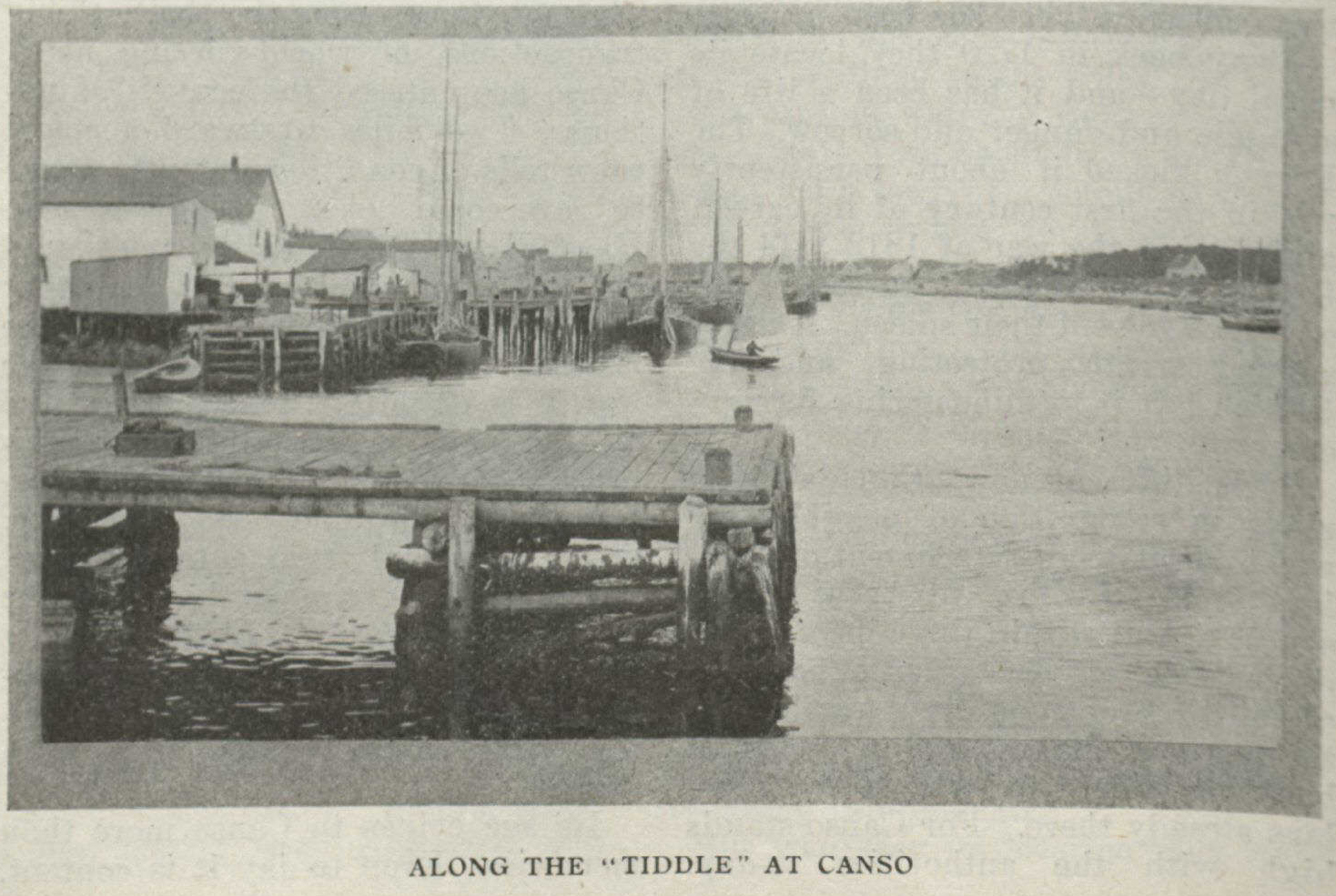
Communication with the outside world is uncertain, with the unreliability of water connection. At times the straits are full of ice, or a southeaster rages up the Atlantic. Then the only way out is by a long, dreary route up the shores of Chedabucto Bay, a terrible trail in winter, where strong men numb in the heavy gales and ruthless, unimpeded snow.
There is a reckless tang in the life of the cod-fisherman that makes Canso the centre of stories of daring evasion of the law. Nowhere east of Halifax is there license to sell liquor—but the French island of Miquelon is only a few days away on the coast of Newfoundland. It is not too far for the venturesome fisherman, and the excitement of liquor-running repays the risk. They tell of the skipper who long made profit of his daring runs across the south coast of Cape Breton. But the authorities interfered. They awaited his return one day, and laid heavy, gleeful hands on him as he entered the harbour—only to find an empty hold. They were still cursing as his brother sailed in a couple of hours later with deep-sunk hull—filled with the load transferred ten miles out at sea. And many times thereafter it was transferred before official wits got working.
They narrate with many a laugh the adventures of an illicit, distiller whose plant on a neighbouring island was surrounded one night by revenue officers. The moonshiner managed to escape by a flying leap through the window. The officers, sure of their quarry, took their time loading the outfit into the man’s own boat, and then set out to beat the island. But their prey escaped through their lines to the laden boat and calmly pulled away with both boats, leaving them marooned and helpless, watching him from the shore.
It is along the wharves you hear these stories. For there you find the life of Canso. The village itself is but a sleeping-place for this living that throbs along the water’s edge. There they work and play and live their social life. I passed among them for days, with the freedom a stranger nowhere else feels. They are eager to talk, to answer questions, to offer trips to the fishing-grounds. They also wanted to be photographed. One easy group of three, lounging on the deck of an isolated boat, sprang below at the first sight of the camera, to return in a minute with—hats, one a very pale pearl, and another a stiff black. And yet, uninteresting as they now were, they had to be taken. A fisherman sculled me across the tiddle that I might take his boat, the largest in the harbour, in full swordfishing attire, one member of the crew in the cross-trees, one in the “chair,” another with the float ready to cast. Still another skipper begged me to wait until be had daubed a few bare places with fresh paint. On that Saturday afternoon they were industriously shining up, for their affection for their boats is undying.
Up against the Corporation wharf lay an ugly gray steamer, an English trawler, its 134,000 pounds of haddock running over in heaps on the deck, a dirty, slimy mass hauled up perhaps a week before from the ocean bed by huge nets and rushed at the limit of time to the cold-storage plant to be turned into the market as fresh fish. The fishermen eyed it askance, the stale fish an eyesore in their sight. And they told me angrily how that load of three thousand dollars, caught any time within the week, brought the catchers a higher rate than did their daily-trawled fish, given straight from the sea into the hands of the merchants. The clumsy English trawler-men, working to the point of exhaustion under the goal of a percentage and swift-moving machinery, sent basket after basket ashore all day long, and left at the end for another sweeping of the depths away up through the straits in the Gulf of St. Lawrence.
Now and then a schooner or a “vessel” drifted into harbour, and along the wharves the fishermen stopped work to guess the business and name of the newcomer. One was an American swordfishing boat, and a deputation left immediately to learn the luck, and the whereabouts of the swordfish. But most of the lazy boats that blundered in, and wheeled about anchor in mid-harbour to the flapping of sails and the creaking of anchor chains, were Lunenberg fishermen, doomed by shortage of bait to await a new supply. Some of them lay there a week, a dead loss to the owners, and still no herring to sell them.
Out on the tiddle in boats, and along the wharves, boys frolicked and fought and raced. Three little fellows, scarce able to toddle, launched a big dory undisturbed, to give chase to a toy sailboat carried into the tiddle by the wind. From a snubbing-post a current of naked youngsters plunged into the dirty water, some stopping before each dive to cross their foreheads with hurried hand. A tottering old fellow tried to explain to me the characteristics of a “pinkie” that lay near, an old boat that had just been brought from “the Western” and a younger fisherman dared to maintain that it was a shallop. I left them arguing the relative merits of the sharp stern and the blunt, each adhering stubbornly to the things of his age. And all about was the overpowering odour of fish.
It was the life of Canso down there, Canso concentrated, packed into the narrow border of a narrow harbour.
At night it rained: rainy nights are not unusual in Canso. The rain falls with a persistence that defies defiance from the inexperienced. Through the open windows of my room I could hear but the murmur of a few muffled voices from the street. From somewhere downstairs a metallic piano—the first I had heard for weeks—drummed out the good old tunes that have stirred the throng for many a year. The window-blind flapped drearily in the wind, and a boat whistled suddenly from the harbour and pulled to rest beside some dark, deserted wharf. And after the piano became silent and the voices had long since ceased, I sat by the window and listened to Canso’s own heartbeat—a foghorn from a distant lighthouse, thickened by the blank gray fog, and dreary bell-buoy that gloomily wafted its warning on the varying wind, always low, always menacing; and over it all that dull boom of dashing surf on the islands outside. Canso was asleep at last to its own lullaby.

Sunday, 13 December 2015

With The Cod Fishermen

With The Cod Fishermen
By Lacey Amy
From The Canadian Magazine, May 1915. Digitized by Doug Frizzle, Dec. 2015.


COD fishing is not what it used to be. The fishermen themselves will tell you that. The fish are not so plentiful, the grounds are more distant from the old convenient harbours, and there are other openings for the energy of the fishermen offering brighter lure. The result is a more or less discontented worker who is either actively looking for another occupation or lacks the ambition. Around Newfoundland and Labrador the uncertainty of the “run” is annually driving hundreds from the calling, and frequently (as this year) leaves hundreds more a charge to the Government. At the Magdalen Islands it has advanced little further than grumbling, for the fisherman knows that to change his occupation he must change his home, and that is the last resort. But along the south coast of Nova Scotia there is a different kind of fisherman, one who has kept pace with the times. Cod fishing there is an industry developed like transportation and surgery and peace organizations and the other outgrowths of later-day leisure and wealth.
And the fisherman himself is changing, especially where he has advanced his methods. That is the altered condition which appeals most to the nonfisherman. But it is still a special train of thought that runs in the cod fisherman’s mind; a unique style of life is his, a vivid independence, and an uncertain recklessness that cannot be fathomed by the uninitiated. Therefore, to-day or yesterday, he is interesting. A day with him is liberal entertainment.
In the introduction of the motor one finds the most startling evidence of the altered conditions. A deep-sea fisherman without sails would seem like a farmer without horses; and yet four out of five of the fishing-boats in some of the harbours of Nova Scotia use sails only when the engine balks. Half the waste time of cod fishing and most of the danger have been thus eliminated, and grounds formerly far beyond range are now the regular goal of the day. Where the Magdalen Island, the Labrador, and most of the Newfoundland fishermen trust to their deep brown sails to get them in touch with the cod or run them to shelter in a storm, the Nova Scotia fisherman starts a couple of hours later, arrives sooner, and negligently watches the heavens. Instead of starting soon after midnight, as must the Amherst Island fisherman, his Canso brother sleeps comfortably until daylight, and, independent of the wind, casts his trawls exactly when and where he desires. And at night supper awaits him at an hour as definite as the city man’s dinner.
Three hundred dollars of engine and a few gallons of gasoline have made fishing an industry, not a gamble. A few years hence it may be a profession.
But there is one characteristic which sticks to the fisherman—the careless indefiniteness of his morning’s mood. “What a difference in the morning” must have originated with a member of the crew awaiting his skipper on the wharf in the shivering mists of early morning. Patience is the primary requirement of dealings with the independent cod fisherman. He has always come and gone as he liked—save for the elements—and he always will. He has no set hours, no assured returns, no master. To-day a threatening storm forces him to idleness; to-morrow it catches him adrift and sends him home before the day is half over; and all next week a dog-fish raid on his fishing-grounds drives him to another quarter. No wonder he is unsettled!
During several summers amongst them it has been borne home to me that keeping an appointment with them is as tantalizing as the promises of a politician. At the Magdalens, two successive mornings I rose at one o’clock, on specific direction of the skipper, but was doomed to disappointment. Fear of a storm prevented the first day’s fishing, and the previous day’s idleness impelled a start at eleven p.m. for the second day’s work. I gave it up for a night’s sleep.
At Canso I fared worse in the way of waiting, but better in results. It required four almost sleepless nights to effect the reward of a day’s fishing. On Monday a seven o’clock appearance on the wharf, according to instructions the night before, brought the information that the boat had left two hours earlier. Tuesday was featured by a rainstorm only possible beside the ocean. On Wednesday morning by four o’clock I was on the wharf from which they were to pick me, and down the “tiddle” I could see the boat leisurely making ready. But five minutes’ absence for something I had forgotten furnished me with the maddening spectacle of a receding stern chugging out to sea. The next morning I took no chance. I closed my teeth and set the alarm for two a.m., closed my teeth and obeyed its message, closed them again and wandered forth on the deserted moonlit streets and down to the cold, damp wharf where the boat was tied. And I sat down on the edge of that boat for three hours, kicking my heels to keep warm, but a little proud that I had discovered a way of overcoming such an unreliable thing as a cod fisherman’s start for the fishing-grounds.
And those few hours on the deserted wharf in the brilliant moonlight will never be considered as wasted. All about lay the well-finished, trim boats of the Canso fishermen, models of grace and surprising cleanliness and order. In the moonlight the masts rose like a bare forest around me, gleaming here and there where the light struck them, and black elsewhere against the clear sky. Below it was all darkness, with edges of cabins, dories, tubs, ropes, creeping into sight as my eyes became accustomed to the gloom. Further down was the utterly black water.
I was alone. Not a sound came from the sleeping boats, although I knew that each had its sleeper—a hundred of them within sound of my voice. The water was as motionless as only tight-bound water can be—the silence that is the uncomfortable waiting and listening of a thing with life. The utter loneliness of the sleeping life was disturbing to a novice. My day seemed to have no start; everything was at a standstill.
A gloomy yawn was my first company, proceeding from a boat that, before the heartless introduction of its motor, had been the champion of the annual sailing races. Presently a spot of light revealed the outline of a cabin window, and immediately someone stumbled up on deck and sleepily shook himself, stretched, and growled at the cold. Then two or three little oval windows flashed into life, and yawns and growls sprang up all about me. A man clambered up the side of the wharf and stretched himself where there were no spars and ropes to interfere. He gave no sign that he saw the stranger within six feet of him, but proceeded to feel the mooring ropes, and disappeared below. It was not surliness—merely an intimation that I was not a part of his morning duties. Gradually others appeared, each retreating below after the preliminary stretch and careless reading of the sky. From the length of time between the appearance of the cabin light and the man on deck the scant amount of disrobing necessary for a night’s sleep could be accurately estimated.
Then, with every man below, two things happened almost simultaneously in all the boats. From tiny stovepipes protruding above the cabins drifted uncertain whiffs of smoke, and from the cabin entrances poured no uncertain language. If you have ever tried to light a fire in a cabin, beneath the shadow of overhanging wharves and buildings, you will understand the connection. Almost immediately the men began to reappear, thunderously, fluently, giving utterance to a variety of comment that agreed only in its general meaning. They fiddled with the pipe, swore, went below, swore, tumbled up on deck, swore—and swore between times. Those who light the fires of anchored fishing-boats know nothing of the dread effects of example; and I had no desire to enlighten them.
A cup of tea! That is the beginning of the fisherman’s day, and the end—and also the middle. The teapot is on the cabin stove before the boat is ten minutes awake, and it is there humming until the last member of the crew has gone. All day long it sings accepted invitation, and by the afternoon it offers a stimulant unrivalled by anything short of end-of-steel whiskey. I tried it—and it’ll do until I visit the fishermen again.
A member of my crew appeared, with the information that he had whistled beneath my window at the hotel until he was told of my departure, and through the next hour or so the others came straggling down. They did not apologize to each other, nor resent the expressive allusions to the damp disagreeableness of waiting on a wharf before daylight. To-morrow it would probably be their turn to wait and make comment. From all about us motors were chugging away, stopping to get swung into position, and then puffing steadily off into the distance. For hours little motorless boats had been swinging lifelessly along with flapping sails behind ridiculously small rowboats pulled by one man—and for hours more they would still be within sight. The patient seemingly profitless toil of a rower towing a big boat is almost pathetic—if you aren’t in the boat. To the luxurious occupant of a motored vessel it is ludicrous. But I was still on the wharf; I could see things in their proper proportions.
As we pulled out from the wharf in the hazy light of the rising sun, a long line of boats stretched before us right out to sea—big and little in an irregular line, the motor-driven skimming noisily past the sail-driven, and watched by envious eyes, the less powerful engines yielding in their turn to the greater. Right into the sun we aimed, a big globe of red rising from the ocean with the glare of coming beat—out past the Lunenburg “vessels” anchored in mid-harbour, around the lighthouse on the edge of the open. As we passed one helpless sail-boat we suddenly swung about and threw them a line, although it meant an hour’s delay in reaching the fishing-grounds six or eight miles out. The unselfishness of the fisherman is the quality that makes his life most worth living. Where all are so much at the mercy of the elements each strives to help the other.
And then our course began to be more up and down than along. It was not a rough day, they told me, but later they acknowledged that it was the record for that year’s roll. I have never been able to bring myself to the nicety of distinction that unhesitatingly separates roughness and roll. I have heard landlubbers do it as an excuse for seasickness. Sometimes we could see the boat we towed rushing down towards us, and sometimes it was out of sight behind a mountain of water that brought the uncomfortable conviction that only our rope was keeping it from hitting the bottom. I liked to keep that tow in sight, even if it threatened to drop on our deck. . . . And I had twelve hours of this ahead. I began to wonder if I had not rashly overestimated the pleasures of a day’s cod fishing.
In the meantime the crew—those who were not engaged with the towline and the tiller—were preparing for the fishing. We had taken aboard at the wharf a couple of boxes of herring for bait, the cost to be deducted from our day’s catch, and now these were being cut into small pieces. Later the bait was fastened to hooks on short lines attached more than a foot apart on a long, larger line. Net fishing was over, and the cod were being caught on trawls and handlines. The trawls had been carefully wound in tubs the night before, the hooks towards the centre, and baiting was done with a dexterity that looked positively dangerous, and the baited trawls thrown deftly in place in another tub.
We had come up with the fleet. In all directions boats of every size stood out against the dark water and bright sky, some casting hand-lines over the side, some lying idle while their dories pulled off with the trawls. Off on the port side a peculiar, uncanny wave broke and disappeared over one spot, broke and disappeared again. They told me a rock came close to the surface there, a constant menace to navigation. Away back when the French and English were tussling sporadically for Nova Scotia a French frigate struck there and sank; and many a ship since. It stood at one edge of the fishing-grounds, in about twenty-five fathoms of water, and the fishermen pursued their calling all about it.
Out past the fleet we twisted, and, beside the flashing buoy that marked the channel into the Straits of Canso, we dropped our dories. In each a fisherman took his tub of bait, and another of trawl and, standing recklessly in the stern, sculled with one hand while dropping two hundred feet of trawl with the other. And there we left them all day, running alongside only at noon. I tried hard not to picture their day on that sea in those tiny bobbing boats, with no protection from the blistering sun, and nothing to think of but the swell and their sins. I was in comparative comfort on fifty feet of deck that was at least flat and solid to the feel—and it was mighty little just then. One thing—it wasn’t far to the side of the dory.
From the larger boat we tried to supplement the catch with hand-lines, the last resort of the cod fisherman. Only after netting and trawling are past does he rely upon the more laborious, slower method; and when it comes to hand-lines around Canso the end of the season is at hand. Catching cod in this manner is like trying to satisfy thirst from a pump-spout—an unprofitable task performed in the hardest way. About all we caught was blistering salt water and sunburn, and now and then a phlegmatic bit of fish that seemed glad to be at rest. No wonder a fisherman leaves hand-lines to the last, when the children are crying for bon-bons. Casting unsuccessfully all day for trout is hilarious revelry compared to cod fishing with a line.
Between acts the professional members of the crew drank tea. If Chinese commerce were bound up like Germany’s is now there would be a rush of fishermen to enlist and get the war over in a hurry. At noon we ran alongside the dories and received their catch; and I looked after the tiller while the others went below for stimulant. Seated on deck I tried to forget the all-pervading smell of cod. I couldn’t. Why must a fish smell so fishy? And then the dories dropped astern once more to their work.
Occasionally coasting vessels went by, turning around the light buoy into that great path of commerce, the Straits of Canso. A small steamboat cut across our stern headed for Canso, and a couple more passed along between Halifax and Gulf ports, all of them staggering helplessly in the swell. And then, a mile outside, something dark and ominous flashed by, the black smoke streaming furiously out behind so long as it was in sight. Twenty-five miles an hour—nothing less! So fast that a steady wave curled high above the bow, and the stern was out of sight beneath the water. It was a British cruiser going west in chase of reported German boats off the south coast. For war had been declared and the dogs let loose. With regulars and big guns protecting the cable stations in Canso, German cruisers sighted off every corner of the coast, and British cruisers searching them diligently, we felt as if we were the centre of hostilities.
All afternoon fishing boats were leaving the grounds disgusted, some with insufficient catch to pay for the bait, and none with a day’s pay. Our luck was a little better. But at sixty cents to two dollars a hundred pounds cleaned it required a large catch to make the day worth while. But the Canso fisherman does not do so badly. The crew with which I fished had made a thousand dollars in four days the year before, and the skipper had cleared $1,475 for the season. He was not complaining. But he followed the run of cod throughout the season, from Prince Edward Island to the “Western”—in fishing parlance, the western part of the south coast of Nova Scotia.
In at the wharves the boats were moored two and three deep, discharging their catch. The five members of the crew had their work definitely assigned. One pitchforked the cod from the hold to the deck, another passed them to the wharf, a third lifted them to the splitting tables, and the other two performed the expert work of splitting. It was a dirty mess to the novice—fish cleanings, tobacco juice, and odour. The livers and heads were saved, the former bringing forty cents a pail for cod liver oil, and the latter finding a market at the glue factory down the “tiddle. ” Later in the season a dog-fish factory on the outer islands would take even the bane of the fishing-grounds for manufacture into fertilizer. The byproducts of cod fishing are making up to some extent for the decrease in the cod.

His day’s work done usually some time before six, the cod fisherman is again the care-free, light-hearted workman who is satisfied that he has done his best. Be the catch good or bad, there is no sign of it when the day is done. Around the wharves he sits with his fellows, telling yarns of past records, banter running through it all, and the unoathlike oaths of a good-tempered people. For the stranger they have a bright welcome, and a willing information that is seldom unreliable. The future is not a worry to them, and the present bears lightly upon them. But the future is often serious. A man of no more than sixty sat totteringly on an upturned dory, hands twisted pitifully in to his body, head bent forward and down, vainly trying to light his pipe. Tremblingly he inquired what was good for rheumatism; he had no faith in the local doctors. Almost in the prime of his life he had been forced from the water, but each evening he faltered down to the wharves to see the catch come in and to tell of things that were in his day. A small boy took his pipe below and lit it with his own breath, and brought it back and pushed it between the old man’s lips. Next day they told me partial paralysis had come to him in the night, and the poor old fellow lay weeping to get out with the boats again, to feel the dash of the spray in his face, the tilt of the boat before the wind, the drag of the filled net. But his day was done.

Blog Archive

Countries we have visited