Showing posts with label Spanish Conquest. Show all posts

Friday, 21 February 2014

The Lost Mine -Part 2

The Lost Mine -Part 2
A. Hyatt Verrill
Illustrated by CYRIL HOLLOWAY
From The Wide World magazine, June 1929, UK edition. Digitized by Doug Frizzle, Feb 2014.

Link to Part 1 in 1952

Somewhere in the little-known interior of Panama, lost to the sight of civilized men for centuries, lies Tisingal, reputed to be one of the richest gold-mines ever worked by the Spaniards when they ruled the New World. Many expeditions have set out to seek the vanished bonanza, but all of them ended in failure and disaster. When the Author went into the jungle to study the wild Indians everybody assumed he was in search of Tisingal, and before long he found himself involved in some very strange experiences. The first instalment described the start of Mr. Verrill's up-river journey and his meeting with various people who told him of the existence of a mysterious native “King,” whom he determined to seek with the aid of an Indian guide called Chico.

II.—(Conclusion.)
THE following morning we left the General’s home in a torrential shower and, until he was hidden from sight by a bend in the stream, we could see the old Spaniard standing motionless in the drenching rain, wistfully watching us. I had been the first white man to visit him for ten years or more, and our short stay had been an epoch in his solitary, hermit-like existence.
At the end of a week it seemed to me we must have traversed the entire length of Central America, but Chico, Indian-like, would not commit himself. It was always “Un poco mas lejo” (“A little farther") to all questions as to the distance to the Comisario’s home. And then, quite suddenly and without a word of warning from Chico, we were there!
No one but an Indian would have dreamed that there were human beings within a hundred miles. No boat was drawn up on the bank, no opening showed in the fringe of dense jungle, no tell-tale smoke rose above the trees, and no sounds of voices issued from the forest. A scarcely-distinguishable trail led from the verge of the stone-strewn playa into the bush, and with Chico in the lead we trudged along it.
Half a mile inland we came upon a small clearing and were vociferously welcomed by yelping curs who rushed toward us from three thatched huts. As we reached the largest of these, the Comisario himself appeared. He was a dignified-looking, keen-faced Indian, and—much to my surprise and momentary disappointment—he was clad in white home-spun cotton coat and trousers.
His appearance, in fact, was far more that of a well-to-do native planter than a wild Indian; but I soon found that his more or less conventional costume was a mere veneer, and that he and his family were at heart as primitive and unspoiled by civilization as I could wish. All of them, men and women alike, wore clothing, but the garments of the women were a blaze of gay colours; their necklaces and other ornaments were of teeth, bones, and shells; and there was not a single “civilized” article or utensil in the houses.
Finely woven hammocks swung between the palm-wood timbers; baskets, calabashes, and peculiar pottery vessels were scattered about; beautifully finished bows and long arrows rested on the rafters overhead; and two young Indians were occupied in painting each other’s faces. Upon a fire of glowing coals a great earthen olla was boiling and sending forth appetizing odours, and one of the women was busily crushing cacao beans on a wooden slab by rolling a heavy oval stone backwards and forwards.
No one exhibited the least surprise at our appearance, and Chico informed me that the sphinx-faced Comisario had been aware of my approach for the past four days. How he had received the news he did not reveal, but I have no doubt that couriers telling of my plans had been sent overland from the Indian hut where we first stopped. Toluka, as the old fellow was called, seemed quite friendly, but he did not appear at all enthusiastic over my proposed visit to his king.
However, under the influence of presents to himself and family, he presently unbent, and not only gave his official permission for Chico to guide us to the king’s palace, but even volunteered to send one of his own youths with us, so that we should be under Government protection, so to speak. And once Toluka had discovered the contents of my trade-box, his bartering instincts were aroused and he brought forth innumerable articles of great enthological interest.
During the remainder of the day we rested, and I made good use of my time by acquiring a fairly complete list of Shayshan words, with the result that I became convinced that these Indians were actually of Mayan ancestry, or at least of a race which had come under Mayan influence in the past.
We made an early start, accompanied by a bright-eyed youth who gabbled incessantly with Chico, and performed most amazing acrobatic stunts in balancing himself on the gunwale of his ticklish cayuca as he poled the craft along. He was a cheerful, willing fellow, a great help in portaging, and seemed to take everything as a huge joke. And we certainly needed someone of an optimistic disposition!
All that had gone before was as nothing compared with the following three days. It was all up-grade, and the river, although very low, tore through its rocky bed like a mill-race. Often the united strength of the whole party was required to drag our canoe against the current, and I tried to picture what the passage would be like in the rainy season, with the river in full flood. Then it would fill the bed from bank to bank, nearly half a mile; and the water-swept bluffs and trees, and the bare, rounded boulders on either side, showed that the torrent would rise fully fifteen feet above its present level.
Here and there great trees were stranded high and dry upon the playa, and at one place we passed an uprooted tree over sixty feet in length and five feet through at the base, which had been carried down by the raging torrent and left firmly wedged between two enormous boulders ten feet above my head. Bad as the going was now, I thanked my lucky stars that I had not attempted to reach the Shayshans’ territory in the rainy season.
If current tradition and history were true, and Tisingal actually lay somewhere in this wild, untamed land, then superhuman indeed must have been the labours of the old Dons. It seemed utterly impossible that human beings could have transported supplies and equipment, machinery and tools—even a bell and cannon—over this route to the lost mine, or that they could have built a road through such an impenetrable wilderness.
But they worked with slave labour, loss of life meant little or nothing to them, and suffering and hardship were forgotten in their lust for gold. As we toiled onward I wondered how many worn and tortured men had died along the route, and how many millions in precious metal had been carried dowm this self-same river to enrich the coffers of the King or Spain or to fall into the hands of the dare-devil buccaneers.

A NIGHTMARE JOURNEY.
Meanwhile the country grew steadily wilder and rougher. The river-bed became a canyon, and huge masses of grey, pink, and green porphyry took the place of boulders. On every side rose lofty mountains, covered with dense forests. Often we toiled for hours, lifting and carrying our canoes over impassable cataracts or through foaming rapids. .
To traverse the dry river-bed was like scaling the walls of some ruined castle. Scrambling and climbing, with bruised and barked shins and hands, we surmounted the barriers of glass-smooth rocks, leaped—with fear gripping our hearts—across the yawning chasms between them, or crawled and crept and wormed our way through cavern-like interstices. To portage our goods necessitated Herculean efforts.
No living man could force his way for a hundred yards with a load upon back or shoulders. Each parcel and package had to be carried piecemeal from one rock barrier to the next. Finally it became obvious that our craft could go no farther. Before us the river-bed was barred by a great dyke of jagged, razor-pointed, black lava. Through a narrow break in this the water poured in a roaring, plunging torrent, and on both sides the mountains rose in sheer thousand-foot precipices to the low-hung clouds.
Apparently all our labours had been for nothing. We had come to the end of our tether. Further progress was impossible!
But Chico and his fellow-tribesmen merely grinned, as, calmly and deliberately, they drew their canoes from the stream, began packing the contents of the boats into portagable packages, and gave obvious evidence of intending to continue onward. Evidently they knew of some way out of the impasse, and, encouraged by their attitude, Cordova and Pepe fell to work. But Chico promptly interfered. Only the lighter and most essential articles could be taken, he declared; the rest must be left in the canoes. In reply to my questions he pointed toward the frowning, multi-coloured wall of stone that rose on our right.
“Road too narrow,” he announced. And then, as though stating a most ordinary and familiar fact, he added: “Not any farther. The King’s house here.”
Was it possible? Had we actually reached our goal?
I was not to be kept long in doubt. Shouldering their loads, the two Indians picked their way across the stony river-bed toward the precipitous cliff. At the very base of the overhanging wall a narrow, scarcely-visible trail had been cleared, cut, and cleaned from among the debris fallen from above. It wound about enormous masses of rock, passed through a tunnel-like aperture under piled-up fragments of precipice, zigzagged this way and that, and finally came to an end. Pointing dramatically ahead, Chico exclaimed: “Look, sir! The house of the king!”
Before us the bare, rocky playa came to an end. The river flowed in a broad, swift expanse stretching from bank to bank, burbling musically over miniature rapids. Above our heads rose the cloud-hung precipice. On the farther shore the land sloped gently upward to a high hill crowned with jungle, and rising, tier after tier, to the distant mountains.
Up from the pebbly beach stretched a broad sweep of smooth greensward dotted with clumps of lime, palm, and orange trees; and upon the summit of the grassy hill stood a large hut, its thatched roof of palm leaves gleaming like gold in the afternoon sunshine.
It was the palace of the Shayshan king, and, gazing at it, all the hardships we had suffered were forgotten, for we had accomplished the seemingly impossible, and arrived safely at the home of the mysterious cacique of the Shayshans.
Our arrival had obviously been expected, for a group of Indians had gathered at the water’s edge below the “palace,” and already a long, narrow canoe was being poled toward us, its bronze-skinned occupant balancing himself upon the after-end, and handling his frail and cranky craft with incredible dexterity.
He was a stocky, sturdy youth and, as I learned later, no less a personage than the Crown Prince. Truly we were being received with high honours! He was thoroughly democratic, however, and, having greeted me in his own tongue—not a word of which was intelligible to me—he commenced chatting volubly with my two Indian boys.
We were to cross the stream in his canoe, it appeared, though it seemed impossible that our party and our dunnage could be ferried across the swirling river in such a tricky craft. But it would not do to show my doubts in the presence of royalty, and so, as it was a case of trusting to the canoe or swimming, I followed my men and belongings into the dug-out.
I hardly dared to breathe, for the water was within two inches of the gunwales, and a dozen times I felt certain the canoe was on the point of capsizing. But the Indians, and especially the Prince, were as unconcerned as though on dry land. Standing erect, the Prince poled his craft against the swift current and performed feats of balancing that would have shamed an expert performer on the slack-wire. And, almost before I realized it, the canoe grated on the opposite bank and we stepped safely ashore just below the home of the Shayshan king.
Like all Shayshan “houses,” the palace was open on three sides, was built upon posts several feet above the earth, and was floored with strips of black palm-wood. Its steeply pitched roof was of thatched palm-leaves, with low eaves.
A hearth of baked clay held an ever-smouldering fire. Its furnishings consisted of several carved wooden stools, a number of bark-cloth mats, several large earthenware pots, baskets of various sizes, a platform-like affair of split palm strips on which were calabashes and baskets of provisions, and three or four hammocks. Squatted about near the hearth were several women and girls, while naked princes and princesses played and rolled about like brown kittens.

THE SHAYSHAN KING.
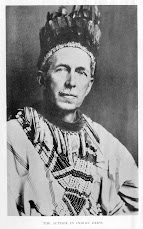
The king himself reclined in a hammock. He was of indefinite age, with copper-coloured skin, a remarkably high forehead, an aquiline nose, a firm, thin-lipped mouth and keen eyes; he was obviously an Indian of most unusual intelligence. Much to my surprise he was dressed in a cotton shirt and trousers, but upon his thick, blue-black hair rested the regal crown of eagle feathers and macaw plumes.
He displayed no signs of either curiosity or surprise at my appearance, but through the medium of Chico as interpreter, received me most hospitably. He had carved wooden stools placed for myself and my men, and put the palace and all it contained at my disposal with almost Castilian politeness. Then the welcoming calabash of thick, unsweetened chocolate was passed round, and, having solemnly drunk this with due ceremony, I explained the reason for my visit.
Almost instantly I discovered that King Polu understood Spanish perfectly, and after this our conversation proceeded in that language. I soon found that the King of the Shayshans was a most remarkable man for a Central American Indian. Unlike his fellows, he was as stoical and reserved as any Sioux or Apache, and he possessed all the eloquence, the love of the dramatic, and the power of simple, poetical expression of a North American Indian.
When I asked him how long his family had ruled the Shayshans he rose and led me to the open side of his house facing the river.
Stretching out his arm the king pointed to the towering mountain-side high above the rushing stream.
“Once,” he exclaimed, pointing to the water-worn crags hundreds of feet in air, “the river flowed on top of the mountain. But even then my fathers were kings of the Shayshans.”
Despite all that had been told me, he proved to be a most amiable and friendly fellow. He assured me that to find all the members of his tribe would be a long, weary, and probably hopeless task, for they were scattered through the mountains, miles apart. But, he added, to save me trouble and help me, he would send a messenger to the outlying tribesmen with orders for all of them to gather at his house and to bring in such of their possessions as they were willing to trade.
My suspicions that the Shayshans were of Maya stock and were perhaps the oldest of existing Central American tribes were rapidly confirmed. Not only was the language distinctly Mayan, but the feather head-dresses were precisely like those depicted on Mayan sculptures and figuring in the engravings and paintings made in the days of the Spanish Conquest, and unlike those of any other known tribe.
Even more remarkable was the fact that the Shayshan’s bows were designed to be bent round side outwards, thus differing from the bows of other races. Apart from their bows and arrows, the Shayshans used blow-guns, ten or twelve feet in length, and here again the tribe differed from all their neighbours, for instead of darts the Shayshans used spherical clay pellets, which, at a distance of thirty or forty yards, were as effective as a small-calibre rifle for bringing down large birds.
Except for maize and a few plantain, banana, and cacao trees, these Indians raised nothing in the way of foodstuffs. An almond-like nut, the boiled fruit and young flower-buds of the palm, and a wild tuber resembling a potato were their mainstays. Corn was eaten whole, and the cacao beans, instead of being fermented and made into chocolate, were roasted and ground to a powder, from which a beverage resembling thick black coffee was made. The Indians drank this in inordinate quantities, taking it, boiling hot, almost incessantly from morning to night.
The Shayshans appeared so shy, so friendly, and so docile, that I could not imagine them in the role of hostile savages. When I mentioned this matter, Polu and the others declared that the tribe had always been peaceful, and that while they distrusted and disliked the Spaniards, by whom their ancestors had been enslaved, they had merely sought protection from these traditional enemies by moving farther and farther into the wilderness.
By this time I had come to the conclusion that Polu was a wily fellow, and that his sphinx-like face concealed a great deal more guile than one might suppose. When I asked about the other tribes who were reputed to inhabit the even more inaccessible mountains, Polu seemed loth to answer, and professed the greatest dread of them, although claiming to be at peace with all his neighbours.
And when I proposed visiting the Doraks, as the Shayshans called them, the king and his friends showed the greatest concern. They declared it would mean my certain death, explaining that though a Shayshan might enter and pass through the Dorak country, provided he did not linger, no white man would be permitted to set foot beyond the recognized boundary of Shayshan territory.

When pressed for reasons for this attitude, the King and his companions evaded the question. I felt certain they were trying to keep something from me, and as I puzzled over this I remembered Senor Toro’s words, the tales of the old General and others, and the universal belief that the Shayshans held the secret of the lost Tisingal mine. I also recalled Polu’s evident anxiety that I should not attempt to visit his subjects, and his suggestion that I should remain with him while a courier summoned the tribe.

I AM PUZZLED.
Was there, after all, some truth in the rumours? Could it be that the wily King was trying to prevent any possibility of my stumbling upon the jealously-guarded secret of the lost mine? Was I “getting warm?” as they say in the game of “Hunt the Thimble.” It was a fascinating conjecture, and it seemed by no means impossible nor even improbable, I reflected, that the fabulously rich Tisingal might be located not very far from King Polu’s palace.
But I was not there to investigate mines, old or new, and I had no intention of searching for Tisingal, especially if to do so might result in arousing the resentment or even the suspicions of the Indians, and thereby thwart my purpose in visiting them.
Nevertheless, the romantic aspect of the matter appealed to me; my exploring instinct was aroused and—well, I doubt if there is anyone who would not be somewhat thrilled at the thought of being almost within stone’s throw of a long-lost, incredibly rich mine which countless men have sought in vain and whose history is one of tragedy, mystery, and romance.
But the most adroit and roundabout questioning failed to draw any definite information from Polu and his fellows, even though I felt sure I had convinced them that I was not searching for gold.
It might be, they agreed, that the Doraks knew of the old mine.
They themselves had heard from their fathers, who had heard it from their fathers, that long ago the Spaniards had a mine somewhere in the mountains, where they forced the Shayshans to labour as slaves.
But, they added, they themselves knew nothing. They had no knowledge of gold. It was valueless to them, and if they knew where the mine was they would gladly tell me, for was I not their friend; had I not given them presents, lived with them like a brother, and dwelt in the King’s house?
So, deciding my imagination had over-ridden my common sense, and that in all probability the Shayshans knew nothing definite about Tisingal, I busied myself with my scientific work and forgot all about the lost mine.
Then, as so often happens, Fate intervened and opened the sealed lips of the Shayshan King. His daughter, a chubby brown princess of eight, was seized with a most agonizing but far from dangerous fit of colic, the result of eating far too many oily piva-palm nuts. Her shrieks and screams in the middle of the night aroused everyone, and the Indians, firmly believing some evil spirit had taken possession of her, added their wails, lamentations, and incantations to the uproar.
At first Polu and his copper-coloured queen would have none of the white man’s medicine. But when the most powerful of Shayshan potions, the beating of drums, the application of “magic” wood and fungus, and even the slaughter of a cock failed to exorcise the “devil,” the Shayshans, as a last resort, turned to me.
The little princess’s trouble quickly responded to proper treatment, her screams of agony changed to sobs, the sobs to whimpers, and soon she was sleeping quietly and soundly on her mat of pounded bark beside the queen. I very much doubt, however, if Polu slept again that night. When I tumbled into my hammock he was sitting motionless, staring into the black, starlit night, and when I awoke at dawn he was in precisely the same position, immobile as a bronze statue, his mind evidently concentrated on some deep and important matter.
Not until the inevitable chocolate was passed to him did he come back to earth. Then, having swallowed the steaming mess, he rose, took down a long and powerful black palm bow and sheaf of wicked-looking six-foot arrows, and very carefully examined each one in turn. Evidently, I thought, the King was preparing to go out on a hunt. Then, to my unbounded surprise, he requested me to accompany him.
For a time he walked on in silence. Not until we had passed beyond sight and hearing of the house and were well within the jungle did he speak. Then, halting, he turned, beckoned me to his side, and grinned. His Spanish was somewhat crude and limited, and my recently-acquired knowledge of Shayshan was even more exiguous. But we had always got along famously, and there was no possibility of misunderstanding him.
Rubbing his stomach, he twisted his face into an agonized expression. “Child sick; very sick,” he said. Then he closed his eyes and sighed contentedly. “I am grateful; you were good to my daughter,” he added.
“I am glad the child is well again,” I replied, using his own dialect.
Polu narrowed his eyes and the half-quizzical expression I had often noted—an expression suggestive of crafty shrewdness—came over his face. For fully a minute he studied me. Then he turned abruptly and pointed toward the sombre green mountains, their sides still streaked with shreds of the night mist, their shadows purple, fathomless, mysterious.
“Come!” he ejaculated, suddenly, “Tisingal!”
I could scarcely believe my ears, hardly convince myself I heard aright. I was absolutely dumbfounded. Polu did know the secret of the lost mine! He was about to reveal it to me, was taking me to it as proof of his gratitude for curing the little princess!
For seemingly endless hours we climbed the mountains through a misty, penetrating drizzle. Mile after mile I followed Polu into the shadows of the vast, inpenetrable forest, until I lost all sense of direction. I was drenched to the skin and heartily sick of the whole business when the King suddenly halted and beckoned me to him. Carefully parting the drooping ferns and interlaced creepers, he pointed to a pile of rotting, moss-grown masonry rent by the snake-like, twisted roots of great trees, and almost hidden in the accumulation of decaying vegetation.
Here, buried in this untrodden jungle, was the age-old work of civilized man, and unquestionably, as proved by the mortar, of Europeans. Polu walked a few paces farther, and, stepping aside, showed me a stretch of roughly-paved roadway, beside which were the almost vanished hard-wood logs of what once, centuries before, might have formed a stockade or a massive gate. Was it possible that I was actually gazing at the remains of the approaches to Tisingal?

THE GUNS OF TISINGAL!
Then, while my mind was still a chaos of sensations, Polu, with furtive glance about him, as though desecrating a tomb, bent low, and, pressing through a thicket, halted among the trees. Before him lay two large cylindrical objects half buried in the earth. At first glance I took them for moss-covered logs, and then, with fast-beating pulse, I realized my mistake. There was no doubt about it—they were cannon! Cannon of bronze; ancient guns of small bore, ornately ringed, bell-mouthed and thick with the verdigris of countless years of drenching tropical rains and ever-dripping moisture.
Carefully scraping away the growth of moss and tiny ferns, I could distinguish raised figures and letters upon the metal. Corrosion had almost obliterated them, but here and there a letter was decipherable, and on one the date—“1515”—was quite plain.
I had thought that ancient mines, real or imaginary, held only a passing interest for me, and yet as I knelt there beside those centuries-old guns, in the heart of that unknown forest, I felt a wave of exultation such as I have seldom known.
Beyond the shadow of a doubt I was looking upon objects that many a man would have given half his life and thousands of dollars to behold—the ancient Spanish cannon that once guarded the way to the richest mine in the New World; the long-lost, long-sought, almost fabulous Tisingal! And, strangest of all, that which no other civilized man had been permitted to see had been revealed to me through a child’s attack of colic!
Unquestionably, I was the first white to view those relics of the past and live to tell of it during all the centuries that had passed since Tisingal had been lost to the world. Somewhere near by, hidden in the rank growth, was wealth beyond one’s wildest dreams, but if I had dared to enter that ominous jungle alone a silent arrow might have sped from some lurking, watching savage, and my bones might have been added to those of other seekers for the elusive Tisingal.
As I stood there in that shadowy forest and looked upon those ancient bronze weapons, the whole tragic story of the mine came vividly to me. I could revisualize the Dons—mail-clad, ruthless, cruel, caring nothing for life or bloodshed where gold was to be won—murdering the simple Indians who resisted the invaders, enslaving those who were peaceful.
I could imagine them hewing their way through the jungles as they penetrated farther and farther into the mountains. I could see them in their cumbersome craft conquering the rapids, falling by the wayside, suffering martyrdom in their lust for gold, until at last they reached the Shayshan country and, by inhuman tortures, wrung the secret of Tisingal from some captive Indian.
And, having come that way myself, I could appreciate the Herculean labours of the Spaniards and their slaves as they transported their goods and equipment up the river, made rude roads through the jungle, built forts and bridges, and erected their dwellings, their barracks, and even their church, deep within these forests. And I could picture the savage exultation of the long-oppressed, tortured, and enslaved Indians when, at last, they squared accounts and, massacring the Spaniards to the last man, destroyed every vestige of the Dons’ work.
No wonder, I thought, that the Doraks maintained an endless vigil and prevented all white men from rediscovering Tisingal! Gold and the white man’s greed for wealth have always been the curse of the Indians, and I was thankful that the secret was so well and so effectively guarded. My only regret was that I had no camera. I had not brought it with me when I left Polu’s home, for I thought I was merely accompanying the King on a hunting-trip.
And now Polu was becoming nervous. He was impatiently urging me to go, meanwhile peering furtively about him, searching the surrounding jungle as if in fear of stealthy, hostile savages. Perhaps it was pure imagination, or perhaps the King’s fears were contagious. At any rate, I felt that we were being watched, that unseen eyes were upon us, and that I stood very close indeed to death. So, with a last glance at the mute guardians of the old mine, I turned, and, in Polu’s footsteps, threaded my way along the indistinguishable trail that led back to the domains of my silent companion.
At last we emerged from the jungle with the King’s house in view, and instantly I halted in amazement. Gathered in a little knot before the thatched hut were half-a-dozen wild-looking, naked savages!
Who were they? Had the hostile Doraks swept down on the Shayshans to demand satisfaction for the King’s action in betraying the secret of Tisingal to a stranger? Before I could ask a question, or utter a word, however, they caught sight of us, and, in the twinkling of an eye, had vanished!
Oddly enough Polu did not seem at all surprised or disturbed. He could not or would not understand my queries, and merely grinned amiably as we hurried across the few rods of open grassland to his palace.
Then I understood. Seated in the house were the Shayshans the King’s courier had summoned. They were wild-faced, shockheaded, shy-looking tribesmen, but each and all garbed in ragged shirts and much-patched trousers. At sight of the white man they had hurriedly transformed themselves from untamed savages to semi-civilized Indians—at least outwardly.
Not until much later did I learn the real facts, however. When I was leaving for my long and thrilling trip downstream Polu, with a twinkle in his keen eyes, revealed the great secret. The Shayshans and the Doraks were one and the same people! A Jekyll and Hyde tribe—peaceful, quiet, friendly, and with an external veneer of civilization, or wild, savage, and hostile, as the conditions called for, the Shayshans were the sole guardians of the lost mine!

The End

Tuesday, 3 April 2012

The Lost Mine -Part1

 This may be familiar to Verrill’s readers that have read the book ‘Thirty Years in the Jungle’ as it appears to be almost a complete copy of that section of the book (chapters 15 and 16.) This selection is just part 1 of a two part story.
The Lost Mine
By A. Hyatt Verrill
Out of the Past, from The Wide World magazine, June 1952 (UK Edition) (and republished from 1929 edition). Digitized by Doug Frizzle, April 2012
Somewhere in the little-known interior of Panama, lost to the sight of civilized men for centuries, lies Tisingal, reputed to be one of the richest gold-mines ever worked by the Spaniards when they ruled the New World. Many expeditions have set out to seek the vanished bonanza, but all have ended in failure and disaster. When the Author went into the jungle to study the wild Indians everybody assumed he was in search of the mysterious Tisingal, and before long he found himself involved in some very strange experiences. We originally published this story in 1929.

THE jolting, rocking banana-train dropped us at the last outlying station at the end of the line. I say "station," but the place was far from being worthy of that appellation. Beside the uneven, weed-grown tracks stood a tiny hut of corrugated iron. Beyond this lay a half-acre of partly-cleared land, and in the centre of the clearing was a ramshackle, unpainted building of roughly-hewn planks raised a few feet above the soggy, rain-soaked earth. This was the "store," canteen, and trading-post in one—the last outpost of "civilization" in that wild tropical land.
Lounging about the "station" and "store" were half a dozen ragged, filthy, unshaven, and dull-eyed peons, while several semi-civilized Indians squatted motionless in the shade of the buildings. Bedraggled black vultures hopped half-heartedly about the compound, hopelessly searching for chance scraps of offal. Mangy dogs skulked everywhere, and two rat-tailed, mud-covered native pack-horses stood shivering, with drooping heads, in the descending torrents of rain.
As we alighted and our dunnage was tossed into the partial shelter of the "station," a burly figure appeared in the doorway of the store and came splashing through the black mud toward us. Thick-set, broad-shouldered, bull-necked, with a mottled, bloated face covered with a stubble of beard and topped by a mop of reddish hair, he was far from a prepossessing-looking character. He introduced himself as Señor Anastasio Toro, and informed me that he was the agent, manager, commandante, alcalde (mayor), store-keeper, and proprietor combined.
As is so often the case, Señor Toro's character belied his looks. He proved a most genial and good-natured fellow, a bit of a braggart and boaster, perhaps, but kindly, friendly, and hospitable. Bellowing to the peons, he roused them from their semi-somnolent state, ordered them to shoulder our luggage, and led the way through the mud to the store.
The door gave entrance to an immense, bare room, with dingy whitewashed walls. On one side was a high plank counter littered with odds and ends of everything from patent medicines to cheap jewellery; behind this were shelves piled high with calico, blankets, cotton cloth, and bandana handkerchiefs.
Saddles, guns, rope, hats, lanterns, and countless other articles hung from hooks in the ceiling; and piled in confusion upon the floor and in corners were deer and ox-hides, rubber "biscuits," cacao, coconuts, dried fish, Indian baskets, and a thousand and one jungle products. On the opposite side was a roughly-made bar behind which an oily-haired, yellow-skinned Chinese bartender was serving fiery rum to a group of wild-looking, fiercely-bewhiskered, sandal-shod fellows in rubber-coated cotton ponchos.
Shouting boisterously but good-naturedly, Señor Toro shoved the customers aside, vaulted over the bar, and produced glasses and an unopened bottle of Scotch whisky. Keeping up a running fire of questions, all roared as if everyone within hearing were deaf, our host served the drinks. Then, without ceasing his interrogations to enable me to reply, he led us across the room and up a flight of rickety stairs. Here, with an all-embracing wave of his arms, he invited us to take our pick of the rooms, and, in response to a shout from below, rushed off.
A brief tour of exploration proved there was little choice so far as our temporary quarters were concerned. The four rooms opening from the hall-way were all equally dirty. The rain rattled like musketry upon the corrugated iron roof and spattered into the open, shutterless windows; but the place at least offered shelter. So, selecting the least draughty and rubbish-piled of the four rooms, I changed my sodden clothes for dry garments, bundled the filthy bedding into a corner, spread my own blankets on the cot, and—with the help of Tom, my black camp-boy—brought something resembling order out of the chaos.
We were interrupted by Toro's bellow summoning us to dinner, and descended to find him awaiting us in a cubby-hole that was evidently dining-room and kitchen combined. Planks laid across saw-horses served as a table, and were covered with a piece of fresh cotton cloth, on which cracked dishes and cheap steel cutlery were piled hit-or-miss. There were huge piles of native bread, mounds of violent orange-coloured tinned butter, an immense kettle of steaming black coffee, and a battered gallon tin of thick sancoche, or native stew.
Upon the grill above the smoky clay stove a loin of venison was broiling, and from the oven of a rusty oil range Señor Toro raked sweet potatoes and plantains. But, despite surroundings and appearances, the meal proved excellent, and I complimented friend Toro upon his culinary skill. This pleased him immensely; he fairly beamed. "Nothing like being able to do everything for oneself," he roared. "No women messing about here! Has the Señor observed? Here am I, keeping house as well as you please; me myself chamber-maid, mozo, and cook. Why should I want servants? And women! Ah, Señor, one never knows where one is with women about!
"Three things there are which one can never count on—a woman, a cat, and a pigeon. One thinks one has them, that they are tame, and then, first thing—Psst!—one finds them as wild and savage as ever. Is it not so, Señor? I myself, Señor Anastasio Toro, know! But how of yourself, amigo mio? You tell me you come here to search for Indios. So be it, Señor, if you would have it that way." Here he winked and grimaced knowingly.
"But between ourselves, my friend, you cannot deceive Don Anastasio. It is Tisingal you seek! Men have come here saying they searched for rubber, for oil, for timber, for land— all sorts of things. But never before has one come searching for Indians, and I know well that all of you are looking for Tisingal!"
It was useless trying to convince him to the contrary. To his mind strangers would only visit this out-of-the-way spot for one purpose— to seek the lost Tisingal Mine, the golden will-o'-the-wisp that had defied all investigators for centuries, and whose secret was still guarded by the vast, impenetrable jungle stretching northward for hundreds of miles through Panama and Costa Rica.
Somewhere within that wild, unmapped region, in the fastnesses of those mighty forest-covered mountain ranges, lay the vanished bonanza which, if we are to believe the old records and stories, was the richest mine in all New Spain.
A fascinatingly romantic story is that of Tisingal. Discovered soon after the Spanish Conquest, Tisingal was famed as the most fabulously rich of all the rich gold mines of the New World. A road was built to it, and a great dam and waterwheels erected to operate the crude mills. A town sprang up, and a chapel was built in whose tower hung a bronze bell specially sent overseas from Spain.
To protect the mine from the buccaneers and other enemies of the Dons, a fort was erected commanding the only road to Tisingal, and—with incredible labour—great guns were mounted behind the stockade. For many years the Spaniards drew vast fortunes from the mine. Countless mule-loads of gold were shipped to the river, carried down to the sea, and transported in stately galleons to Spain.
Thousands of Indian slaves toiled under the lash at Tisingal, and as they died off raiding-parties brought in new captives to take their places. But at last came retribution. The Indians far outnumbered the Spaniards, and suddenly, without warning, they revolted. The Dons were overpowered and massacred to the last man, the buildings and fort destroyed and burned, the mine and road obliterated. By the time knowledge of what had occurred reached the outlying world, Nature had done her part and the rank, quick-growing tropic jungle had concealed every vestige of man's handiwork.
For years the Spaniards sought to re-discover Tisingal. But the vengeful Indians lurked in the jungles, the seekers were driven off or killed, and finally the mine became merely a name and a memory. A century or so later, a white man was made captive by hostile Indians. But the chief's daughter fell in love with him, his life was spared, and he married the princess. Eventually he succeeded in inducing her to leave her tribe and return with him to civilization.
As she guided him through the mountains he came upon the ruins of the long-lost mine. From a mass of quartz rotten with virgin gold he hacked a sliver of the precious metal with his machete. There was no time to stop for more; already the tribesmen were hot upon the fugitives' trail. But the two escaped and reached the settlements in safety. There the fellow told his story and showed the fragment of gold. Memories of Tisingal were revived; an expedition was fitted out, and, guided by the Indian girl, started for Tisingal. Not a single man ever returned!
Another century passed, and then two rubber-gatherers, wandering in the jungle, became lost. As they cut their way through the tangled vegetation one of their machetes rang upon metal. Investigating, they found an ancient, corroded bronze bell. They were far too intent upon discovering a way out, however, to bother with bells, and they had never heard of Tisingal.
When, at last, they reached civilization and related their experience, the older inhabitants remembered the story of the lost mine and identified the bell as that of the chapel at Tisingal. Once more a search-expedition went out, but, as before, no man came back to tell the fate of the party.
From time to time, during the ensuing years, explorers have gone out seeking Tisingal, but few have returned and none has been successful. Some died of fever, others fell to the poisoned arrows of hostile Indians; yet others met with unknown deaths, and to this day the ancient mine remains hidden from civilized man somewhere within the mountain forests.
Little wonder, therefore, that Señor Toro was convinced I, too, must be in search of Tisingal. That anyone in his sane senses should be looking for Indians, and be willing to undergo all sorts of hardships and perils just for the purpose of scientific study, was quite beyond his comprehension. Accordingly I abandoned trying to convince him that Tisingal held no interest for me, and fell to questioning him about the jungle, the waterways, and the Indians.
Shaking his head, he declared it would be impossible for me to travel by river into the Indian territory. There were certainly Indians in that country—untamed, uncivilized tribes. How many? That he could not say. Who were they? "Quien sabe?" (Who knows?) Some, he knew, were Terribis—good enough fellows for Indians, and peaceful if left alone. But they resented strangers entering their country.
He knew some of them personally; he had traded with them, met them on the river and in the bush, and visited a few of their nearer villages. But he had never been to their headquarters—the home of their cacique, or king—and he had no wish to attempt it. He had no desire to find a poisoned arrow in his back, and Indians were always uncertain and unreliable.
Obviously Toro was not an adventurous soul, but I could scarcely blame him, for the Indians, apart from the miserable semi-civilized vagabonds near the settlements, cherish no love for folk of Spanish ancestry; while seldom actually hostile, they do not encourage visiting Panamanians.
Nor was Señor Toro's ignorance of the aborigines of the district at all surprising. Rarely indeed do the dwellers in the settlements know anything definite regarding the jungle tribes. The Indians may at times visit the outposts of civilization to trade or barter; occasionally they are met upon the rivers, but they remain shy and aloof, and even if they understand or speak broken Spanish they pretend ignorance of the language.
Toro had stated that some of the Indians were Terribis, but he had little idea of their racial stock or their habits and customs, and I felt sure that even if there were no other tribes in the district I should find a rich field for study once I reached the Terribi villages. But this, Toro insisted, would be impossible.
In the first place, he averred, I should not be able to get men to accompany me. No peon of the district, he vowed, would care to leave that apology for civilization and go into Indian-inhabited jungles. In the second place, even if I could secure men, I could not obtain a canoe, for the only craft available were the big dugout cayucas of the local banana-growers.
Finally, to clinch the matter, he reminded me that it was now only the beginning of the rainy season; the rivers and streams were all low and would be impassable for a canoe. Should I, by some miracle, succeed in ascending the rivers, a torrential downpour might bring on a flood that would destroy us all.
The outlook, as he pictured it, was neither promising nor encouraging. During my many years' experience in Latin America, however, I had learned to discount natives' statements; I had always found that where there's a will there's a way. I had discovered, moreover, that money will often work wonders, even in places where it appears to have little value.
My usual luck did not desert me. By the time dinner was over the rain had ceased, the sun was setting in a blaze of gold beyond the green-clad hills, birds were chirping and singing in the dripping trees, and flocks of noisy parrots and macaws were winging overhead with hoarse, raucous voices. It was too inviting to remain indoors, so, accompanied by the faithful Tom, I picked my way across the quagmire of a clearing, reached firm ground beyond the crazy, irregular railway tracks, and strolled toward the river.
Between its steep clay banks, with their crest of bananas and trees, the great stream flowed majestically in an eddying brown flood. In one respect, Toro had not exaggerated. The river was low, for sand-bars showed above the water in many places, and scores of huge crocodiles were basking in the last rays of the setting sun.

A STROKE OF LUCK
Presently, from around an outjutting point, a cayuca appeared, its two occupants steering the craft with their paddles as it drifted with the current toward where we stood. When its bow grated upon the bank the nearer man leaped ashore—a gigantic, coal-black Negro in patched and ragged garments.
Feeling sure he could give me definite information as to the state of the river, I greeted him and put my query. The fellow grinned, doffed his hat, and returned my greeting. "But why does the Americano wish to know of the river?" he asked, ignoring my question. "Does he think of going in search of Tisingal?"
Evidently the lost mine was uppermost in everyone's mind!
"No," I replied. "I wish to visit the Indians—the Terribis and others. Señor Toro tells me it is impossible; he declares no man here will accompany me. They all fear the Indians, I shall not be able to obtain a canoe, and the rivers are too low."
The Negro threw back his head and roared with laughter. "So!" he exclaimed. "Thereby Señor Toro proves himself a great liar and a greater fool. Of a truth he would not dare to go—he has good reason! And neither would these sons of Panama pigs who think themselves men. As for the cayuca, he is right; there is not a canoe fit to travel in this accursed spot. But if the Señor wishes—and will pay—I, Jesus Maria de Cordova, of the Cauca, will accompany you. And there is no better cayuca than mine in a hundred leagues. Is it not so, compaisano mio?" He turned to his companion for confirmation.
The latter, a slim, muscular, lithe-limbed half-breed, showed his teeth in a delightful grin. "Si, si, compaisano," he exclaimed, nodding his head. "And it would be a journey after my own heart," he added. "When do we start, Señor Americano?"
"As soon as possible," I replied. "But how about the water? Can your cayuca make it?"
"Señor," answered the Negro, "for twenty years—ever since I left the Cauca, when by the will of God the cause of General Gonzales failed and I cared not to be shot for a rebel—I have travelled up and down this river. I know its ways as well as I know the ways of my own wife, and—"
"In that case, compaisano, thou knowest nothing of it!" chuckled the other.
"Be still, Pepe," commanded the Negro loftily. "Interrupt not thy betters when they are speaking to an American caballero! But the ways of the river I know, and though it is certainly low, and doubtless the smaller streams are still lower, yet will I carry you and your mozo through. Of a truth, yes, even if I have to carry you upon my back. But what of the pay, Señor?"
I laughed. "And the more the pay the easier will be the going, I suppose?"
Cordova grinned and scratched his woolly head. "In a way, yes," he admitted. "But a thousand, even five thousand pesos could not make the going easy. I leave the amount to you, Señor; it matters not so much to us. So seldom do we earn an honest peso—"
"Or one not so honest," interrupted the irrepressible Pepe.
"Si, thou art right," continued the other. "Honest or not, the pesos we earn are so few that we have all but forgotten how they look. Here we seldom use money, Señor. We trade; and that robber and liar, Toro, cheats us and keeps us in debt. Give us enough to buy clothes, Señor, and to leave something with the Señora while we are gone."
"Perhaps two pesos a day for each of you?" I suggested.
"But the cayuca, Señor!" pleaded the Negro. "Surely a peseta a day for such a fine cayuca! And the risk is so great."
"Bueno!" I exclaimed. "Two pesos apiece for you, and a peseta for the cayuca; you furnish your own food. And now, to seal the bargain, take this and go to the cantina and drink to our journey."
As I spoke I handed the Negro a half-dollar.
Señor Americano, I give you ten thousand thanks," exclaimed Cordova, with a low bow. "Truly it is the will of God that brought me and Pepe to this spot to-night! I go to drink to your health and the cursing of your enemies, Señor."
When Tom and I returned to the store, Cordova and Pepe were still drinking, meanwhile boasting of being tough Colombians who were not afraid of Indians, jungles, or anything else. The few natives present were half-heartedly trying to argue in their own favour, while Toro, bellowing like a bull as usual, was swearing that if anything happened to me, he, as local representative of the Government, would he held responsible, and that he forbade Cordova to undertake the trip.
"Por Dios!" shouted the big Negro, waving his drink and glaring savagely. "Am I a pig of a Panamanian, to obey you? Carrajo, Don Anastasio, the Señor Americano will have something to say as well. Think you he is one to be ordered to do this or that by such as you?" "Patron!" he cried, turning to me. "El Toro yonder forbids me to take you up the river. Is it not a joke, then?"
"Very much of a joke," I assured him. "But Señor Toro means well, and I absolve him of blame. I take all risks. You see, Señor Toro, I have found my men and the cayuca. We start at daybreak to-morrow."
"May You Go With God, Señor!"
Toro spread his hands and shrugged his shoulders in a gesture of hopeless resignation. "Bueno," he exclaimed. "The Señor will do as he will. I have done my duty. But the Señor, I know, goes to his death. No one has ever sought Tisingal and returned."
"But I am not seeking Tisingal," I reminded him.
"Then, Señor" he declared solemnly, "you are mad. But all Gringos are mad! Let us drink to your safe return, though I fear it will not be. But may you go with God, Señor."
It is one thing to plan starting a trip at daybreak and quite another thing to do so. My Colombians' overnight libations made them sleepy. Rain was falling steadily again, and there were innumerable small matters to be attended to and countless articles to be purchased—after much haggling by my boatman. By the time everything was ready and we at last embarked it was nearer noon than dawn.
Everyone in the neighbourhood—which is not saying much—came to the riverside to see us off, and I could not help laughing at the woebegone expression on Toro's face as he shook hands in farewell and, with bared head—as though already attending my funeral—repeated gloomily: "May you go with God!"
Within a few hours I began to feel that perhaps friend Toro had been right after all. The river shoaled rapidly, and soon Cordova and Pepe were forced to forgo paddles and pole the cayuca upstream. But if the water was low it had one advantage; there was little current, and we made fairly rapid progress. Moreover, it was still raining steadily, and there was every prospect of the waters rising and not falling as we proceeded.
By sundown we had travelled many miles and reached the first rapids. Here the canoe was run ashore at the edge of a great park-like savannah dotted with groves of trees, with the mountains rising in the background. It was a lovely spot in which to camp, but no camp was needed as it turned out, for my Negro's home was close at hand. Though merely a thatched cane hut, it was neat and clean. With the air of a grandee, Cordova informed me that his house and all it contained were mine.
By daybreak the following morning we were off once more, but several hours were consumed in getting the heavily-loaded cayuca through the rapids. These, though not dangerous, were swift, and so shallow that the craft had to be half-lifted and half-forced through the broken water.
Then the punting recommenced, and for hour after hour we worked steadily upstream, Cordova, with consummate skill, picking the deeper portions of the river, until at noon we came to a fork where two streams joined. We were now in jungle country, with great trees rising above the banks and impenetrable bush stretching away on every side. The left-hand stream was far the larger and more promising of the two, but Cordova declared that it dwindled rapidly and that no Indians dwelt about its headwaters, whereas the right-hand branch, which rose in the far distant mountains, led to the Indian country.
As we proceeded up this, however, even Cordova admitted that the rivers were far lower than he had imagined. Almost at once we came to rapids—a mile-long stretch of broken, rushing water through which the cayuca had to be forced by main strength. Throughout the afternoon we did little more than push the craft upstream through rapid after rapid until, exhausted, soaked through and through, and with aching muscles, we decided to call it a day, making camp in a grove of giant bamboos.
But the worst was yet to come. A few hours after breaking camp next morning the stream dwindled to a mere rill flowing through the wide, deep river-bed of smooth, water-worn cobbles and boulders. It was impossible to force the laden cayuca farther, and there was nothing to do but unload it, portage canoe and contents upstream to some deeper spot, and then restow the cargo.
However, the job was done at last, and again we embarked—but not for long! Very soon the stream divided, each narrow brook following its meandering channel across the mile-wide expanse of cobbles, and a reconnaissance was necessary in order to determine which branch to follow. Throughout the rest of the day we alternately poled, pushed, dragged, and forced the cayuca onward, tramping with blistered feet across the stone-strewn river-beds as we portaged our cargo round impassable stretches.
At last, just as we were about to make camp, we heard the yelping of dogs ahead and, rounding a bend, saw a small clearing in the jungle. Drawn up on the cobbles was a battered dugout, and, half-hidden under the trees, a thatched hut.
"Indios, Señor," explained Cordova. "Terribis. I know them well."
The occupants of the hut proved to be a wrinkle-faced old Indian, his two wives, and several children. He was, as Cordova had said, a Terribi, but a sophisticated, semi-civilized aborigine who spoke Spanish fluently. He was, however, an agreeable and intelligent fellow, and I plied him with questions about the Indians of the interior.
His replies were not encouraging. His tribe, he declared, had been decimated by influenza, introduced by Indians who had visited the settlements to trade. Scores had died, others were ill. How many were left he could not say. There were no villages, the Indians dwelling in isolated houses containing one or two families each, and several days' travel apart. Somewhere—very far away—dwelt the king; but the Indians of the lower river knew nothing of him.
Our informant said that he and his kind were gente (civilized folk), while the king and the people in the mountains were bravos (wild). Yes, he declared, they were all of the same tribe—Terribis. This, he added, was the name given them by the Spaniards. In their own tongue they were Shayshan. But there were also Doraks—real savages. It would be well if the Señor did not meet them!
Concerning the wild Indians' customs and habits, he either could not, or would not, tell me anything of importance. To his family he spoke in his native tongue, and the dialect interested me. It was quite distinct from that of any other tribe I had met in Panama, and the more I studied the words I jotted down in my notebook the more puzzled and interested I became.
Many of them bore a striking resemblance to those of the Guatemalan and Honduras dialects; one or two were distinctly Mayan. Was I on the verge of an ethnological discovery? Were the Shayshans remnants of some race from the north, or perhaps even descendants of some ancient Mayan colony? I was determined to find out, determined to overcome all difficulties and visit the mysterious Shayshan king and his subjects.

THE INDIAN GUIDE
Meanwhile, Cordova and Pepe had been conversing earnestly with a sturdy Indian youth who had come in from the fields laden with manioc roots. Presently the big Negro rose and joined me.
"Señor," he said, "I have good news. Chico yonder will go with us. He knows the river even better than myself, and being Indio, we shall be safer if he is with us. He asks no pay other than tobacco and a knife or two. Does the Patron approve?"
"Bueno!" I assented. "But does the boy know the way to the king's house?"
Cordova lowered his voice. "Señor Patron," he rumbled. "All the Indians know where their king lives, though they will not tell unless one is a friend. But with Chico we can reach the home of a Comisario, and if the Señor wins his friendship then all will be well."
"A Comisario?" I repeated. "What do you mean by that?"
"There are many Comisarios" explained Cordova. "Just as the President in Panama has his governors and his alcaldes, so the Indian King has his Comisarios. He is a great man, Señor, and cannot be seen by all his people, nor can he be everywhere among them. So his Comisarios rule their districts and report to the king. And Chico here knows how we may reach a Comisario— if the Saints permit us to go so far!"
Obviously the Shayshan king was an aloof and difficult monarch to meet in person; obviously, also, he surrounded himself with considerable mystery. But, as I well knew, the presence of an Indian with us would greatly facilitate matters, and Chico was promptly added to our party and presented with an advance payment of tobacco and a knife.
With Chico's help the going was far easier and quicker than on the previous day. In the first place, he insisted upon taking along his own canoe, a cranky, narrow, semi-cylindrical dugout about twenty feet in length by eighteen inches in width. Part of our cargo was transferred to this, and as a result we were able to navigate many shoals and rapids without portaging. When it did become necessary to portage the cayuca's cargo, the heavier packages could often be transferred to Chico's dugout and transported by water instead of by land.
The first day under the new system was bearable. At several places we were able to make portages through jungles, over soft earth, and often, for several hours at a time, we had little difficulty in travelling by water.
The days which followed, however, were indescribable. Never, in all my experience, have I met harder or more horrible going! Often fifty or more portages had to be made daily— and always the only "road" was over the mile-wide river-bed, consisting of stones of every size, from small pebbles to immense masses of glass-smooth rock weighing many tons, scattered in a confused jumble, and ready to roll or turn at a touch.
At every step one was in imminent peril of a sprained ankle or broken limb. Until one has experienced it one cannot imagine the hardship and suffering endured when tramping for mile after mile over such going. One moment your feet are sinking to the ankles in loose, burning-hot gravel; the next you are clambering over delicately-balanced boulders a yard or more in height. You slip and stumble across stretches of loose, rolling cobbles, splash through stagnant pools where the green slime, slippery as grease, covers invisible stones beneath the surface; and you are alternately drenched by showers and broiled by a merciless sun.
Again and again I was on the point of turning back. Nothing on earth seemed worth the exhaustion, the suffering, the wrenched muscles, the swarms of gnats and flies, the seemingly endless struggle to cover a few miles when countless leagues still stretched ahead.
Despite our snail-like pace, however, we made progress. The country was becoming wilder, the river-banks higher; great stone cliffs and bluffs rose here and there, and each time we caught a brief glance of the mountains in the distance they appeared nearer.
From the time we had left the Indian's hut, days previously, we had seen no sign of a human being. We were traversing an uninhabited primeval wilderness; it seemed incredible that any man could ever have passed that way before. Hence it was a most amazing thing when, rounding a point, we saw a wild-looking man hurrying from the jungle to the water's edge, shouting to us in Spanish.
Despite his ragged appearance and sun-browned skin, his grey beard and moustache proved him no Indian. Here, I thought, was some castaway of the bush, some unfortunate wanderer who saw salvation in our approaching canoes. But the fellow's first words proved me wrong.

WE MEET A QUAINT CHARACTER
"Señor!" he exclaimed, as soon as we were within conversational distance, "it is the will of God that I saw you approaching. For three months I have not tasted tobacco. Has the Señor, by the grace of God, a little to spare that he can sell to me? But a thousand pardons, caballero," he added, as the cayuca grated against the stones. "So long have I dwelt far from my fellow-men that I have forgotten myself! Permit me, Señor, to introduce myself. I am General Valdez Jimenez, at your service. And if the caballero will do me the honour of partaking of such humble hospitality as I can offer, my house and all it contains are the property of the Señor."
I was astounded. Here, at the very back of beyond, where I had thought no civilized man had ever trod before, I found myself speaking to an educated, courteous Spaniard who, despite his rags, bore himself with the dignity of a Castilian grandee.
Mutual introductions over, and the General having been supplied with the coveted tobacco, he led the way to his house, a thatched, open hut of the Indian type, elevated some ten feet above the earth upon stout posts. Had I come upon the General's residence minus occupants I should have thought it merely the home of an Indian, for there was nothing inside or out to indicate that it was the abode of a cultured white man. And, to add to the deception, two shy Indian women were busy at culinary operations in one corner.
The story of this queer character was as remarkable as his appearance in such a remote spot. A Spaniard by birth and a former General in the army of Colombia, he had become so disgusted with the politics of his adopted country that he had betaken himself to the bush, and for thirty years had dwelt with his Indian wife here in the jungle. But news of the outer world filtered through even to this most isolated and unknown spot.
Word had reached the General of Panama's declaration of independence, and, strapping on his rusty sabre, and embarking in his dugout, the old soldier had journeyed to civilization to offer his services to the new republic. Long before he had reached his destination, however, the bloodless revolution was over. Panama was a free and recognized republic, and, finding his services were not needed, General Jimenez turned about and retraced his weary way to his jungle home, which he had never left save on this one occasion.
"Doubtless the Señor seeks Tisingal?" he suggested, when he had told me his history.
"Do all the people think of nothing but Tisingal?" I asked, smiling.
The General shrugged. "But of what else is there to think?" he replied. "For thirty years, Señor, I have thought of Tisingal! For thirty years I have searched for it—as the Señor may see, entirely without success. But it is here—somewhere in this forest, among these mountains. But only the Indians know where. If the Señor seeks"
"No," I interrupted. "I care nothing for Tisingal! I search for wild Indians. I am a scientist, engaged in studying the natives of the country. Do you think, General, that I shall be able to reach the home of the Shayshan King? "
The old soldier looked thoughtful. "I have seen King Polu thrice in thirty years," he answered. "But whether or not the Señor will see him, quien sabe? He is not hostile if one goes to him in peace. But the Indians, who know the secret of Tisingal, believe that no strangers come this way unless in search of the lost mine; and they do not wish anyone to find it. And there are the Doraks, Señor—horrible savages! Whatever you do, Señor, don't go beyond the Shayshan country into the land of the Doraks! But with Chico there, and Cordova, and possibly a friendly Comisario, I think the Señor may succeed in visiting King Polu."
In a way the old General's words cheered me. Evidently there was a king, and obviously it was not impossible to find him, for the old soldier had visited him. I plied the General with questions, but could get little further information of any value. The king, he declared, was a strange, retiring man, surrounded by an atmosphere of mystery and superstition.
He was an unusually intelligent Indian; it was said that, when a boy, he had lived for a time in the settlements and acquired much knowledge of civilization. As to the truth of this the General could not say, but King Polu at least spoke and understood some Spanish. I made up my mind to seek this elusive monarch at the earliest possible moment.
(To be concluded)

Blog Archive

Countries we have visited