Bluefield and Corn Islands, Nicaragua.
https://www.scribd.com/document/468321748/Maureen-Tweedy
Dated about 1955?

While doing a little research on pirates and
privateers, I came across an old PDF on the Corn Islands which we had visited
in 2008. We did not visit Bluefields but A. Hyatt Verrill's descriptions came to mind. I was fascinated by the descriptions so I spent some time converting
into text. Hope you enjoy, as I did. /drf
England first gained her foothold in Jamaica in 1659 and, twenty years later, came
to an arrangement with Spain, the Treaty of Madrid, in which it was agreed: “That
the Most Serene King of Great Britain, his heirs and successors shall hold,
keep and enjoy forever, with plenary right of sovereignty, dominion, possession
and propriety, all these lands, regions, islands, colonies and places,
whatsoever, being or situated in the West Indies or any part of America, which
the said King of Great Britain, or his subjects, do at present hold and
possess.”
It is this treaty that explains the presence on the Atlantic Coast of
the descendents of British subjects the use of their language, names and
customs; and, still faintly, their influence. In no circumstances can we
English flatter ourselves that our occupation was anything but the most
egregious impudence. Nor did we add a glorious page to our history whilst there.
But at the same time the whole story is an amusing one and worth recording.
The middle of the
seventeenth century was, in every way, the Golden Age of piracy for there were
two rich areas of plunder. One was the Indian Ocean and the Persian Gulf where
untold wealth awaited the successful buccaneer who boarded the ships, chiefly
Portuguese, carrying the pungent spices of the East Indies, the costly silks of
China and the jewelled treasure of India back to Venice, Constantinople, Lisbon
and London. The other El Dorado of the roving privateer was the Caribbean Sea.
Through this area they had to pass all the Spanish galleons which, laden to the
gunwales with gold and precious metals gained from their new empire, were bound
for their home port of Cadez. Pirates of all nations swarmed to the scene, but the most obstinate were
the Dutch, the English and the French. The pirates did not have matters all
their own way and it must have been on some sortie when the English pirates were
being chased and worsted that they sought a haven on the Atlantic coastline of
Nicaragua. Here they found Indians in occupation and, after the most numerous
tribe, the Miskitos, called it the Miskito Coast. Blueflelds itself was named after
a Dutch pirate, Blewfeldt, and the name was later corrupted by the English to
the prettier sound, Bluefields. The Indians were a lawless society at that time
and seem to have taken to the pirates as brothers in crime. For some while they
seen to have lived happily together until the visitors, restless by their
very calling, became bored either with inactivity or with the Indian novelties
or both. In any case, they decided to weigh anchor and hoist sail under the
evil flag of the notorious Morgan. But, before doing so, they were assailed by
a tardy patriotism and sent word to the Governor of Jamaica that the Miskito-land
they had discovered might, with advantage, be attached to the British Crown.
Strangely enough the Indians were quit agreeable to this audacious suggestion.
Considering that the English pirates evaded authority wherever possible, and
more especially that of their own countrymen, it does reflect the glimmerings
of light in their black souls even if they were offering another’s property.
 The result of this gratuitous offer, which the Governor of Jamaica
accepted
in 1687, was the creation, by him, of the first King of the Miskitos. At the
same time the English government laid the cloak of respectability upon the backs
of the pirates and persuaded them to become law-abiding citizens of the British
Crown. Oddly enough they mostly did, becoming log-cutters in the mahogany
forests and dyewoods of the coast. About this time the first missionaries
landed but, after one look at the unpromising material, hastily withdrew.
The result of this gratuitous offer, which the Governor of Jamaica
accepted
in 1687, was the creation, by him, of the first King of the Miskitos. At the
same time the English government laid the cloak of respectability upon the backs
of the pirates and persuaded them to become law-abiding citizens of the British
Crown. Oddly enough they mostly did, becoming log-cutters in the mahogany
forests and dyewoods of the coast. About this time the first missionaries
landed but, after one look at the unpromising material, hastily withdrew.
The Miskito
King was invited to send his son, Oldham, to be educated in England. On the
return of the young prince he was asked to recognize Charles 2nd, that charming
saturnine Stuart, as his King. Only too pleased to oblige his “royal cousin”
Oldham did so and, in return, was himself crowned king when his father died. The
symbol at the ceremony was an old hat.
In 1720 England secured by treaty a
protectorate over the Miskito Coast and used it chiefly to harass and annoy
Spain. She invaded the interior and also Belize and the islands of Roatan, off
Honduras. It was Robert Hodgson (a name in common use there still) who raised
the English flag at Bluefields. In 1748 England and Spain ratified a treaty,
but England kept control of the Miskito Coast on the pretext that her presence
there would prevent a massacre of the Spaniards. Not to be outdone in guile,
Spain tried to take Belize. But the English were a match for her and, on the
outbreak of the Seven Year’s War, seized their opportunity while Spain was
heavily engaged in Europe. England extended her influence rapidly until she was
mistress of all the eastern littoral of Central America.
Two at least of the Miskito kings were
educated in England, but the rest were an uncouth lot. For the coronation of
Robert Charles Frederick we have an eye witness’s account. “After this solemn
mockery (no doubt the old hat was still in service) was concluded, the whole
assembly adjourned to a large schoolroom to eat the coronation dinner, where
these poor creatures got all intoxicated with rum. A suitable conclusion to a farce
as blasphemous and wicked as ever disgraced a Christian country.”
Homer sometimes nods, and the man who became King Robert was, before his appointment to regal status, the village drunk. The authority guilty of this lapse was indeed misinformed. But the task was not easy for, if the king happened to be of sober habits, his sons, half-brothers and all his relations were invariably wedded to rum. This King Robert, however, was a man of insatiable thirst and large ideas and, having been made a king then he would do things in what he considered was a kingly way. He used the lands over which he ruled as barter for hard liquor and thousands of acres changed hands for the equivalent in barrels of rum. Not content with slicing up Nicaragua he would, if sufficiently and happily intoxicated, trade large tracts of Honduras and Costa Rica as well for the same liquid currency. Banishment, then death mercifully intervened and the English declared null and void the lavish grants of land the dead king had made in his cups.
England
made repeated attempts to establish herself at Greytown and in the San Juan
valley. By this means she hoped to reach Granada and cut the Spanish possession in two. The expedition sent in 1779 failed when it reached Castillo
Viejo, owing to illness. It was an epidemic of some kind and
out of an army of nearly two thousand men only three hundred survived. A year
later Lord Nelson attacked and captured the same place, “the impregnable
fortress.” But nothing much resulted, chiefly because Guatemala saw her chance
to attack Belize.
The protectorate lasted almost another hundred years
and there were various agreements and treaties. Strangely enough it was the
United States, far more than the Nicaraguans who objected to our being there,
and the Miskitos themselves did not wish us to leave when we did in 1894.
The larger number of negroes and mulattos
in Bluefields came from Jamaica, whence they were imported for use on the
banana plantations. But there was already a negro element which had come
directly from Africa. The story of the latter is that a Portuguese slave ship
in 1641 was proceeding from Guinea to Brazil but
on the way across, the slaves revolted
and gained control of the ship but were unable to navigate her
having no knowledge of the sea. Fortune favoured them and, being caught in the
Trade Winds, they were carried to the Nicaraguan coast and cast up on the
shore. The Indians made slaves of them, but allowed them to intermarry and even
decreed that the children of the union should be free. Thus the population is a
mixture indeed, descendants of Indians, Spaniards, English, pirates, negroes and
mulattose. There is a small strong community
who call themselves Creoles, living in Bluefields,
Pearl Lagoon, San Juan del Norte, Corn Island and the islands of Providence and
St. Andrews. They trace their line from negroes
and Mulattoes brought as slaves from Jamaica by the English
in the eighteenth century. They have intermarried with Miskito and Rama
Indians. They speak good and pure English and mostly belong to the Moravian
church. One writer has referred to them: “They are thrifty and law abiding, very
polite, and respectful to strangers, and less noisy and boisterous than the West
Indian negroes who have emigrated to the Miskito Coast in recent years.” This
was written more than fifty years ago, but is just as accurate today. The same
writer goes on to say how inferior the negro is to the Creole, being not only
vain but idle, weak-willed and sensual. His virtues seem to lie in his
strength, his contentment with little and his disinclination to sulk.
 The old English custom of dancing round the
maypole on the first of May has persisted in the most extraordinary fashion.
Instead of a maypole they use a tree, and this is decorated with lights and
coloured streamers. The dance is held at night and, wherever practicable, His
Excellency the President of Nicaragua attends it. It was opened by him this
year, with myself having the honour to be his partner. Probably it was the first
time in history, that the British Ambassador and his wife have taken part. One
of the dancers told me that the steps used and the movements, which are African
in origin, were the nearest the slaves could accomplish to what their English
masters wanted, and, in those days, the maypole dance was performed on the day
of tradition, the first of May, when the corn was planted, and again when the
harvest had been gathered. The music, played on a native band, is very catchy and
attractive, but I have been unable to trace its origin. It is certainly not English.
The spectacle is fascinating. The dancers are supple, agile and fleet of foot,
dancing is in their blood. Their eyes roll and white teeth flash and there is a
tenseness as if so much life is seething and bubbling inside them that they
could never tire. This is not the maypole of the days of Merrie England. “Hey nonny
nonny no” and simpering maidens dressed as shepherdesses in painted calico and
sunbonnets. Here is no tripping along with coloured ribbons to the tinkling
melodies of vial, loots and tabaret. Rather it is the full blooded stamp and
expression of a fierce love that quivers with the ecstasy of the throbbing drums,
a brief recapturing of a long forgotten carefree existence, untrammeled by the
conventions. Thus the custom survived the first shock it must have given the
plantation owners of Jamaica when they saw the new interpretation of a simple
English dance, does credit to those Englishman. Their tradition was maintained, even if it became mangled and
distorted in the process.
The old English custom of dancing round the
maypole on the first of May has persisted in the most extraordinary fashion.
Instead of a maypole they use a tree, and this is decorated with lights and
coloured streamers. The dance is held at night and, wherever practicable, His
Excellency the President of Nicaragua attends it. It was opened by him this
year, with myself having the honour to be his partner. Probably it was the first
time in history, that the British Ambassador and his wife have taken part. One
of the dancers told me that the steps used and the movements, which are African
in origin, were the nearest the slaves could accomplish to what their English
masters wanted, and, in those days, the maypole dance was performed on the day
of tradition, the first of May, when the corn was planted, and again when the
harvest had been gathered. The music, played on a native band, is very catchy and
attractive, but I have been unable to trace its origin. It is certainly not English.
The spectacle is fascinating. The dancers are supple, agile and fleet of foot,
dancing is in their blood. Their eyes roll and white teeth flash and there is a
tenseness as if so much life is seething and bubbling inside them that they
could never tire. This is not the maypole of the days of Merrie England. “Hey nonny
nonny no” and simpering maidens dressed as shepherdesses in painted calico and
sunbonnets. Here is no tripping along with coloured ribbons to the tinkling
melodies of vial, loots and tabaret. Rather it is the full blooded stamp and
expression of a fierce love that quivers with the ecstasy of the throbbing drums,
a brief recapturing of a long forgotten carefree existence, untrammeled by the
conventions. Thus the custom survived the first shock it must have given the
plantation owners of Jamaica when they saw the new interpretation of a simple
English dance, does credit to those Englishman. Their tradition was maintained, even if it became mangled and
distorted in the process.
 As the night wears on the experts give place to
others, the circle is enlarged and soon all are dancing with an astounding
energy and no one thinks of giving up and returning home until three o’clock at
the earliest. The older women, strenuous performers all, have a tendency to
appear in very garish colours, slightly on the small size, and invariably wear
men’s straw hats. Also, unlike the Pacific slopes, where the Nicaraguans have
not yet accepted the fact that it rains six months of the year, umbrellas are
as common in Bluefields as in Oxford Street or on Broadway. Tropical downpours
descend without warning, and the older generation are never seen without a
large black umbrella, always open, as it serves the role of sunshade as well.
Even at a dance the straw hat must be protected in case of indecent weather.
As the night wears on the experts give place to
others, the circle is enlarged and soon all are dancing with an astounding
energy and no one thinks of giving up and returning home until three o’clock at
the earliest. The older women, strenuous performers all, have a tendency to
appear in very garish colours, slightly on the small size, and invariably wear
men’s straw hats. Also, unlike the Pacific slopes, where the Nicaraguans have
not yet accepted the fact that it rains six months of the year, umbrellas are
as common in Bluefields as in Oxford Street or on Broadway. Tropical downpours
descend without warning, and the older generation are never seen without a
large black umbrella, always open, as it serves the role of sunshade as well.
Even at a dance the straw hat must be protected in case of indecent weather.
The town of Bluefields is colourful, neat and clean. The weather-boarded houses are built in the English cottage style with two story and dormer windows. They are painted white with red roofs, and each stands in a small garden enclosed by wooden palings similar to those in any suburb of England. The insularity of the English, their determination to ‘keep themselves to themselves’ and the inviolable maxim that an Englishman’s home is his castle, seem to be perpetuated by the many Bluefieldians today who learned it from their masters nearly three hundred years ago. The streets are wide and straight, the churches, predominantly Protestant, are white and red like those seen in Bavaria (…unreadable…).
At
the far end of the town is a small section known as Cotton Tree, although the only tree of this name no longer exists.
Here on a shaded green sward are numerous simple wooden houses chiefly occupied
by the Creoles.
The ground slopes down to the water and, through an avenue of trees, the view
of the creek is cool
and beautiful. Coconut trees are everywhere
and it is a case of ‘ware heads’ when a high wind is blowing. Falling from the height at which
they grow, they cause
a pretty severe head-ache if they catch a person immediately below them.
Bluefields is completely West Indian in appearance and seems to have no connection with Nicaragua. English is more freely spoken than Spanish and, except for a certain lilt in the voice and a few idioms introduced from Jamaica, the English is purer and more pleasing than that heard today in many working class districts in the British Isles. It is not unusual when talking to some of the older people, to hear them refer to the Pacific side of the country as Nicaragua as if it were a foreign country.
To the traveller, or onlooker, there is a quaintness in this complete cleavage of a country, a unique situation unparalleled in any other nation. At the same time it is an unwholesome feature reminding one of the old adage of a house divided against itself. The daily air service, that has now been in operation two or three years, has helped to bridge the gap between the oceans and bring at least a few of the people closer together. The aeroplane makes a round trip from Managua to Bluefields, up the coast to Puerto Cabazas, inland to the gold mines at La Luz and so back to the capital. There are two flights a day as well as freight planes, and the service is well maintained and patronised. Aeroplanes, however, are powerless to unify the country which can only be done by a fusion of both populations. This will provide mutual understanding and toleration of the problems peculiar to each, and a desire to promote benefits common to all. At present the Atlantic Coast inhabitants consider themselves neglected and are in consequence, resentful. There is not enough employment for the people and the resulting hardship is a discouraging basis for co-operation. Nor can they be expected to live on repeated assurances that their paramount needs will be met. Even now, when the Rama road is a fact and the tremendous possibilities attaching to it visible, the people are skeptical. But if they could only realise it, undreamed of prosperity is within their grasp, and Bluefieids could easily rival Managua.

To begin with the setting is one of enchantment, framed as she is on two sides by dense foliage, and on the other two by blue sea and a silver river. Whether approached by air or water makes no difference, for all is in harmony, a rich enduring colour. With money, enterprise and plenty of imagination the town could rapidly be developed into one of the thriving holiday resorts of the Caribbean sea. Although dormant, everything is there for the most exacting tourist. The great bar would be admirable for sailing, particularly for the fourteen-foot sailing dinghy, suitable to racing, and is comparatively safe. For the larger yachts and the bolder spirits, there is the rough-and-tumble of the Bay to be faced, the Indian coast villages and the Pearl Lagoon to be explored, and, well out to sea, the Corn Islands and those of St. Andrew and Providence. For the timid and lazy there could be leisurely launches in which to invade the many rivers and creeks in cushioned ease.
 To the fishermen, both the devotee of the fresh
water sport and the deep sea angler, it is surely one of the paradises of the
earth. The variety is unequalled, and even the most discerning could find
something to his taste from spinning for mackerel, battling with sailfish and barracuda
while eluding sharks, or enjoying the humble pastime of shrimping. As things
are now, the cost of all these activities
is trifling.
To the fishermen, both the devotee of the fresh
water sport and the deep sea angler, it is surely one of the paradises of the
earth. The variety is unequalled, and even the most discerning could find
something to his taste from spinning for mackerel, battling with sailfish and barracuda
while eluding sharks, or enjoying the humble pastime of shrimping. As things
are now, the cost of all these activities
is trifling.
The pleasures of the table would not be forgotten for here can be eaten the most luscious langouste, as big as a lobster, and small but delicious oysters and shrimps, all of which are extremely cheap to buy.
Owing to the north-east Trade Winds which become saturated with moisture as they cross the Caribbean, the rainfall is heavy and this accounts for the saying of the people that ‘it rains thirteen months of the year.’ The wettest month is October, the driest April, high winds come in January and February and, in July and August, sudden severe squalls blow up from the south and south-east. Hurricanes are extremely rare and, if they do occur, are not of the magnitude of those experienced in the Gulf of Mexico and the West Indies. On the whole, the temperature is below that of the Pacific slopes.
As a cottage industry the cultivation of flowers might well be encouraged. The fertile soil, warmth and rain are all there waiting, and zinnias and larkspun grow wild in the bush. Both the exotic tropic and those of the temperate zones would flourish quickly and it could be flown to Managua and marketed there as fresh as when they were gathered, the flight taking only one hour. This method would compete on very favourable terms with the high price of those flowers now imported from Costa Rica.
 Surrounded as it is by beautiful forest,
Bluefields naturally employs wood as the building medium and, of course,
exports it. With such an adaptable and living material to hand it is surprising
that there is not more carving to be seen, or even paneling. This is an art
that could easily be taught, especially to the Indian Miskito who is, by nature
clever. The making and carving of models and the creation of bowls, boxes,
salad servers and trays could provide another cottage industry that would be
well patronised by the tourist. On a recent visit we bought some charming
things made from the lovely rosewood, among them models of canoes and pit-pans.
As far as I know these
can only be obtained from the bookshop of the Moravian Mission in
Bluefields, and all are made by one man, an Indian living in Pearl Lagoon. As more
often than not the shop is sold out of articles, there is no doubt that the demand
for this type of craftsmanship exists. The color and feel of
the smooth rosewood are a delight in themselves.
Surrounded as it is by beautiful forest,
Bluefields naturally employs wood as the building medium and, of course,
exports it. With such an adaptable and living material to hand it is surprising
that there is not more carving to be seen, or even paneling. This is an art
that could easily be taught, especially to the Indian Miskito who is, by nature
clever. The making and carving of models and the creation of bowls, boxes,
salad servers and trays could provide another cottage industry that would be
well patronised by the tourist. On a recent visit we bought some charming
things made from the lovely rosewood, among them models of canoes and pit-pans.
As far as I know these
can only be obtained from the bookshop of the Moravian Mission in
Bluefields, and all are made by one man, an Indian living in Pearl Lagoon. As more
often than not the shop is sold out of articles, there is no doubt that the demand
for this type of craftsmanship exists. The color and feel of
the smooth rosewood are a delight in themselves.
Seven miles across the water from Bluefields is the Bluff, a long promontory encircling the Bay and sheltering inside the Bar. Banana boats belonging to the United Fruit Company and others can tie up here and load their cargoes at leisure against a fair sized wharf. At one time the banana plantations were a thriving concern which gave work to all. Then they were attacked by disease which caused devastation so wide spread as to be beyond recovery. The blight was not confined to Nicaragua but spread all along the Atlantic seaboard. The native, who has his own interpretation of the inscrutable ways of the Almighty, is firmly convinced that the invention and use of radio are entirely to blame for the banana disease.
There are many Indian villages both inside the Bluff and up the coast. The Rama Indians live on a tiny island called Rama Cay, about seven miles from Bluefields. They can often be seen paddling to and fro in their canoes, for many of the Indian tribes bring their produce to sell in the market. Cukra Hill is towards the river and then there is Pearl Lagoon, as lovely as its name, Marshall Point, Brown Bank, Taswapounia and Haulover. Far up the coast and inland there are still many Indians of all sects and many tribal ramifications.

During the four months from April to July the green turtles, some of them of enormous size, come in droves from all the Cays around, from the far Caymans and from the waters off Costa Rica, to lay their eggs on the shallow Miskito shore of Nicaragua. Many of them are killed for the use of their fat which the Indian melts down, fixes with oil, and uses as butter. The eggs are also taken and preserved by drying in the sun. These practices, however, are rarely followed nowadays in view of the competing demand for corned turtle, a great delicacy in Europe and the United States. The reason the turtles migrate at this time of the year is because there are on the surface of the sea millions of tiny blubber fish. The fishermen call these ‘thimbles’. There is also a peculiar grass growing on the sea bed. The turtles live on this strange diet, and as they have large lungs and have to surface every so often for ‘blowing’ and also cannot go deeper than five or six fathoms, one presumes that they live on alternate mouthfuls of grass and blubber. And if their appearance is odd and their mode of feeding odder, their mating and hatching are oddest of all. A male and female live together for nine days. During this time the female gains in strength and well-being until at the end of the period she is in the pink of condition. Not so her mate who becomes more and more exhausted until, finally, he cannot even eat. After this unusual courtship, the female digs a hole in the ground about two feet deep where she deposits about sixty eggs or eighty. These she covers carefully and then, about dawn, departs and does not return for fifteen nights. As soon as she comes back, digs another hole, inlays about the same number of eggs. The young turtles emerge after thirty-two days, all ready for the battle of life, and go straight down into the sea and, if they are wise stay there, for they have many enemies beside man. Among them the raccoon, fox, squash, cougar and puma; all of whom in company with the Lord Mayor of London, have a pronounced liking for the succulent turtle. There are three species of turtle, the hawksbill, the loggerhead and the trunk turtle. The latter is of immense size and fatness and likes to live in peace. If one of them is found dead on the beach, none of the other breeds will lay within a mile of it; an efficacious way to ensure privacy.
There is much coming and going between Bluefields and Corn Island which lies thirty-nine sea miles east-north-east of the Bluff. The little country boats that make the passage in six to eight hours are stoutly built of wood but unpainted, rough and the very epitome of discomfort. They carry everything from sails to stallions and it is a tribute to the seaworthiness of the craft and haphazard, yet skilful, crew that a weekly service is maintained, for the crossing is more often stormy than smooth, and the Bar, a confusion of waters at all times. The boats usually leave in the evening and navigation is mostly by guess and by God. The very thought of embarking in one of those small leaky boats, the largest with an overall length of only forty feet and crossing nearly forty miles of open sea, is frightening. The people seem quite unaffected by the prospect merely giving a shrug when asked and saying “we are accustomed to it.”
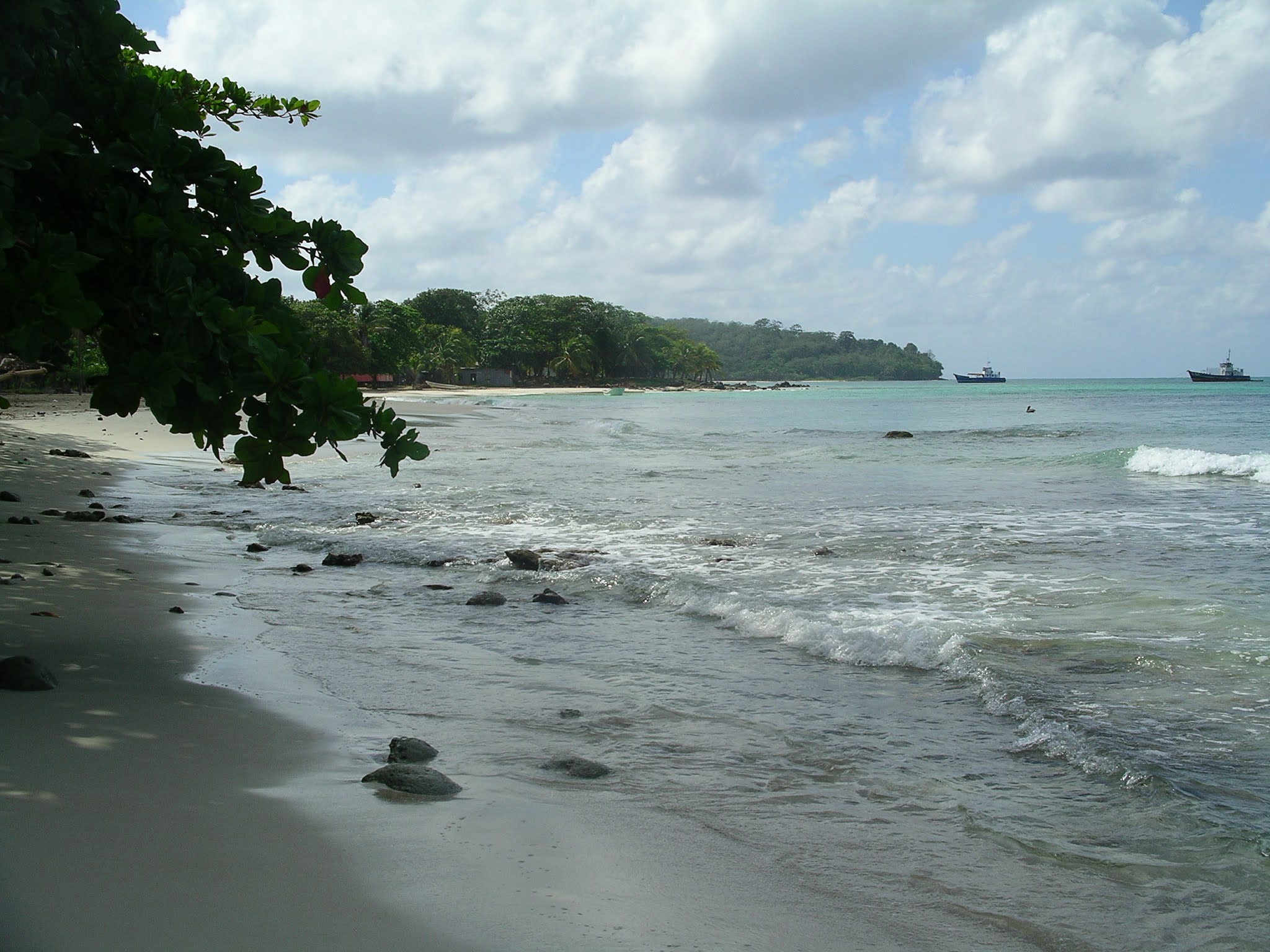
Now and again opportunity offers a passage in the sturdy coastguard’s launch, or the tug boat “Siquia” but we had the good fortune to make the journey in the fifteen-hundred ton vessel of the Mamemic Line as guests of His Excellency the President. Yet whatever the craft available, no one must miss seeing Corn Island. Sea-sickness, fear and discomfort will all vanish the moment one steps ashore on the green island with its thatch of waving coconut palms, dazzling white sand and wonderful sea.
The English pirates were familiar not only with the Miskito coast but with the neighbouring islands and, of them all, Corn Island was the nearest to Heaven any of then ever reached. There seem to have been degrees of piracy, and at the bottom of the scale were the cut-throats Morgan, Jackson and Morris, who not only landed on Nicaragua soil but plodded overland to the great lake and sacked Granada, a city they compared in size to that of Portsmouth. At the top of the scale comes the French aristocrat Raveneau de Lussan who combined the art of literature with that of privateering, and William Dampier his English contemporary.
Dampier was born in England in 1652, the son of a Somerset farmer. He left home as a
youth and sailed for the West Indies and, from 1675 - 1678,
worked as a log cutter at Campeche, in the Yucatan province of Mexico. Two
years later he joined the buccaneers at Bluefields and, in their company
visited Corn Island. In those days adventures to the Caribbean considered the
following as necessities and an indispensable part of their baggage: “beer,
hardtack, gunpowder, knives, razors, needles, twenty-nine barrels of pipes for
tobacco, four boxes of hats and fourteen ream of paper.”
Dampier became a famous navigator and travel writer.
He carried the manuscript of his book about with him in a bamboo tube to ensure
its protection against moisture and, commendable foresight, its keeping afloat
in case of shipwreck. The work was published in London in 1697, as “A New Voyage Round the World,” and
was soon to be translated into French, German and Dutch. Being now a man of
some importance the author came in contact with the great ones of his day and,
among then Daniel Defoe. Recounting his exploits to this man of letters, he
mentioned an island in the Pacific Ocean where they had picked up a castaway.
The man, guilty of some grave fault, had been landed there by an irate captain,
unknown to the prisoner, made arrangements for another ship to take him off
after a specified period of punishment. The man was thus rescued in due course
and that was the end of the story. However it appealed so strongly
to the listener that, from this
true account, Daniel Defoe wrote his immortal
work “Robinson Crusoe.”
While moving in the Caribbean, Dampier met a certain William Paterson, who, via Amsterdam where he had taken refuge for some misdemeanour committed in his native land, had come out to seek his fortune. A cautious Scot, he was no swashbuckling corsair, but a visionary who had hopes of establishing a great trading company. His idea was probably inspired by the success of the East India Company in Bombay. Having gathered much information he returned to London to enlist the aid of the King and the city princes, and then, by way of beginning, founded the Bank of England in 1654.
If all these wanderers were now to return to Corn Island they would find little change in this Caribbean jewel. The iridescent sea that surrounds it is so deep, and so translucent, that the ocean bed unrolls clearly beneath, with its fronds of swaying sea-weed, brilliant fish and glistening shells. The water is constantly changing colour from the glowing emerald to aquamarine, to jade and to the nearly peridot and as the sea deepens, first to the sparkling sapphire and then the opaqueness of lapis lazuli. Surf, crisply curled and chalk white, creams over the rocks, the coconut trees make little pools of shade and all is peace.
Hers, untouched by science and unspoiled by man, is a Garden of Eden, seven and a half miles long and one and a half miles wide, of such utter tranquillity and soothing beauty that commercialization of it seems a crime. A sandy track girdles the island and similar ones tunnel their way through the coconut groves, the dense flower-stream undergrowth and the standing timber. Mechanical transport is unknown and only the favoured few can afford to keep ponies. For a population of just over thirteen hundred souls, there are four churches which include the Seventh Day Adventist, the Roman Catholic, the Anglican and the Baptist. The latter mission having been founded over one hundred years ago, and the Anglican Mission, have the largest membership. Both houses and churches are replicas of those in Bluefields.
The inhabitants of the Island are nearly all Creoles and English is their mother tongue, here again the purity of their speech has been maintained, free of any metallic harshness or distortion of words. As in Bluefields Anglo-Saxon names predominates and many of these are common to both places. There are families called Quinn, Downs, Hodgson, Lampson, Jackson, Nicholson, Taylor, Archibald, White, Tucker, Campbell, McCoy, Green and Wilson. It is customary among these families to have their own burying ground, a fenced-in plot of land in which the graves are dug. Should a friend die while visiting any of them, then the body will be interred in the land belonging to the host.
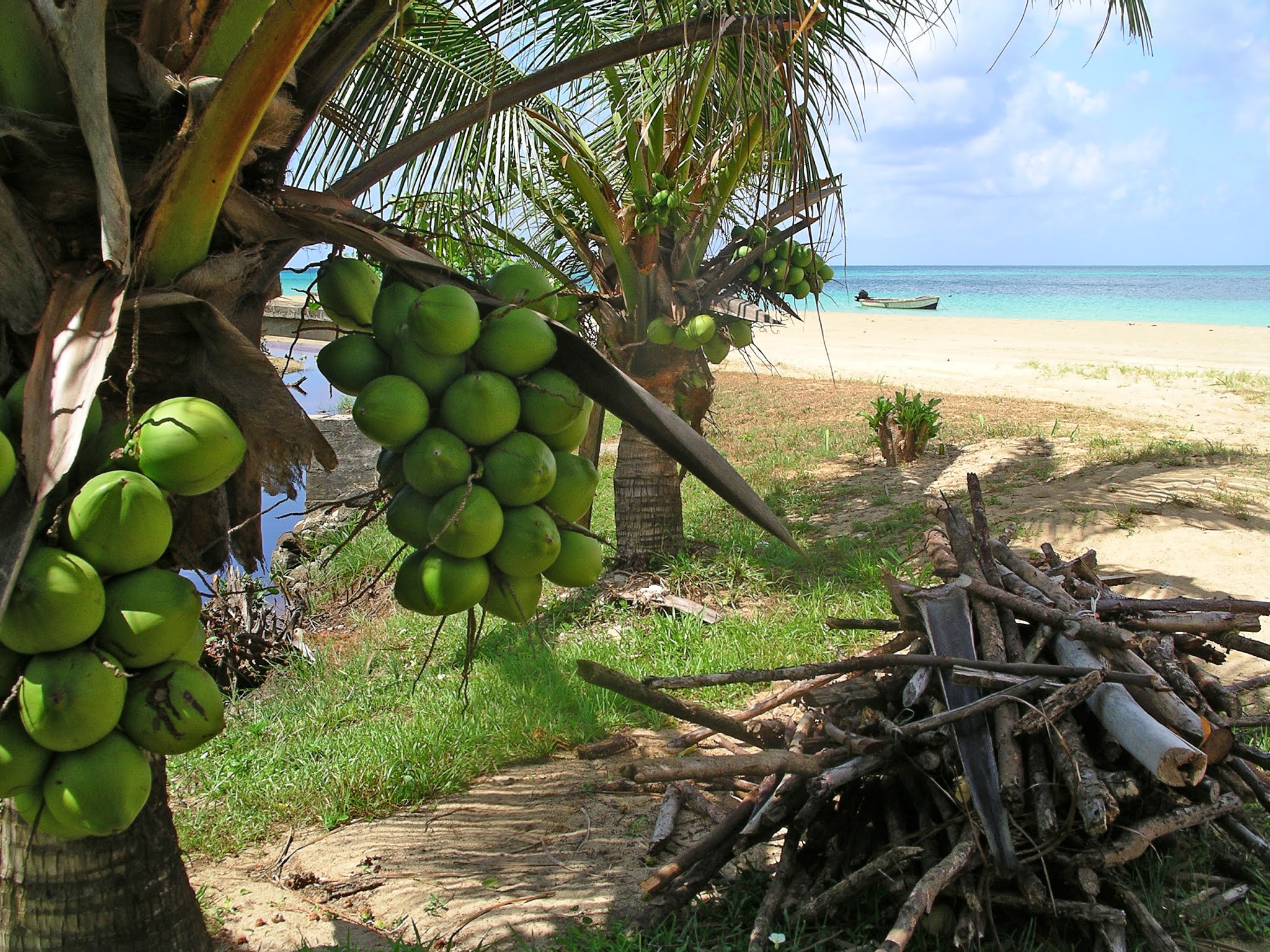
 The islanders gain their livelihood from the
prolific coconut which, disdaining the sea bears the whole year round. The nuts
are of especially good flavour as the visitor soon discovers. Every guest is at
once presented with a freshly gathered and prepared nut. The drink is most
refreshing, cool and not too sweet, and the flesh is delicious. All over the
Island are many little mills which extract the coconut oil. This is then sealed
in drums, shipped to Bluefields, and flown over and sold in Managua. Drying of
the copra is another lucrative side-line and the nuts themselves are exported
to the United States. For local consumption the housewives make a very rich
coconut cake, well sweetened with syrup from the sugar cane, another local product.
Despite the name, no corn is grown on the Island.
The islanders gain their livelihood from the
prolific coconut which, disdaining the sea bears the whole year round. The nuts
are of especially good flavour as the visitor soon discovers. Every guest is at
once presented with a freshly gathered and prepared nut. The drink is most
refreshing, cool and not too sweet, and the flesh is delicious. All over the
Island are many little mills which extract the coconut oil. This is then sealed
in drums, shipped to Bluefields, and flown over and sold in Managua. Drying of
the copra is another lucrative side-line and the nuts themselves are exported
to the United States. For local consumption the housewives make a very rich
coconut cake, well sweetened with syrup from the sugar cane, another local product.
Despite the name, no corn is grown on the Island.
A small traffic in turtle shells takes place with Jamaica. This lovely shell is also used by the men for making peaks on their caps. (A fashion which does nothing to enhance the natural delicacy of the shell.)
Huge conch shells may be picked up on the beaches. This shell is blown to signal the arrival of a ship. For this purpose a hole has to be drilled in one end, and if this is skilfully performed and the blower proficient, the sound will carry for twelve miles. At Santa Maria de Ostuma, conch shells from Corn Island are always blown to summon or dismiss the labourers.
Plans have already been discussed for building an air strip and erecting a large hotel on the island thus enabling holiday makers from Managua and other large towns to enjoy this beauty spot. The flight would only take one hour and ten minutes and the project would certainly bring prosperity with it and much needed employment. At the same time it will receive mixed reception from the more conservative element but there is no doubt it will, in time, be achieved.
But, for those who rank solitude, untroubled calm and the simple pleasures of life higher than hard cash and Scotch whiskey there is the sanctuary of Little Corn Island. This rises, a hazy mound on the horizon, a few miles north of its bigger sister and is the proud possessor of an important light-house, the guardian of both islands and the sailor’s friend.
Little Corn Island is the same again, only in miniature, as its namesake. Several families reside here and they live the same pastoral existence as on the other islands. They grow their own fruit, vegetables and corn and utilise the coconuts in the same way and send over the extracted oil, copra and the nuts to their sister island for export to the mainland. They also have the added advantage of a large savannah where cattle can graze. In Nicaragua itself there are great tracts of open land used as cattle ranges and the rearing and export of the beasts could easily become a very lucrative and important issue in the economy of the country. Two breeds that thrive particularly well are the Holstein and the Brown Swiss and experiment is being made successfully with Jerseys and Guernseys.
At one time there was a jail on Little Corn Island which, one would have thought, would have been an encouragement to crime rather than a deterrent, incarceration on such a lovely isle can hardly be classed as punishment although I believe the majority of the prisoners were political ones and not the ordinary felon. In any case the authorities must, eventually, have reasoned much the same way, and the jail is no longer in use.
Further out to sea are the islands of St. Andrew and Providence, and further still, the group known as the Caymans. All these islanders are on visiting terms with one another and there is continued contact among all five of then with Bluefields. Intermarrying takes place as well as emigration from one to another. Yet everything is done at a slow and measured tempo for, in these lovely languorous waters time is of no account, and man’s efforts dwindle to insignificance in this superb setting where the hand of God predominates.
BY MAUREEN TWEEDY (Mrs. Hubert Evans)