Monday, 14 December 2015

Canso and Hazel Hill

Canso and Hazel Hill
By W. Lacey Amy
From The Canadian Magazine, July 1916. Digitized by Doug Frizzle, Dec. 2015

IT was not the most favourable conditions under which to make the acquaintance of any town—a tumbling boat of ninety small tons beneath me, seemingly ill-fitted to cope with the swell and roar of the stormy waters of the straits; a drizzling mist that developed into a heavy rain and blotted out everything but the crude, blank, staring things of nature; the waning light of a day that had started before 4 a.m., and had, in the fourteen hours afterwards, included a forty-two-mile coach drive, a two hours’ wait at an uninteresting station, and five hours of train and boat. Naples might languish under such a burden. Certainly Canso did.
A low gray loom through the misty rain, and then a bare gray tumble of rocky coast, surf-lined, and nothing more at first. A tall white steeple, bayoneting the sky, crept round a point, high-placed on a bare hill-top. Lower down a lighthouse came dully over the rocks and pushed its feeble gleam into the drab fog. Farther westward a lonely mast shot up above an island, tilted a little, telling the victory of wind and wave that had driven it upon the shore. Through a narrow passage between the sullen out-lying islands we slowly drifted, and within the harbour made two right-angle turns before reaching the wharf. Canso was in no hurry to disembark us.
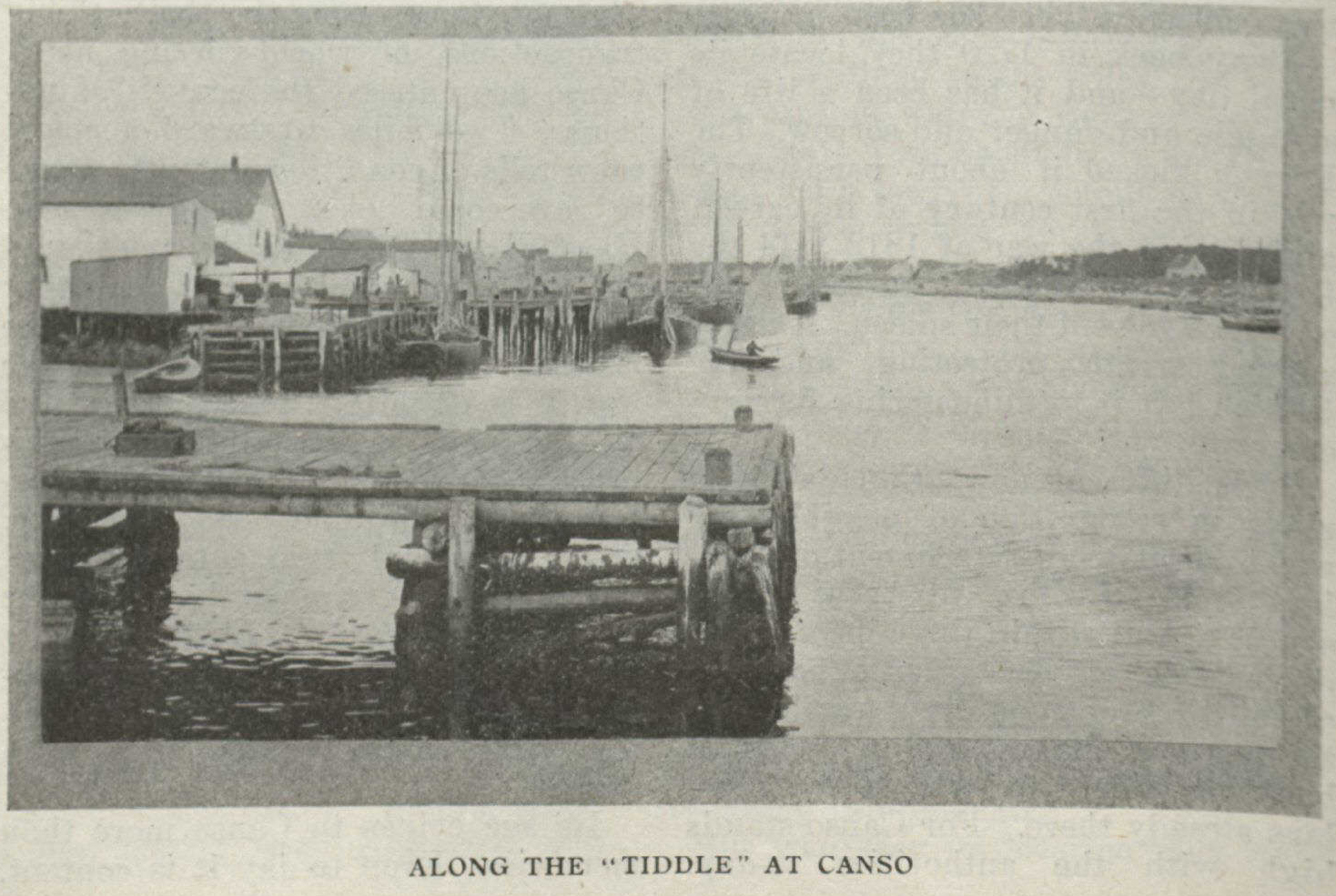
From the water it was a very long town, and very narrow, as if each house begrudged another a place beside the water that gave them their living. In architecture they did not struggle with one another—drab, plain and unpretentious, content that they were part of Canso, the cod-fishing centre of “the Eastern”. Only here and there a larger structure told of public affairs independent of Canso and its cod—a school, a church or two, the post-office. And down beside the water the one big industry of the town, placing Canso outside the list of mere fishing villages, the warehouses of a government-fed institution. with a cold-storage plant, which carries “fresh” fish across the continent. The rest was but a mass of drab, with indefinite lines of windows and flat roofs, through the fog. But there was no drabness down the “tiddle.” the narrow harbour wherein lie the life and commerce of Canso. There row after row of fishing-boats tied up to the wharves faded into the distance as an indistinct blur of upright points.
But fog and rain did not dull Canso’s nightly entertainment. The wharf was crowded. The R. G. Cann was Canso’s little touch of outside world, its daily dissipation, its purveyor of mails and visitors and floating bits of gossip denied the mails. Every morning, in the early light, the boat draws out for Mulgrave, thirty-five miles away to the north, to pick up connection with the outside. Fishermen lounged about the wharf in yellow slickers fresh from the sea, and the townspeople wore waterproofs—or stood calmly in the rain. Umbrellas are for places where water does not enter so seriously into the life of the citizens. To a gentle, white-bearded man I delivered my baggage and wandered up the pavementless streets to the hotel.
At the best of times Canso is not pretty. The builders of it cared for nothing but the fish; their descendants are worthy of followers of the same idea. To make Canso beautiful would be to translate it to another region, and to deprive it thereby of the things that count for much more than beauty. Rock is everywhere, cropping out through the thin soil in all sorts of inconvenient places. Streets stumble and clatter over rock that will never wear out—that will never permit waterworks or sewers. A telegraph company was inaugurating its service by incessant blasting of rock to give foothold to the poles. It is a town without water or light or sewerage—lights were about to be installed—and yet a town of a couple of thousand people, whose forefathers had lived on these rocks a half century before an invisible line was cut through North America. Old rusted lampposts still stand awry about the corners, the remains of a lighting system this generation does not know. Streets wander without regard, but to the path of least resistance. Shops are splattered in disconnected locations without favouritism to any street. There is no business centre, no residential suburb, no slum. It is all Canso, a unit that looks anxiously out to sea to catch the first glimpse of the returning fishing-boats.
But whatever its location may deprive it of is made up for by its honourable, steadfast history. For almost two centuries there has been a Canso—away back in 1720 they locate its natal day—and it has been a life of struggle and danger and sorrow. The French kicked it about persistently within the first century of its career, and during the war of 1812-1814 the United States found it an easy mark on which to vent their spleen. It never seemed worth protecting, and the British left it to filibustering foreigners.
It is different now. Canada’s first move in recognition of possible war was to despatch a detachment of regulars from Halifax to those rocky shores. And within three days of the declaration of war a large boatload of militia and guns drew warily into the tortuous channel and unloaded its bristling freight to back up the regulars already there. For Canso stands high with the authorities to-day.
Through its two cable stations Canada touches hands with Europe. Through Canso runs the thrill of big transactions, of world-stirring news. Canso has entered the council of nations. Two miles westward a model town tells of conditions manufactured to overcome local inconveniences. Hazel Hill, with its eighty telegraphers and their families and the other requirements of what is said to be the largest receiving cable station in the world, is definitely placed to be the antithesis of Canso—uniform architecture of some ambition, scenic surroundings suitable to residence, green grass and trees, entertainment, and everything to make the life of the operators pleasant. Hazel Hill is Canso modernized—without the qualifications that brought Canso into being long before cables were even dreams.
Its age brings to Canso more than memories. Even to-day it is content. Hundreds of its people have never been outside its limits—old men and women whose ancestors ran to cover many a time at sight of a French frigate or an American privateer. Hazel Hill is foreign travel to some of them. They are content to die without hearing the rumble of a train. Into the career of a woman of sixty has come one big event—a visit to a neighbouring fishing village, five miles along the coast, in honour of the opening of a new church; and she talks about it yet. One of the top-notch families first sailed into Canso harbour a little more than a hundred years ago, while on the way to Labrador. It stopped there. To-day a descendant is the local squire and landed proprietor, owner of the largest wharf and largest store, a man who condescends to receive the visitor who is sufficiently recommended.
Communication with the outside world is uncertain, with the unreliability of water connection. At times the straits are full of ice, or a southeaster rages up the Atlantic. Then the only way out is by a long, dreary route up the shores of Chedabucto Bay, a terrible trail in winter, where strong men numb in the heavy gales and ruthless, unimpeded snow.
There is a reckless tang in the life of the cod-fisherman that makes Canso the centre of stories of daring evasion of the law. Nowhere east of Halifax is there license to sell liquor—but the French island of Miquelon is only a few days away on the coast of Newfoundland. It is not too far for the venturesome fisherman, and the excitement of liquor-running repays the risk. They tell of the skipper who long made profit of his daring runs across the south coast of Cape Breton. But the authorities interfered. They awaited his return one day, and laid heavy, gleeful hands on him as he entered the harbour—only to find an empty hold. They were still cursing as his brother sailed in a couple of hours later with deep-sunk hull—filled with the load transferred ten miles out at sea. And many times thereafter it was transferred before official wits got working.
They narrate with many a laugh the adventures of an illicit, distiller whose plant on a neighbouring island was surrounded one night by revenue officers. The moonshiner managed to escape by a flying leap through the window. The officers, sure of their quarry, took their time loading the outfit into the man’s own boat, and then set out to beat the island. But their prey escaped through their lines to the laden boat and calmly pulled away with both boats, leaving them marooned and helpless, watching him from the shore.
It is along the wharves you hear these stories. For there you find the life of Canso. The village itself is but a sleeping-place for this living that throbs along the water’s edge. There they work and play and live their social life. I passed among them for days, with the freedom a stranger nowhere else feels. They are eager to talk, to answer questions, to offer trips to the fishing-grounds. They also wanted to be photographed. One easy group of three, lounging on the deck of an isolated boat, sprang below at the first sight of the camera, to return in a minute with—hats, one a very pale pearl, and another a stiff black. And yet, uninteresting as they now were, they had to be taken. A fisherman sculled me across the tiddle that I might take his boat, the largest in the harbour, in full swordfishing attire, one member of the crew in the cross-trees, one in the “chair,” another with the float ready to cast. Still another skipper begged me to wait until be had daubed a few bare places with fresh paint. On that Saturday afternoon they were industriously shining up, for their affection for their boats is undying.
Up against the Corporation wharf lay an ugly gray steamer, an English trawler, its 134,000 pounds of haddock running over in heaps on the deck, a dirty, slimy mass hauled up perhaps a week before from the ocean bed by huge nets and rushed at the limit of time to the cold-storage plant to be turned into the market as fresh fish. The fishermen eyed it askance, the stale fish an eyesore in their sight. And they told me angrily how that load of three thousand dollars, caught any time within the week, brought the catchers a higher rate than did their daily-trawled fish, given straight from the sea into the hands of the merchants. The clumsy English trawler-men, working to the point of exhaustion under the goal of a percentage and swift-moving machinery, sent basket after basket ashore all day long, and left at the end for another sweeping of the depths away up through the straits in the Gulf of St. Lawrence.
Now and then a schooner or a “vessel” drifted into harbour, and along the wharves the fishermen stopped work to guess the business and name of the newcomer. One was an American swordfishing boat, and a deputation left immediately to learn the luck, and the whereabouts of the swordfish. But most of the lazy boats that blundered in, and wheeled about anchor in mid-harbour to the flapping of sails and the creaking of anchor chains, were Lunenberg fishermen, doomed by shortage of bait to await a new supply. Some of them lay there a week, a dead loss to the owners, and still no herring to sell them.
Out on the tiddle in boats, and along the wharves, boys frolicked and fought and raced. Three little fellows, scarce able to toddle, launched a big dory undisturbed, to give chase to a toy sailboat carried into the tiddle by the wind. From a snubbing-post a current of naked youngsters plunged into the dirty water, some stopping before each dive to cross their foreheads with hurried hand. A tottering old fellow tried to explain to me the characteristics of a “pinkie” that lay near, an old boat that had just been brought from “the Western” and a younger fisherman dared to maintain that it was a shallop. I left them arguing the relative merits of the sharp stern and the blunt, each adhering stubbornly to the things of his age. And all about was the overpowering odour of fish.
It was the life of Canso down there, Canso concentrated, packed into the narrow border of a narrow harbour.
At night it rained: rainy nights are not unusual in Canso. The rain falls with a persistence that defies defiance from the inexperienced. Through the open windows of my room I could hear but the murmur of a few muffled voices from the street. From somewhere downstairs a metallic piano—the first I had heard for weeks—drummed out the good old tunes that have stirred the throng for many a year. The window-blind flapped drearily in the wind, and a boat whistled suddenly from the harbour and pulled to rest beside some dark, deserted wharf. And after the piano became silent and the voices had long since ceased, I sat by the window and listened to Canso’s own heartbeat—a foghorn from a distant lighthouse, thickened by the blank gray fog, and dreary bell-buoy that gloomily wafted its warning on the varying wind, always low, always menacing; and over it all that dull boom of dashing surf on the islands outside. Canso was asleep at last to its own lullaby.

Sunday, 13 December 2015

With The Cod Fishermen

With The Cod Fishermen
By Lacey Amy
From The Canadian Magazine, May 1915. Digitized by Doug Frizzle, Dec. 2015.


COD fishing is not what it used to be. The fishermen themselves will tell you that. The fish are not so plentiful, the grounds are more distant from the old convenient harbours, and there are other openings for the energy of the fishermen offering brighter lure. The result is a more or less discontented worker who is either actively looking for another occupation or lacks the ambition. Around Newfoundland and Labrador the uncertainty of the “run” is annually driving hundreds from the calling, and frequently (as this year) leaves hundreds more a charge to the Government. At the Magdalen Islands it has advanced little further than grumbling, for the fisherman knows that to change his occupation he must change his home, and that is the last resort. But along the south coast of Nova Scotia there is a different kind of fisherman, one who has kept pace with the times. Cod fishing there is an industry developed like transportation and surgery and peace organizations and the other outgrowths of later-day leisure and wealth.
And the fisherman himself is changing, especially where he has advanced his methods. That is the altered condition which appeals most to the nonfisherman. But it is still a special train of thought that runs in the cod fisherman’s mind; a unique style of life is his, a vivid independence, and an uncertain recklessness that cannot be fathomed by the uninitiated. Therefore, to-day or yesterday, he is interesting. A day with him is liberal entertainment.
In the introduction of the motor one finds the most startling evidence of the altered conditions. A deep-sea fisherman without sails would seem like a farmer without horses; and yet four out of five of the fishing-boats in some of the harbours of Nova Scotia use sails only when the engine balks. Half the waste time of cod fishing and most of the danger have been thus eliminated, and grounds formerly far beyond range are now the regular goal of the day. Where the Magdalen Island, the Labrador, and most of the Newfoundland fishermen trust to their deep brown sails to get them in touch with the cod or run them to shelter in a storm, the Nova Scotia fisherman starts a couple of hours later, arrives sooner, and negligently watches the heavens. Instead of starting soon after midnight, as must the Amherst Island fisherman, his Canso brother sleeps comfortably until daylight, and, independent of the wind, casts his trawls exactly when and where he desires. And at night supper awaits him at an hour as definite as the city man’s dinner.
Three hundred dollars of engine and a few gallons of gasoline have made fishing an industry, not a gamble. A few years hence it may be a profession.
But there is one characteristic which sticks to the fisherman—the careless indefiniteness of his morning’s mood. “What a difference in the morning” must have originated with a member of the crew awaiting his skipper on the wharf in the shivering mists of early morning. Patience is the primary requirement of dealings with the independent cod fisherman. He has always come and gone as he liked—save for the elements—and he always will. He has no set hours, no assured returns, no master. To-day a threatening storm forces him to idleness; to-morrow it catches him adrift and sends him home before the day is half over; and all next week a dog-fish raid on his fishing-grounds drives him to another quarter. No wonder he is unsettled!
During several summers amongst them it has been borne home to me that keeping an appointment with them is as tantalizing as the promises of a politician. At the Magdalens, two successive mornings I rose at one o’clock, on specific direction of the skipper, but was doomed to disappointment. Fear of a storm prevented the first day’s fishing, and the previous day’s idleness impelled a start at eleven p.m. for the second day’s work. I gave it up for a night’s sleep.
At Canso I fared worse in the way of waiting, but better in results. It required four almost sleepless nights to effect the reward of a day’s fishing. On Monday a seven o’clock appearance on the wharf, according to instructions the night before, brought the information that the boat had left two hours earlier. Tuesday was featured by a rainstorm only possible beside the ocean. On Wednesday morning by four o’clock I was on the wharf from which they were to pick me, and down the “tiddle” I could see the boat leisurely making ready. But five minutes’ absence for something I had forgotten furnished me with the maddening spectacle of a receding stern chugging out to sea. The next morning I took no chance. I closed my teeth and set the alarm for two a.m., closed my teeth and obeyed its message, closed them again and wandered forth on the deserted moonlit streets and down to the cold, damp wharf where the boat was tied. And I sat down on the edge of that boat for three hours, kicking my heels to keep warm, but a little proud that I had discovered a way of overcoming such an unreliable thing as a cod fisherman’s start for the fishing-grounds.
And those few hours on the deserted wharf in the brilliant moonlight will never be considered as wasted. All about lay the well-finished, trim boats of the Canso fishermen, models of grace and surprising cleanliness and order. In the moonlight the masts rose like a bare forest around me, gleaming here and there where the light struck them, and black elsewhere against the clear sky. Below it was all darkness, with edges of cabins, dories, tubs, ropes, creeping into sight as my eyes became accustomed to the gloom. Further down was the utterly black water.
I was alone. Not a sound came from the sleeping boats, although I knew that each had its sleeper—a hundred of them within sound of my voice. The water was as motionless as only tight-bound water can be—the silence that is the uncomfortable waiting and listening of a thing with life. The utter loneliness of the sleeping life was disturbing to a novice. My day seemed to have no start; everything was at a standstill.
A gloomy yawn was my first company, proceeding from a boat that, before the heartless introduction of its motor, had been the champion of the annual sailing races. Presently a spot of light revealed the outline of a cabin window, and immediately someone stumbled up on deck and sleepily shook himself, stretched, and growled at the cold. Then two or three little oval windows flashed into life, and yawns and growls sprang up all about me. A man clambered up the side of the wharf and stretched himself where there were no spars and ropes to interfere. He gave no sign that he saw the stranger within six feet of him, but proceeded to feel the mooring ropes, and disappeared below. It was not surliness—merely an intimation that I was not a part of his morning duties. Gradually others appeared, each retreating below after the preliminary stretch and careless reading of the sky. From the length of time between the appearance of the cabin light and the man on deck the scant amount of disrobing necessary for a night’s sleep could be accurately estimated.
Then, with every man below, two things happened almost simultaneously in all the boats. From tiny stovepipes protruding above the cabins drifted uncertain whiffs of smoke, and from the cabin entrances poured no uncertain language. If you have ever tried to light a fire in a cabin, beneath the shadow of overhanging wharves and buildings, you will understand the connection. Almost immediately the men began to reappear, thunderously, fluently, giving utterance to a variety of comment that agreed only in its general meaning. They fiddled with the pipe, swore, went below, swore, tumbled up on deck, swore—and swore between times. Those who light the fires of anchored fishing-boats know nothing of the dread effects of example; and I had no desire to enlighten them.
A cup of tea! That is the beginning of the fisherman’s day, and the end—and also the middle. The teapot is on the cabin stove before the boat is ten minutes awake, and it is there humming until the last member of the crew has gone. All day long it sings accepted invitation, and by the afternoon it offers a stimulant unrivalled by anything short of end-of-steel whiskey. I tried it—and it’ll do until I visit the fishermen again.
A member of my crew appeared, with the information that he had whistled beneath my window at the hotel until he was told of my departure, and through the next hour or so the others came straggling down. They did not apologize to each other, nor resent the expressive allusions to the damp disagreeableness of waiting on a wharf before daylight. To-morrow it would probably be their turn to wait and make comment. From all about us motors were chugging away, stopping to get swung into position, and then puffing steadily off into the distance. For hours little motorless boats had been swinging lifelessly along with flapping sails behind ridiculously small rowboats pulled by one man—and for hours more they would still be within sight. The patient seemingly profitless toil of a rower towing a big boat is almost pathetic—if you aren’t in the boat. To the luxurious occupant of a motored vessel it is ludicrous. But I was still on the wharf; I could see things in their proper proportions.
As we pulled out from the wharf in the hazy light of the rising sun, a long line of boats stretched before us right out to sea—big and little in an irregular line, the motor-driven skimming noisily past the sail-driven, and watched by envious eyes, the less powerful engines yielding in their turn to the greater. Right into the sun we aimed, a big globe of red rising from the ocean with the glare of coming beat—out past the Lunenburg “vessels” anchored in mid-harbour, around the lighthouse on the edge of the open. As we passed one helpless sail-boat we suddenly swung about and threw them a line, although it meant an hour’s delay in reaching the fishing-grounds six or eight miles out. The unselfishness of the fisherman is the quality that makes his life most worth living. Where all are so much at the mercy of the elements each strives to help the other.
And then our course began to be more up and down than along. It was not a rough day, they told me, but later they acknowledged that it was the record for that year’s roll. I have never been able to bring myself to the nicety of distinction that unhesitatingly separates roughness and roll. I have heard landlubbers do it as an excuse for seasickness. Sometimes we could see the boat we towed rushing down towards us, and sometimes it was out of sight behind a mountain of water that brought the uncomfortable conviction that only our rope was keeping it from hitting the bottom. I liked to keep that tow in sight, even if it threatened to drop on our deck. . . . And I had twelve hours of this ahead. I began to wonder if I had not rashly overestimated the pleasures of a day’s cod fishing.
In the meantime the crew—those who were not engaged with the towline and the tiller—were preparing for the fishing. We had taken aboard at the wharf a couple of boxes of herring for bait, the cost to be deducted from our day’s catch, and now these were being cut into small pieces. Later the bait was fastened to hooks on short lines attached more than a foot apart on a long, larger line. Net fishing was over, and the cod were being caught on trawls and handlines. The trawls had been carefully wound in tubs the night before, the hooks towards the centre, and baiting was done with a dexterity that looked positively dangerous, and the baited trawls thrown deftly in place in another tub.
We had come up with the fleet. In all directions boats of every size stood out against the dark water and bright sky, some casting hand-lines over the side, some lying idle while their dories pulled off with the trawls. Off on the port side a peculiar, uncanny wave broke and disappeared over one spot, broke and disappeared again. They told me a rock came close to the surface there, a constant menace to navigation. Away back when the French and English were tussling sporadically for Nova Scotia a French frigate struck there and sank; and many a ship since. It stood at one edge of the fishing-grounds, in about twenty-five fathoms of water, and the fishermen pursued their calling all about it.
Out past the fleet we twisted, and, beside the flashing buoy that marked the channel into the Straits of Canso, we dropped our dories. In each a fisherman took his tub of bait, and another of trawl and, standing recklessly in the stern, sculled with one hand while dropping two hundred feet of trawl with the other. And there we left them all day, running alongside only at noon. I tried hard not to picture their day on that sea in those tiny bobbing boats, with no protection from the blistering sun, and nothing to think of but the swell and their sins. I was in comparative comfort on fifty feet of deck that was at least flat and solid to the feel—and it was mighty little just then. One thing—it wasn’t far to the side of the dory.
From the larger boat we tried to supplement the catch with hand-lines, the last resort of the cod fisherman. Only after netting and trawling are past does he rely upon the more laborious, slower method; and when it comes to hand-lines around Canso the end of the season is at hand. Catching cod in this manner is like trying to satisfy thirst from a pump-spout—an unprofitable task performed in the hardest way. About all we caught was blistering salt water and sunburn, and now and then a phlegmatic bit of fish that seemed glad to be at rest. No wonder a fisherman leaves hand-lines to the last, when the children are crying for bon-bons. Casting unsuccessfully all day for trout is hilarious revelry compared to cod fishing with a line.
Between acts the professional members of the crew drank tea. If Chinese commerce were bound up like Germany’s is now there would be a rush of fishermen to enlist and get the war over in a hurry. At noon we ran alongside the dories and received their catch; and I looked after the tiller while the others went below for stimulant. Seated on deck I tried to forget the all-pervading smell of cod. I couldn’t. Why must a fish smell so fishy? And then the dories dropped astern once more to their work.
Occasionally coasting vessels went by, turning around the light buoy into that great path of commerce, the Straits of Canso. A small steamboat cut across our stern headed for Canso, and a couple more passed along between Halifax and Gulf ports, all of them staggering helplessly in the swell. And then, a mile outside, something dark and ominous flashed by, the black smoke streaming furiously out behind so long as it was in sight. Twenty-five miles an hour—nothing less! So fast that a steady wave curled high above the bow, and the stern was out of sight beneath the water. It was a British cruiser going west in chase of reported German boats off the south coast. For war had been declared and the dogs let loose. With regulars and big guns protecting the cable stations in Canso, German cruisers sighted off every corner of the coast, and British cruisers searching them diligently, we felt as if we were the centre of hostilities.
All afternoon fishing boats were leaving the grounds disgusted, some with insufficient catch to pay for the bait, and none with a day’s pay. Our luck was a little better. But at sixty cents to two dollars a hundred pounds cleaned it required a large catch to make the day worth while. But the Canso fisherman does not do so badly. The crew with which I fished had made a thousand dollars in four days the year before, and the skipper had cleared $1,475 for the season. He was not complaining. But he followed the run of cod throughout the season, from Prince Edward Island to the “Western”—in fishing parlance, the western part of the south coast of Nova Scotia.
In at the wharves the boats were moored two and three deep, discharging their catch. The five members of the crew had their work definitely assigned. One pitchforked the cod from the hold to the deck, another passed them to the wharf, a third lifted them to the splitting tables, and the other two performed the expert work of splitting. It was a dirty mess to the novice—fish cleanings, tobacco juice, and odour. The livers and heads were saved, the former bringing forty cents a pail for cod liver oil, and the latter finding a market at the glue factory down the “tiddle. ” Later in the season a dog-fish factory on the outer islands would take even the bane of the fishing-grounds for manufacture into fertilizer. The byproducts of cod fishing are making up to some extent for the decrease in the cod.

His day’s work done usually some time before six, the cod fisherman is again the care-free, light-hearted workman who is satisfied that he has done his best. Be the catch good or bad, there is no sign of it when the day is done. Around the wharves he sits with his fellows, telling yarns of past records, banter running through it all, and the unoathlike oaths of a good-tempered people. For the stranger they have a bright welcome, and a willing information that is seldom unreliable. The future is not a worry to them, and the present bears lightly upon them. But the future is often serious. A man of no more than sixty sat totteringly on an upturned dory, hands twisted pitifully in to his body, head bent forward and down, vainly trying to light his pipe. Tremblingly he inquired what was good for rheumatism; he had no faith in the local doctors. Almost in the prime of his life he had been forced from the water, but each evening he faltered down to the wharves to see the catch come in and to tell of things that were in his day. A small boy took his pipe below and lit it with his own breath, and brought it back and pushed it between the old man’s lips. Next day they told me partial paralysis had come to him in the night, and the poor old fellow lay weeping to get out with the boats again, to feel the dash of the spray in his face, the tilt of the boat before the wind, the drag of the filled net. But his day was done.

Swift: A Precocious Pioneer

Swift: A Precocious Pioneer

Author of “The Blue Wolf
From The Canadian Magazine, 1
913 September.
Digitized by Doug Frizzle, November 2015.

WHEN Canada’s new transcontinental, the Grand Trunk Pacific, pushed its way into the unknown Rockies of Northern British Columbia it was welcomed by one pair of hands only—the only white ones in all that vast region of undiscovered grandeur. Swift, the pioneer, was official recep­tion committee of the Yellowhead Pass, appointed by himself to repre­sent himself as the total of the white population of two hundred miles of mountain peak and torrent and for­est.
Not that the railway was essential to Swift! He had lived so long in there on his own resources that noth­ing on earth seemed able to interfere with his independence. But the same brains that had turned into a sus­taining home a mountain valley three hundred and fifty miles from the nearest neighbour came to his assist­ance in realizing that the two little rails could bring him luxuries he had not learned to despise as well as re­nounce.
And the Grand Trunk Pacific? It was too experienced to ignore the out­stretched hands, for the way to the Pacific was effectually blocked by Swift’s domain, the most unique farming enterprise in Canada—a lit­tle patch of tilled ground that extend­ed across the only available pass from mountainside to mountainside. Yes, Swift stood there with extended hand—but he kept his back to the Pacific and his eyes open. Even the big rail­way stopped to shake hands, to smile its thanks and commence the parley.
When Swift first looked about him in the centre of what is now Jasper Park he could have pitched his tent anywhere within many hundreds of miles without comment or opposition. That was about thirty-five years ago. The Hudson’s Bay Company repre­sented everything of authority within a month’s journey, and the only pre­sent or predicted value of the Rockies was on the back of the fur-bearing animals that appreciated the protec­tion of unscalable heights and un­charted valleys. Swift himself was not drawn to the spot by any special prescience. He just liked it, and, lik­ing it, sat down because it fitted his mood. That he has continued to sit there is proof of the durability of the surrounding attractions.
Swift—nobody seems to have heard any other portion of his name—de­veloped the wanderlust as a youngster down near Washington, away back when Edmonton was only a Company trading-post and the whole north country a Company hunting-ground. He and a partner reached Edmonton still unsatisfied. They passed farther westward through the Rockies to Jasper House, the mountain post of the Hudson’s Bay Company; and near there the unfordable Athabaska forced them to pause.
That moment’s hesitation was suf­ficient to make more than a passing scene of the grandeur around them. Anyone else would have pulled out a sketch book, or built a raft to see what was beyond. But Swift and his mate built a shack. And instead of making lines on paper they made them on the ground. There in the heart of the western mountains they dared at­tempt to introduce the arts of the East, to rouse the soil into a belief in bigger things than the production of spruce and poplar and cottonwood trees. But Swift seems to have mono­polised faith in their works, for his partner showed a decided preference to his traps and rifle.
They parted—over a little bit of workable level ground in the midst of the Rockies, with no neighbours but a few Indians a hundred miles west on the Fraser, and no future that promised profit. The partner wan­dered off through the Yellowhead Pass, rifle in hand; and Swift, left alone to an impossible life, capitulat­ed and shouldered pan and pick for the gold that might lie in those moun­tains.
But the little clearing beside the Athabaska kept calling to the man who had felled the trees and broken the sod. Restlessly he wandered about, hoping to drown the profitless call, but in his ears it kept tinkling like sweet music. Before his eyes there floated pictures of towering peaks, snow-covered, of a swift river and tumbling torrents in the midst, and of a crude, log shack where he had dreamt dreams. The beckoning finger of the wilds would not be de­nied, and he yielded. Thirty years ago he struck back through the moun­tains to the only “home” he knew, to a life whose lonesomeness only Swift can know. He takes no credit for being a prophet. He just smiles and looks out over the few tilled acres and smiles as a father would pat the back of a son who has not dis­appointed him.
It was a simple operation for the erstwhile prospector to stake out two thousand acres. If the mountainside had not obtruded itself he might as well have made it two million. He built another little shack beside a rushing mountain stream that poured down from the glaciers of Pyramid Mountain on its way to the Atha­baska. He cut down more poplars and cottonwood. And after he had two acres cleared he began to plan and hope.
To plant he must have seed. Ed­monton was three hundred and fifty miles to the east, but after years of travel without destination that dis­tance was negligible. With his sup­ply of seeds and what few provisions even he required he started back to his lonesome home in the mountains. And ahead of him tramped six cat­tle. It must have been a trail of dif­ficulties; but there was the satisfac­tion of knowing that, once the cattle reached their two thousand acre pas­ture, a reasonable stability of moun­tain and river would keep them there without a cowboy.
Then the serious work of the moun­tain farmer began. It was possible to drive in cattle, but he could not set down on his farm an outfit of factory-made implements. Just there com­menced a display of that ingenuity that would prevent even a socialist begrudging Swift the opulence that will be his. A big fir tree was a simple conversion into a roller, and jackpine trees lacked only the finish of machine-turned shafts. Of wood he made a plough, a harrow, and even garden tools. And the wooden tools he planned and cut in those days he is using now, without the land resenting the absence of style and polish.
When the land was seeded Swift was only beginning to know his own resources. He discovered that the rainfall of the mountains was too un­certain for his ambitions. So far as is known he expressed no grouch against Providence for deceiving him into attempting the impossible. In­stead, he dug a trench from a moun­tain stream back of his shack, and radiating from it many little ditches cut the farm. Where each ditch left the main trench he placed a sluice gate—and then this single-handed mountain farmer was as independent of nature as it is well for man to be. If his potatoes were languishing he lifted a couple of gates and sat down to watch the glacier do his work. If his wheat was ripening to the scythe he jammed down the interested gates and definitely decided when to harv­est. Swift, with his wooden imple­ments, with his unmarketable crops from his unmarketable land, was farming scientifically.
Twice a year he had to endure that month’s weary trip to Edmonton, and like any other obstacle in Swift’s way it must have a remedy. All that long trail meant only flour to him, for he had long since learned to forgo the luxuries of civilisation. And the problem of flour he accordingly set out to solve. He built a millwheel, placed it in one of the convenient mountain streams, and watched it for a few days like a new toy, as it shaki­ly yielded to the rush of the water. Then he set out for Edmonton and brought back a small grinder. Doubt­fully he set it in place, connected it with the wheel, and sat down to see if Edmonton had anything on the Rockies. The flour came—good enough for his purpose — and there was his own flour mill on his own farm, manufacturing solely for him­self. Lots of us afford inexpensive luxuries like automobiles and yachts and valets, but Swift has a monopoly of the personal flour mill luxury.
My first visit to Swift’s farm was via a gasolene “speeder” that rattled its way over the eight miles of new track from Fitzhugh, the mountain divisional point of the Grand Trunk Pacific. "When the speeder drew up before the shack a cluster of young faces that had curiously watched my approach disappeared instantly, and I had time to look around.
The railway ran within twenty yards of the front door, passing be­tween the shack and the stables, and cutting a line through scenic gran­deur that branded it as an intrusion. The shack, a long, low, log building, was in three sections, one the over­hanging, log-roofed porch that is a feature of all ambitious residences in the wilds, then the original house, and behind it an addition of more re­cent years, the demand of an increas­ing family. Back of the shack toward Pyramid Mountain, one of the prom­inent peaks of the Yellowhead Pass, and from it a noisy stream rushed past the house, appearing here and there through the trees Swift had al­lowed to remain along its banks, and rattling off towards the Athabaska a half mile away. Opposite the door, across the Athabaska, was a precipi­tous upheaval of mountain, like the first efforts of a landscape maker who is unfamiliar with his tools. East and west the railway disappeared in the clutching folds of other mountains on mountains.
It was a spot for a tourist hotel, rather than for a farmer. Either Swift had fallen upon a freak of na­ture in such a glorious combination of agricultural possibilities and scen­ery, or his weird ability had utilised nature to his own ideas of beauty and use. Anyway, the farm lay there in the centre of a valley of greatest love­liness.
Just inside the door sat a stout half-breed woman, Swift’s wife of lat­er years, working on a pile of moc­casins that flecked with brilliant col­our the top of a rough table.
“He way two, tree day. Mebbe back soon,” she said in answer to an inquiry for Mr. Swift.
The information was not sufficient­ly definite whereon to base an ap­pointment, but it was interesting as a sidelight on the wandering, inde­pendent life of the pioneer, who hap­pened also to be a husband and fath­er.
Inside, the first thing that came in­to view was an oil-cloth-covered table on which rested soup plates and cups and saucers. Probably it was the Rocky Mountains version of a curio table, for the rest of the inter­ior and the history of Swift scarcely paved the way for soup plates. A stove, innumerable tins, old blankets, and three rough chairs that carried the overflow of litter covering the floor, made it a matter of careful pro­gress to reach the one chair that was emptied of its load. Swift’s special hobby appeared in a line of eight or ten clocks and watches that hung from the logs supporting the roof. One would think time of value in the Rockies. Most of the walls and ceil­ing was concealed by pictures clip­ped from newspapers, the only system of selection appearing in the child­ren ’s faces that covered the outside of the front door.
Besides the mother four children managed to squeeze into the room, the younger generation well-dressed, intelligent and alert, and eager to supply the missing English of their mother’s halting conversation. The woman faced the pile of bright leath­er—the light brown of the young moose, the white caribou, the brown, smoked caribou, and a few shocking developments of her own ideas of leather staining. The cheapest of the moccasins was held at three dollars, and the white caribou brought four; but then the caribou had disappeared since the railway came in with its hilarious bohunks, its rattle and rush. Of late she has been forced to recog­nise Edmonton once more as the source of supply.
In all, fifteen acres have been brok­en on the farm, and the success with wheat and most of the vegetables jus­tified replanting year after year. Horse raising is one of the main fea­tures of the Swift industry. Forty-five horses now roam the range, the easy pasture and open winters mak­ing them a clear profit. Mrs. Swift is proud of what her husband has done, but she looks forward to that which will make her prouder still. The presence of the one railway would have profited Swift for much of his life, but a second, the Canadian Northern, has built its grade to his borders and beyond.
Swift has recently knocked much from the romance of his life by giv­ing up part of his farming for the lure of real estate. He says it is be­cause the railway has interrupted his irrigation system, but the avidity with which he dropped the one for the other speaks well for his perspica­city. The business negotiations he has carried on with the Government and with the two railways are ample proof that the pioneer life does not necessarily narrow a man.
When the Canadian Government decided to anticipate the railway by setting aside all that district in the mountains as a national park it ap­proached Swift in the light of its ex­perience. But Swift enlarged that ex­perience. He refused to move. He had a pretty firm conviction that thirty years of unquestioned resi­dence was above governments. He stuck. And the Government succum­bed. They granted him a quarter section in the centre of one of the grandest national parks in the world. Swift knew it was enough for any or­dinary man to hope for or to require.
When the Grand Trunk Pacific came along it learned that Swift made no favourites. He set a price for the land the railway required; and rath­er than suffer the tedious delay of arbitration they paid it. Again Swift had won.
The Canadian Northern rushed its work to catch up to the Grand Trunk Pacific; and once more Swift blocked the wheels of progress. Negotiations failed to move him, and, as there was no way round his farm, the railway built its grade to the edge of the quarter section and then jumped to work from the other side. Last fall terms had not been made, but Swift is content to wait. His demand is that the Canadian Northern establish a townsite on his farm. It wouldn’t cost the railway anything, and the level bit of land is the most suitable in many miles.
In anticipation of that event the townsite is already laid out, and the name of Swiftholme will assist in the monetary returns.

Swift deserves the best that can come to him. He took up a task that would have lain to this day like the rest of the Rockies. He lived entirely alone for a dozen years where comforts were the products of his own hands. He put his brains to the solu­tion of problems that would have driven another back to civilisation de­cades ago. But probably he will never be worth writing about again, now that wealth is his. For it was in the fastnesses of the mountains he found himself.

Where Nature’s Gas is King

Where Nature’s Gas is King
By W. Lacey Amy
The Canadian Magazine, 1909 November; digitized by Doug Frizzle, Dec. 2015.

A DEPRESSION in the prairie; a wide river running through to the east, then turning abruptly to the north-west around a delightfully wooded, sweet-briered point; cut banks all around, steep, save on the south where houses wander up the incline and spread out a half mile beyond; a cross-continent railway winding down a long coulee from the east and climbing along the face of a steep cut bank to the west; cottonwood trees thickly dotting the valley on two sides—and in the midst Medicine Hat, “The Gas City of Canada,” “The Chicago of Western Canada,” “The Hub of the West,” “The Town that was Born Lucky,” and a few more appellations less generally known.
It was in this city that the delegates to the Convention of Canadian Municipalities were entertained during the last week in July in a manner typical of the West, and especially of Medicine Hat, which has acquired the name of “the Convention City” from its whole-hearted invitation to convening bodies and its uniform success in presenting its claims with sufficient attraction. The august municipal leaders from Halifax to Victoria will give voice to the sincerity of the welcome and the surprising facility with which the smallest city ever honoured by their official presence accommodated and entertained them. From the commonest tourist to Kipling and Lord Charles Beresford, Medicine Hat has long had a reputation for filling in pleasurably every moment of the visit.
Familiarly called “The Hat” in the West, an abbreviation not popular with its six thousand people, there has long been a desire among some of the citizens for a change in the name, for Medicine Hat has had an undeserved reputation in the United States for everything disagreeable in the way of weather. Ask any citizen of the Western States where the snowstorms come from, and he will say “Medicine Hat,” with no other idea of its nature or location than that it is in Canada and is the location of the factories of Ǽolus. The Dominion Government in the old days confined its meteorological observations in Western Canada to Medicine Hat. Accordingly any storm from the north was reported from that city. As a matter of fact, Medicine Hat has a higher average temperature than any other Canadian town between the great lakes and the mountains. Sleigh runners are almost unheard of in the city, and up to the severe winter of 1907-08 snow shovels were not a part of any hardware stock. An alderman who proposed a by-law dealing with the removal of snow from the sidewalks was laughed at by his fellow aldermen and the city at' large. The mildness of the climate in the valley from a period long before the knowledge of white man is attested by the statements of very old Indians, who tell of thousands of buffaloes wintering under the cut banks; and the innumerable buffalo-trails down the steep sides and the wallows for miles around give evidence to-day.
A change in the name might dispel the prevalent idea of the home of storms. It would at least relieve the citizens of the necessity of explaining the origin of the weird name. To save time and trouble a Medicine Hatter will explain that the location of the city resembles an inverted hat, and the inquirer is satisfied. As is the case with many other western towns, the Indian is responsible for the name. And as might be expected the legend apparently has very little to do with “medicine” and nothing with “hat,” but additional explaining will show a vague connection. To make it clear requires more effort and a better memory than the citizens consider should be necessary in answering a daily question, so they take the easiest way out of it. To-day there are not a half-dozen persons in the valley who could give you the legend.
However, the name is not to be changed just at the moment, partially because Kipling advised no alteration, the same Kipling who described Medicine Hat as “the town that was born lucky.” But if you desire peace forbear mentioning the illustrious author’s pet name. So conspicuous a feature of its publicity literature did the “Lucky” appellation become that the consequent ridicule of scores of writers in Canada and the United States has made it a tabooed subject. Nobody but the Publicity Commissioner ever uses it now, and he only on the sly.
Dating back to “pre-construction” days, the city possesses a history full of incident. Its origin is similar to that of a dozen other western towns. The trail from Winnipeg to Calgary and the mountains led across a ford on the South Saskatchewan just where the city now lies. When the river flowed swift with the melted snow of the mountains, the trekkers were forced to camp on the east side until the waters subsided. Away back in the early ’80’s an unusual flood delayed a long train of loaded waggons on the trek westward. The Canadian Pacific Railway was still several hundred miles to the east. On the waggons were store-supplies and one complete outfit for a new store to be opened in Calgary. The owner, seeing several days of waiting ahead, opened his bales and boxes, and, as the new arrivals increased, he did a thriving business. The approach of the iron rails brought more travellers and the merchant built a shack. The shacks have changed to brick and stone buildings of a quality of which any city might be proud.
Until a lustrum ago, the city remained at the point where progress was measured by the general growth of the West. The location was ideal, no other towns were near, and the climate was delightful; therefore, even then, Medicine Hat met with favour. But when suspicions of natural gas led the City Council to set aside a sum of money for drilling, the citizens watched the work with feverish anxiety. The huge drill pounded away day after day, eating up the money voted by by-law. As the fund diminished, the faces of the aldermen grew longer and longer. The thousands of dollars wasted on the well would seriously handicap the town. Gas pockets maintained the excitement, but no steady flow was struck. Deeper and deeper the drill went; smaller and smaller grew the remnant of money. Then the money ran out. A special meeting of the city fathers debated the question long after midnight. Any further expenditure without another vote would be illegal, and it was certain the ratepayers would never spend another cent. The driller begged for a few feet more, and the Council turned a blind eye to the technicalities. It was decided to resume work for a few feet the next morning. At 9 o'clock, just after the Mayor had opened his harness store, a coat-less, hatless man rushed into the store and gasped: “For God’s sake, man, come up to the well.” The Mayor stopped not for running shoes. At the well everything seemed to be going up into the air. A terrific pressure had been struck after just ten feet of drilling.
Now they strike gas at about 300 feet, more at 600, and a flow of three million at 1,000. Until this spring no deeper well had been sunk. But about thirty-five miles west of the city the Canadian Pacific Bailw'ay, on the trail of oil, sank pipes 2,000 feet, and the gas is flowing about six million feet a day. Medicine Hat has given the contract within the past few weeks to reach the same level. Any place is suitable for a well. There are a half-dozen in the city and four or five more within thirty-five miles, all but the one mentioned being close to the city. The gas is almost odourless, and so cheap that it is easier to open the windows than check the furnace. Lights bum on the streets day and night, and a rate of thirteen and a half cents for heat, light and power renders of little value the coal mines within a couple of miles of the city.
It is in vain that neighbouring cities indulge in every witticism at the all-prevailing gas of Medicine Hat. That fortunate city simply chuckles with a full knowledge of the envy at the back of it. A half-dozen years of experience of natural gas is sufficient to place it beyond ridicule. All the light, heat and power of the city comes through a six-inch pipe. Every wheel turns, every corner is illuminated, every building is heated, without machinery, without man’s intervention, save the sinking of a little pipe. The day and night burning of the street lights never ceases to interest the traveller. Tourists from the exhausted areas across the border hold up their hands in dismay at the fate they predict for the gas. But the pressure continues—even increases. Down below gas seems to be manufactured faster than it can be used. The city fathers cannot see the necessity of paying men to manipulate a gas tap, and replace the mantles they break in doing so. In fact, jets are left burning in buildings under the firm belief that the mantles broken by the sudden changes of temperature of lit and extinguished lights cost more than the gas. Some time ago the Canadian Pacific Railway, influenced by the protests of experienced natural gas consumers, and thinking to teach the city a lesson, gave orders to extinguish the lights on the station platform. The unusual economy continued for three days.
At Duumore, three miles away, the railway company bored for oil, and at something over a thousand feet struck such a flow of gas that their apparatus was unable to cope with it. To prevent accident a match was applied to the escaping gas, and for almost a year the surrounding country never saw darkness. Finally a controller was applied. Out at Grassy Lake the gas struck at 1.900 feet shot a flame seventy-five feet into the air, throwing sufficient light for the photographing of a building a halfmile distant. For weeks the flame burned steadily, but was then put under control until the other day when someone fired it again. Little wonder is it that nobody concerns himself about the waste.
As a convenience, the natural gas must be experienced to be realised. No ashes or coal to handle—the householders’ paradise! Some of the houses have even installed automatic controllers, which maintain the same heat in the house throughout the season. The furnace then is never touched from November to March. Whereas any kind of stove used to serve as a heater, a pipe with many holes being the only necessary attachment, nowadays modern gas stoves and furnaces are being installed. A bill of five dollars a month is not likely to make the householder long for coal and illuminating gas; nor is a gas engine, with an expense of only two dollars for every horse-power a year apt to conceal its value from a manufacturer.
It is in the big Canadian Pacific Railway shops that the most practical use is made of Medicine Hat’s specialty. Here a saving of $60,000 a year is effected by the use of gas, an amount which does not include the added convenience and the facility of operation. The railway has its own gas well at the corner of the shops, and pipes the gas to all parts of its large yards. The illustrations show the processes passed through between the well and the final place of use. A well pressure of 557 pounds is reduced in some cases to a mere eight ounces.
The enterprising railway company has done much for the better understanding of the uses of natural gas in the Alberta city. In fact, to them is largely due the present development of this great natural advantage, and of the city at large. Thousands of dollars have been spent in experiments, many of which have brought no practical results. The biggest engineers in the service have been brought to Medicine Hat from time to time, and every facility has been provided for experimenting. A locomotive was last year placed on a platform consisting of revolving wheels, and a thorough test of many weeks’ duration made of the value of natural gas for power in the ordinary locomotive. Speed and power tests were made exhaustively, and the engineer in charge expressed surprise at the results. It may not be long before the yard engines at least, are run by natural gas stored in tanks. After a long test of gas lighting, the passenger train that runs from Medicine Hat to Kootenay Landing and return is entirely lighted in this manner. The ordinary Pintsch gas tanks are loaded in Medicine Hat. and the run of 800 miles is made on the one charge, with a quantity remaining when the train pulls in at the end of the trip. A passenger train was run from Medicine Hat to Winnipeg, 688 miles distant, and the gas left in the tanks after the run burned for almost a day. Were there any other points of replenishment even a thousand miles apart the entire Canadian Pacific Railway service would consume natural gas. The railway shops are open at all times to travellers in order to demonstrate the efficiency of gas for every conceivable purpose in that, line—heating, lighting, power, smelting, welding, lighting engine fires, and so forth. Gas is used even for whistles all through the city.
The city itself has not been behind in experiments, as far as its facilities have afforded. A small engine is maintained in the Publicity Commissioner’s office, and power can be turned on in a moment. Around the top of the standtank, 125 feet above the lower town, is a ring of lights visible forty miles away. Two years ago a local genius, Doctor Smith, made experiments in running an automobile by gas. Although using only a rude tank without control of pressure other than by tap, he proved its adaptability and cheapness for that purpose. Sand has been brought in for glass-making, with perfect results. Every day the Publicity Commissioner and the Board of Trade are devising new methods of exhibiting the value of natural gas. The Southern Alberta Land Company, a great English irrigation syndicate, has had gas experts on the ground for a year, one of them being probably the greatest authority in America. Samples of the gas sent to the United States gave results in heat value that proved Medicine Hat gas to be much superior to that found in Western Ontario, and equalled by only one rapidly-weakening area in America.
Two immense English gas engines pump the city water, and two men handle them for the twenty-four hours. The many large brick yards in the vicinity accomplish their drying by gas. A number of small irrigation schemes for market gardens are possible through tiny gas engines. When the big 1,100-foot bridge across the Saskatchewan was being built two winters ago a gas pipe kept the gangs in warm quarters, heated the rivets, and performed all the work where heat was necessary, thus facilitating speedy construction in the depth of winter. If there is anything to be done anywhere in the city a gas tap is turned on. “What natural gas can’t do, can’t be done,” is the slogan of Medicine Hat. And its possibilities have merely been touched on the, outside.
The bid for manufacturers is based largely on the cheapness of power, and the thousands of dollars saved to any factory makes the need of money bonus very slight. The city is almost at the point where it will ignore the proposition that demands more than the five-cent gas offered to manufacturers. This growing feeling is increasing rapidly from recent experiences with firms which have traded on the desire of the city to become a Chicago. Within the past three years three or four industries that were willing to promise anything if they could get everything have shown the citizens that the firm with both hands out and a begging tongue is worth to the city much less than it asks for. The city has not yet struck its gait. It means much slower progress to depend upon factories in the West than upon farmers. But it is sure to come.

Five years of fairly good times should see Medicine Hat many times its present size. Its natural advantages cannot hold it back. The rancher who has long made it his special work to keep out the settler is either out of business or an enthusiast through speculation. Providence did not place the cheapest and best of heat, light and power in Medicine Hat to have it remain unused. The man who faces a bill of only four dollars in a winter month for heating and lighting a seven-roomed house and can spend his leisure hours without the ash sifter and coal shovel is naturally a believer in the future of the city. The manufacturer who can obtain his power at two dollars and ten cents a year for every horse-power, instead of at twelve times that price, is going to act as a drawing-card for other manufacturers. And when you combine with it all a normal tax rate of only nine mills, a perfect water service, a system of sewage, three of the best public schools in the West and an energetic, fearless City Council, it is little wonder that the man who knows the city wishes his money spent there.

Saturday, 12 December 2015

Tramping in Unfrequented Nova Scotia

Tramping in Unfrequented Nova Scotia
By W. Lacey Amy
The Canadian Magazine, 1915, February. Digitized by Doug Frizzle, Dec. 2015.
This story is so interesting; we live in Nova Scotia and have travelled the Eastern shore just a few times. His description is one hundred years old but the remarks are so fresh they belong to today./drf

NOVA SCOTIA, almost equally with Newfoundland, is little more as yet than a coast-line. The great interior remains a hunting-ground, despite the existence along the coast for a century and a half—long before Ontario passed the forest stage—of a hard-working, serious-minded people, who have struggled, first to hold the country for England and latterly in some parts to hold existence in the face of commercial disadvantages. On the south coast from Halifax westward the tourist has begun to seize the scenery as his own, but eastward there is still no railway, no tourist traffic, and little in the way of real industry save cod fishing.
To see this country of unsearched rivers, untrod forests to the very water, and indentations that twist and wind behind an outpost of innumerable islands, you must forgo your chauffeur—and a lot of other things you may have become accustomed to connect with comfortable travel. It depends upon your point of view. So long as you refuse to lend yourself to the scheme of life that is on a fair way to make man’s legs merely historical—like the appendix and the tonsils—there are pleasures to be enjoyed along that coast that outweigh the absence of comforts. The Woman-who-worries[i] and I thought so. Three hundred miles of roadway—and four times that length of coast—was bound to open up new delights not obtainable where the dining-car menu faces you or the summer resort obtrudes its tiresome affectation.
Along that railwayless coast lives a thin line of fishermen—nothing north of them for fifty miles but man-less forest, nothing south but the ocean, nothing in life but the harvest of the water. Stores there are few. Boarded-up show-windows here and there tell of the inroads of the mailorder house, the cheapness of water transportation from Halifax, and latterly the parcels post. All along the road stand these mute signs of a dead trade, with empty houses thickly strewn. Steadily, year after year, the people have moved to the West, or died of the dread scourge, tuberculosis, which plays such havoc with the fishermen. Many of those who remain will tell you of depleted fisheries and repeat longingly the lurid tales of fortunate friends in the West. A kindly people and honest, with hands out to the stranger and an unaccountable lack of many of the ordinary comforts of life. Doctors are few and scattered, visiting their patients in summer by motor-boat and naturally dependent upon Halifax for surgery. The few stores offer few luxuries. The mail-order catalogue is the closest connection between the fisherman and the life we know.
Along that three hundred miles of coast there is but one road, with little off-shoots leading southward here and there to fishing villages on the peninsulas. The “coach road” has covered everything even the careless indulgence of a winking government could permit, but it couldn’t reach every cluster of houses on such a sinuous shore. There seemed to be no other limitation to it. Payment per mile has made the miles many. Hills that might have been avoided, with a saving of length, structural difficulties, repair, and climbing, are carefully included. The road glimpsed over simple country only a mile away wanders two or three to get there, for no reason save the extra mileage it means. One would think that the natural tangle of that coast would satisfy even a government contractor.
Thus it is that settlements appearing on the map four or five miles apart are really ten, and in the passage every physical feature of the surrounding country is encountered.
It is not mere rhetoric to assert that a new road could be built through every essential point almost as cheaply as to repair the old one. For years there has evidently been no attempt to repair the bridges over some sections; in one stretch of twenty miles there were missing culverts of an average much exceeding one a mile. How the mail driver overcomes them at night is a mystery; upon inquiry he merely grins and says the horses know the holes by this time. Right in the heart of Ship Harbour the roadway up a grade misled me into thinking we had wandered into the bed of a dry stream. Everywhere along the way springs use the road as the simplest channel for getting there. They ripple merrily along the trail, crossing unbridged at their leisure, fulfilling no purpose but the drainage of the Provincial Treasury and the convenience of the thirsty traveller.
Here and there are short stretches that show the possibilities of the road, and a few cement bridges were under construction over the more dangerous streams. And yet it was under more continued pseudo-repair than any road I ever saw. “Where will we reach decent roads?” asked one of the two automobiles we met in our walk more than a hundred miles east of Halifax. I referred them to the possibilities beyond Halifax; I had never been there.
It was a hundred miles of that kind of road we trudged—and walking was the only method of doing it with anything resembling comfort. It gave us time, and exercise, and entire freedom of action. The only other way to do it was by “coach”—what we would call the stage;—and we tried some days of it to the most kindly memories of the walking.
It was a lonely hundred miles—lovely and lonely, lonely and lovely. In that distance we met two automobiles—and they were sorry for it—and not more than a half-dozen vehicles outside the settlements. There seems to be no communication between settlements save by coach and telephone. It is explained by the fact that there is no inter-trade. Each village looks only to Halifax, where it sells its fish, buys its supplies, spends its holidays. Mile after mile there was evidence that nothing but the coach had passed that way for days.
We commenced our walk from Musquedoboit Harbour, a name we learned to pronounce with the greatest pride. Further along we came to a dozen villages that troubled us more that we mentioned to each other in our own jargon, and stumbled blindly over in getting directions. I carried a large map as the simplest method of finding our way. Chezzetcook, Petpeswick, Newdy Quoddy, Necumteuch, Ecumsecum, Mushaboon and the rest of them derive their names from sources of criminal intent, the tourist is apt to think. Getting rid of the words with quick confidence is the only chance of being understood.
Musquedoboit Harbour will some day be a week-end resort for Halifax. My memories of it are a deserted sawmill, a deep, menacing river with steep banks, and an inexhaustible supply of four-pound speckled trout that lay beneath the dam awaiting the first bare hook to be “jigged” out for the table. “Jigging” may be the extreme of bad sportsmanship, but it makes unrivalled eating at Musquedoboit Harbour.
The daily coach provided a solution of the baggage problem, and we experienced little difficulty in keeping in touch with our conveniences. From Musquedoboit Harbour we set out one afternoon eight miles for Jeddore Oyster Pond. On the way we passed through the tiny settlements of Salmon River Bridge, Head of Jeddore, and Smith’s Settlement, each liable to be missed, but jealous of its name. A little Sunday-school picnic in a sheltered nook beside an arm of the sea reminded us that there was still pleasure-taking along the coast. Not even in the settlements did we see another sign of life.

Jeddore Oyster Pond derives the familiar portion of its name from the cultivation of oysters there at one time. A saw-mill quickly put an end to that. Now there are only a few white shells to tell of it. At Jeddore we had our first taste of the possible difficulties we might have to face. By request the coach-driver had unloaded our baggage before a house which had been named to us as a possible stopping-place. But stopping-places along that coast are only possible, as a rule—by which I mean nothing to their discredit. Liquor is not sold east of Halifax, and the roadhouses serve you or not, as they please. There are very few to serve. Our baggage was in front of the house, all right, but we were firmly informed that it was not a stopping-place, and even if it had been, a wedding the day before prevented the entertainment of guests. A mile back there was a woman who might take us. I looked at the two suit cases and decided camping out there had its attractions over a mattress a mile back. We went up the road begging accommodation, and a woman took compassion on us for the nights were cold. It was no relief later in the evening to be told in a kindly way that no one would have seen us stuck for a place to sleep. We learned then that there must be no guesswork in our information, and that there was not a horse to be had anywhere for moving baggage. It increased our delight that we had not trusted to the steamboats running along the coast, the landings being anywhere up to a couple of miles from the stopping-places.
Next morning we set out for Ship Harbour, an easy day of ten miles intending to stop for dinner at Lower Ship Harbour, reported to be four miles on the way. By the time my pedometer registered the four miles we had advanced a mile beyond the last house into the heart of unbroken dismal forest. It was noon, and we had had no meat—and little else since the noon before, and I carried thirteen pounds of camera. Once more we had come a mile too far and didn’t go back. On we ploughed into the most lonely bit of road we met in the whole journey—not a sign of habitation, not even the tinkle of cowbells, and but the dim tracks of the coach of the day before. We learned to yearn for the cowbells from that day, for they told of settlement near at hand.
At two o’clock we burst suddenly on a welcome road-gang at the edge of Ship Harbour, and a few minutes later were making a meal at a table that haunted us for the rest of the trip. Mrs. Newcombe, of Ship Harbour, I remember as one of the bright spots of the journey. With sickness on her hands she still had time for cleanliness of house and pleasing variety of table—and a roll of hooked rugs beneath the parlour sofa made me regret the limits of my baggage.
At Ship Harbour was a relic of prosperous times, a deserted saw-mill. All along the way we came on them. Financed by English capital, they had gone the way of so many industries in Canada thus backed, through prodigal management, ignorance of local conditions, and careless control by the shareholders. Some of the mills were closed through the clearing-out of the saleable timber, and powerful waterfalls and well-built dams were wasting their force. Only one other industry revealed itself along the coast. Two or three gold mines were making desperate efforts to keep at work, depressed a little by the failure of others. At Tangier and Sheet Harbour there were lively hopes that the local workmen would not be turned off.
Ship Harbour, situated at the head of a beautiful arm of the sea, is now best known along the coast for its salmon; but the salmon season was about over, the one or two belated fishermen we met being most concerned about the quickest way out. Down each side of the arm a road ran, the one used only by the coach to avoid the ferry, and the other leading to a fishing settlement down by the sea and to a ferry across to the coach road.
That four-mile walk down to the ferry on a vivid Saturday morning—the coach road, they told me, was almost impassable—was one of the most beautiful stretches along the coast. A church or two, one lone blacksmith shop, a working sawmill, an old mill of our grandfathers with its overshot wheel, and here and there a herring fisherman drawing his nets—these were enough, without the fleeting glimpses of faraway sea, deep green islands, and quaint houses. Hanging on the fence I found the horn to summon the ferryman across the three-quarters of a mile of water. It was a small horn for such a big job, but it possessed a voice that would have made it the most brilliant memory of any youngster’s Christmas. It echoed and rolled over the water, and up the hill behind me, and in among the trees, until I thought I had been playing with a tempest. The little rowboat that ferried us over for seven cents each was manned by a boy who could have had no possible use for land.
I found it difficult to explain that we were tramping—with enough money to pay our way. One kindly-intentioned resident considered he was elaborating on my story by telling of his meeting with “another fellow walking along the coast. He was covering more ground than you a day, and he’d worn the soles off his shoes and had paper tied around them, his feet were terrible sore.” If we had not providentially got through two days before the declaration of war I have no doubt of our classification as German spies. As it was, we were—a new kind of tramp.
That day we had before us a walk of twenty-three miles. We had heard of the stopping-place at Spry Bay, and wished to make it for Sunday. On the way we encountered one of the confusing tangles of the country. Many of the villages have neighbouring settlements distinguished from them only by some qualification. Ship Harbour has its distant suburbs of Ship Harbour Lake, Lower Ship Harbour, and Lower Ship Harbour East, covering an area of a dozen miles, and entirely disconnected by miles of unsettled country. A careless memory is a calamity on the Nova Scotia coast. We learned, too, that distance cannot be gauged by villages, but only by individual houses, for some of the villages are four or five miles long. Five miles is a factor in a tramp of twenty miles, about meal-time.
We dined at Tangier—pronounced as it is spelled—and after an hour’s rest in a light shower, set out in the threatening skies ten miles for Spry Bay; and one of those ocean rains is not to be trifled with. For the last four miles it was village all the way, Spry Bay being separated from Spry Harbour only in the imagination of the residents. Here we found the first mistake in our Government map, but it was a serious one. That four miles followed every dent in the coast in a most aggravating manner, the stopping-house in plain view only a half-mile away as the crow flies, but two miles by the road.
We spent Sunday at Spry Bay, a day of continued rain and fog. We were thankful to be where we were. The table we faced was in a class by itself along that coast.
Speaking of tables reminds me of the beds—and the memory is not the most pleasant. Everything from ropes and feather ticks up we tried, and the springs were usually not the most comfortable. Travellers with ironclad demands in the way of bed comforts will not be at home there. Breaking new ground has its discomforts, one of the greatest to me being a set of springs that sags a foot and a half in the middle. In case of extremity the rug beside the bed is comparative luxury.
Monday we made but eight miles, to Sheet Harbour, the most important village between Halifax, and Sherbrooke. We had of necessity to stop there for we had been unable to learn anything of the coast beyond. Nobody west of Sheet Harbour goes east of it. Between Spry Bay and Sheet Harbour we passed over a great height, the island-dotted, peninsula-pierced sea beneath us specked with groups of distant fishing boats. Mushaboon was a quiet little place of cod flakes and a wharf where a vessel was loading.
Sheet Harbour, you would remember, as composed of Mrs. Conrod, the travellers’ friend, and a Catholic church crowning the end of the harbour. To be received by Mrs. Conrod is recommondation enough for the south coast. “Do you see any name out there to say this is a hotel?” she demanded of a complaining traveller. “Well, then, get out.” Three years later he returned, confident that he would be forgotten. She recognized him in the midst of dinner—and he finished it elsewhere. We spent a whole night there. We’re proud. Mrs. Conrod is Irish, and seventy-five, and, with one maid, handles a big house and a store across the road. “Go to the other store,” she hurled at a customer who had interrupted her afternoon nap.
In the meantime events had been shaping to force us to the coach. The soles of the shoes of the Woman-who-worries were making effective protest against the roads. We didn’t appreciate the paper our fellow-tramp had used to fill the gap; but not a shoe repairer had we seen since we left Halifax, and we were informed we probably wouldn’t this side of Sherbrooke. At Spry Bay a fisherman drove in a few tacks. At Sheet Harbour we heard of one who worked in the mines by day, and by night cut the village hair, and sometimes repaired shoes. I was waiting for him at six, and found him willing, “supposin’ they didn’t bother him too much with hair-cuttin’.” At eleven that night I stumbled through the darkness to his house and was rewarded with soles that were, at least, solid leather and securely tacked. It prevented the paper situation.
East of Sheet Harbour the average accommodation deteriorates, but is not at all impossible. Sheet Harbour seems to be the end of ordinary traffic, and travellers thereafter must take what they can get. We also began to feel the distressing effects of unreliable information. Having planned to walk only sixteen miles that day, we decided at the end of it to push on five miles further in the uncanny darkness of an ocean fog after sundown. It was a venture I don’t want to repeat in a wild country without fences to keep you in the road—and the memory of a bear cub we had seen saunter out on the road before us that day.
Twelve miles farther on, at Marie Joseph, we were forced to give up walking and take to the coach. The weather was becoming unsettled and raw, the roads were terrible, the stopping-places more irregular, and our meals coming at all hours owing to mistaken local ideas of distance and direction. To reach Marie Joseph we were directed down a branch road that carried us two miles out of our way, having already walked four farther than the distance given; and then another mile out of our way—with a great, gaunt feeling where the last meal should have been two hours before. The remainder we did by coach—longing every minute for better weather, that we might walk.
In six days, the Sunday of which we had spent at rest, we had covered almost exactly one hundred miles, according to my pedometer, more than eighty of which was along the coach road. During that week—and through the preceding and succeeding days by coach—we opened to ourselves a variety of scenery indigenous to Nova Scotia. Little, indifferent fishing villages, asleep by day, lively in the early morning and late afternoon, unsullied by the outside world or local class distinctions; ample basins where a country’s fleet might anchor, but only bobbing little fishing boats in sight; fresh, white-washed houses set without regard to aught but the owners’ whims; white-towered churches peeping over the hills and breathing peace and thoughtfulness; ox-carts here and there, lumbering gravely along as if the world were free of rush and care; a patient people, kind and gentle, bearing the difficulties of their life with wonderful calmness—these but a few of the brush-touches of the picture we saw. Ever it unfolds, bringing to us new memories, new humours, new gladnesses of the life, new sorrows—always beautiful and free and tinged with the colours of simplicity and patience.


[i] Lacey Amy’s wife, Lilian Eva Amy, later received the MBE from His Majesty King George V at Buckingham Palace on 24th September 1918 for her efforts during the War./drf

Blog Archive

Countries we have visited